FDA Panel Recommends Approval Of Preventative HIV Med

From CBS News:

In a landmark decision, an advisory panel to the Food and Drug Administration voted to recommend approval of Truvada to prevent HIV infection. The FDA is not required to the follow the panel of experts’ advice, though it typically does.

In a series of votes, a Food and Drug Administration advisory panel recommended approval of the daily pill Truvada for healthy people who are at high risk of contracting HIV, including gay and bisexual men and heterosexual couples with one HIV-positive partner.

A final decision on Truvada is expected by June 15, but the FDA doesn’t confirm such action dates and says the review of the application is ongoing, a spokesperson told CBS News.

“I think this is a huge milestone,” Dr. Robert Grant, associate director of the Center for AIDS Research at the University of California, San Francisco, who led the panel’s research, told CBS News medical correspondent Dr. Jon LaPook. “I think we are in an era for the first time when we can see the end of the AIDS epidemic.”

Gilead Sciences Inc., based in Foster City, Calif., has marketed Truvada since 2004 as a treatment for people who are infected with the virus. The medication is a combination of two older HIV drugs, Emtriva and Viread. Doctors usually prescribe it as part of a drug cocktail to repress the virus.

Since Truvada is already on the market to manage HIV, some doctors have prescribed it as a preventive measure. FDA approval would allow Gilead Sciences to formally market its drug for that use.

While panelists ultimately backed Truvada for prevention, Thursday’s 12-hour meeting highlighted concerns created by the first drug to prevent HIV. In particular, the panel debated whether Truvada might lead to reduced use of condoms, the most reliable defense against HIV. The experts also questioned the drug’s effectiveness in women, who have shown much lower rates of protection in studies.

The panel struggled to outline steps that would ensure patients take the pill every day. In clinical trials, patients who didn’t take their medication diligently were not protected, and patients in the real world are even more likely to forget than those in studies.

“The trouble is adherence, but I don’t think it’s our charge to judge whether people will take the medicine,” said Dr. Tom Giordano of Baylor College of Medicine, who voted in favor of the drug. “I think our charge is to judge whether it works when it’s taken and whether the risks outweigh the benefits.”

My view: This also allows sero-discordant couples- one HIV+, one not- an extra layer of protection. It may also help adherence if two persons are taking the same meds (or at least having to share a daily regimen) in the same household. That in itself is worth it….

 Full story here

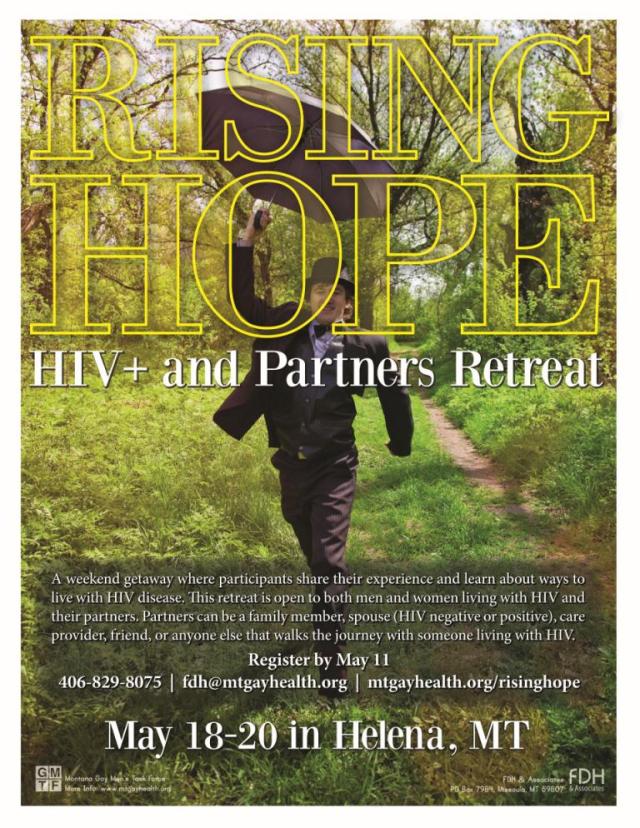
HIV+ and Partners Retreat

Montana does something that, to my knowledge, is not done anywhere else in the U.S.- we invite HIV+ persons and their partners/support persons to learn about coping and living with HIV. It’s a fantastic weekend filled with information, activity, relaxation, community and support, and I’ve been part of it for five years now.

I highly recommend it. Out-of-staters welcome. To check it out and/or register, click the pic below.

Missoula County Sees Spike In HIV Infection

HIV infection has increased unexpectedly in Missoula County- 12 new cases in five months- almost half the number of all reported cases in Montana last year.

From The Missoulian:

“We tend to see small numbers of new cases every year, but to have this many new cases – at this count 12 – documented in a five-month period is an unusually high number,” Missoula City-County Health Department Director Ellen Leahy said on Wednesday. “Twelve cases in one county in five months is an outbreak.”

HIV causes acquired immune deficiency syndrome or AIDS, a debilitating and sometimes fatal disease. It is spread by unprotected sexual contact or infected blood transfer, such as sharing infected hypodermic needles. Leahy said all the Missoula cases appeared to stem from sexual activity.

The announcement was made after consulting with many community groups, including Partnership Health Center, the Montana Gay Men’s Task Force and the Open Aid Alliance. Open Aid director Christa Weathers said the decision to publicize the outbreak was a hard one, because health officials depend on people self-reporting their condition to track the disease’s spread.

“It’s hard to issue a public health risk without creating alarm, or without pointing fingers at any group of people,” Weathers said. “It’s a great opportunity to remind people this is a risk and why testing is so important. But we don’t want to discourage anyone who may know they may need to get tested, but they’re afraid to come in and then this hits the media and they’re gone.”

So far, all the confirmed cases are adult males. But Leahy warned that women who don’t consider themselves members of a high-risk group for HIV infection have also been exposed.

“It’s sexually spread, but it’s time to remind ourselves – you really cannot know if you’re infected unless you’ve been tested,” Leahy said. “We recommend health clinics regularly offer HIV testing to sexually active patients. Rather than presume someone is in a risk group, it’s risk behavior, not membership in any group, that they need to think about.”

Several of my sources say the newly-infected persons are young men who simply didn’t practice safe sex, thinking “It’s Montana- I’m not at risk”. These men, mostly in their twenties, I’m told, will now have a lifetime of medication, stigma and health issues to deal with. It saddens me.

Today is a good day to be tested. For a list of Montana free Rapid HIV Testing sites, click here.

If you’re in Bozeman, call AIDS Outreach 406-451-5718 (the number in the link above is incorrect) or go to AIDSOutreachMT.org

Young Men’s Retreat In One Word: AMAZING

I had the privilege to spend the weekend with 14 young gay/bi men from across the state of Montana for a weekend of fun, education, fun, community building, fun, discussion and did I say, fun?

Whenever I go away for the weekend I have a lot to catch up on- thus the reason for no posts for the last two days. But I wanted to say that being around these guys, watching their enthusiasm for life, their interest in making life better for young gay men in the state and the strength and energy they brought to (and hopefully took home from) this weekend, energized me and gave me renewed energy to do what I do.

It might sound sappy, but I don’t care. This retreat was the best I’ve ever been involved in- and the (I want to call them kids, but I don’t want to sound condescending) participants made me realize that the future is in pretty good hands.

That’s excellent, because I’m not getting any younger.

Special thanks to FDH and Associates (David Herrera, Chantz Thilmony) and the Montana Gay Men’s Task Force for their dedication to the wellness, safety and education of gay/bi men in Montana. And to Bernie Kneefe for being the Den Mother.

If you’re a young gay/bi man who wants to be involved in this next year- go here. They’ll hook you up.

Still time To Register! Young Men’s Retreat

An awesome opportunity for young gay/bi men in Montana to feel less isolated, learn about themselves, talk frankly about life and make some friends!

Click pic for registration link.

Warning! Gonorrhea Threat Is Real

HIV isn’t the only reason to use condoms. From Tim Horn:

"WARNING - VENEREAL DISEASES" - NARA...

The last line of therapeutic defense against gonorrhea is losing its strength, according to an editorial published February 9 in the The New England Journal of Medicine. With no new antibiotics effective against the sexually transmitted infection (STI) on the horizon, Gail Bolan, MD, of the U.S. Centers for Disease Control and her fellow authors are worried about an upswing in gonorrhea samples showing to be less susceptible to cephalosporins—the only class of drugs still widely effective against the bacteria.

“It is time to sound the alarm,” the authors state. “During the past 3 years, the wily gonococcus has become less susceptible to our last line of antimicrobial defense, threatening our ability to cure gonorrhea and prevent severe [associated illnesses].”

Gonorrhea, caused by the bacteria Neisseria gonorrhoeae, is the second most commonly reported communicable disease in the United States, with more than 600,000 new cases reported annually. Typically spread through sexual activity, it disproportionately affects vulnerable populations such as minorities who are marginalized because of their race, ethnicity or sexual orientation.

Untreated gonorrhea can cause serious and permanent health problems in both women and men. Gonorrhea is a common cause of pelvic inflammatory disease (PID), affecting roughly 750,000 women every year in the United States. It can be painful and may lead to internal abscesses—pus-filled “pockets” that are hard to cure. PID can also lead to fallopian tube damage and ultimately cause infertility or increase the risk of ectopic pregnancy.

In men, gonorrhea can cause epididymitis, a painful condition of the ducts attached to the testicles that may lead to infertility if left untreated.

Gonorrhea can also spread to the blood or joints, which can be life threatening. Additionally, gonorrhea can make it easier to either transmit or become infected with HIV. 

…[the increased resistances] Bolan and her colleagues note, were most pronounced in the western United States (up to 3.6 percent) and among men who have sex with men (up to 4.7 percent).

Montana Young Gay Men’s Retreat

An awesome opportunity for young gay/bi men in Montana to feel less isolated, learn about themselves and make some awesome friends!

Click pic for registration link.


HIV 2fer: Early Treatment Works and Truvada Prevents

HIV DataToday’s HIV News shelf is crowded. Two stories on the HIV front involve good news about early HIV treatment and Pre-Exposure Prophylaxis(PrEP) to reduce infection rates among high-risk persons.

A study (popularly known as the Setpoint Study) finds that people newly-infected with HIV-1 who immediately start anti-retroviral therapy are more likely to have beneficial medical outcomes than those who wait until CD4 counts fall below medically acceptable levels (currently 350-500 depending who you talk to).

“This is very welcome news,” said Frank J. Oldham, NAPWA President and CEO. “The study supplies scientific confirmation of something we at NAPWA have always believed: the closer we can come to bringing all people living with HIV into treatment, and the earlier they start treatment, the better. We already knew this is true for populations as a whole: more and earlier treatment means fewer new infections. Now we know that – on the whole – it’s also better for individuals already infected.”

The news on the HIV front just keeps getting better. The setpoint study follows on the heels of a groundbreaking study which provides proof of HIV treatment as prevention: HIV-infected persons on medication with undetectable viral levels are 96% less likely to pass on the virus.

It also accompanies Gilead’s application to offer Truvada as the first drug marketed to prevent HIV:

Gilead Sciences Inc. announced that it has submitted a supplemental New Drug Application (sNDA) to the U.S. Food and Drug Administration (FDA)for the approval of once-daily Truvada (emtricitabine/tenofovir disoproxil fumarate) for pre-exposure prophylaxis (PrEP) to reduce the risk of HIV-1 infection among uninfected adults. Truvada was approved by the FDA in 2004 for the treatment of HIV-1 infection and is currently the most-prescribed antiretroviral treatment in the United States.

If the sNDA is approved, Truvada would be the first agent indicated for uninfected individuals to reduce the risk of acquiring HIV through sex, a prevention approach called PrEP. The sNDA is based on the results of two large placebo-controlled trials of Truvada as PrEP, sponsored by the U.S. National Institutes of Health (NIH) and the University of Washington. Several other clinical studies support the use of Truvada for HIV risk reduction.

“The data from these large-scale clinical trials suggest that Truvada may have a role to play in meeting the urgent public health need to reduce new HIV infections,” said John C. Martin, PhD, Chairman and Chief Executive Officer of Gilead Sciences. “Gilead is proud to have played a part in helping to define the use of Truvada as a potential new prevention tool and we commend the many institutions, investigators and study volunteers for their commitment to advancing this important area of research.”

Truvada is not currently labeled to reduce the risk of infection, it is labeled only for HIV treatment.

This could be an important step in slowing HIV. Around 50,000 people are still being infected with HIV every year in the U.S. according to the CDC. More than half of new infections (61%) occur among men who have sex with men, and nearly a quarter (23%) occur among women.

If Truvada can be given to high-risk persons (which includes negative partners in a sero-discordant relationship) and insurance companies will pay for it, it may, along with the groundswell of early treatment science, start a trend of slowing the progression of HIV in this country.

But only if we can get more high-risk people in for testing and treatment….

When was your last HIV test?

Study: Rural Persons Less Likely To Be Tested For HIV

A new study reports that rural areas score lower on self-reported testing of high-risk populations than urban areas:

In this nationally-representative, population-based study of HIV testing frequencies in the United States, we found that the frequency of self-reported HIV testing decreased substantially as the residential environment became progressively more rural. After adjusting for differences in demographics and self-reported HIV risk factors, the odds of HIV testing in the past year were 35% lower among persons living in the most remote rural areas compared to persons in the most urban areas. Rural persons with a prior HIV test were more likely than urban to report testing in a hospital, but less likely in the outpatient setting.

A prior study in the early years of the HIV epidemic in the US also found that rural persons were less likely than urban to report HIV testing.[6] Our results demonstrate that this gap in testing persists in the modern era of effective HIV therapy, when early diagnosis and linkage to care are even more essential. Moreover, recent efforts to increase testing have not impacted the rural-urban gap in testing. Although rural persons with HIV experience barriers to care, prior studies have described effective models for delivering high-quality HIV care in rural settings.[12–18] This accentuates the importance of early testing and diagnosis among rural persons with HIV.

Still work to do…

New STD Rates “Shockingly High”

Logo of the Centers for Disease Control and Pr...

Image via Wikipedia

Today, the Centers for Disease Control and Prevention (CDC) released its 2010 sexually transmitted disease (STD) surveillance data.  This annual report of statistics and trends for the three reportable sexually transmitted diseases in the United States shows that STDs rates in this country are still shockingly high, particularly in communities of color and among gay men and other men who have sex with men (MSM).

“This new data shows a persistence of the same trends that we have been seeing for years—that MSM and communities of color are continuing to bear a disproportionate share of the STDs in this country,” said William Smith, Executive Director of the National Coalition of STD Directors. “We should also not lose sight of a number of new additional studies this past year on the link between STDs and acquiring HIV.  The 2010 STD data released today shows that we need to look closely at further investments in STD prevention as a means to prevent HIV as well,” continued Smith.

While the 2010 data shows that overall rates for syphilis went down compared to 2009, the first decrease in in ten years, rates among Hispanics went up just over nine percent in the last year and MSM still account for two-thirds of the syphilis in this country.  In addition, black men continue to have the highest rates of syphilis in the U.S., with young (20-24) black MSM seeing an increase of syphilis of a shocking 135 percent between 2006 and 2010.  Co-infection of those with syphilis and HIV also continues; between 25-54 percent of those with primary or secondary syphilis were also HIV positive.

“The good news is that there was a drop of 8.5 percent in the rate of black men diagnosed with either primary or secondary syphilis in 2010 compared to the year prior,” said Smith.  “While too early to definitely assess the cause for this drop, there has been a distinct appeal for several years now to help address the explosion of syphilis among black men, particularly among young black MSM, and we must keep up efforts to prevent increasing rates of STDs and HIV among this group,” concluded Smith.

Rates for Chlamydia continued to increase over the last year, as they have for twenty years.  This is in part due to increased testing which is increasingly identifying positive cases, of which there were more than 1.3 million reported in 2010.  Black women continue to have the highest rates for Chlamydia, as well as gonorrhea.  While there was only a small increase in the overall rates of gonorrhea, the rates of gonorrhea in Hispanics went up 12 percent compared to 2009.

Across all three diseases, communities of color and young people overall continue to be most affected, though even for all ages of whites, increases were seen for all three diseases in 2010.  Among whites in 2010, rates of chlamydia increased by 7.5 percent, 9.2 percent for gonorrhea, and 3.6 percent for syphilis in 2010 compared to 2009.

Smith concluded, “We hope the unacceptably high rates of STDs in this country continue to be clarion call for securing the sexual health of all people. This means that state and federal investments in STD prevention remain a critical need in these times of tight budgets and that as healthcare reform continues to move ahead, that partners in every sector ensure that the safety net for these services continues to exist.”

The full 2010 STD surveillance data can be found on the CDC website at: http://www.cdc.gov/std/stats10/default.htm.