Butte AIDS Support Services holds their Third Annual Copper Cotillion to benefit those living with HIV in Southwest Montana. Check out their Facebook event page here.
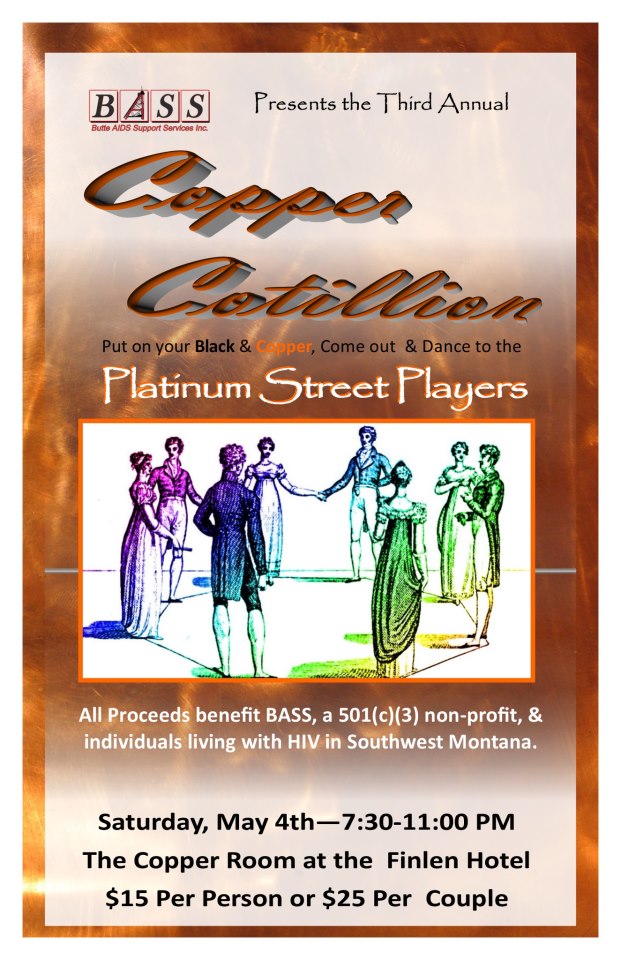
Butte AIDS Support Services holds their Third Annual Copper Cotillion to benefit those living with HIV in Southwest Montana. Check out their Facebook event page here.

WOMEN’S HEALTH IN MONTANA (DHHS REGION VIII) Female Population of MONTANA
Total state population: 989,415 (492,748 females; 496,667 males)
Health Status (Age-adjusted§ percent of adult females)
In poor general health: 4.4%
Activity limitation due to poor phys/mental health: 8.9%
No natural teeth: 5.4% Sources: 2010, BRFSS
Access to Care (Age-adjusted§ percent of adult females) No health insurance coverage (under 65): 21.2%
No personal doctor or primary care physician: 79.2% Saw a dentist in past year: 61.5%
Fact sheets are now available for each of the 50 states and the District of Columbia. Each fact sheet presents a snapshot of demographic characteristics as well as a variety of health status indicators for females within the area. These include:
· Health Status
· Access to Care
· Health Conditions and Risk Factors
· Preventive Services and Screenings
· Mortality
· Prenatal Care and Pregnancy Risk
· Birth Outcomes
· Sexually Transmitted Infections
· Violence and Abuse
· Mental Health and
· Teen Health
For complete Montana stats, click here.
I’m also featured in this video at the Gazette website:

English: A section of the Berlin Wall with Graffiti regarding Act Up. (Photo credit: Wikipedia)
Some sad (and possibly troubling) news for those of us living with HIV: NAPWA, the lobbying and rights organization for HIV+ persons in the U.S. has closed and filed for bankruptcy. John Manuel Andriote has the story- be sure to read the last paragraph.
Although it wasn’t a total surprise when the National Association of People With AIDS (NAPWA) announced on Feb. 14 that it was suspending operations and filing for bankruptcy, it felt like a shock. Exactly 30 years after its founding by the very first people to go public about having HIV, all of them gay men, NAPWA’s financial immune system finally collapsed under the weight of allegations of misused funds and the demands of creditors, employees and a landlord who wanted to be paid.
NAPWA was never exactly flush with cash, and it restructured itself several times over the decades. But a Dec. 5 open letter to the community from its board made it clear that the end was all but inevitable. Longtime HIV activist and POZ magazine founder Sean Strub blamed NAPWA’s business model and leadership that was “inexperienced or inadequate, and, in some cases, compromised or lacking integrity.” He added that “accountability and transparency were concepts largely absent from their operations in recent years. The problem was so deep-rooted that even the most dedicated and sincerely committed people on their board or staff could not fix it.”
Time (and an apparent investigation by the Montgomery County State’s Attorney’s Office) will shed light on what exactly led to this sad state of affairs. Meanwhile, a history lesson is in order to understand what NAPWA was and why its demise is a sad (and worrying) occasion for tens of millions of people.
On May 2, 1983, a small group of gay men with AIDS carried a banner during the first AIDS Candlelight March in San Francisco. “Fighting For Our Lives,” it said. A month later, several men took the banner to Denver for the Second National AIDS Forum, held in conjunction with the then-annual gay and lesbian health conference. A dozen people with AIDS met together at the forum to discuss how they might organize themselves. They agreed that the slogan on the banner would be their slogan, because it captured what it was that they were doing: fighting for their lives.
The group proposed that local groups of people with AIDS from around the country join together to form a national group. They adopted a manifesto called the “Denver Principles,” a series of rights and recommendations for health care providers, AIDS service organizations and people with AIDS themselves. The Denver Principles became the charter of the self-empowerment movement for people with AIDS. Its preamble said, “We condemn attempts to label us as ‘victims,’ a term which implies defeat, and we are only occasionally ‘patients,’ a term which implies passivity, helplessness, and dependence upon the care of others. We are ‘People With AIDS.'”
After the Denver meeting, Bobbi Campbell, Michael Callen from New York and other gay men with AIDS and their supporters formed the National Association of People With AIDS. For three decades the Denver Principles were NAPWA’s foundational document. “NAPWA was the last keeper of the flame for the Denver Principles,” said veteran ACT UP New York activist Peter Staley, “and it’s sad to think there are few if any institutions willing to defend them going forward.”
But even without the organization built around them, the principles endure because they are now woven into the world’s responses to HIV/AIDS. At the United Nations’ 2006 High Level Meeting on AIDS, 192 nations unanimously adopted the Political Declaration on HIV/AIDS, including the so-called GIPA (Greater Involvement of People With AIDS) Principle. GIPA essentially made universal the principles of self-empowerment and involvement first articulated by that group of brave gay men who met in Denver in 1983.
Still, NAPWA’s demise leaves a void that no other organization has yet shown the capacity to fill. Terje Anderson, who was a NAPWA board member before joining its staff as policy director in 1998 and then serving as executive director from 2000 until 2006, said in an interview that one of the group’s most important legacies is the new community leaders NAPWA trained. “Something NAPWA wasn’t credited for,” he said, “was figuring out ways to identify, train and support leaders, not just white gay men from New York but people of color, women and people in rural areas.”
The group made other major contributions too. NAPWA was one of the first HIV/AIDS groups to advocate for HIV testing as a tool of personal empowerment. Anderson pointed out that the group was instrumental in helping pass the Ticket to Work and Work Incentive Improvement Act of 1999, which allowed people receiving Social Security disability benefits to return to the workforce without losing their Medicaid or Medicare health insurance. This was hugely important as improved medical treatment beginning in 1996 allowed HIV-positive people to live with the virus rather than await an inevitable death from AIDS.
“One of the things I’m proudest of,” said Anderson, “is that when I was there, we were the first domestic group that started to say we need to talk about the global epidemic. Other groups said, ‘Oh, no, that will take away from our funding. We said, ‘No, you have to worry about our African, Caribbean and Latin American brothers and sisters.'”
Tom Kujawski, who was NAPWA’s vice president of development from 2004 to 2010, said the organization “became vulnerable due to lax internal financial systems and controls further complicated by changing senior management.” He said there were contributing factors that hastened NAPWA’s end, including decreased philanthropic and corporate support due to the faltering economy and competition for that support, “fractionalization of the HIV/AIDS movement” and over-reliance upon federal grants.
Kujawski said he hopes NAPWA will endure through the Chapter 11 process “and emerge as a truly new entity.”
Sean Strub said, “I’m sad to see them go but hopeful that this will provide an opportunity for a more effective, representative and accountable national voice for people with HIV to emerge.” Although there are other national organizations run by people with HIV, including his own Sero Project, Strub said a group like NAPWA “is needed more than ever before.” He said a strong national voice is needed “to deal with rising stigma and criminalization, declining interest in and commitment to empowerment principles as embodied in the Denver Principles.” He added, “We have to do it amidst a massive HIV industry where it is sometimes difficult to sort out the real agenda driving individuals, institutions and initiatives.” If these aren’t reasons enough, Strub said, “Most of all, we need to focus on how we bring attention and effective resources to the epidemic that continues to grow amongst young gay men and especially amongst young African-American men who have sex with men.”
One big reason that NAPWA’s loss is shocking is that now gay and bisexual men, who account for two thirds of new HIV infections and most of those living with HIV in the U.S., will have no strong HIV advocates in Washington. The national LGBT organizations for years haven’t advocated forcefully for proportionate HIV prevention funding, or for anything else significant to the health and well-being of American gay and bisexual men with or at risk for HIV/AIDS. Instead, they have been focused like laser beams on marriage equality, an issue dear to the hearts of the privately insured, mostly white professionals who fund them. The young gay men of color at greatest risk and carrying the greatest burden of new HIV infections aren’t priorities. As Sean Strub put it, “Remember how angry we were with the Reagan and Koch administrations when they ignored the crisis and let it rage unabated? What about when we were abandoned by our own community’s leadership and institutions? Why can’t we be angry then as well?”

I read an article by an ethicist who answered a question in the New York Times about the morality of gender transition pitted against the harm it may cause a family. It is a Hobson’s choice, really, as there is no good answer in the end. But, I guess that’s why ethicists get paid the big bucks.
Gender transition is selfish. No doubt about it. But, so is just about any medical treatment, alcohol recovery for instance. Gender dysphoria might just as surely kill you as alcoholism in my experience. Yes, I had both, and after several years of living in the proper gender and in recovery with all of the attendant hardship, heartbreak and happiness, I am perhaps uniquely qualified to say that both are a means of survival. I had to do both, or neither would have saved me from myself, so bad was my sense of demoralization and hopelessness.
Yet, behind me lies a trail of loss, separation and broken relationships. My decision to transition hurt other people whether or not their reaction may be perceived as just or warranted. Thus, I might be rightly asked whether it was the right thing to do. Was it just? Was it ethical? Or was it merely necessary irrespective of the consequences?
In reverse order, my need to transition was more than manifest at the time, so frail was my grasp upon a life not hell bent on personal destruction. Some may rightly conclude that my transition should not matter to others if I was going to be dead anyway, even if by my own hand. At the time, and for all the years since I have believed that I would not have made it, but for transition and recovery. But what if . . . ?
What if I had found recovery and reserved transition for later in life, if at all? Of course, I was already 48 when I began. But, might I have learned a way through recovery to live a sober life as a man, and still kept my job, my friends, my family and my marriage? Is that possible? Of course it is? But is it likely? That is a much more germane question, given the level of dysfunction following nearly half a century of gender confusion, fear, guilt, shame, ambiguity, etc., which was merely masked and drown out through alcohol dependancy.
The answer, then, is that it is much more likely that as the masks of dependency were stripped away, the difficulty maintaining the duality of self would have only grown worse, not better, and continually threatened the chances of recovery taking hold. But, even If I could have made it through reliance on God, a sponsor and a recovery group, what difference would it have made.
Would I have kept the relationships and people I lost in my transition – my children, friends, colleagues and acquaintances who have all turned away? Probably, but I must believe that those relationships would be strained as ever, particularly because recovery involves rigorous honesty. It is our secrets which often make us so sick. At some point, I would have had to tell my truth to the people in my life. I could not have continued to live vicariously through cross-dressing in private, for it would seem ever more the lie. And what then? What purpose does it serve to tell the truth and not live it – to be honest, but not authentic? Forgive me for waxing apologetically.
I never meant to hurt the people in my life, but, I still believe to my core that I did the right thing. Moreover, I could not foretell a person’s reaction, and, though I knew them well, predictions and expectations of how a person will take the news of gender dysphoria are pure and painful folly.
Therefore, I had to step out in faith, reveal the dysphoria and prescribed treatment and then deal with the reaction. It does not work the other way around, as there is no way to sort of test the waters before jumping in. People have no frame of reference, no experience to fall back on when a trans person reveals themself, and they can no more control their reaction than I can. It is a gut level, sometimes gut rendering response that typically involves either rejection or openness, if not confusion. If a person can be open and willing to accept the trans person, there is a chance at a continued relationship. However, if the knee jerk reaction is rejection the door may be firmly closed. And I have second guessed myself enough times to know that the process of revelation makes very little difference in the long run. Either a person gets it, or they don’t. And there is simply no way to know ahead of time which it shall be.
Thus, the trans person can take only one of two paths. They can remain forever inside their secret gender box with all the dueling emotions and resulting pain and dysfunction that hiding brings for the sake of their family and friends and to avoid the risk of emotional harm to others. Or, they can stumble blindly and uncertainly along the path to authenticity, assuming the risk that not all will choose to go along.
Gender transition is not a question of right or wrong, per ‘se, but rather it is one of possibility, necessity and risk. Can the trans person live without transition, and are they willing to assume the risks inherent in either choice – a life forever locked in dysfunction and incongruence, or one without the ones they love who also lose someone dear.
..is tomorrow at the SUB at 8:30 pm!
And it’s FREE! Click on the link below for the way cool poster.
 AIDS Outreach is also offering free HIV testing from 4-8pm right at the SUB!
See you there!
Here’s an opportunity to do some good:
FREE 3-day Training!!!
.
Click here for more info: CTRS Training February 2013
And if you’re interested in becoming a testing associate for AIDS Outreach, please email info@aidsoutreachmt.org
(click to see the book)
I was moved today by the story of a young (30) trans woman who wants be a mother. Not surprisingly, she is plagued with fears of the unknown. Her parents have disowned her because she had the courage to reveal her truth. What if her child did the same? Can she find a man who can embrace her and walk with her and a child as a family? Though she has much love to give, she searches for someone to give it to. It is a familiar story, tragically repeated amongst so many trans persons.
It is one that daily resonates with me. (Only, it is my children who have disowned me.) “Who will love me?” I often wonder. “Who can love me?” is the great trans lament.
“I realized that gender transition, even under the best of circumstances, is unequivocal and unforgiving. It required of me everything I had, and then some. I was still paying for it. Yet, there was no compromise, no half measure. I had to make my way in the world as a woman or not at all. I had been blessed and fortunate to have done so as quickly as I had and with relative ease. Still, I was resigned to accept the fact that some pieces would never be complete. I doubted that I would overcome gender identity discrimination in Montana, and it did not seem likely that I would find a man who could accept me and love me as the whole person that I am. I had a whole heart, and I wanted the person who could take the hard part and love that too. (The “Hard Part” by Dave Wilcox). I wanted the person with whom I could share every secret so that secrets would be no more. That person was not to be found.
I began to accept that too, as I mused about just who would want a trans woman for a partner. In the ordinary course, a heterosexual male is looking for a heterosexual woman, not a heterosexual trans woman. Guys, with few exceptions, think it’s just too freaky for them to accept. A lesbian woman likewise does not want a lesbian trans woman, as we are sometimes perceived as something less than a real woman. And I get that. Even though I have this hunger to be known, I’m not like the girl next door.”
TransMontana, pp 281-82. (I try here to write for the entire trans community – not just me.)
So, I try to stop speculating about what might or might not be. I have no control over what is yet to come, so must try to let go of fear. My life is now – not some distant point in the future. It is right here, right now. I must live it, even though not as full or complete as I might like. I have peace and joy in whom and what I am. I may be a social enigma, but I know in my heart that I am whole as a woman, even though born as a man. I believe in myself. That gives me great comfort and strength. Thus, I am able to interact with the rest of the world with honesty, authenticity and integrity. And if I may find someone who can love me like that, well, it will have been worth the wait.

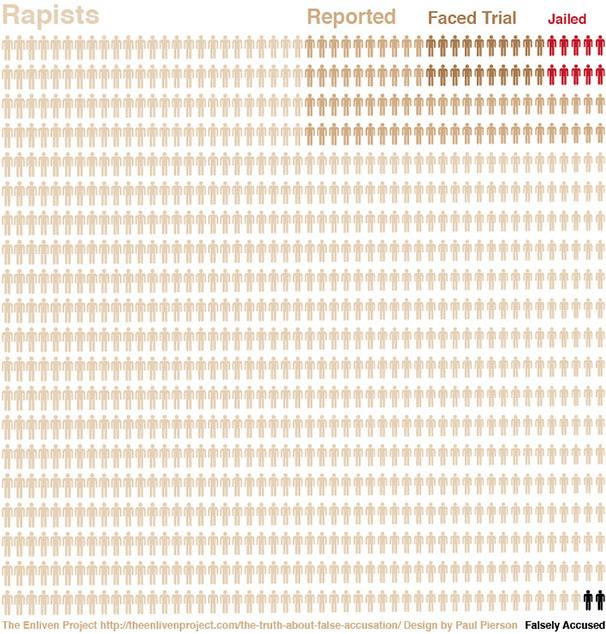
The infographic below was created by The Enliven Project, a truth-telling campaign to bring sexual violence out of the closest and convert the most powerful bystanders to new allies. It appeared in the Washington Post yesterday and has since received some criticism for being misleading. Either way the truth of the matter is that nearly one in five women have been raped and over 50 percent of rapes go unreported which is depressing all on its own.

 From Eternity To Here