Joint Statement Regarding HIV Prevalence, Urgency For Gay/Bi Men

NEW HIV INCIDENCE ESTIMATES CONFIRM URGENCY TO ADDRESS CRISIS AMONG GAY MEN OF ALL RACES AND ETHNICITIES

Washington, DC – New HIV surveillance data released today by the Centers for Disease Control and Prevention (CDC) indicates that while the overall number of new HIV infections has remained fairly stable from 2006–2009, there continues to be cause for great concern about increasing numbers of new infections among gay men.

While the new HIV incidence estimates, published in the Public Library of Science Medicine, show that prevention activities in the United States have successfully held the number of new infections steady, the National Alliance of State and Territorial AIDS Directors (NASTAD)i and National Coalition of STD Directors (NCSD)ii, remain alarmed about the continued disproportionate impact of HIV and sexually transmitted disease (STD) infections among gay and bisexual men of all races and ethnicities in this country. New estimates indicate that the top most impacted populations include white gay men, Black gay men and Latino gay men, followed closely by Black women.

“An unacceptable increase of HIV incidence among gay men, particularly young Black gay men ages 13-29, requires an honest and critical examination of our prior efforts and a sharpening of our prevention-focused activities among gay men,” remarked Julie Scofield, NASTAD’s Executive Director. “We need to strengthen our communities by breaking down the silos across program and sector and by investing in targeted and innovative programming that promotes the health equity of gay and bisexual men of all races and ethnicities,” she added.

“Increasing HIV rates, coupled with increasing incidence of syphilis and a frequent neglect of rectal STD infections, underscore that we are not doing enough to prevent all STD infections and reduce their role in HIV acquisition,” said William Smith, NCSD’s Executive Director. “NASTAD and NCSD will continue to work with state and local health departments and other partners to develop and implement effective tools and initiatives to address all STDs among all gay and bisexual men,” he continued.In this peer-reviewed article, the CDC estimates 48,100 new infections occurred in the U.S. in 2009, with gay and bisexual men remaining the population most severely impacted by HIV and the only population in which new HIV infections have been increasing steadily since the 1990s. New infections among gay men of all races and ethnicities continue to increase as a proportion of all new infections, with those among young Black gay men ages 13-29 increasing by 48 percent since 2006. This new HIV surveillance data closely follows data released by CDC last month that showed a growing resistance of gonorrhea to antimicrobials, particularly in men who have sex with men (MSM). Gonorrhea is an STD that can facilitate HIV transmission.

In June 2010, NASTAD and NCSD released a Statement of Urgency expressing concern regarding the HIV and STD crises among gay men and other MSM of all races and ethnicities in the United States. Pursuant to the recommendations made in the National HIV/AIDS Strategy (the Strategy), the joint statement calls for greater investment (financial and human) and leadership to address the epidemic among gay men. Given CDC’s decision to cut $20 million from core HIV prevention funding, our federal partners must continue to work with state and local health departments to ensure that all existing resources are leveraged to improve HIV prevention and care and treatment.

NASTAD and NCSD, with support from MAC AIDS Fund, will soon launch a series of targeted activities within HIV and STD programs that will examine and address stigma in public health practice. These efforts will aim to increase comprehensive and appropriate access to prevention, care and supportive services for young Black and Latino gay men, particularly those at-risk for STD transmission. Additionally, these efforts will target social and sexual networks to promote positive sexual health messages and reduce stigma. NASTAD and NCSD will work with their respective members to establish and promote evidence-based practices and tools to educate state and local health departments, service providers and other key community stakeholders about the sexual health of gay men.
______________________________________________________________

i- Founded in 1992, NASTAD is a nonprofit national association of state and territorial health department HIV/AIDS program directors who have programmatic responsibility for administering HIV/AIDS and viral hepatitis health care, prevention, education, and supportive services programs funded by state and federal governments. For more information, visit www.NASTAD.org.

ii- The National Coalition of STD Directors (NCSD) is a partnership of public health professionals dedicated to the prevention of STDs. NCSD provides dynamic leadership that strengthens STD Programs by advocating for effective policies, strategies, and sufficient resources and by increasing awareness of their medical and social impact. For more information, visit www.NCSDDC.org.
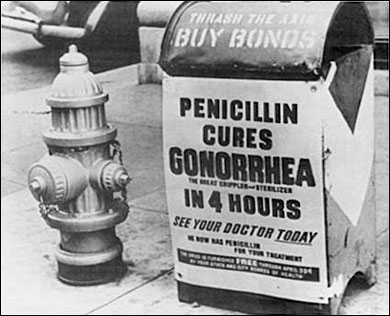

Gonorrhea: Not So Easy To Kill Anymore

Not anymore. . .

Think if you get the clap, you can just go get a shot or take a pill to be cured?

Not so fast, bucko. There’s now another reason to protect yourself:

Today, the Centers for Disease Control and Prevention (CDC) outlined laboratory trends from 2000-2010 that show growing resistance of gonorrhea to antimicrobials.  Gonorrhea, a sexually transmitted disease (STD), is a major cause of pelvic inflammatory disease, ectopic pregnancy, and infertility and can facilitate HIV transmission. (Press release, National Coalition of STD Directors)

Yep. Gonorrhea. It used to be a serious disease, before antibiotics made it easy to treat. Now that we’ve been taking antibiotics for everything, resistance is setting in and we’re running out of effective drugs to cure it.

…cephalosporin antibiotics are the last line of defense for treating the disease, as the bacteria has developed resistance to all other antibiotics.  The highest level of resistance to cephalosporins, regardless of sexual partner, was found in the Western region of the United States, particularly Hawaii and California, as well as in men who have sex with men in all regions.

“This new data outlines what state and local health departments have been seeing on the ground—that highly untreatable gonorrhea is near,” stated William Smith, Executive Director of the National Coalition of STD Directors. “There are currently no new drugs in development for this infection.  If this last class of drugs fails we will have no definitive treatment options for gonorrhea.  We call on researchers, government, and partners in industry to make the development of new, effective drug treatments for gonorrhea a public health priority,” continued Smith.

This is a big deal.

It’s important for sexually active persons to be screened for all STD/STI’s at least every six months, or more often if you have many sexual partners and/or have had unprotected sex- and that includes oral- gonorrhea can easily infect the throat. And, remember, any STD/STI increases the risk of contracting/spreading HIV. From the CDC:

Untreated gonorrhea can cause serious and permanent health problems in both women and men.

In women, gonorrhea is a common cause of pelvic inflammatory disease (PID). About 750,000 women each year in the United States develop PID. The symptoms may be quite mild or can be very severe and can include abdominal pain and fever. PID can lead to internal abscesses (pus-filled “pockets” that are hard to cure) and long-lasting, chronic pelvic pain. PID can damage the fallopian tubes enough to cause infertility or increase the risk of ectopic pregnancy. Ectopic pregnancy is a life-threatening condition in which a fertilized egg grows outside the uterus, usually in a fallopian tube.

In men, gonorrhea can cause epididymitis, a painful condition of the ducts attached to the testicles that may lead to infertility if left untreated.

Gonorrhea can spread to the blood or joints. This condition can be life threatening. In addition, people with gonorrhea can more easily contract HIV, the virus that causes AIDS. HIV-infected people with gonorrhea can transmit HIV more easily to someone else than if they did not have gonorrhea. (emphasis mine)

We’ve taken the cure for granted for too long. So- be careful out there.

Full article here.

End The Ban On HIV+ Organ Donation?

When I was diagnosed with HIV, a friend said “You’re an organ donor aren’t you? You’d better change that.”

I agreed, and changed my driver’s license organ donor status (goodbye, little red heart!). But in the back of my mind I wondered “Why couldn’t I donate to other HIV+ people should they need it? Surely having an infected organ and a few more years of life would be worth it.” Especially now, when HIV (unlike, say Hepatitis C) is a very medically treatable disease. Not a picnic, but neither is renal failure

Is it worse to have HIV than having to undergo weekly dialysis? Or to have a heart that works, or a liver, etc.? And if you already have HIV and need an organ, does it make sense that HIV+ donors be excluded?

Now it seems the feds are starting to think about the same things. According to The New York Times, The Centers For Disease Control And Prevention are about to issue new guidelines that will allow the study of HIV+ organ donation and transplantation.

It’s about time. Literally.

What do you think? If it were about saving your life, would you accept an HIV+ organ?

World AIDS Day: A Need To Remember

Because I think it’s still relevant, I’m reprinting (with a few updates) my column for World AIDS Day from last year. I may just continue to do so as long as it still makes sense….


Remember when World AIDS Day used to be important?

I do.

I remember December 1st as a day when people gathered in terror and grief with candles and tears listening to words that couldn’t begin to touch the pain and anger and sadness.

I remember when it was a time for all kinds of people to gather together, people that probably wouldn’t be in the same room for any other reason. At World AIDS Day services in the early Nineties, I remember seeing queer activists, quietly closeted gay men and women, Episcopal and Catholic priests, Native American leaders, Protestant ministers, atheists, nuns and agnostics. I saw elected officials, Republicans and Democrats, wheelchair-bound elderly, parents, children, nurses, doctors, cowboys, lawyers, accountants, little old ladies and, once, a rodeo clown. All coming together, all looking for comfort and hope and compassion among others who could maybe understand.

We don’t really do that now. And maybe it’s okay that we don’t.
Maybe it’s good that the terror I remember so vividly on the faces of  friends and complete strangers is no longer there. Maybe it’s good that people aren’t dying so fast and so painfully, isolated and afraid. Maybe it’s good that we’re not so traumatized by fear and grief and anger.

Maybe.

Is terror a good thing? Is a painful death beneficial? Is emotional trauma something to be longed for?

No. But I have to say, those scenes of suffering and bravery certainly helped capture the zeitgeist of the Eighties and Nineties. It helped keep AIDS in our collective consciousness. Drama and fear and compassion fueled activism and grassroots movements and the formation of community-based organizations. AIDS was overwhelmingly real. It was dramatic. It went to the Oscars, the Emmys, the Grammys and the Tonys. And it won. More than once.

So I’m not sure if it’s a good thing that HIV isn’t such a drama queen anymore. Not to say that I want people to suffer needlessly. I don’t. I just happen to think we’re not paying attention because it’s no longer hip, sexy, avant-garde and noble to do so. I think that our short attention spans need to be constantly reminded. And, there’s really not a lot of spectacular theatrics to grab our attention today. Well, not compared to the past.

But, trust me, it’s still there. There are some rather dramatic facts to consider:

  • People are still being infected. In the U.S. there are over fifty thousand new diagnoses a year. The CDC estimates that one in five persons with HIV doesn’t know it. That means they may not be protecting their sexual partners out of ignorance. That means more HIV.
  • Gay men, and/or Men who have Sex with Men (MSM) account for more than half of all new infections each year, and MSM is the only risk group in the country whose infections are increasing. MSM account for nearly half of all persons living with HIV in the United States today. Nearly half. And those are just the ones we know about. That means that for all the talk we hear about “AIDS is not a gay disease,” it is. That means sexually active MSM are having sex with HIV+ partners statistically more often than any other members of the general population- and being infected. HIV significantly and dramatically lives in the bodies of gay men.
  • HIV strains the budget of every state in the Union. So much so, that states have cut or are considering cuts in funding to drug assistance programs and other HIV support and prevention services. These services keep people alive at a cost of hundreds of millions of dollars a year. More money is needed with every new infection. That money comes out of your taxes.
  • People are still dying. Yes, the drugs help, and people with HIV are living longer lives, but the drugs don’t always work, and HIV mutates. Our immune systems are under a great deal of strain and one serious opportunistic infection can kill. I lost a friend just this year.
  • It’s not over. Families are still being traumatized and our community is being hurt by this epidemic. Here in Montana, with its relatively miniscule gay population, new members joined my HIV+ support group this year,  most are gay men in their twenties- kids, really. All facing a lifetime radically different than they had hoped for.

And those are just some of the many points to consider.

Is it good that people are no longer dying and suffering in such huge numbers? Yes.
Is it good that we no longer gather in great numbers, sharing strong emotions, standing hopefully resolute in the face of pain and suffering and memory? I don’t think so.

Personally, I need to remember these facts and these people, because they’re part of my history, my community, my country and my world. I need to be reminded that my compassion, my voice and my heart are all still relevant. I need to be reminded that I’m not alone, I need to remind others of the same thing. And I think doing it once a year is the least I can do.

That’s why I’ll be going to a World AIDS Day service this year. That’s why I’ll be wearing a red ribbon, holding a candle in the dark, listening to words of grief, bravery and encouragement. To remember, to remind, to regroup.

Because I still think it’s important.