Montana Congressional Delegation Statements About DOMA, Prop 8

In stark contrast, here are the statements issued by Montana’s Congressional delegation in light of the historic DOMA and Prop 8 rulings today:

Gay Rights in America

Gay Rights in America (Photo credit: Poldavo (Alex))

Daines “I am disappointed by the Supreme Court’s ruling today. Marriage, as the union of one man and one woman, matters for our children, and I remain a strong believer in defending the family.

While I do not agree with the Court’s ruling concerning the application of federal benefits, I am encouraged that the Court did not rule against states’ rights, ensuring that the voice of the people, not a ruling from a court, is the driving force behind marriage laws in Montana and the other states.”

Tester: “The Supreme Court today made the right decision.  The federal government has no place telling Americans who they can love and who they can marry.”

Tester affirmed his support for same-sex marriage earlier this year, saying “how Montanans define a family should be their business and their business alone.”

Baucus: “Today is a proud day in American history when we can say to all Montanans, Americans and their children: your love and your family are just as good as everyone else’s under the law.  For too long, same-sex couples and their children have been denied more than 1,000 federal rights and obligations that married couples enjoy. That was wrong. In the United States of America, no one should be treated as a second class citizen simply because of who they choose to love.

I believe each of us has a moral obligation to leave this place in better shape than we found it, and today’s decision puts our country on the right side of history. Now it’s time to pass the Employment Non-Discrimination Act and guarantee all Montanans the same opportunity to succeed in the workplace.”

Pride Foundation Executive Director On SCOTUS Rulings

 Truly unbelievable—it’s hard to know where to begin, what to feel, how to put into words what this day represents for our community and for our country.
Equality, fairness, and love won. Twice.
Today, Wednesday, June 26, 2013, the Supreme Court of the United States struck down Section 3 of the Defense of Marriage Act (DOMA) “as a deprivation of the equal liberty of persons that is protected by the Fifth Amendment,” allowing same sex couples legally married in 13 states and the District of Columbia access to federal protection and benefits. The Court also ruled that proponents of Prop 8 did not have “standing” to appeal the federal court ruling that invalidated Prop. 8, reinstating the right of same sex couples to marry in California once again.
As the DOMA and Prop 8 challenges wound through various federal courts, we patiently and anxiously waited for this moment—the recognition that the U.S. Constitution guaranteed equal protection for all, including lesbian, gay, bisexual, and transgender people. We persisted as a community in spite of every obstacle faced along the way.
The legal implications of these rulings are significant and complex. Over the next few days and months to come, experts will translate the details of the decisions so that we can understand what the rulings mean long-term and how each will impact the day-to-day lives of LGBTQ people and our families—both for those same-sex couple who are legally married and for LGBTQ people who live in states that do not currently have relationship recognition laws.
If you’re not already connected to us on Facebook or Twitter, please do and we’ll be sure to keep you posted as we learn more along the way.
As we celebrate the enormity of this historic moment, let’s hold on to and remember what it took to reach this mountain top. We are here thanks to the courage and leadership of pioneers who toiled through the decades and carried us to this moment.
We have gained another victory to guide us as we strive for equality in all aspects of our lives and for all LGBTQ people, here in the Northwest and across the country. Because of our hard work as a community and the help of passionate allies, we are closer to that vision. Today represents a giant leap forward. It will take our ongoing commitment and continuous energy to keep crossing the mountains to full and lasting equality.
Congratulations to all of us—this celebration is for everyone. Thank you for all that you have done and will continue to do to bring full equality home to every person and every family.
With great Pride,
Kris Hermanns
Executive Director
http://www.pridefoundation.org | info@pridefoundation.org | 1.800.735.7287 | Headquarters Mailing Address: 1122 E Pike St PMB 1001 | Seattle, WA 98122 US

DOMA, Prop 8 DOWN

The Federal government will now recognize people who are legally married in any state. It’s unclear if they will recognize marriages if the participants move to a state where it is not legall recognized- like Montana. Would it mean that MT couples could go get married in WA and then file federal income taxes together?


Prop 8 is struck down- which means that it is legal for a CA clerk of court to give a marriage license to a same-sex couple- maybe a brave one will do that today…


The rainbow flag, sometimes called 'the freedo...

The rainbow flag, sometimes called ‘the freedom flag’, has been used as a symbol of gay and lesbian pride since the 1970s. The different colors symbolize diversity in the gay community, and the flag is often used as a symbol of gay pride in gay rights marches. It originated in the United States, but is now used around the world. (Photo credit: Wikipedia)


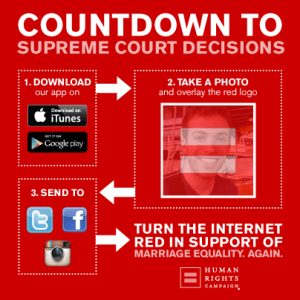
Turn The Internets Red

HRC

Student Loans, National Debt & Congress- An Infographic


banking-on-education-OPTIMIZED


Here are just a couple key points:

— Since 2002, student debt in America has quintupled from $200 billion to $1.1 trillion
— 62% of workers aged 30-39 have insufficient resources for retirement — meaning less money on critical necessities like housing, food, and medicine
— If Congress doesn’t act by July 1st, the average student will owe an extra $2,564 — but if  Congress passes Sen. Warren’s plan, they’ll save $6,552


Interchange Schedule!

With a lineup that’s sure to rock, Interchange brings human dignity center stage to Bozeman, Montana. Here’s the fantastic schedule:

Interchange_FB_event

Wednesday, June 26th:

  • Women’s Voices for The Earth Presents “Unacceptable Levels”- Emerson Cultural Center 7:30pm, free

Thursday, June 27th:

  • Interchange Pre-Party 10pm-1am, BAR IX

Friday, June 28th:

  • Interchange Summit 5pm
  • Cocktails and Jazz (Leigh Lounge, MSU) 6:30-8pm
  • Electra Sexton’s Summer Meltdown! (MSU Ballroom) 8-10pm
  • Zebra Afterparty with the B-Side Players- $6 at the door
  • Konfadense at Plonk! -free entry

Saturday, June 29th

  • Interchange Parade (Main Street) 11am-Noon
  • Rally and festival at the Bozeman Public Library 12:15pm
  • “Racism & Human Trafficking” Library Community Room, 1:15pm
  • “Scripture & Science & Sex- Oh, My!”, Library Community Room 2:45pm
  • Interchange Festival- featuring Chiddy Bang and SOL, Lindley Park 5-10pm
  • Official After-Party featuring Ana Sia & Anavox, Zebra $12 at the door
  • Ampathy at Plonk!- free entry

Sunday June 30th

  • Kiki Garden Party- Soroptomist Park (catered by the Nova Cafe!) 9:30-11am

HIV testing will also be available throughout the weekend, provided by AIDS Outreach and Yellowstone AIDS Project. For more info, just click the Interchange logo above…. It’s gonna be awesome!

Analysis: Most At-Risk For HIV Not Studied


New Analysis of World’s Premier AIDS Conference Finds Poor Coverage of Populations Most-at-Risk for HIV

Hundreds of Organizations Worldwide Call on Conference Organizers to Increase Meaningful Coverage of Gay Men, Transgender People, People Who Inject Drugs, and Sex Workers

A new report produced by a coalition of global advocacy organizations shows that the International AIDS Conference (IAC) program continues to lack meaningful coverage of populations most-at-risk for HIV, including men who have sex with men (MSM), transgender people, people who inject drugs (PWID), and sex workers. Over 220 organizations from more than 70 countries around the world have called on the organizers of the IAC to take concrete measures to increase coverage of HIV-related issues concerning the health and human rights of these populations worldwide.

The report features a systematic quantitative audit and qualitative analysis of the topics and countries covered by abstracts on most-at-risk populations at the 2012 IAC, also known as AIDS 2012. These populations are also called “key populations,” because they are both key to the epidemic’s dynamics and key to the response. As an in-depth examination of research presented at the world’s premier AIDS conference, the report also offers a glimpse into the current state of research on these key populations globally.

The quantitative audit of the AIDS 2012 program showed that only 17% of all abstracts presented at the conference were exclusively focused on MSM, transgender people, PWID, or sex workers. Some key populations were better represented than others. The percent of all abstracts exclusively dedicated to each key population was 8% for MSM, less than 1% for transgender people, 5% for PWID, and 4% for sex workers.

The qualitative analysis of abstracts on these populations was even more revealing, indicating that more abstracts on key populations focused on individual risk factors (40%) than any other topic, including structural factors [e.g. policy, stigma, violence] (26%); primary prevention (19%); testing, care, and treatment (15%); and surveillance (10%). Only 29% of abstracts on key populations focused on describing interventions, while 71% described vulnerabilities without offering any detailed solutions.

“This meager level of coverage on issues concerning our communities at the International AIDS Conference is unacceptable,” said Dr. George Ayala, Executive Director of the Global Forum on MSM & HIV (MSMGF) and co-author of the report. “Not only was there a comparatively low number of abstracts on key populations at the conference, but the content of these abstracts was largely divorced from the most urgent needs of key populations as identified by members of the populations themselves.”

The report cites the body of abstracts at AIDS 2012 focused on MSM as an example of the gap between the kind of research prioritized by key population stakeholders and the kind of research ultimately presented at the conference. Ahead of AIDS 2012, the MSMGF conducted a global survey of nearly 300 MSM advocates and service providers around the world to identify the topics they felt would be most important to address at the conference. The top three themes were “Prevention,” “Stigma and Discrimination,” and “Law and Criminalization.” Of all abstracts presented at AIDS 2012, the percentage dedicated to these themes in relation to MSM was 1.6%, 0.5%, and 0.3%, respectively.

“After thirty years of AIDS, we know key populations are at much greater risk than the general population in nearly every country around the world,” said Allan Clear, Executive Director of the Harm Reduction Coalition and co-author of the report. “Our communities deserve proper attention, and mounting evidence argues that addressing HIV among key populations is central to ending the global AIDS crisis. It is time for the IAC and the broader AIDS response to start addressing HIV among key populations in a more equitable, more appropriate, and ultimately more effective way.”

In addition to examining the number and focus topics of abstracts on key populations, the report also assessed geographic coverage. Of all abstracts on key populations, nearly 40% focused on North America and Western Europe. A country-level analysis revealed that nearly two-thirds of all key population abstracts were concentrated in 10 countries alone. Of the remaining 79 countries represented in these abstracts, 32 had only 1 abstract on 1 key population. Numerous regions and countries with concentrated epidemics among key populations were either underrepresented or entirely absent.

“The poor coverage of topics concerning key populations, especially from lower-income countries, may reflect inequitable global funding for research on key populations as much as it reflects the IAC’s processes that reinforce these inequities,” said JoAnne Keatley, Director of the Center of Excellence for Transgender Health at the University of California, San Francisco and co-author of the report. “The IAC’s organizers must update the conference’s processes to ensure the event is as valuable as possible for addressing the urgent HIV epidemics among key populations. As the premier platform for sharing the latest research on HIV and AIDS, it must lead the global AIDS research field to do the same.”

“The IAC represents a unique and powerful opportunity to impact the global AIDS epidemic,” said Anastacia Ryan, Global Policy Officer on HIV and Sex Work at the Global Network of Sex Work Projects (NSWP). “The conference offers unparalleled potential to shape the industry’s discourse, funding priorities, and locus of scientific inquiry, giving key affected populations the recognition they deserve as partners in fighting the epidemic. By updating its processes to increase meaningful engagement with and coverage of key populations, the IAC will not only support the development of more effective strategies to address the needs of key populations, it will bring the global AIDS response closer to developing the comprehensive solutions we need to end the epidemic.”

The report concluded with a set of 5 recommendations for measures that can be taken by conference organizers to increase meaningful coverage of key populations at future IACs. The recommendations include conducting community consultations, issuing targeted calls for abstracts, and advocating with large funders and research institutions for more appropriate funding and support for research on key populations. A total of 221 organizations from 73 countries endorsed the recommendations for action.

The full report, entitled “Coverage of Key Populations at the 2012 International AIDS Conference,” is available online at http://www.msmgf.org/files/msmgf//Advocacy/AIDS2012_KeyPopulations.pdf  The report was jointly produced by the Global Forum on MSM & HIV (MSMGF), Global Action for Trans* Equality (GATE) , the Center of Excellence for Transgender Health (CoE), the Harm Reduction Coalition, the International Network of People Who Use Drugs (INPUD), Different Avenues, and the Global Network of Sex Work Projects (NSWP).

The full list of recommendations and endorsements can be found online at http://www.msmgf.org/files/msmgf//Advocacy/Action_Alerts/AIDS2014_CCC_Signatures.pdf


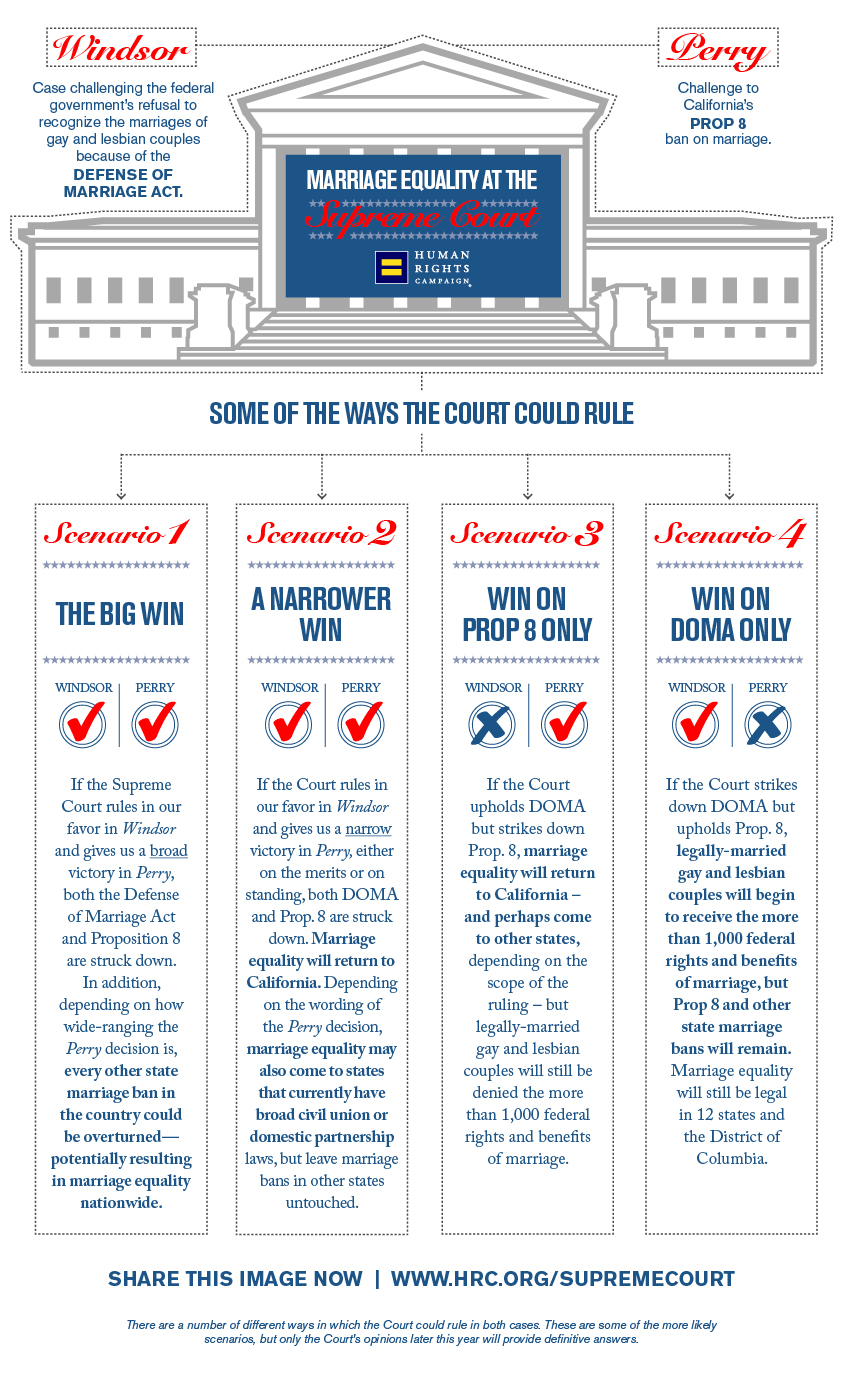
Infographic- Supreme Court Decision

click to embiggen

click to embiggen

Tonight: Montana PBS to Air Inlaws & Outlaws!

Some good news for Montana- Inlaws and Outlaws will be screened on Montana PBS tonight.

inlawsFrom the director, Drew Emery:

Montana friends!
Set your DVRs for Sunday night 6/9 10:30 pm: your local PBS station is airing our marriage documentary Inlaws & Outlaws — along with our story update: Just Marriage.

If you believe in love… and equality, please do pass on the word to friends & family!

Drew was in Montana last year, sharing the film with audiences in Helena and Bozeman. It’s an opportunity to see what love looks like up close.

Grab your peeps and watch this- it’s amazing.