![]() |
Author Archives: D Gregory Smith
Presidential Advisory Council on HIV/AIDS Issues Groundbreaking Resolution
The Transgender Law Center applauds the Presidential Advisory Council on HIV/AIDS (PACHA) for passing a groundbreaking resolution recommending ways to address the high rates of HIV/AIDS among transgender communities throughout the United States. Recently made public, the resolution was passed in February.
PACHA’s advice and recommendations are vitally important in assisting the White House to implement the National HIV/AIDS Strategy. This resolution is groundbreaking in nature, as it is the first time PACHA has issued a transgender-specific set of recommendations.
“We’re incredibly grateful to PACHA for passing such a strong and compelling resolution,” said Cecilia Chung, Senior Strategist. “These recommendations, if implemented, will meet some of the dire needs of our community, which include data collection, education, and culturally competent prevention and care for transgender people, as our community continues to face extreme violence and discrimination which contribute to a high prevalence of HIV/AIDS.”
Some of PACHA’s 15 recommendations include:
- Relevant Health and Human Services (HHS) operating divisions should dedicate grant funds to projects specifically focusing on transgender health, particularly in the context of HIV prevention and treatment…;
- The Indian Health Service (IHS) should develop a health services protocol specific to providing culturally and clinically appropriate care for male and female bodied, Two-Spirit individuals, including HIV prevention, education, outreach, and treatment;
- And The Centers for Medicaid and Medicare Services (CMS) should require facilities and providers receiving any federal funding to undertake regular staff trainings on transgender cultural competency.
The report “Injustice at Every Turn” is one of the few studies that has some data about transgender HIV rates. According to the report, the HIV sero-prevelance among transgender women in the U.S. is more than seven times the national average. The PACHA resolution notes that there is a lack of adequate data about transgender HIV risk and infection rates and recommends ways to collect it. It also points out that transgender people are protected from discrimination in the Affordable Care Act and lists ways to ensure agencies are aware of this and have adequate funding in place to care for transgender people.
Transgender Law Center works to educate legislators, policymakers, and advocates about the importance of addressing the HIV/AIDS epidemic in the transgender community, and eliminating discriminatory barriers that transgender people face when attempting to access quality care. The staff has held meetings with personnel from HHC, HRSA, and the CDC to help educate them about the important issues addressed in the PACHA resolution.
Additionally, in collaboration with Lyon-Martin Health Services, Transgender Law Center has spearheaded Project HEALTH: Harnessing Education, Advocacy, and Leadership in Transgender Health. Since 2008, Project HEALTH has led a comprehensive effort to improve access to and quality of healthcare for transgender people throughout California, and increasingly in other regions as well. Project HEALTH has trained more than 60 students in professional health programs through a clinical rotation hosted at Lyon-Martin Health Services and provided administrative, cultural, and clinical training to more than 25 community clinics and hospitals. In September, Project HEALTH launched TRANSLINE, an online consultation service for healthcare professionals seeking help caring for transgender patients. The team of leading organizations and practitioners has responded to more than 70 requests since September, with a 100% satisfaction rating.
Transgender Law Center works to change law, policy, and attitudes so that all people can live safely, authentically, and free from discrimination regardless of their gender identity or expression. http://www.transgenderlawcenter.org To learn more contact Mark Snyder,mark@transgenderlawcenter.org, 415.865.0176 ext. 310.
Related articles
- Transgender Women 49 Times More Likely To Have HIV, Study Says (dailyqueernews.wordpress.com)
- Arizona wants to ban transgender people from using washrooms not designated for their birth gender (theprovince.com)
- California lawmaker seeks rights for transgender students (mercurynews.com)
Odawa Indian tribe hosts Michigan’s first legal same-sex marriage
In case you missed it:
Tim LaCroix, 53, of Boyne City, and his longtime partner Gene Barfield, 60, of Boyne City are married at the government headquarters complex of the Little Traverse Bay Bands of Odawa Indians on Friday March 15, 2013 in Harbor Springs. / Ryan Garza/Detroit Free Press
The groom wore a black sweater. The other groom wore a red one.
Tim LaCroix, 53, and Gene Barfield, 60, were in the enrollment office this morning (March 15th) at the Little Traverse Bay Band of Odawa Indians government facility.
The couple took turns filling out an application
to get married, paid the $15 fee and received a marriage license. Both smiled nervously.
It was a historic day. Not just for them and not just for the tribe that LaCroix belongs to, but for Michigan too.
The two men were about to be the first same-sex couple to be legally married in this state.
Last year, the Odawa tribal council debated a resolution to recognize gay marriage, but the measure failed by one vote. When it was reintroduced, the language was changed to require at least one spouse to be a tribal citizen, and that swayed support. On March 2, it passed by a 5-4 vote.
All that was needed was the signature of tribal chairman Dexter McNamara, whose veto would have required a difficult 7-2 council majority to override.
McNamara not only signed it, but also asked to perform the wedding ceremony.
“I’ve always felt that either you believe in equal rights or you are prejudiced,” McNamara said. “We don’t have a dividing line in this tribe. Everyone deserves to live the lives of their choice.”
Out of 500 federally recognized tribes in the country, and a dozen in Michigan, the Odawa tribe became the first ever to legalize gay marriage in the state and only the third in the nation.
And because of tribal sovereignty, neither the state’s constitutional amendment prohibiting gay marriage nor the federal Defense of Marriage Act can stop them.
“This is their turf,” Barfield said, standing in the tribal offices. “They have their own government, they have their own police force, they have their own rules and regulations. They’re very big on respect, and for them to say to us ‘We respect your relationship and your prerogative to define it as you choose’ is really special.”
“I’m so proud of my tribe for doing this,” LaCroix added. “I just can’t say enough.”
The couple met in 1983 while both were on active duty in the Navy. They live in northern Michigan, where they garden, assemble model railroads and share
two dogs and a cat.
“We’ve been partners for 30 years in the way people use the word ‘partner’ for a same sex couple,” Barfield said. “Now we’re not going to be partners anymore. We’re going to be spouses.”
They wanted to get married at the signing ceremony for the statute, which gave them barely two weeks to prepare.
They hastily ordered cupcakes for the impromptu reception to follow. They found a tribal member to perform a traditional ceremony, alongside the secular one. They made little pouches of tobacco to hand out in a nod to tribal custom. And they invited friends and family from this small-town region.
About three dozen guests filled the seats arranged in the lobby this morning. There were relatives from both sides, beefy tribal members, employees who work in the building and wanted to wish the couple well, and a contingent from the hardware
store where LaCroix works.
“We’re just all giddy over it,” said Kathy Hughes, his longtime coworker. “They’re like family to us.”
Once McNamara signed the bill, tribe communications coordinator Annette VanDeCar acknowledged it was a controversial decision.
“I’ll be honest,” she told the crowd. “There are people in our community that aren’t supportive of what is happening today, but that’s OK. We as Indians are taught to respect people as individuals, and as individual people have the right to decide what is best for them.”
For this couple, a few tweaks were necessary in both the paperwork and the ceremony, like changing the word “wife” in the vows and on the license application to “spouse.” But it otherwise was a standard civil ceremony.
The chairman read the vows, and LaCroix went first in repeating them.
For better or for worse, to love and to cherish, from this day forward.
“I do,” he said.
Then came Barfield’s turn, and his composure melted a little. As he read the vows, his voice began to crack and his eyes grew moist. All the while, he looked at LaCroix with a beam of a smile.
“I do.”
They exchanged rings, and the chairman pronounced them married. They punctuated the ceremony with a brief kiss and a long, long hug.
Then they repeated it with a tribal ceremony using the sage, the feathers, the maple branch and the drum that were carefully laid out on a table.
There were no activist speeches, no protesters — only a crowd witnessing a wedding that was unlike any they’d ever seen, but was really no different than any other.
“We’re just so excited for them,” Hughes said. “They’ve been together 30 years. It’s longer than a lot of marriages have lasted.”
John Carlisle is a columnist and can be reached at jcarlisle@freepress.com or 313-222-6582.
Montana Medicaid Expansion Fails
Young Gay Men’s Retreat April 12-14
Still Wearing Red?
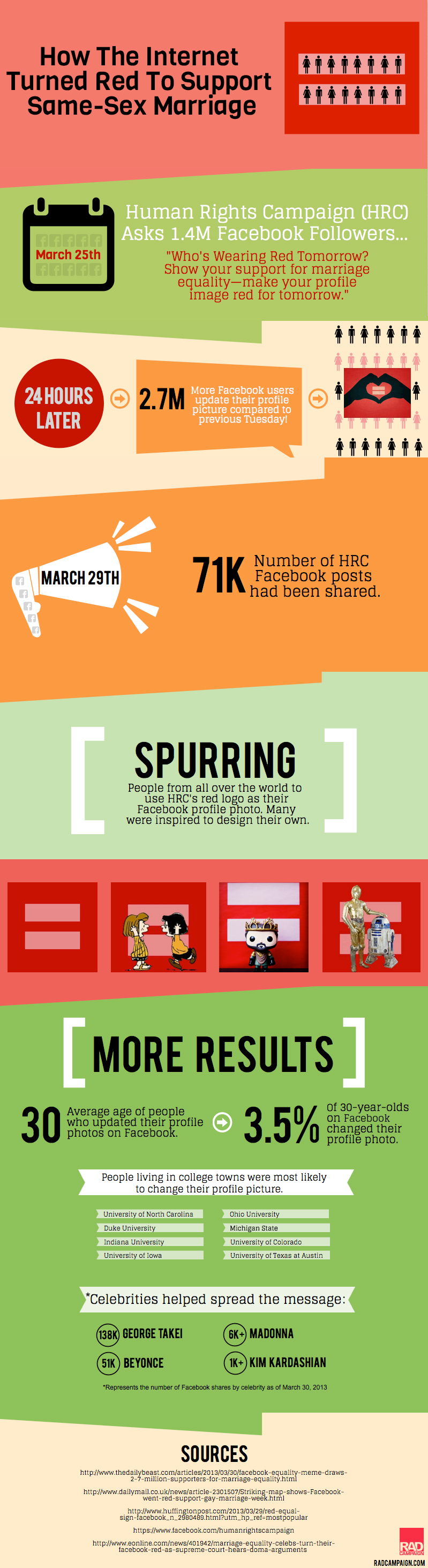
You should- the arguments to strike down the Defense of Marriage Act are being heard today. So if you changed your Facebook profile photo yesterday (and most of mine did) don’t change it yet! One of my friends has vowed to keep his red equality pic up until they hand down the decisions.
For a good brief on the impact of DOMA, see today’s Washington Post.
And if you don’t have your facebook pic changed yet- feel free to borrow from yesterday’s post.
Related articles
- Live Updates: Day 2 of Gay Marriage at the Supreme Court (abcnews.go.com)
- Facebook users show support for marriage equality (al.com)
- On Today’s Docket: DOMA (newser.com)
- How Getting Rid Of The Defense Of Marriage Act Will Boost The Economy (thinkprogress.org)
Stand For Marriage Today
Supporters of marriage equality will gather outside the Supreme Court on the first day of hearings: March 26 at 8:30 a.m. in Washington, D.C. Together we will show the nation that we believe all Americans deserve to be treated fairly and equally under the law — no matter who they love.
Wear red, share this graphic as your facebook profile pic:
Related articles
- Support marriage equality! (thevaleriechang.wordpress.com)
- U.S. Supreme Court Takes Up Same-Sex Marriage Debate Today (whnt.com)
- Same-sex marriage: A potential Supreme Court blockbuster (news.blogs.cnn.com)
- SCOTUS to Hear Prop 8 Challenge Today (radio.foxnews.com)
Women’s Health Stats For Montana
WOMEN’S HEALTH IN MONTANA (DHHS REGION VIII) Female Population of MONTANA
Total state population: 989,415 (492,748 females; 496,667 males)
Health Status (Age-adjusted§ percent of adult females)
In poor general health: 4.4%
Activity limitation due to poor phys/mental health: 8.9%
No natural teeth: 5.4% Sources: 2010, BRFSS
Access to Care (Age-adjusted§ percent of adult females) No health insurance coverage (under 65): 21.2%
No personal doctor or primary care physician: 79.2% Saw a dentist in past year: 61.5%
Fact sheets are now available for each of the 50 states and the District of Columbia. Each fact sheet presents a snapshot of demographic characteristics as well as a variety of health status indicators for females within the area. These include:
· Health Status
· Access to Care
· Health Conditions and Risk Factors
· Preventive Services and Screenings
· Mortality
· Prenatal Care and Pregnancy Risk
· Birth Outcomes
· Sexually Transmitted Infections
· Violence and Abuse
· Mental Health and
· Teen Health
For complete Montana stats, click here.
Related articles
- Suicide rate among Montana’s senior citizens outpaces national figure (billingsgazette.com)
- Millions of Americans Have an STD: Report (news.health.com)
- New study reveals sex to be pleasurable with or without use of a condom or lubricant (eurekalert.org)
- Few pregnant women treated for sexually transmitted infections (scienceblog.com)
- Women’s health must be priority for state health exchange marketplaces, new report says (eurekalert.org)
Today’s Must See: Alfredo’s Fire
“It was the Italian Stonewall, absolutely, the Italian Stonewall…”

About The Film
ALFREDO’S FIRE is a powerful and timely documentary that tells the forgotten story of Alfredo Ormando, a gay Italian writer who set himself on fire at the Vatican to protest the Church’s condemnation of homosexuality.
As Pope Benedict XVI resigns this month, the time is ripe for dialogue aimed at building a more open and inclusive Church, in the hope that no more lives are extinguished by the effects of religious intolerance.
With successful backing, the film will be finished in the next few months. We expect it to premiere in a major film festival in the U.S. and in conjunction with Italy’s National Pride celebration, this year in Alfredo’s hometown of Palermo.
For more information about the project visit: www.alfredosfire.com
Alfredo’s Story
On January 13, 1998 Alfredo Ormando, a 39-year old Italian writer, arrived in Rome just as the sun was rising. After a long journey from his native Sicily, he found his way to the empty plaza of St. Peter’s Square and, facing the entrance to the Basilica, knelt down as if to pray. He made a rapid hand gesture and suddenly was engulfed in flames. Before the Church and God, Alfredo Ormando had lit himself on fire.

Not long afterwards, and overlooking the spot where Alfredo had set himself aflame, Pope John Paul declared that “homosexual acts are against the laws of nature.” Pope Benedict XVI has even more vehemently advanced anti-gay rhetoric and policies.
Shaped by Alfredo’s manuscripts and letters, as well as rich cinematography, and provocative interviews with Alfredo’s friends, family and intimate companions, our film reveals Alfredo’s longing and the struggle to reconcile his own faith and sexuality.

My Story
As someone who has similarly struggled to reconcile his sexuality and spirituality, I became obsessed with Alfredo’s story and his choice of fire. Alfredo’s gesture was simultaneously a self-annihilation, an expression of pent-up passion and rage, a communion with God, and a dramatic “coming out.”
When Alfredo lit himself on fire at the Vatican, he hoped that his protest would be witnessed everywhere. Instead, his story was silenced by the Church and downplayed by the media. In death, as in life, he was made invisible. With our film, I want his light to reach millions worldwide. It is a flame by which to remember, witness, and come out of the dark.
VIDEO State of Despair: Suicidal thoughts pervasive among sexual minorities
I’m also featured in this video at the Gazette website:


