With Resistance to Treatment Rising, CDC Updates Gonorrhea Treatment Guidelines

From The National Coalition Of STD Directors:

Today, the Centers for Disease Control and Prevention (CDC) released updated guidelines for the treatment of the sexually transmitted disease gonorrhea, which is a major cause of pelvic inflammatory disease, ectopic pregnancy, and infertility and can facilitate HIV transmission.[i]  CDC estimates there are more than 700,000 gonorrhea infections each year in the United States.  The updated guidelines were published in CDC’s Morbidity and Mortality Weekly Report. 

The change marks an end to CDC exclusively recommending oral antibiotic treatment as the first line of defense for gonorrhea, and now instead recommends that infections be treated with the injectable antibiotic ceftriaxone in combination with one of two other oral antibiotics, either doxycycline or azithromycin.  This change in treatment has significant implications for clinical service delivery and infected patients alike, as the simple act of taking pills is replaced by an administered injection by a certified health professional.

“We applaud the CDC’s preemptive strike of changing recommended treatment and with the intention of extending the life of the last effective drug,” said William Smith, Executive Director of the National Coalition of STD Directors (NCSD). “However, the rising resistance of gonorrhea to our last line of defense against it must be a clarion call to policymakers and private industry alike to invest in the research and development pipeline for new antibiotics and more sophisticated diagnostics…and quickly.  We desperately need additional options to meet the challenges of this infection,” continued Smith.

Last summer, the CDC sounded the alarm on gonorrhea’s rising resistance to antimicrobials. This report outlined that we are on the verge of a highly untreatable gonorrhea epidemic as   gonorrhea has developed resistance to every class of antibiotics put up against it and there is no new drug in the pipeline.  Documented increases in resistance throughout the U.S. are what has prompted the CDC to make the current recommended treatment change.

Full presser here.

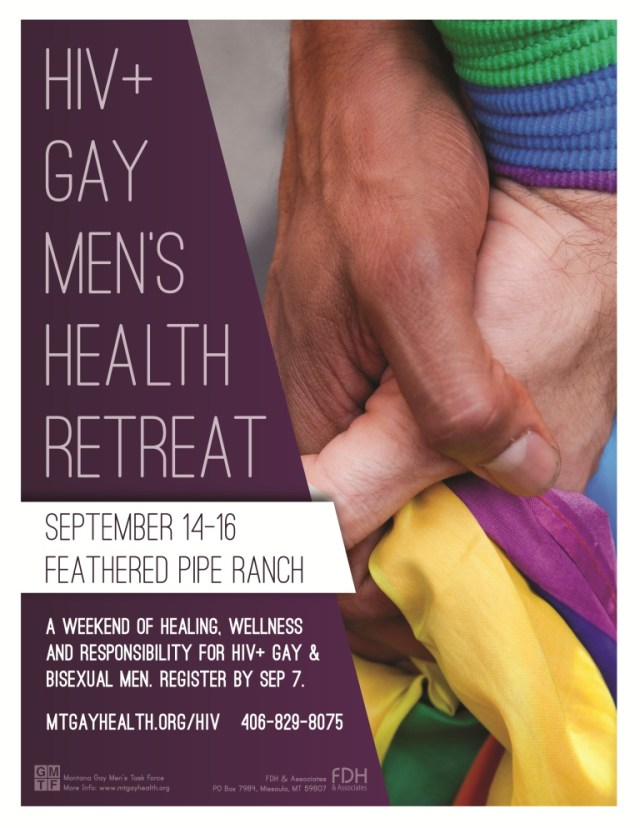
HIV Gay/Bi Men’s Health Retreat

When:  September 14 – 16, 2012

Where:  Helena, MT

Cost:  FREE

Registration Deadline:  September 7, 2012

• Experienced facilitators and educators • Great workshops on accessing resources  • Safe and confidential space

To Register, CLICK HERE, or if you have Questions, call:

FDH & Associates ● 406.829.8075 Or email: fdh@mtgayhealth.org

Olympic Awareness

From AIDS Healthcare Foundation’s Facebook page:

I love that they’re different sizes…

Let’s Talk About Sex

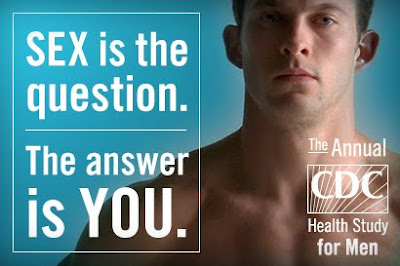
“Sex Is the Question,” is an engaging and important survey regarding the sexual practices of gay and bisexual men. This entirely confidential survey is sponsored by the Center for Disease Control, and will be used by state and local health departments to better understand the HIV epidemic among gay and bisexual men and potentially create new techniques to reverse the trend. “Sex Is the Question” is the largest survey ever attempted by a US federal agency for gay and bisexual men, and it will only take you a few minutes to complete. Do you want another great reason to take the survey? For every completed survey, “Sex Is the Question” will make a monetary donation to the It Gets Better Project.

How can you take the survey? Just click on this link. After you complete the survey, you will also have the opportunity to invite your friends to participate, and a donation will be made to the It Gets Better Project for each of your friends who completes the survey too. In addition, “Sex is the Question” is not just a survey. It is the first study of its kind to provide immediate feedback to its participants by incorporating videos and other interactive tools. At the end of the survey, you will be presented with personalized insight and comparisons based on your answers. Thank you for your consideration! With you support, we can help put an end to HIV once and for all, and in doing so, support a terrific organization.

Gay Men Are Flunking The Test

Also published on Bilerico.com

Yesterday, I posted an article about  a press release by the Journal Of The American Medical Association:

“…all adult patients, regardless of CD4 cell count, should be offered antiretroviral therapy (ART), according to an article in the July 25 issue of JAMA, a theme issue on HIV/AIDS. Other new recommendations include changes in therapeutic options and modifications in the timing and choice of ART for patients with an opportunistic illness such as tuberculosis.”

This follows the “treatment as prevention” model, based on the scientific research that people with HIV on antiretroviral therapy- with an undetectable viral load- are 96% less likely to pass on the virus.
us-statistics-2.jpgThis seems to be very good news. If you have HIV, you should find out early, get on meds and you’ll have a better chance of living a longer healthier life.

So what’s the problem? The problem is twofold:

  1. People at risk aren’t being tested: 20-25% of all HIV-infected people don’t know they have it.
  2. People at risk are still not being tested: Gay and Bisexual men of all races are the most severely affected by HIV

That’s not a typo- they’re basically the same reason, but there’s a difference. Any guesses?

Hint: It’s probably why most gay men won’t even read this article.

20-25% of all people with HIV don’t know they have it. Why not?

Here’s my take: Denial is one of the strongest mechanisms in the human psyche. It is fed by lack of information, by avoidance and by a strong desire for an alternative reality. If you’ve had unprotected sex, you’ve probably engaged in the process of denial. You’ve probably downplayed the risk, probably lied to yourself a little. You may have even gone over and over it in your mind, seizing every opportunity to deny the possibility of trouble.

“He looked okay”; “He didn’t seem sick”; “He pulled out”; “He would have told me if he had HIV”, etc, etc, and etc.

Well, we all know where that goes…. As individuals, we’re not facing facts. If we were, we’d be getting tested.

us-statistics-1.jpgGay and Bi men of all races are the most severely affected by HIV. Of course. We know that. Don’t we?

Again, denial applies. Gay and Bi men aren’t talking about HIV anymore. Our friends aren’t dying, so there’s no reason to be concerned. People with HIV aren’t out- aren’t well-known in our communities. Why? I was once told “You don’t need to harp about HIV all the time- it’s not that big of a deal.” Except that it is.

HIV has complicated my life in ways many people can’t believe. I am on catastrophic health insurance through the state- almost three times as expensive as my partner’s insurance. I get assistance for my meds- which cost about $25,000 a year- but (crazily), I can’t make more than $30,300 and still qualify for the program. I have joint pain, sleep issues, battles with depression, fatigue and a body that is aging at several times the normal rate– most probably due to inflammation- the hallmark of HIV disease. And yet, if I talk about this to friends or family, I’m seen as a whiner or someone trying unnecessarily to worry people I care about. It’s the “shut up- at least you’re not dying” defense. I know several HIV+ people who haven’t told anyone of their status, mostly because it’s “uncomfortable”.

No shit.

As a community, we’re not facing facts. If we were, we’d be talking to our friends about the importance of maintaining our health. We’d be talking about the hard reality of HIV.

But we’re not. Denial still holds sway, both individually and as a community. We’re lying to ourselves- we’re lying to each other- and infection rates stay the same.

We have a chance to change this trend. But only if everyone with HIV starts treatment, gets into care. This recommendation of the AMA may help with that. But it’s not up to doctors, nurses and social workers, it’s up to us.

We’re being tested, both as individuals and as a community. The problem is, we’re flunking.

Because we’re not showing up.

(Images source)

“All Adult HIV Patients Should Be Offered Antiretroviral Therapy”

From Science Daily:

Included in the 2012 International Antiviral Society-USA panel recommendations for human immunodeficiency virus (HIV) patient care is that all adult patients, regardless of CD4 cell count, should be offered antiretroviral therapy (ART), according to an article in the July 25 issue of JAMA, a theme issue on HIV/AIDS. Other new recommendations include changes in therapeutic options and modifications in the timing and choice of ART for patients with an opportunistic illness such as tuberculosis.

Melanie A. Thompson, M.D., of the AIDS Research Consortium of Atlanta, presented the findings of the article at a JAMA media briefing at the International AIDS Conference.

Journal of the American Medical Association

Journal of the American Medical Association (Photo credit: Wikipedia)

“Since the first antiretroviral drug was approved 25 years ago, improvements in the potency, tolerability, simplicity, and availability of ART have resulted in dramatically reduced numbers of opportunistic diseases and deaths where ART is accessible,” according to background information in the article. “New trial data and drug regimens that have become available in the last 2 years warrant an update to guidelines for ART in HIV-infected adults in resource-rich settings.”

The benefit of suppressing the virus, in my opinion, is greater than the possible toxicity of medication and navigating possible side effects. We know that as long as HIV is in the body, unchecked, it’s doing damage. It’s more likely than possible that people who start antiretroviral therapy early will have less problems with secondary conditions (joint pain, arthritis, memory problems) as they progress in their lives. I think this is tremendous news.

Full Story Here.

Truvada Approved For HIV Prevention

The first-ever daily pill to help prevent against HIV was approved Monday by U.S. regulators for use in uninfected adults who are at risk for getting the virus that causes AIDS.
Truvada, made by Gilead Sciences in California, has been on the market since 2004 and was approved by the Food and Drug Administration for a new use as a tool to help ward off HIV in otherwise healthy people, in combination with safe sex and regular testing.
The pill as pre-exposure prophylaxis has been hailed by some AIDS experts as a potent new tool against human immunodeficiency virus, but some health care providers are concerned it could encourage risky sex behavior.
In addition, the regimen is estimated to cost around $14,000 per year, making it out of reach of many.

The National Association of People With AIDS  (NAPWA) strongly supports today’s move by the United States Food and Drug Administration to approve use of Truvada (emtricitabine/ tenofovir disoproxil fumarate) for pre-exposure prophylaxis (PrEP) to reduce the risk of sexually acquired HIV-1 infection.

“It’s time for people at high risk of HIV infection to be empowered to protect themselves and others,” said Frank J. Oldham, Jr., NAPWA’s President and CEO. “Today’s approval of Truvada for HIV prevention gives them an important new tool to do that.

“PrEP is not a final solution to the spread of HIV,” Oldham continued, “but it can be one tool, and a very useful one, in a well stocked toolkit of prevention measures. We urge all Americans to assess their HIV risk realistically and use condoms if they are at risk, but we thank the FDA for approving Truvada for PrEP for those who cannot or will not.”

Truvada is one of the pills I take every day- if it can prevent anyone from getting HIV- it should. The “how” is still being determined.


AIDS Vaccine Possible Before End Of This Decade, HIV Scientist Says

From The New Civil Rights Movement:

HIV Particle

HIV Particle (Photo credit: AJC1)

A vaccine to protect against the Human Immunodeficiency Virus (HIV) and AIDS may be available before the end of this decade, a leading HIV research scientist says. RV144 may be the answer to fighting HIV/AIDS.

“We’re really working as fast as we can,” said Colonel Nelson Michael, director of the U.S. Military HIV Research Program at the Walter Reed Army Institute of Research, “who expects large-scale effectiveness studies to start in 2016,” according to a report in Reuters:

The hope is to have at least 50 percent effectiveness, a level that mathematical modelers say could have a major impact on the epidemic. Michael thinks this might be the pathway for getting the first HIV vaccine licensed, possibly by 2019.

Exciting news- Read the rest here

United In Anger

I remember ACT UP as a bunch of people who would do anything to get AIDS seriously discussed by officials- hell by anybody. In the 80s and early 90s, gay men were often reviled as AIDS-infested refuse. ACT UP was founded to fight for their lives.

In his new movie, Jim Hubbard tells the story of the group. From The Hollywood Reporter:

Deutsch: Act Up Logo

Deutsch: Act Up Logo (Photo credit: Wikipedia)

Making a confrontational movement accessible without diluting its life-or-death message, Jim Hubbard‘s United in Anger: A History of ACT UP offers a straightforward biography of the activist group as seen from within its ranks.

In opening titles making a few stark assertions — 40,000 people died of AIDS in the U.S. between 1981 and 1987 (others sources offer different figures), a period during which Ronald Reagan couldn’t say the disease’s name in public — the film establishes both the immense fear within the gay community and the way that fear and anger attached itself to uninformed, foot-dragging, or oppositional politicians and institutions.

Following an onscreen timeline, the doc begins with Larry Kramer‘s call for a protest movement in 1987, using copious period footage to show how quickly New Yorkers took to the idea. Video shot in meetings and on the streets shows a movement that, in laser-guided messaging and organization, contrasts with some current protest movements — a comparison made inevitable as we hear one ACT UP member suggesting they take over an official building “by occupying it with our bodies.”

With chapters focusing on major demonstrations at the FDA, Wall Street, NIH and White House, the film charts the movement’s evolving mood and expanding agenda. If bystanders at the time saw them as mainly making a lot of noise, Hubbard and his many interviewees cite an impressive number of successes arising from these events; sped-up drug approvals, lowered pharmaceutical costs, and various bureaucratic victories, seen in hindsight, allow veteran activists to express satisfaction they couldn’t show while chanting accusations or being hauled out of sit-ins in handcuffs. They also acknowledge how central ACT UP meetings became to participants’ social lives, with some members attending meetings every night; in between the die-ins and agit-prop campaigns, we hear, “ACT UP was very sexy.”

Probably hard to watch- I can’t watch AIDS-era movies without a deep, overwhelming grief- but I will. We can’t afford to forget.

ONE Singular Sensation…

If you run out of condoms this Pride weekend, you have no excuse.

ONE ® Condoms has provided Montana Pride 2012 with 4,000 “Pride Mix” Condoms:

Watch for the condom buckets!