Oregon Removes Barriers To Transition-related Care‏

From Basic Rights Oregon:

Basic Rights Oregon Header

Great news! The Insurance Division of the Department of Consumer and Business Services (DCBS) just announced that insurance companies doing business in Oregon must end discriminatory exclusions of medically-necessary healthcare for transgender Oregonians.

We all know someone who has been denied medically necessary care by an insurance company working to protect its bottom line. It’s unfair, painful, and downright dangerous when it happens. And for transgender people, these denials are often a fact of life.

Many transgender Oregonians are denied the ability to purchase health insurance or are denied coverage for basic, medically necessary care solely because they are transgender (watch a video of their stories here). These exclusions are wrong, discriminatory– and the Insurance Division has made it clear that this kind of discrimination has no place in Oregon.

The Insurance Division bulletin specifically states that:

  • Health insurers may not categorically exclude transgender patients from coverage.
  • Health insurers must provide coverage and cannot deny coverage of treatments for transgender policy holders if the same treatments are covered for other policy holders.
  • Health insurers may not deny treatment on the basis of a policy holder’s actual or perceived gender. That means that all policy holders can rely on annual exams, cancer screenings, and gender-specific health care, regardless of their gender on file.
  • The statewide mandate for coverage of mental health services must apply to transgender patients.

To learn more about this bulletin, or if you are denied care following this announcement, please refer to our Frequently Asked Questions sheet and to theInsurance Division website.

After years of work on this issue, the Trans Justice team at Basic Rights Oregon is celebrating a tremendous victory for trans, genderqueer, and gender non-conforming Oregonians. Portland resident and Trans Justice Working Group member Ray Crider said,

For me, this coverage is preventive health care. As a transgender man, part of my daily routine is binding my chest to create a masculine appearance. This created health problems for me by restricting my breathing and causing inflammation in the wall of my lungs. As a result, I ended up in the emergency room several times for shortness of breath and chest pain. Doctors told me the only solution was to stop binding, but the surgery I needed ended up being the same cost as my emergency room visits. Transgender exclusions in insurance policies are a lose-lose proposition, and I’m glad they’re coming to an end.


Basic Rights Oregon and transgender community leaders will continue working together to increase access to medically necessary care for trans Oregonians. And we’ll share more updates as this exciting bulletin is implemented.


Need A Last Minute Gift?

From our friends at The ONE Campaign:


Give the gift of music and hope this holiday season.

This World AIDS Day, (RED), ONE & Tiësto have teamed up to create a compilation album to help support HIV/AIDS programs. It topped the dance music charts in 33 countries and was the #2 album on iTunes over World AIDS Day weekend!

The album features an exclusive collaboration between Tiësto and Bono on U2’s “Pride” and some of the biggest names in dance music like Avicii, Calvin Harris and Diplo.

download DANCE (RED) Save Lives

Download DANCE (RED), SAVE LIVES.

This album is a great last-minute gift item! And the best part is all proceeds go to the Global Fund to Fight AIDS, Tuberculosis and Malaria. Make the dance music fan in your life happy and help save lives with just a single purchase.

Happy Holidays!

ONE


HIV Patients Lose More Years To Smoking Than HIV

Bad news for people with HIV who smoke: you’re losing twice as many years of your life by continuing your habit. And that’s not all. You’re also going to die at three times the rate of non-smokers with HIV….

Smoking

Smoking (Photo credit: Wikipedia)

From Science Daily:

Among HIV patients receiving well-organized care with free access to antiretroviral therapy, those who smoke lose more years of life to smoking than to HIV, according to a Danish study published in Clinical Infectious Diseases and available online. The findings highlight the importance of smoking cessation efforts in the long-term, integrated care of patients infected with HIV.

Marie Helleberg, MD, of Copenhagen University Hospital and colleagues estimated the effect of smoking on mortality, risk of death, and life expectancy, and the number of life years lost to smoking compared to years lost to HIV among nearly 3,000 HIV-infected patients treated in Denmark from 1995 to 2010. They also compared mortality associated with smoking between HIV patients and the country’s background population. Where HIV care is integrated and antiretroviral therapy is available at no cost, “more than 60 percent of deaths among HIV patients are associated with smoking,” rather than HIV, Dr. Helleberg said.

Estimated life expectancy differed significantly based on smoking status. A 35-year-old HIV patient who currently smokes had a life expectancy of 62.6 years, compared to 78.4 years for a nonsmoker infected with HIV. The loss of years of life associated with smoking was twice as high as that associated with HIV among HIV-infected patients. In addition, researchers found the excess mortality of HIV-infected smokers to be three times higher than that of individuals not infected with HIV.

Quitting smoking-along with increased exercise- are the two things people with HIV can do to extend their lives and overall health. I quit over three years ago. And yeah, it’s not easy. But it’s worth it.

So if you need a New Year’s resolution, it’s staring you right in the face. And if you need help, it’s readily available here.

Read the full article at Science Daily 

Racing in the Wrong Direction on Gun Issues

The most common type of gun confiscated by pol...

The most common type of gun confiscated by police and traced by the ATF are .38 special revolvers, such as this Smith and Wesson Model 60 .38 Special revolver with a 3-inch barrel. LaPierre, Wayne (1994). Guns, Crime, and Freedom . Regnery Publishing. p. 58. ISBN 0895264773. (Photo credit: Wikipedia)

The terrible events in Newtown sent my mind racing this weekend. I kept coming back to where we in Montana stand on preventing gun violence in our state. It was clear that we’re not just moving in the wrong direction on preventing gun violence in Montana we’re racing in the wrong direction.

The best way to illustrate this point is by looking at the work of Sen. Dave Lewis (R-Helena). Last session, Sen. Lewis chaired the Senate Finance & Claims Committee (the primary Senate budget committee), and, as chair, he slashed funding for crucial services- including mental health services. He and his Republican colleagues maintained that the state didn’t have enough money to pay for treating and providing support for those with mental illness (and some other issues as well).

While Lewis was busy slashing services for Montanans, he sponsored a bill that would have given tax cuts to gun ammunition manufacturers to “ensure availability.”

So in Sen. Dave Lewis’ world, we have enough money to give ammunition manufacturers tax cuts, but we don’t have the money to provide mental health counselling for Montana’s most vulnerable people.

While I do find Lewis to be one of the most detestable political figures in Montana history, this post isn’t about him. It’s about the fact that through their decisions, Montana’s elected officials are making our communities more vulnerable to the types of gun violence we’ve seen throughout the country over the past few years.

In the 2011 legislative session, there were 13 bills introduced related to guns and firearms. Only 2 of these bills could be construed as gun control measures. The rest would have done things to allow guns in banks, bars and other buildings. These bills would have allowed people to carry concealed weapons (simply by telling themselves they were allowed to), and would have even allowed students in public schools to bring guns on campus.

We as a state, much like the country, have to get beyond partisan dogfights over guns and gun violence, and have an honest effort to pass policies that will keep our communities safer. These policies must deal with not only rules about who, when, and where you can carry guns, but they must also deal with ensuring adequate mental health services for all Montanans.

I’ll be honest, I don’t expect our elected officials to display the courage to push responsible gun control laws. But I do think we have an opportunity to tackle the mental health aspect of the puzzle.

The Medicaid expansion that is part of the Affordable Care Act is our best chance to expand mental health coverage to tens of thousands of currently uninsured Montanans. This expansion is the part of the Affordable Care Act(ACA) that the US Supreme Court ruled states had the option of whether or no to implement.

Unfortunately, this expansion is sure to get marred by political games by Republicans who refuse to vote in support of anything related to the ACA. While Republicans may hold majorities in the legislature, Democrat Steve Bullock will hold the Governor’s office, and its bully pulpit and veto pen. He should use this bully pulpit and veto pen to ensure the Medicaid expansion is implemented in our state.

Governor Schweitzer accounted for the expansion in his final budget proposal, but thus far Bullock hasn’t said whether or not he’ll push for the expansion.

I hope that the horrible events of Friday will provide Bullock with a little more incentive to champion the expansion of Medicaid as a means of preventing gun violence in our state, without taking on a battle over gun control laws that he almost certainly cannot win with the legislature. If Bullock does this, we’ll begin to finally take small steps towards preventing gun violence in Montana.

Identification of LGBT Needs in the Exam Room

A physician performs a routine checkup on a pa...

A physician performs a routine checkup on a patient at the medical clinic. (Photo credit: Wikipedia)

Last time you were in an exam room, did you feel that the attending physician received all the information needed to gain an accurate perspective of your plight? Did you share everything you felt you should, no matter how personal? Did said physician even ask about anything, aside from the usual short list of inquiries we are all too familiar with in that particular setting?

If you are a physician, do you really get the answers you need from your patients? Or perhaps it is just too uncomfortable when talking about sexual health and behaviors. More likely, they do not disclose the details out of discomfort, or even fear.

LGBT persons have shown to have some unique healthcare needs, sometimes experiencing disparities in care. LGBT patients are often uncomfortable or inhibited from talking openly with healthcare providers about sexual orientation, gender identity, and sexual behaviors. Certain sexual behaviors do not automatically define that patient as LGBT, and not all LGBT patients are going to have similar sexual behaviors. Truthfully, it’s not about whether a person is a member of the LGBT community or not. It’s about the individuals choices and behaviors that could be putting their health at risk, as well as the health of others. In order to cover everyone’s needs, patients must speak openly with providers. Providers must delve into the patients behaviors and understand where the risk behavior is at for each patient. I am going to lay out a few examples, ideas, and suggestions for physicians, as well as patients.

In any healthcare position, you will find people from diverse backgrounds and lifestyles. Different interests, tastes, and mindset. The right approach will reassure patients that the provider is knowledgeable, genuine, concerned, confidential and accepting. This enables the patient to open up and discuss the very private matters of sexual behavior, often in this society a ‘taboo’ subject.

Ask the patient to tell a bit about themselves. As the patient, make sure you indulge your sexual partner(s), safe sex practices, and concerns. Some behaviors have an amount of risk attached to them that is often unknown to the patient.  A physician might ask “Do you have any questions or concerns about your sexuality, sexual orientation or sexual desires?”. Use gender-neutral terms and mirror the patient’s terminology to better understand how they identify. For example, asking “do you have a partner or spouse?” “Are you currently in a relationship?” “What do you call your partner?” are all good ways to decide how the patient will identify without offending them with clinical terms which may sound cold and ‘labeled’. From here the in-depth sexual questions begin: “Are you sexually active?” “When you have sex, do you have sex with men, women or both?” “Are you and your partner monogamous?” “How many sexual partners have you had in the past year?” “Do you have vaginal sex, anal sex, or both?”. These and many more are the key to finding out just what unique needs your particular patient might have.

It is important to differentiate between sexual identity and sexual behavior. Providers need to discuss sexual behavior with patients regardless of sexual identity in order to define risk-assessment, ascertaining what activities they engage in and to learn what they are doing to prevent the transmission of disease.

And for the majority of readers, as  patients we have a personal responsibility to find the courage to openly discuss in confidence all of our behaviors and desires with our doctors, nurses, therapists and counselors, etc. This is extremely important. We cannot rely on someone to read our thoughts and know the truth.

Stand up and be proud of yourself. I can almost guarantee that the person treating you has heard it all. And if they haven’t, they will soon enough.

Presidential Proclamation for World AIDS Day 2012

WORLD AIDS DAY, 2012

– – – – – – –

BY THE PRESIDENT OF THE UNITED STATES OF AMERICA

A PROCLAMATION

On World AIDS Day, more than 30 years after the first cases of this tragic illness were reported, we join the global community once more in standing with the millions of people who live with HIV/AIDS worldwide. We also recommit to preventing the spread of this disease, fighting the stigma associated with infection, and ending this pandemic once and for all.

In 2010, my Administration released the National HIV/AIDS Strategy, our Nation’s first comprehensive plan to fight the domestic epidemic. The Strategy aims to reduce new infections, increase access to care, reduce health disparities, and achieve a more coordinated national response to HIV/AIDS here in the United States. To meet these goals, we are advancing HIV/AIDS education; connecting stakeholders throughout the public, private, and non-profit sectors; and investing in promising research that can improve clinical outcomes and reduce the risk of transmission. Moving forward, we must continue to focus on populations with the highest HIV disparities — including gay men, and African American and Latino communities — and scale up effective, evidence-based interventions to prevent and treat HIV. We are also implementing the Affordable Care Act, which has expanded access to HIV testing and will ensure that all Americans, including those living with HIV/AIDS, have access to health insurance beginning in 2014.

These actions are bringing us closer to an AIDS-free generation at home and abroad — a goal that, while ambitious, is within sight. Through the President’s Emergency Plan for AIDS Relief (PEPFAR), we are on track to meet the HIV prevention and treatment targets I set last year. We are working with partners at home and abroad to reduce new infections in adults, help people with HIV/AIDS live longer, prevent mother-to-child transmission, and support the global effort to eliminate new infections in children by 2015. And thanks to bipartisan action to lift the entry ban on persons living with HIV, we were proud to welcome leaders from around the world to the 19th International AIDS Conference in Washington, D.C.

Creating an AIDS-free generation is a shared responsibility. It requires commitment from partner countries, coupled with support from donors, civil society, people living with HIV, faith-based organizations, the private sector, foundations, and multilateral institutions. We stand at a tipping point in the fight against HIV/AIDS, and working together, we can realize our historic opportunity to bring that fight to an end.

Today, we reflect on the strides we have taken toward overcoming HIV/AIDS, honor those who have made our progress possible, and keep in our thoughts all those who have known the devastating consequences of this illness. The road toward an AIDS-free generation is long — but as we mark this important observance, let us also remember that if we move forward every day with the same passion, persistence, and drive that has brought us this far, we can reach our goal. We can beat this disease. On World AIDS Day, in memory of those no longer with us and in solidarity with all who carry on the fight, let us pledge to make that vision a reality.

NOW, THEREFORE, I, BARACK OBAMA, President of the United States of America, by virtue of the authority vested in me by the Constitution and the laws of the United States do hereby proclaim December 1, 2012, as World AIDS Day. I urge the Governors of the States and the Commonwealth of Puerto Rico, officials of the other territories subject to the jurisdiction of the United States, and the American people to join me in appropriate activities to remember those who have lost their lives to AIDS and to provide support and comfort to those living with this disease.

IN WITNESS WHEREOF, I have hereunto set my hand this twenty-ninth day of November, in the year of our Lord two thousand twelve, and of the Independence of the United States of America the two hundred and thirty-seventh.

BARACK OBAMA

Study: Access to HIV Services for Gay Men Worldwide Stunted By Homophobia

Global study finds homophobia, comfort with service provider, and community engagement make significant impact on access to condoms, lubricant, HIV testing, and HIV treatment

A large-scale study of gay men and other men who have sex with men (MSM), conducted by the Global Forum on MSM & HIV (MSMGF), indicates that only one third of MSM can easily access condoms, lubricant, HIV testing, and HIV treatment. Combining a multi-lingual online survey and focus group discussions, the study suggests that structural barriers like homophobia play a significant role in blocking access to HIV services for MSM, while greater comfort with service providers and community engagement are associated with higher levels of service access.

The MSMGF’s study aimed to identify barriers and facilitators that affect access to HIV services for MSM. The online survey conducted this summer included 5779 men from 165 countries.  In addition, the MSMGF collaborated with African Men for Sexual Health and Rights (AMSHeR) to conduct focus group discussions with a total of 71 MSM across five cities in South Africa, Kenya, and Nigeria.

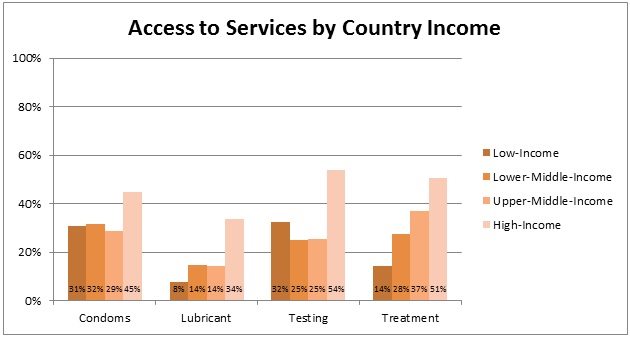
Of men who participated in the online survey, only 35% reported that condoms were easily accessible, 21% reported easy access to lubricant, 36% reported easy access to HIV testing, and 42% reported easy access to HIV treatment. Levels of access differed across low-, lower-middle-, upper-middle- and high-income countries, with reduced access to services more commonly reported in lower-income countries.

Percent of MSM reporting that condoms, lubricant, HIV testing, and HIV treatment
are easily accessible
(organized by country income level using World Bank country income classifications)

“Such poor levels of access at the global level are unacceptable,” said Dr. George Ayala, Executive Director of the MSMGF. “The differences in access by country income level are especially important to note as the Global Fund moves into a new funding model where countries are grouped into bands by income level. Even in upper-middle-income countries, MSM still have extremely low access to services. Without targeted funding to MSM and other key populations, the new funding model may continue to deteriorate levels of access for the groups most affected by HIV.”

The MSMGF research team also conducted analyses to identify barriers (factors associated with lower access) and facilitators (factors associated with higher access) that impact the ability of MSM to obtain condoms, lubricant, HIV testing, and HIV treatment.

Adjusting for country income, greater access to condoms, lubricants and HIV testing were associated with less homophobia, greater comfort with health providers, and more community engagement. Among participants living with HIV, higher access to HIV treatment was associated with less homophobia and greater comfort with service providers.  Greater access to lubricants and greater access to HIV testing were also associated with less outness (the degree to which others know of one’s sexual orientation) and fewer negative consequences as a result of being out, respectively.

“As we collectively forge ahead into the new territory of treatment-based prevention, it is clear that many of the old challenges remain,” said Noah Metheny, Director of Policy at the MSMGF. “Addressing structural barriers remains essential to realizing the potential of HIV interventions for MSM, and it becomes more important with each new prevention and treatment option that is made available. Investments in the development of new interventions must be accompanied by efforts to increase access.”

The quantitative data from the online survey was supplemented with qualitative data from focus group discussions, helping to place barriers and facilitators in the broader context of the sexual health and lived experiences of MSM. Focus group discussion participants identified barriers and facilitators that were highly consistent with those found in the online survey, and many participants explained the ways that structural barriers at the policy, cultural, and institutional levels cascade down through the community and individual levels to block access to services for MSM.

Focus group discussion participants described how structural barriers like stigma, discrimination, and criminalization force MSM to hide their sexual behavior from health care providers, employers, landlords, teachers, and family members in order to protect themselves and maintain a minimum livelihood. The inability of MSM to reveal their sexual behavior to health care providers was linked to misdiagnosis, delayed diagnosis, and delayed treatment, leading to poor health prognosis and higher risk of transmitting HIV and other sexually transmitted infections to partners.

Conversely, focus group discussion participants explained that the negative consequences of structural barriers were moderated by the existence of safe spaces to meet other MSM, safe spaces to receive services, access to competent mental health care, and access to comprehensive health care. Participants described MSM-led community based organizations as safe spaces where they could celebrate their true selves, receive respectful and knowledgeable health care, and in some cases receive mental health services.

“The study’s findings underscore the urgent need to improve access to essential HIV services for gay men and other MSM worldwide,” said Dr. Ayala. “Interventions must both disrupt the negative effects of barriers and bolster the protective effects of facilitators. Study participants clearly indicated that community engagement and community-based organizations are central to moderating barriers and facilitating service access. Successfully addressing HIV among MSM will require a real effort to address structural barriers, and the findings from this study suggest that investing in MSM-led community-based organizations may be the best way to do that.”

Agreed. MSM-led community-based organizations must continue to work tirelessly to eliminate fear, shame, stigma and ignorance. They are all still very much with us.

And they’re killing us.

Related articles

Clinicians Asked To Screen All Patients For HIV

The US Preventive Services Task Force (USPSTF) strongly recommends that clinicians screen all people aged 15 to 65 years for HIV infection, according to a draft recommendation statement posted online November 20. The statement also recommends HIV screening for all pregnant women, including those who present at the time of labor, and for younger adolescents and older adults who are at increased risk.

“The draft recommendation reflects new evidence that demonstrates the benefits of both screening for and earlier treatment of HIV,” task force member Douglas K. Owens, MD, said in a USPSTF news release. “Because HIV infection usually does not cause symptoms in the early stages, people need to be screened to learn if they are infected. People who are feeling well and learn they are infected with HIV can begin treatment earlier, reduce their chances of developing AIDS and live longer and healthier lives.”

Although US prevalence of HIV infection is nearly 1.2 million and annual incidence is about 50,000, nearly one quarter of those infected are unaware that they are HIV-positive. Since the first reports of AIDS in 1981, more than 1.1 million people have been diagnosed with AIDS and nearly 595,000 have died from it.

Combined antiretroviral therapy (ART) has been shown to reduce the likelihood of HIV transmission, and earlier initiation of treatment lowers the risk for AIDS-related complications.

In issuing this recommendation, the task force hopes to improve and maintain the health of persons who are already infected with HIV, to delay the onset of AIDS, and to lower the risk for HIV transmission.

For Men Only- Your Sexual Health

From the National Association of State and Territorial AIDS Directors (NASTAD) and the National Coalition of STD Directors (NCSD) comes a new pamphlet aimed at helping men who have sex with men (MSM) take charge of their sexual heath:

“Whether you are gay, bisexual or any man who has sex with other men (MSM), there are certain health services that are important for you to talk about with your doctor to protect your sexual health. This brief pamphlet is designed to help you get the best sexual health care during your visit to the doctor.”

An amazing array of helpful information about special health concerns and working with your healthcare provider.

View “For Men Only- Your Sexual Health” here.

Cognitive Training Beneficial For People With HIV

From Science Daily:

As more effective antiretroviral therapy has evolved over the past 30 years, HIV/AIDS has shifted from an acute to a chronic condition. But as patients live longer, research indicates that they are experiencing cognitive impairments at a higher rate than people without the disease.

A new study by researchers at the University of Alabama at Birmingham, published online Oct. 15, 2012 in the Journal of the Association of Nurses in AIDS Care, shows that cognitive training exercises can help — improving mental processing speed and the ability to complete daily tasks in middle-age and older adults with HIV.

“Today, more than 25 percent of people living with HIV in the United States are older than 50,” says the study’s lead author, David Vance, Ph.D., associate professor in the UAB School of Nursing, associate director of the UAB Center for Nursing Research and scientist in the UAB Edward R. Roybal Center for Research on Applied Gerontology. “Thirty to 60 percent of adults living with HIV experience cognitive problems at some point in the illness, a condition known as ‘HIV-associated neurocognitive disorders.’ It’s imperative for people with HIV and their treatment teams be proactive in addressing cognitive problems as they emerge, because without treatment these issues — which mimic premature aging — can lead to difficulties in working and living independently.”

 Full story here.