New York Times: Expanding HIV Treatment Necessary And Overdue

This hasn’t taken that long.

I’m blaming Hillary Clinton and Barack Obama.

The news that HIV treatment is prevention has taken a remarkably short time to hit the mainstream media, and it’s due to Secretary Clinton’s address to the NIH last month, and the President of The United States.

The NYT:

President Barack Obama announces a new compreh...

Image via Wikipedia

Important new findings show that very early treatment of people infected with H.I.V. enhances their health and greatly lessens the likelihood that they will spread the virus that causes AIDS. We welcome the Obama administration’s announcement of a farsighted effort to treat millions more infected people abroad, especially in sub-Saharan Africa.

The administration expects that the expanded treatments can be paid for with existing resources, by pushing for greater efficiencies and more financing from recipient nations. But if that effort stalls, the administration should re-evaluate quickly whether to ask Congress for money.

… Mr. Obama also announced that he would commit an additional $50 million in this country in fiscal year 2012 to help pay for treatments at AIDS clinics and in-state programs that provide AIDS drugs to people who can’t afford them. The money may be drawn from $1 billion available through the health care reform law.

Working to get these changes made legislatively have proven impossible in a Republican-owned House and a Republican-bullied Senate- especially when it involves the health of gay and bisexual men- so policy and administrative action were required. And by beginning to make testing and immediate treatment for HIV routine, medical practices are established that will be hard to take back.

An estimated 1.2 million Americans were infected with the virus at latest count, of whom 240,000 people are unaware. The Centers for Disease Control and Prevention started a campaign last week to increase testing with special emphasis on warning black gay and bisexual men, whose infection rates have been soaring, to get tested and treated.

Meanwhile, the New York City Health Department became the second (after San Francisco’s) to recommend doctors offer drug therapy immediately to every person diagnosed as infected, instead of waiting for the virus to damage their immune systems. The city has made enormous strides in testing, treating and cutting the number of new infections. Some 110,000 infected residents are under treatment; aggressive testing might find another 2,500 immediately and perhaps 500 a year thereafter.

The investments here and abroad should pay off in the long run by reducing the number of people infected and easing the severity of illnesses.

Thanks to you both.


Mayo Clinic Makes Kidney and Pancreas Transplant Available to HIV-Infected Patients

Science Daily reports that:

Mayo Clinic in Florida is now offering kidney and pancreas transplants to HIV positive patients with advanced kidney disease and diabetes. Evidence is now solid that HIV-positive patients have the same favorable outcome in terms of patient and allograft survival as non-HIV positive organ transplant recipients, says Mary Prendergast, M.D., a kidney specialist whose focus is the care of patients who receive kidney and pancreas transplants.

Full story here.

Study: Rural Persons Less Likely To Be Tested For HIV

A new study reports that rural areas score lower on self-reported testing of high-risk populations than urban areas:

In this nationally-representative, population-based study of HIV testing frequencies in the United States, we found that the frequency of self-reported HIV testing decreased substantially as the residential environment became progressively more rural. After adjusting for differences in demographics and self-reported HIV risk factors, the odds of HIV testing in the past year were 35% lower among persons living in the most remote rural areas compared to persons in the most urban areas. Rural persons with a prior HIV test were more likely than urban to report testing in a hospital, but less likely in the outpatient setting.

A prior study in the early years of the HIV epidemic in the US also found that rural persons were less likely than urban to report HIV testing.[6] Our results demonstrate that this gap in testing persists in the modern era of effective HIV therapy, when early diagnosis and linkage to care are even more essential. Moreover, recent efforts to increase testing have not impacted the rural-urban gap in testing. Although rural persons with HIV experience barriers to care, prior studies have described effective models for delivering high-quality HIV care in rural settings.[12–18] This accentuates the importance of early testing and diagnosis among rural persons with HIV.

Still work to do…

Benefits Tonight For Montana HIV Agencies

Through a calendar snafu, there are two- count ’em, TWO- benefits for HIV organizations in  the State of Montana tonight.

I’ll be in Billings tonight, speaking at the Yellowstone AIDS Project’s evening called Simply Elegant: Thirty Years of Fighting and Thriving.
From their website:

On December 3rd, 2011, the Yellowstone AIDS Project will host the 16th Annual World AIDS Day Benefit to be held at the Big Horn Resort (1801 Majestic Lane,  Billings) at 6 pm. This year’s event is titled Simply Elegant: Thiry Years of Fighting & Thriving.

The evening will include tapas catered by Beyond Basil, a wine tasting, silent and live auction items, a moving speech by HIV positive Montanan, D Gregory Smith and Venture Theatre will be performing excerpts from the Broadway Musical, “Rent”.

If you are in the Billings area, please come and say “Hi”- I’d love to see you – and these folks do good work.

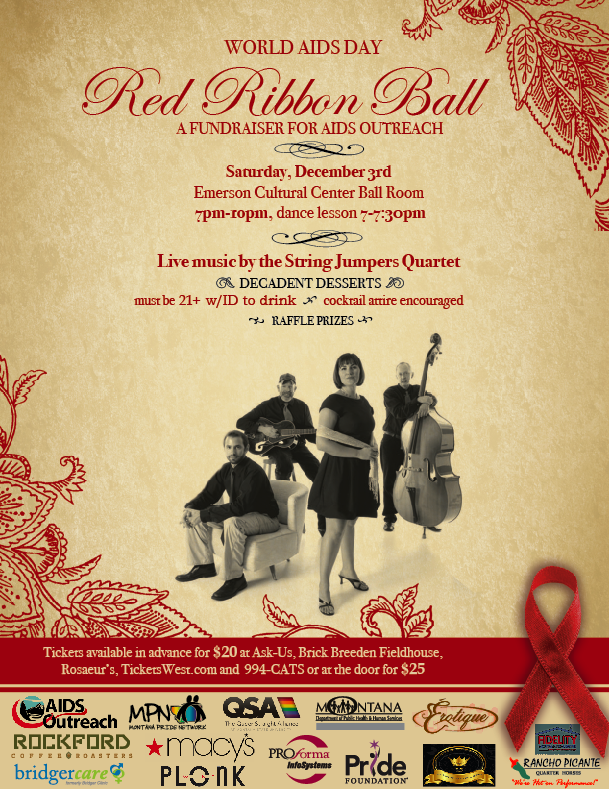
And in Bozeman, we have The Red Ribbon Ball, AIDS Outreach’s 1st annual classy soiree to benefit client services at AIDS Outreach:

Please support these very worthwhile causes….


World AIDS Day in Montana

On World AIDS Day we should not only remember the lives we’ve lost and think of those who are continuing to battle this disease, but we should also remember the challenges we’ve overcome and move forward towards the challenges ahead.
Here in Montana, we have a lot of challenges in regard to HIV/AIDS, but it’s important to me to highlight something some people may not pay particular attention to; something that drives me crazy every time I think about it;  the particular challenge of Congressman Dennis Rehberg.
Congressman Rehberg has a long history of furthering stigma and reducing access to treatment for people with HIV.
When he was our Lt.Governor, Congressman Rehberg argued against providing treatment for people with HIV, saying, “The problem with AIDS is, you get, you die, so why are we spending any money on people that get it...”
And no apology.
I’ve documented more recently that Congressman Rehberg hasn’t changed his thoughts on fighting this disease. In fact, he wants to eviscerate the budget. His recently released budget bill (in which he solicited no input from Montanans) would cut nearly $33 million from the CDC to fight the spread of HIV, Hep-C and other STDs. Obviously, Congressman Rehberg doesn’t realize that stopping the spread of these diseases now will save us millions of dollars in health care costs down the road- and potentially save the lives of millions of Americans and hundreds of Montanans.
He’s too busy pandering to the Tea Party.
I attended the Governor’s World AIDS Day awards today and I heard the award recipients and the many inspirational people talk about the theme of this year’s World AIDS Day, “Getting to Zero: Zero Infections, Zero Discrimination, Zero AIDS-Related Deaths.” It struck me as I was listening to the speeches, that, over his decades as a politician, Denny Rehberg has done an incredible disservice  to his hundreds of constituents living with HIV/AIDS- and their families. His ignorance and inability to separate HIV from stigma and shame is repugnant- and the exact opposite of the hope, selflessness, dedication and service those people in the Capitol Rotunda represented today.
Let’s make sure that by next year’s World AIDS Day Congressman Rehberg won’t be able to work against our efforts to stop the spread of this disease and the stigma associated with it.

World AIDS Day 2011

This time of the year is probably the best time (at least in our hemisphere) for World AIDS Day. Our twenty four hour days are filled with more darkness than light in December than any other month of the year. In some places it can be very dark and dreary, indeed. It’s an appropriate time of the year to remember the darkness of HIV.

The darkness can be frightening.

We have sometimes been very afraid here in our communities, in our states, in our country and in our world, because at times, it has been very, very dark. I especially remember the darkness and terror of 30 years ago when AIDS made itself known.

I also remember the panic that ensued- people bullied, driven from their families, homes, schools and places of employment out of fear and ignorance. Gay men were shamed and vilified openly by politicians and communities and churches.

I remember the shame that halted progress for research, treatment and prevention. I especially remember people- my friends- who wasted away in front of my eyes. Some died painfully and alone- their families too ashamed to ask for help or proper care.

We have lost good men, women and children to HIV/AIDS. Families have been broken, beautiful lives have been twisted by suffering.

It has been very dark, indeed.

But in this darkness, in this December, there always flickers the promise of light.

This disease can now be treated- treatment is now quite possibly the key to prevention. Shame has decreased. It is not gone, but it has decreased.

In this promise of light, I remember with gratitude the people whose bravery has driven away darkness. Whose voices refused to give in to hopelessness or complacency or fear. They got us here.

HIV is still here; it is still among us, it is still causing fear and shame. But the voices of reason and compassion have grown stronger.

You have heard those voices. You also are those voices. And when we use our voices to proclaim the truth- that disease is not a reason for judgment and shame- the light grows stronger.

When we refuse to give in to fear, we change for the better- and so does the world.

As a gay kid growing up in Montana, I remember walking in the cold dark of a wintery Big Sky, feeling alone, misunderstood and very small. But I also remember being under that same dark sky with friends and family, working happily to build a bonfire beside the skating pond. The dark of the night is no match for the voices of friends- especially when they’re united in a common purpose.

As a gay man living with HIV in a rural state, I know that my voice alone isn’t going to make much of a difference when it comes to education, treatment and prevention. It’s only together that we can truly make a significant difference for the lives of all HIV+ persons in our country and in our world. Because there is still work to be done. That’s why I”ll be going to a vigil tonight, holding a candle  in the dark with other people who know what it’s like to feel small and alone

The darkness never really goes away- but it’s also never a match for the voices and presence of friends. Especially when there’s a fire to build.

Knowing Is Cool. Get Tested

Watch this:

World AIDS Day in Bozeman

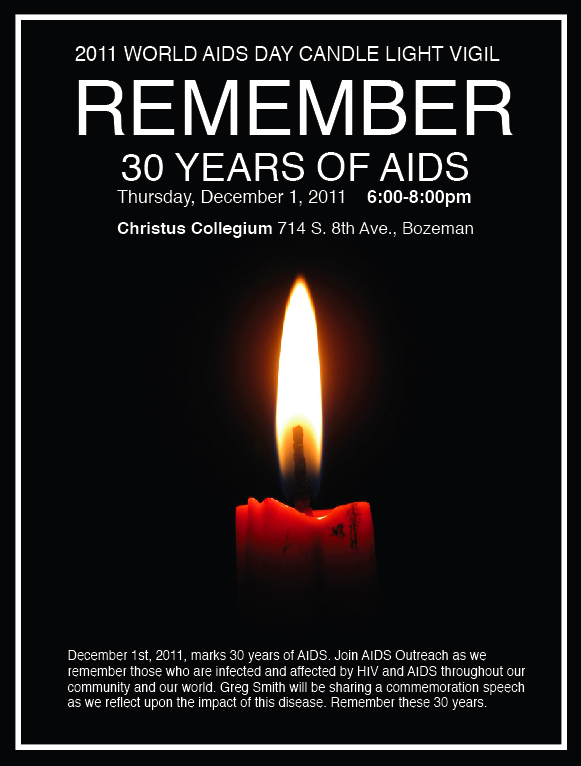
World AIDS Day is December 1st, and we’ve planned an event to commemorate 30 years of HIV/AIDS- I hope to see you there.

Bozeman AIDS Outreach Benefit

For a great way to spend next weekend- and to support a great cause- Bozeman’s AIDS Outreach, check this out:

Study: Incarceration Increases Risk Of STI’s, HIV Infection

Something nobody ever seems to want to talk about: sex, prison and STD’s.

The study’s objective was to assess the link between incarceration and sexually transmitted infection, including HIV, from a social network perspective.

Data collected from a social network study in Brooklyn (n=343) were measured for associations between incarceration and infection with herpes simplex virus-2, chlamydia, gonorrhea and syphilis or HIV and sex with an infected partner, adjusting for characteristics of respondents and their sex partners.

“Infection with an STI or HIV was associated with incarceration of less than one year (adjusted prevalence ratio=1.33; 95 percent confidence interval=1.01, 1.76) and one year or longer (adjusted PR=1.37; 95 percent CI=1.08, 1.74). Sex in the past three months with an infected partner was associated with sex in the past three months with one partner (adjusted PR=1.42; 95 percent CI=1.12, 1.79) and with two or more partners (adjusted PR=1.85; 95 percent CI=1.43, 2.38) who had ever been incarcerated,” the results found.

There is a need for STI and HIV treatment and prevention for current and former prisoners, concluded the authors. The results provide preliminary evidence to indicate that incarceration may influence HIV and other STIs, “possibly because incarceration increases the risk of sex with infected partners.”

I love it when science follows common sense. Well, at least informed common sense…