HRC: Romney Gave 10k To Prop 8

From LGBT/POV:

Mitt Romney - Caricature

Mitt Romney - Caricature (Photo credit: DonkeyHotey)

A number of politicos jumped on GOP presidential contender Mitt Romney for the casual way he offered to make a $10,000 bet with rival Rick Perry during a debate, saying it clearly illustrated out “out of touch” Romney was with regular folks for whom $10,000 is a lot of money. And certainly, $10,000 was a lot of money during the Prop 8 fight in California – which the Human Rights Campaign and its project NOM Exposed revealed was the amount Romney gave to the National Organization for Marriage when the antigay group emerged as a leading proponent for the Prop 8 ballot initiative that successfully stripped marriage rights from same sex couples in California. NOM has been working hard to keep the names of its donors private.

Scott Wooledge at the Huffington Post has more, finding the contribution cited “in the Oct. 28, 2008 edition of Deseret News reporting on Mitt Romney’s $10,000 donation to the National Organization for Marriage (NOM). We since have come to learn that NOM circulated some nefarious memos to convince donors that their cause was strategically planned.”

HRC’s Fred Sainz says:

The aide quoted in The Deseret News that gets Romney into campaign disclosure problems is none other than Eric Fehrnstrom, the same trusted aide who infamously compared the general election to an “Etch A Sketch.” The NYT has a great profile of Fehrnstrom here.

It also bears mentioning, that Robert George, the chairman emeritus of NOM and the author of two federal marriage amendments, sits on the editorial board of the Deseret News. You will remember that Mr. George was appointed this week by Speaker Boehner to the U.S. Commission for International Freedom.

It’s not that surprising, but in the era where “Don’t Ask Don’t Tell” ended with barely a whimper, State Legislatures enacted marriage equality, and Republicans have backed off the gay marriage issue, Romney’s anti-equality contributions should be noted.

Did anyone notice a Log Cabin Republican response to Romney’s contribution?

I didn’t either.

Full story here.

Gay Marriage – A Mystery – Church History

Scott Terry’s sculpture about Proposition 8 is now a YouTube video:

From his website:

When the religious right campaigned to repeal the right of California gays and
lesbians to marry, I was silent.  It’s not that I didn’t care or was uninterested…I
just didn’t care enough to get involved.  I don’t ever see myself getting
married, so I did not join the fight.

That was a mistake.

So while I did not voice my opinions or feel alarmed at the potential for
California voters to feel strongly enough about gay marriage to amend the
state constitution, I do have a really short fuse when people take their
religious dogma out of their respective churches and expect everyone else to
adopt it.  I get even more impatient with the “it’s the way it’s always been”
argument.  I mean, get real.  If we lived by the way it’s always been, we’d still
believe in slavery and child labor.

This art piece is my late entry into the argument and an apology for my earlier
silence.
On December 5th, 2008 when I first envisioned the creation of this piece, I
sent an email to the ProtectMarriage group, inquiring where I might obtain
some YesOn8 lawn signs.  Here’s the text of that email:

Me:  “Hi.  I need some YesOn8 lawn signs.  Can you tell me where I could get
them?”

The ProtectMarriage folks reply:  “Your best option would be visiting your
local church.  They might have some leftover from the campaign.”

Powerful message, I think.

Me, too. Thanks Scott!

The Pope Chooses War, I Choose Self Defense

Yesterday Pope Benedict XVI spoke to a group of bishops on their ad limina visit- and with all the topics available to him (hunger, poverty, abuse of women, social injustice, racial inequalities, nuclear threat, stewardship of resources, etc), he chose to speak to them about the necessity of battling the “powerful political and cultural currents seeking to alter the legal definition of marriage….The church’s conscientious effort to resist this pressure calls for a reasoned defense of marriage as a natural institution,” which is “rooted in the complementarity of the sexes and oriented to procreation,” he said.

“Sexual differences cannot be dismissed as irrelevant to the definition of marriage,” the pope said.

Defending traditional marriage is not simply a matter of church teaching, he said; it is a matter of “justice, since it entails safeguarding the good of the entire human community and the rights of parents and children alike.”

Whenever I hear a leader speak the word “Safeguard”, I pay attention. It is a word used by institutions and governments to promote the protection and defense of something fundamental to it. It is not a passive word. It says to me that the Pope is ready to fight for his narrow theological/historical position on sexuality and marriage. Something he believes is fundamental to Christian faith- even though marriage is curiously absent from the Nicene Creed (325-381 ad)- which most Christian churches profess as containing the essential, fundamental elements of Christian belief today.

He did not choose dialog or express interest in hearing about the experiences of thousands (millions?) of LGBTQ catholics and their families. He did not choose to understand, he chose to condemn.

In other words, he openly advocated war.

It’s a culture war, it’s a war of ideologies. It is, in fact, if you count all the open and affirming Christian churches that  welcome LGBT persons and their partners and children into their congregations, a war of christian theology. But it’s a war nonetheless.

I believe it to be totally unnecessary- and I also believe it conflicts with the very theology the catholic church espouses.

“War” is defined thusly: “a state of armed conflict between different nations or states or different groups within a nation or state”. “Armed conflict” is an important term to notice here. I think it can also mean non-physical weapons- weapons of ideology or theology, for example. But I would be naive not to think that some of the faithful out there may hear in these words a clarion call to harm LGBT persons and their families. I would also submit that the Pope’s words have already harmed them by creating ‘enemies of the church” out of persons and families who have nothing more important in mind than following their hearts and minds- and souls. And, if you recall your history, enemies of the church have not fared so well.

And in that case, the Pope needs to take a closer look at his own catechism.

If someone attacks me and threatens my life or my way of life, according to the Catechism of The Catholic Church, I have the right to defend myself.

 2264 Love toward oneself remains a fundamental principle of morality. Therefore it is legitimate to insist on respect for one’s own right to life. Someone who defends his life is not guilty of murder even if he is forced to deal his aggressor a lethal blow:
If a man in self-defense uses more than necessary violence, it will be unlawful: whereas if he repels force with moderation, his defense will be lawful…. Nor is it necessary for salvation that a man omit the act of moderate self-defense to avoid killing the other man, since one is bound to take more care of one’s own life than of another’s.[65]

2265 Legitimate defense can be not only a right but a grave duty for someone responsible for another’s life. Preserving the common good requires rendering the unjust aggressor unable to inflict harm. To this end, those holding legitimate authority have the right to repel by armed force aggressors against the civil community entrusted to their charge.[66]

And with the rhetoric being used by the Pope to the bishops in his address yesterday, I have every reason to believe that these are not words of someone struggling to understand the reality of LGBT persons, these are the orders of attack given by a supreme commander to his highest officials. And I’m confused because- try as I might- I can’t imagine Jesus saying them.

I also have every reason to fear for my safety and the safety of all LGBTQ persons. And before you accuse me of being overly dramatic, remember that the pro-life message has spurred numerous acts of violence- in the name of life, I might add. People in Uganda, the Middle East and elsewhere are being butchered and abused because they are known or perceived to be gay.

So do you think these words will be like soothing balm on the righteous indignation of the zealot?: …”threats to freedom of conscience, religion and worship which need to be addressed urgently so that all men and women of faith, and the institutions they inspire, can act in accordance with their deepest moral convictions.”

I’m an idiot if I don’t believe that someone out there is going to see this as a reason for violence- physical or psychological. And remember how powerful psychological threats are- those are the very things killing our kids.

I want to be clear- I am not advocating violence in any form. I’m advocating self-defense. And I’m advocating a careful, calculated, firm and reasonable response to this madness. I want the argument to be two-sided. I want the voice of the Pope and the bishops to be countered by the voices of people who see the Christian message in a different way.

If the Pope chooses war, I choose to oppose that war. I challenge it on its very principle.

So, if I may be so brazen, I would like to be one of those counter voices. Feel free to add your own voice in the comments.

To my LGBTIQ family,

Love toward yourself remains a fundamental principle of morality. Therefore it is important and necessary to insist on respect for your own right to life. I believe you have been created to fill a very important place in this world- a place often dramatically misunderstood and opposed by people out of ignorance and fear.

It is crucial that you understand that you are not alone- there are millions of people who want to understand you and accept you and who will love you. You have the right to be understood- and you have the right to love and be loved in the ways you feel are most faithful to your created nature.

You have the right to live free from fear of attack and violence. You have the right to defend yourself against ignorant attacks on your dignity, happiness and self-respect. You have the right to fulfill your potential and to follow your heart and mind and soul and dreams to the best of your ability. Despite ignorance, despite persecution, despite fear and power and hate.

I believe that we are all beloved by the God of our understanding. I believe that we are valuable in being beloved. And that value is not diminished, even in the face of anger, fear and ignorance. Even in the face of religious belief which would deny us that value.

We are a courageous, wonderful people, with visions of love and acceptance and equality and happiness that I believe are deeply important to the future of the world.

I beg you, don’t let go of these visions- no matter how strongly others try to pull them away from you. They are your birthright.

They are the key hope to a world filled with peace.

Amen.

Guest Post: An Authentic, Catholic History Of Marriage

By Terence Weldon

With British bishops on the attack against proposals for gay marriage claiming that they are defending “traditional” marriage, it is important to remember that their representation of marriage history is misleading. When Mexican bishops made similar false claims about the history of marriage, I responded with a post on the history of marriage, as described by a specialist on the subject – a Catholic, Jesuit professor of history at a Catholic university.

Here follows that post, republished:

In Mexico,  Cardinal Norberto Rivera has attacked the Supreme Court ruling that upheld same sex marriage in Mexico City, calling it “evil”. It is not surprising that a Catholic bishop should oppose marriage equality, and while I sharply disagree with him, I must respect his right to express an opinion.  He also says it is wrong to go against Christian doctrine that recognizes only marriages between a man and a woman. Again, barring a quibble or two about the effect of disagreement in conscience, even as we disagree with this, it is clear that this is orthodox Catholic teaching.

However, in invoking Christ himself, he goes way too far.

He called same-sex unions “inherently immoral,” saying they “distort the nature of marriage raised by Christ to the dignity of a sacrament.”

This is sheer garbage.

I am not aware of any Gospel passage that endorses marriage as been between one man and one woman. Can any reader point to me one?  Christ most certainly did not raise marriage to the dignity of a sacrament – not even the institutional church did that, until the twelfth century, after half its history had passed. Exploring this history has proven fascinating.

Compare the first two accounts I found. This is Wikipedia:

…..first-century Christians placed less value on the family but rather saw celibacy and freedom from family ties as a preferable state. Paul had suggested that marriage be used only as a last resort by those Christians that found it too difficult to remain chaste.[2]

Augustine believed that marriage was a sacrament, because it was a symbol used by Paul to express Christ’s love of the Church. Despite this, for the Fathers of the Church with their profound hostility to sex, marriage could not be a true and valuable Christian vocation. Jerome wrote: “It is not disparaging wedlock to prefer virginity. No one can make a comparison between two things if one is good and the other evil” (Letter 22).Tertullian argued that marriage “consists essentially in fornication” (An Exhortation to Chastity“) Cyprian, Bishop of Carthage said that the first commandment given to men was to increase and multiply, but now that the earth was full there was no need to continue this process of multiplication. Augustine was clear that if everybody stopped marrying and having children that would be an admirable thing; it would mean that the Kingdom of God would return all the sooner and the world would come to an end.

This negative view of marriage was reflected in the lack of interest shown by the Church authorities. Although the Church quickly produced liturgies to celebrate Baptismand the Eucharist, no special ceremonial was devised to celebrate Christian marriage, nor was it considered important for couples to have their nuptials blessed by a priest. People could marry by mutual agreement in the presence of witnesses. This system, known as Spousals, persisted after the Reformation. At first the old Roman pagan rite was used by Christians, although modified superficially. The first detailed account of a Christian wedding in the West dates from the 9th century and was identical to the old nuptial service of Ancient Rome.[3]

There are obvious difficulties with relying on Wikipedia as a source – but it does at least provide us with references to substantiate its claims. Now look at the Catholic Encyclopedia:

That Christian marriage (i.e. marriage between baptizedpersons) is really a sacrament of the New Law in the strict sense of the word is for all Catholics an indubitable truth. According to the Council of Trent this dogmahas always been taught by the Church, and is thus defined in canon i, Sess. XXIV: “If any one shall say that matrimony is not truly and properly one of the Seven Sacraments of the Evangelical Law, instituted by Christ our Lord, but was invented in the Church by men, and does not confer grace, let him be anathema.”

This can do no more than quote the council of Trent, which claims that the sacramental view of marriage has “always”  been taught – totally disregarding the verdicts of church fathers such as Tertullian, quoted above. On marriage as on so much else, the Vatican likes to refer to a “constant and unchanging tradition”, or to claim that it has “always taught”. These claims are seldom supported by real evidence, and must be received with scepticism.

Then I found an impressive on-line history of marriage , in a lengthy outline by Stephen Schloesser, a Jesuit priest and professor of history, which he submitted to Massachusetts Senator Marian Walsh in 2004, during the turmoil in that state over gay marriage. Here are some extracts  – the introduction, and (mostly) just a summary of the main paragraph headings:

Maybe the most frustrating thing I have heard in the recent debate is this claim that has become a mantra: that we are in the process of changing some allegedly unchanging 3,000-year-old institution called “marriage.”Of course, the decision to grant marriage licenses would be a “change” in marriage practice – but“marriage,” whatever that is, is always in the process of being changed. To pretend that its alteration is somehow a rupture in what is otherwise a three-thousand year continuity is just silly.

It seems helpful to me to recall what traditional marriage is: it is a community’s legal arrangement in order to pass on property. In it, a male acquires (in the sense of owning and having sovereignty over) a female for the sake of reproducing other males who will then inherit property.

In Roman law, the authority of the paterfamilias over his wife and children was absolute, even to the point of death. (Even during the enlightenment), Catholic reactionaries opposed the idea of women and children having independent rights and insisted that puissance paternelle (the absolute power of the father) was rooted in nature.

In Judaism, polygyny is found throughout the Old Testament until the inter-testamental period.In general, a survey of traditional Old Testament marriage makes the reader very grateful that we are not bound to follow its precedents or precepts.

Early Christianity was really not into marriage. St Paul counseled his followers: “It is better not to marry.”Augustine (following St. Paul) counsel ed marriage as a remedy for concupiscence – i.e., satisfying male sexual desire in a non-sinful way.In general, during the early medieval Church, all sex is a problem, and all sex is equally a problem.

Marriage, both in the Roman and the early medieval periods, was the moment that marked the passing of the rights over a woman from her father to her husband. She wasn’t a person under the law.

Serial polygyny was regularly practiced by early medieval kings famous for their Christian piety. Their marital practices did not trouble the Church. Concubinage was also widely practiced among the European elite, and this practice was unproblematic, even in the eleventh century. Divorce was also completely unproblematic until the twelfth century.

In the twelfth century, the idea of marriage as a “sacrament” – i.e., as something fundamentally regulated by the Church – was established along with priestly celibacy and primogeniture.

The simultaneous appearance of these practices shows the way in which the preservation of property suddenly became an issue of great anxiety: celibacy prevented church property from passing on to priests’ wives and children; primogeniture insured that property remain intact as it passed on to only the eldest son; and Church surveillance of marriages made sure that an authority larger than, say, the most powerful warrior / aristocratic families on the block, was overseeing the passing on of dowries – e.g., Eleanor’s region of the Aquitaine. Women became the means of medieval corporate mergers: families consolidated power and property, both by means of dowries as well as by being the producers of male heirs.

Marriage as an “emotional unit” as opposed to an “economic unit” was largely an invention of the early nineteenth century. Bourgeois marriage was a classbound arrangement.

Conversely, for the males, prostitution is seen as an integral part of the new arrangement of marriage.

Divorce, finally legalized again in France in the 1880s, emancipated men but perhaps not women unless they had reserved some independent means. It too was part of the new emotional understanding of marriage, i.e., as something not arranged by parents but rather entered into partly because of emotional desires.

It is hardly coincidental: this is also the period during which the idea of “homosexuality” – and then, later, “heterosexuality” – was invented.

Catholic ideas about marriage and sexuality are in constant conversation with the wider society/culture’s evolving values and needs.

As late as the Code of Canon Law of 1917, the official position continued to be depressingly materialist: the purpose of marriage was considered to be “procreation,” while a secondary end was a “remedy for concupiscence.”

This genuinely two-millennia-old view changed on New Year’s Eve, 1930.(following the Lambeth Conference decision to approve contraception). The papal encyclical Casti Connubii introduced a fairly shocking innovation: one of marriage’s “second ends” was the “unity” between the spouses.The 19th-c. invention of marriage as an “emotional unit” in which two persons came together not merely to procreate but in order to form a sphere of emotional support – a thoroughly modern meaning of marriage – was accepted by the papacy.

On October 29, 1951 came a second important innovation in Catholic views. In one of the most insignificant settings possible – i.e., not an encyclical or synod but rather an address to Italian midwives –Pius XII suggested that couples, as long as they did not use “artificial” contraception, could arrive at a moral decision to be sexually active in a way that did not lead to procreation.

Between the years of approximately 1948 to 1963, the Catholic bishops of New England lobbied furiously against the legalization of contraception. John Ford, a Jesuit moral theologian who was the most aggressive proponent of the anticontraception stance (and taught in Weston, Mass.) admitted letter that the “natural law” argument had failed; if the point of “natural law” arguments was to convince any “rational person” (unlike, e.g., Scripture, which would convince only a religious believer), and if all these rational persons were rejecting the Catholic position, then what did that say about the law’s “natural” aspect? Eventually, the bishops abandoned this fight and made a distinction between public policy and personal religious practice.

To summarize: when one compares the 1917 Catholic view of marriage – “procreation” as a primary end, “a remedy for concupiscence” as a secondary end – with the 1969 view expressed in both the Vatican Council and encoded in canon law – “the community of the whole life” that includes both the “unbreakable compact between persons” as well as the “welfare of the children,” one can see that the change in Catholic doctrine and law has been nothing short of astonishing.

The full piece is the most useful outline of marriage history and the church I have come across.  I have selected here only the bits that refer specifically to the history of Christian marriage. There is much more on marriage in other cultures, and on the church and homosexuality. I strongly urge that you read it in full – or download or bookmark it for future reference, as I have done.

Follow Terence’s amazingly energetic and theologically responsible blog, Queering The Church. Amazing stuff.

Will Minnesota’s Bishop Follow Maine In Marriage Equality?

From New Ways Ministry Blog:

Catholics in Minnesota are asking the states’ bishops to follow the example of Maine’s Bishop Malone by taking a less activist approach to the state’s upcoming marriage equality referendum.  In the past week, the Maine prelate released a pastoral letter on traditional heterosexual marriage, and announced that the Diocese of Portland would not be funding or staffing the political campaign to make sure that marriage equality for lesbian and gay couples is defeated.

Catholics for Marriage Equality Minnesota has instituted a number of new initiatives to make sure that their state’s proposed constitutional amendment against marriage equality will be defeated, including asking their bishops to take a cue from Bishop Malone.  According to a news report in the Minneapolis Star-Tribune:

“ ‘We are encouraged by Bishop Malone’s decision to place at the center of the Church’s mission in Maine Jesus’ call to care for the poor and marginalized,’ said Michael Bayly, executive director of Catholics for Marriage Equality Minnesota. ‘We pray that the bishops here in Minnesota will not only follow the example of Maine but will also be open to the love and commitment embodied in the relationships of committed gay and lesbian couples.’ ”

According to Catholics for Marriage Equality Minnesota’s blog site, Sensus Fidelium, the group

” . . . has organized a weekly prayer vigil during the season of Lent. Over 100 people attended last Sunday’s vigil, and organizers anticipate the numbers of attendees to continue to increase. Those who gather bear public witness to the fact that they do not see anything of Jesus’ life or message in Archbishop John Nienstedt’s support of the so-called ‘marriage amendment.’

“The group has also started an online petition asking Archbishop Nienstedt to re-focus the energy and resources of the Church away from divisive and unnecessary constitutional amendments back towards the core Catholic teachings of compassion and care for others. The petition can be found at FocusOnSocialJustice.Com

You can learn more about Catholics for Marriage Equality Minnesota at their website,c4me.org.

For more information about the Maine bishop’s action, you can read yesterday’sBondings 2.0 blog post.

–Francis DeBernardo, New Ways Ministry

Good News In Maryland, Bad News In New Jersey

By Francis De Bernardo, New Ways Ministry

Yesterday, the Maryland House of Delegates approved a marriage equality bill, virtually guaranteeing it would become law, since the bill is likely to pass the Senate, and Governor Martin O’Malley, a Catholic, has promised to sign it.

Yesterday in New Jersey, however, Governor Chris Christie, a Catholic, vetoed that state’s marriage equality bill which had passed both Assembly and Senate.  The legislature has until January 2014 to override the veto.

MARYLAND

The Baltimore Sun report rightly noted O’Malley’s role in the bill’s success in Maryland, and quoted him saying:

“We are a good people. We all want the same things for our kids.”

The Washington Blade’s story carried a quote from O’Malley that reflected the Catholic social teaching principle behind the issue of marriage equality:

“Today, the House of Delegates voted for human dignity.”

Earlier this week, The Baltimore Sun carried a news report on a talk O’Malley gave in which he described the evolution of his thinking on marriage equality.  New Ways Ministry’s Sister Jeannine Gramick is quoted in that article about her thoughts to O’Malley’s support of the issue. Sister Gramick said:

“I’m proud of him for being a Catholic and for witnessing real Catholic values. … I’m so glad he’s supporting the marriage equality bill.”

Last night, Bondings 2.0 posted New Ways Ministry’s response to the vote, along with a link to The Washington Post article about the news.

Even after the bill would become a law, the struggle would still not be over, as opponents have promised to mount a referendum campaign

NEW JERSEY

In The New York Times account of Christie’s veto, they explain that

Governor of New Jersey at a town hall in Hills...

Image via Wikipedia

“The governor’s veto was conditional, asking the State Legislature to amend the bill, so that rather than legalizing same-sex marriages, it would establish an overseer to handle complaints that the state’s five-year-old civil union law did not provide gay and lesbian couples the same protections that marriage would.

“Mr. Christie also affirmed his call for the Legislature to put a referendum on same-sex marriage on the ballot in November. . . .

“At the same time, Mr. Christie repeated what the State Supreme Court said in 2006 — that same-sex couples deserve the same benefits enjoyed by married couples. Answering testimony that same-sex couples in civil unions had more trouble than married couples in matters like obtaining mortgages and making health care decisions, the governor said he wanted to set up a new ombudsman to make sure gay and lesbian couples did not suffer discrimination.”

Steven Goldstein, chairman of Garden State Equality, responded in the Timesstory to the ombudsman idea by calling it

““the equivalent of gold-plating a separate water fountain for a specific class of people.”

In a posting two days ago, Bondings 2.0 noted that Washington State’s Catholic governor Christine Gregoire, who this week signed a marriage equality bill into law, sent a letter to fellow Catholic Christie, offering to discuss her evolution on the issue. Christie had not responded.

In their editorial column, the Times opined about “Governor Christie’s Misguided and Intolerant Veto,”

“Sadly, there was no surprise to Gov. Chris Christie’s veto on Friday of the same-sex marriage bill that cleared New Jersey’s Assembly and Senate this week. Mr. Christie had said all along that he would block the measure as soon as it reached his desk. That does not change the message of intolerance or lessen the pain for gay residents and their families. Mr. Christie compounded the insult when he dismissed the Legislature’s support for the rights of gay people as merely ‘an exercise in theater.’ The only one who deserves that accusation is Governor Christie, who is clearly pandering to his own conservative base. . . .

“This isn’t about theater and shouldn’t be about politics. Marriage equality is a basic right.”

NYT/CBS Poll: Catholic Religious Leaders Out Of Touch

Today’s poll on President Obama and the economy also gauged voter’s take on two key religious “hot buttons”- and it turns out they’re not so hot:

Mosaic cross ~Lobby of New West Catholic gym

Mosaic cross ~Lobby of New West Catholic gym (Photo credit: laudu)

Despite the deep divide between some religious leaders and government officials over contraceptives, the latest New York Times/CBS News poll found most voters support the new federal directive that health insurance plans provide coverage for birth control.

In addition, most voters said they favored some type of legal recognition for same-sex couples, at a time when the New Jersey Legislature is set to vote on gay marriage and after a federal appellate court ruled that Proposition 8’s ban on same-sex marriage in California was unconstitutional.

A majority of Catholic voters in the poll were at odds with the church’s official stance, agreeing with most other voters that religiously affiliated employers should offer health insurance that provides contraception. Jennifer Davison, 38, a Catholic from Lomita, Calif., agrees with the federal requirement. “My opinion is that it is a personal issue rather than a religious issue,” she said in a follow-up interview.

Unlike Catholics, white evangelical Christian voters were more divided, with half objecting to requiring the health insurance plans of religious employers to cover contraceptives; 43 percent supported it. “It is a religious issue with me,” said Jessica Isner, 22, an evangelical Christian from Elkins, W. Va. “I believe that providing birth control is O.K. if the hospital is not religiously affiliated.”

Gay marriage is another debate in which the Catholic laity disagrees with church doctrine. More than two-thirds of Catholic voters supported some sort of legal recognition of gay couples’ relationships: 44 percent favored marriage, and 25 percent preferred civil unions. Twenty-four percent said gay couples should receive no legal recognition.

Click here for graphic of full poll results

TWO THIRDS. This is bearing out that the sensus fidelium (the sense of the faithful) is much more “common” (read ‘in touch’) than that of the magisterium. And the gap of common sense just seems to be getting wider….

 Read the complete NYT story here

Couple’s Love Inspires A More Equal Montana

By Caitlin Copple

This Valentine’s Day season, many Montanans are blushing about their current crush or building a relationship with that special someone. For same-sex couples here, the butterflies and bliss of true love is often met with a cold, hard legal reality. Only six states and the District of Columbia offer equal marriage rights, and Montana is not one of them. Groups like ACLU of Montana, a recent grantee of The Advocacy Fund at Pride Foundation, are trying to change that by taking a relationship recognition lawsuit to the state Supreme Court.

Kellie, Denise and Morrgan

One of the couples in the ACLU case is Kellie and Denise. They live in Laurel, population roughly 7,000, about 20 miles west of Billings. They are one of six couples who are plaintiffs in the ACLU’s current Guggenheim v. Montana case currently before the state Supreme Court.

Kellie and Denise have been together for 11 years. They’ve raised Kellie’s two children from a previous marriage, and recently jointly adopted Kellie’s 5-year-old nephew, Morrgan. Denise, 47, is a middle school science teacher and a basketball coach. Kellie, 48, worked for many years at a juvenile detention center, but is now on disability because she suffers from a rare brain condition that has required 56 brain surgeries and over 300 spinal taps over the past decade.

Heterosexual married state employees automatically receive 10 days of bereavement leave when a family member or in-law dies, but Denise was denied bereavement leave by her employer when Kellie’s father died last April. This was despite the fact that the couple had a private commitment ceremony in 2001, witnessed by about 30 friends and family members present. They are just like most Montanans – they are active at church, and they love to travel, camp, and fish. Unlike most Montanans, their relationship doesn’t “count” according to state and federal law.

Kellie credits Denise standing by her for being able to make it through her health problems: “She never left me when I was so sick,” she says. “I endure her relentless love of sports and she endures my need for dogs. I love her to infinity and beyond!”

“Kellie and Denise have been incredibly helpful with their participation in Fair is Fair events,” said the ACLU’s LGBT organizer Liz Welch, who is based in Billings. “One of the most touching things to watch is the tenderness and protectiveness they have for each other while at these public events. I admire these two and their affectionate, playful relationship all the more because of the obstacles I know they have had to overcome.”

Guggenheim v. Montana is currently before the Montana Supreme Court. Both sides have submitted briefs and multiple amicus briefs have also been filed in support of both side of the case. Supporting amicus are 65 Montana Religious Leaders, American Psychological Association, Legal Voice, Montana Human Rights Network and Gary J. Gates and MV Lee Badgett. According to Welch, the ACLU expects a court date to be set in the very near future.

Here’s to hoping this is the last Valentine’s Day Montana’s same-sex couples spend being treated unfairly under the law.

To keep updated on the case, as well as other projects of the ACLU of Montana, please visit:www.fairisfairmontana.org or email lwelch@acluofmontana.org to volunteer or sign a petition in support of the lawsuit.

Caitlin Copple is the Montana Regional Development Organizer for the Pride Foundation. Feel free to email her at Caitlin@pridefoundation.org with blog ideas or to volunteer.This story first appeared in Pride Foundation’s Blog.

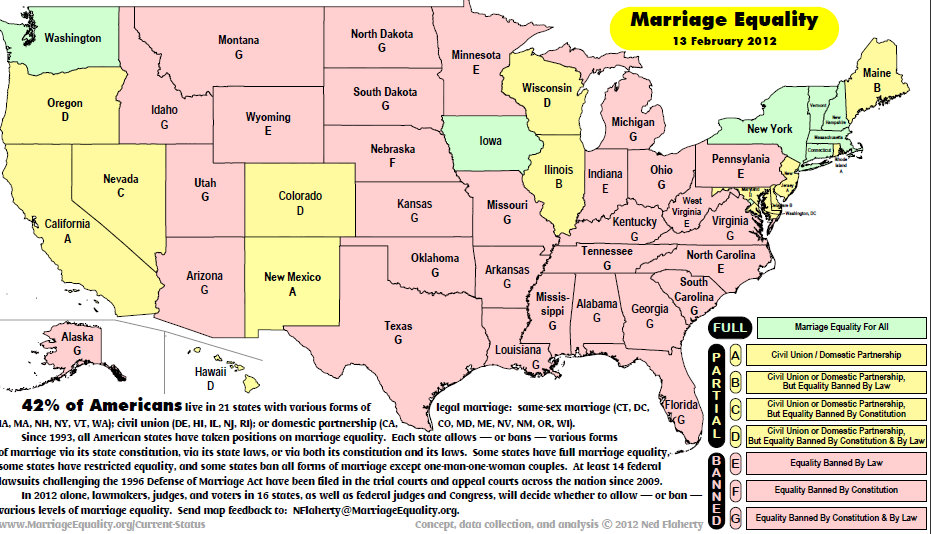
Love For All, Marriage For Some

Click to enlarge

Guest Post: All Across The Land, Religious support For Marriage Equality Continues To Grow

(From Bondings 2.0)
By Francis DiBernardo, Director, New Ways Ministry

As if the legislative victory on marriage equality in Washington State were not evidence enough of a major shift in the landscape of public opinion on this issue, Robert Jones of the Public Religion Research Institute has highlighted important data about religious (including Catholic) support for these initiatives.  In a HuffingtonPost.comcolumn he writes:

Icon for Wikimedia project´s LGBT portal (Port...

Image via Wikipedia

” . . . a new exploration of 2011 polling by Public Religion Research Institute offers decisive evidence that the old assumptions about battle lines between secular proponents and religious foes no longer hold. Majorities of five major religious groups and the religiously unaffiliated favor allowing gay and lesbian couples to marry, compared to three major religious groups who oppose same-sex marriage. On the side supporting same-sex marriage, the religiously unaffiliated (72 percent) are joined by majorities of Jews (76 percent), Americans affiliated with a non-Judeo-Christian religion (63 percent), white Catholics (56 percent), Hispanic Catholics (53 percent) and white mainline Protestants (52 percent). Together, these religious groups make up approximately 45 percent of the general population.”

Even more importantly, Jones notes that even where opposition to marriage equality does exist among religious groups, evidence is strong that the younger generation is much more supportive than their elders, signaling that future change is imminent:

“. . . [A] generational gap signals that with the passage of time, this intense resistance may ebb. Even among white evangelical Protestants — the group most opposed to same-sex marriage — nearly 4-in-10 (39 percent) white evangelical Protestant Millennials favor allowing gay and lesbian couples to marry legally, a rate that is more than 20 points higher than that of white evangelicals ages 30 and older (18 percent). The same is true of Catholics: 66 percent of Catholic Millennials favor allowing gay and lesbian couples to marry, 15 points higher than Catholics ages 30 and above (51 percent).”

Jones is not the only voice proclaiming this new evidence.  On February 7th, the Pew Forum on Religion and Public Life issued a report that went deeper into the statistics on Catholics:

“Among Catholics as a whole, supporters of same-sex marriage now outnumber opponents (52% vs. 37%). In 2010, Catholics were more evenly divided on the issue, with 46% favoring same-sex marriage and 42% expressing opposition. A majority of white Catholics (57%) now express support for same-sex marriage, while Hispanic Catholics continue to be closely divided (42% favor same-sex marriage, 42% are opposed).”

On the Washington Post’s “On Faith” blog, Ross Murray of GLAAD, also notes the important shift in how the media covers the religious angle of the marriage equality debate:

“In 2008, the ‘gays versus religion’ frame was strongly entrenched in the mentality of the American public. Much of the driving force behind Prop 8, in terms of both organization and money, came from the leadership of the Roman Catholic and Mormon churches. People of faith who were personally supportive of marriage equality didn’t speak out, or felt that their support of LGBT people would be seen as being at odds with their faith.

“That is no longer the case. We are in a new reality.”

Murray’s blog post continues with example after example of religious groups speaking out for marriage equality in the media, including the Catholic coalition, Equally Blessed, of which New Ways Ministry is a member, along with Call To ActionDignityUSA, and Fortunate Families.

Murray notes that the religious voice in political debates is not only good for the outcome of the debate, but good for religious LGBT people themselves:

“It is indeed a new reality. In less than four years, our country has come from being one that pitted LGBT people against people of faith. Those of us who hold both of identities of LGBT and faithful no longer have that same struggle. We are not being called to deny our God or the way that God made us. This affirmation from the courts, the increasing public acceptance, and the leadership of people of faith in the call for LGBT inclusion affirms us in our faith, our identity, and our place in this country.”

(The prolific Murray also has a HuffingtonPost column on the same topic, but from a slightly different perspective.  It is definitely worth a read, too.)

And by the way, in the Washington State initiative, which began this post, the only thing left for it to become law is the signature of Governor Christine Gregoire, a Catholic, who has pledged to do so.  Reports say that signature can come as early as next week.