It’s never just HIV

For people with HIV, medical care is about knowledge, self-advocacy and creating a meaningful relationship with your medical provider. We have to know our risks, talk to our doctors and do some work. People who are not practicing safe sex also need to know it’s not just about HIV- there are increased risks of disease across the board if a person has HIV.

An excellent reminder from Sean Strub’s blog at POZ.com.

When you get HIV, it’s never just HIV. You’re at a higher risk for dozens of diseases even if you take medications, diseases like osteoporosis, dementia, and anal cancer.

There are a lot of issues to be aware of if you or someone you love is HIV+.  Do yourself and/or your HIV+ friends a favor and go to Sean’s blog and read the post.

Now.

Specialized Training for IDU and MSM

I’m off to Fairmont Hot Springs for the next two days to do some specialized training for HIV testers about the particular needs of  an often stigmatized part of the Montana population, MSM (Men who have sex with men- not all define themselves as gay or bi) and IDU (users of IV drugs).

These populations aren’t necessarily the same- or different, either, but we’re doing a day for each to get testers better acquainted with their needs. This involves a lot of work around withholding judgment and helping to reduce risky behaviors while playing to the strengths of the client.

Our job is to raise awareness, reduce risky behavior, get those most at risk for HIV in to testing- and if they test positive, to ensure they get into care.

If you have a minute today, think about us, and breathe a prayer for success.

“Be Your Best Self”

Greg squared

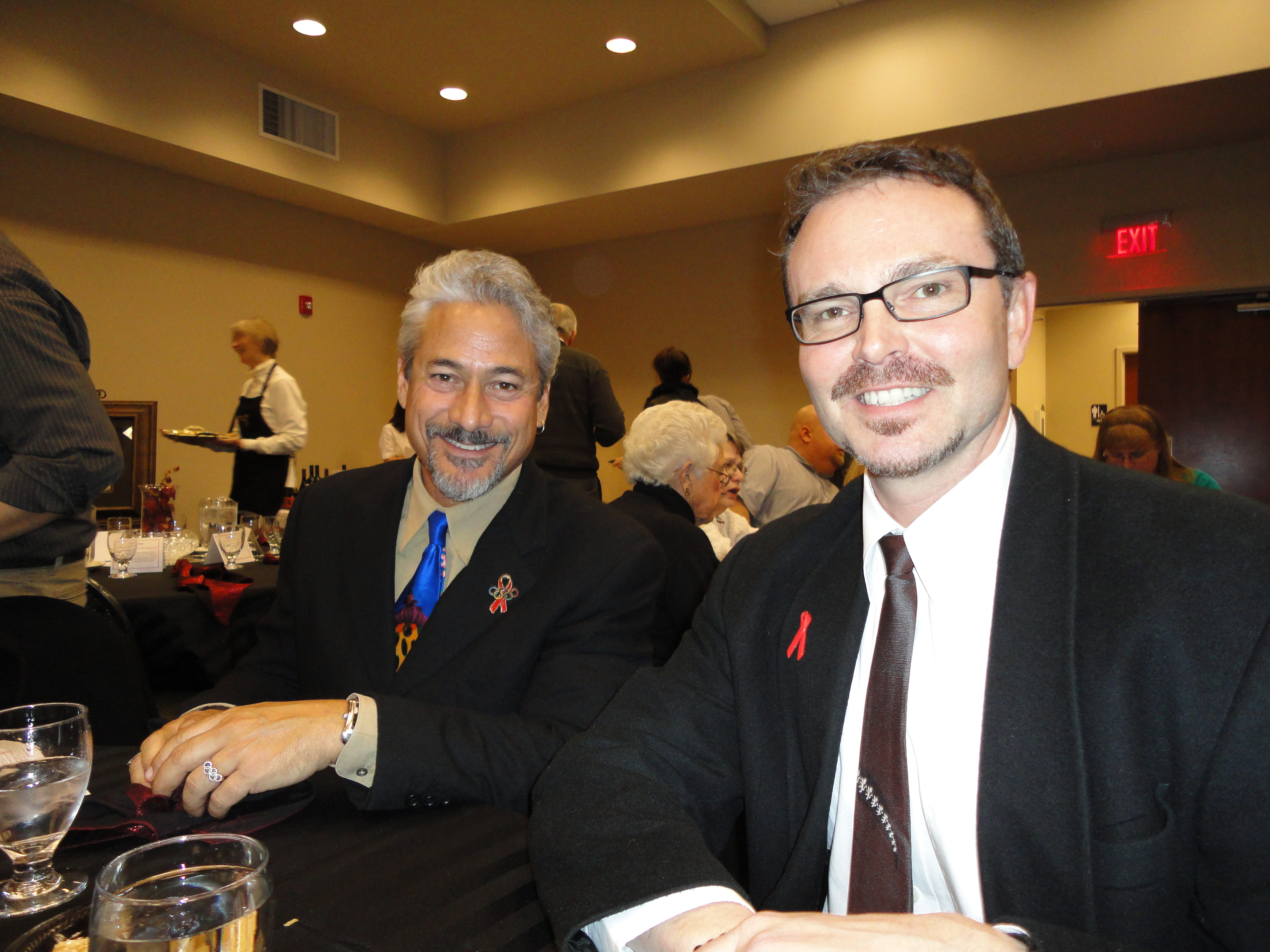
The Yellowstone AIDS Project fundraiser last night was great. The auction items were cool; the people were great; Greg Louganis recounted his path from 3 year-old dancer to Olympic champion to humanitarian and coach. Loved being part of it all to help raise money for a very worthy cause.

This was my favorite quote of the evening:

“Never underestimate your ability to make someone else’s life better- even if you never know it. Just be your best self- it can change the world.”

I’ve gotten to know this guy a bit, and I am happy to say, he’s the real deal. His heart is large, his desire to make the world better is real, and his kindness and generosity made me (humbly) glad to be able to spend some time with him- and share the experience of my friend with the people here in Montana.

They got to know a man who worked hard to achieve his goals with such determination and drive that made me wonder if he was human. That wonder was quelled by the warmth and kindness he showed to me and my friends- and the humor, dedication and insight he shared during his presentation. His openness about being HIV-positive and gay and, (gasp), Californian, were inspiring. The casual comfort with which he presented himself and his life reminded me to not take myself too seriously- even though I’m not at all in his league.

Maybe that’s what everyone else who shared that night was thinking- and I guess that just proves my point.

Thanks, Greg- mission accomplished.

Oh, and thanks for eating my tuna sandwiches….

My Homily, World AIDS Day, 2010

(This is the text of the homily I gave at the interfaith World AIDS Day service at Grace United Methodist Church in Billings last night. The scripture readings were from Isaiah 43 and psalm 22)
I remember when World AIDS Day was different than it is now.

I remember when we gathered in the darkness with candles and listened to words and music that were designed to comfort- but we all knew that comfort was a luxury we couldn’t afford. We were terrified.

We remembered the dead. We hugged the living, and the very sick. We held the hands of people who couldn’t tell their own families that they had lost or were going to lose the most important person in their life. We cried.

Our grief and fear were the engines that drove us back then. We were sick of burying our friends. We were tired of trying to defend the ways we struggled to love. We were working hard to be responsible- to make safe sex cool. We fought to get programs and found organizations that would take care of the often very simple needs that the government couldn’t- or wouldn’t. And the fear- some of you can remember can’t you? It was an entity that lived in our midst, a specter of doom that we couldn’t shake.

Because the work seemed to be so overwhelming and the fear, shame and hopelessness we fought was exhausting, we needed our sorrowful mothers, our indignant sisters and our caring brothers, fathers and friends to carry us.  And carry us they did- often at great risk to their personal livelihoods and professional credibility.

There are people still doing this work because they remember the pain, remember the fear, and remember the exhaustion echoed in the psalm we heard tonight:

“My God, my God, why have you forsaken me?”

We remember. Especially tonight, we remember. We remember that we never want to see it again.

That is the purpose of memory. The pain of those memories has become our strength.

This is our Seder, I daresay our Holocaust.

Only, in this we are not bound together by race, by religion, by nation or even by faith. I think we are bound together by our naked humanity, our compassion, our memory and our hope.

Isaiah gives voice to the hope we share- and not in grand or exalted words, in very simple words actually.

“Do not fear. I have called you by name. You are precious in my sight.  I love you.”

Much like Isaiah, John Donne’s meditations on life, death and salvation in what have come to be known as the Holy Sonnets, show the majesty and humility in the ordinary. And like Isaiah, he works to remind us of a perspective that relies on the struggle of faith.

His familiar lines echo in our world today, where we can instantly see war and famine and suffering- even from opposite places on the globe- places that we have no context for, places that we can only imagine, spurred by the small glimpse on our television or computer screens. The question he asks more than 400 years ago, is still relevant today- Why do we fear?

Death, be not proud, though some have called thee

Mighty and dreadful, for thou are not so;

For those whom thou think’st thou dost overthrow

Die not, poor Death, nor yet canst thou kill me.

From rest and sleep, which but thy pictures be,

Much pleasure; then from thee much more must flow,

And soonest our best men with thee do go,

Rest of their bones, and soul’s delivery.

Thou’art slave to fate, chance, kings, and desperate men,

And dost with poison, war, and sickness dwell,

And poppy’or charms can make us sleep as well

And better than thy stroke; why swell’st thou then?

One short sleep past, we wake eternally,

And death shall be no more, Death, thou shalt die.

Death has only the power we give it. Now life, that’s the true power here. And the life that lives not only for itself, but also for the greater good. Or, as Donne would say, for the greater God.

This is the movement from the psalmist to Isaiah- despair gives way to the reality of God’s infinite love, protection and mercy.

The psalmist gives voice to the doubts and grief brought on by suffering.

Isaiah gives voice to the promise of love, of life, of joy brought on by seeing life as precious, and seeing our own perception as limited.

In short, these two proclamations give us the breadth of human experience. It would be easy to reflect on the pain, the suffering, the agony and the fear. But I think that what we need right now is to celebrate the spirit of life, of courage, of hope.

I think that’s what brings us here tonight.

We are here because we all believe that coming together lessens our pain, strengthens our resolve and renews our courage. We know that HIV is still infecting Montanans- too many. They are often young, they are Native American, and women. Many are not being tested because of the fear, the stigma and still more fear.

We are here because we need the habit of coming together. We need to be each other’s memory. We need to remember that we are not alone. To remind one another when we forget. To comfort one another when we are sad, to celebrate with one another when there is joy. To gather strength in the face of difficulty. To counter ignorance and fear with the truth and with compassion.

To be here now. To show up.

Woody Allen said “80 percent of success is showing up.” I think he had something there.

As a therapist, sometimes the only thing I can do for someone is to show up. To be there with them. To quietly see them for who they are- a precious person who may be lost in the confusion of pain and fear. And who won’t always be lost. Especially if they have someone to join them on the journey out.

It’s not about solving a problem or fixing anything.

It’s about being present and being awake.

My being present involves something a little different than it used to. HIV lives with me. It is a guest in my house. It is the guest I never openly invited, but nonetheless it sits in my living room, it gets into my refrigerator, hogs the bathroom and often makes me just want to go to bed and stay there.

When I was first told I had this “intruder” in my house, I felt strange. Somewhere between elation and anger. I really can’t be more specific. I do remember thinking I had to slow down. I had to stop and sit down and wrap my head around this.

I had to decide what to do. And for me, this was serious. This was the decision that was going to shape the rest of my life. I had to decide how I was going to treat this uninvited guest.

For me there were only two options: I could either hate it, or I could love it.

If I hated it, I would live my life as an angry man, always disappointed, always suffering, always asking “why me?”, never seeing truth, beauty or kindness. I would be causing most of my own suffering.

If I loved it, I would be free.

It was that simple.

And, really, what was not to love? This is my reality. Truth is love. Hate is suffering. And HIV is my reality. The sooner I make friends with it, the sooner I find out what it has to teach me, the sooner my own salvation becomes obvious. This is simply a virus, doing its job. It is not a moral judgment, or a sign of anything but reality.

It is often simply a microscopic sign of the reality that human beings will do almost anything to be loved.

So, I love my little guest. I accept my reality. To be honest, I’m grateful for him. (I’m not being sexist, it’s just easier to think of the virus as him, somehow) Without this home invader, I think it would have taken me a lot longer to wake up. I would have had a longer, more painful road to deeper awareness. I wouldn’t have so easily seen the love that surrounds me every day. I wouldn’t have been able to put up with all of the harsh judgments that people with HIV have to put up with.

I guess I see my role as very simple: I’m here to teach some people how to love better. If they can overcome their prejudice and love me, the gay, HIV+ former priest- they can love anybody!

And I get to learn how to love better in return.

I think there are three great reasons to gather here tonight: To remember, to be present with one another, and to choose love instead of hate. That’s the lesson.

But you get to decide how to love- that’s the human prerogative in all this. You get to decide how to use your gifts, how to stand up to ignorance, how to offer your heart in the face of anger and hatred.

From the psalmist to Isaiah, to John Donne to you and me here in this place the lesson is being passed down.

“Death, be not proud” because, Death, you are not the greatest thing there is.

The God who loves me is always here, even if, like the psalmist, I have my doubts. God is the one saying “I have called you by name, you are mine. I love you and the world is not big enough to contain that love.”

If we listen closely, we can hear the words of God in our own hearts: “Always choose love, even when it’s hard. I promise you will never regret it.”

Tonight, let’s vow to pay attention to that voice.

Choose love.

Even when it’s hard.
Gene Research Finds Important Clue In Long-Term HIV Survivors

H I V

There are human beings who live with HIV- some for decades, without ever having had a symptom.

Not one. The Boston Globe:

For decades, they lived a mystery: Why were they able to survive with the AIDS virus, free of symptoms and the need for potent drugs, while so many others with the same germ turned deathly ill?

Their innate ability to keep HIV infections in check intrigued researchers, who suspected these people, known as “controllers,’’ might carry clues to designing effective vaccines after nearly 30 years of frustration.

Now, an international team of researchers, led by specialists in Boston, has cracked these HIV survivors’ genetic code, sifting through almost 1.4 million pieces of DNA to discover five amino acids that separate the small cadre of controllers from the vast majority who must take medication or face death.

This is the kind of research that could actually go somewhere. The full article here.

Voting For HIV

I am a member of NAPWA, the National Association of People With AIDS/HIV.  As a member, I receive their monthly email newsletter, which has a lot of information regarding HIV, tips for self-care, advocacy and political activism. Frank Oldham, the President and CEO had a column this month that really put some things in perspective for me.

It’s been a pretty interesting election year. NAPWA, as a 501(c)(3) charitable corporation, is not permitted to support or oppose individual candidates or political parties, so we can’t name names – but we can share our general observation that some of this year’s candidates would be pretty grand entertainment if there weren’t a real chance they might get elected.

It’s also been one of the nastiest campaign seasons in recent memory, and a lot of us just want it to end and go away. Here are some reasons to get to the polls and vote anyway.

· Defend the Health Care Reform Act.

Imagine a world where insurance companies can’t ask about preexisting conditions and use our answers to deny us coverage or cover us differently! We’ll have to wait until 2014 for full implementation of that, but it’s in the new law, and candidates who will defend the law against attempts to repeal it outright or amend it out of existence deserve our support. So do incumbent candidates who knew they were risking their seats but voted for the bill anyway; they took a big risk for us.

· The next Congress will – or won’t – fund implementation of the National HIV/AIDS Strategy.

The Obama Administration’s National HIV/AIDS Strategy (NHAS) seeks to reduce the number of new HIV infections, increase access to care and optimize health outcomes, and reduce HIV-related health disparities. All of which is very good news for people living with HIV. It doesn’t mean much, though, if Congressional funding priorities are being set by folks who think anyone who doesn’t look like them is not the “real America.” Simply by being HIV-positive, we don’t look like them. We don’t want a Congress full of elected representatives chanting, “We shouldn’t be spending money on NHAS, ‘they’ wouldn’t have HIV if ‘they’ hadn’t been doing bad things.”

· The next Congress will set the agenda for young people’s HIV-awareness and prevention education.

We’ve seen the lack of results from abstinence-only curricula. Even the current Congress is gradually moving from ideology-driven abstinence-only approaches to evidence-based, frank sex education, and it is saving the lives of our young people. We don’t want to go back.

· There are critical HIV funding needs right now.

State AIDS Drugs Assistance Programs (ADAPs) are in crisis because of the recession which started in 2008. Programs for HIV-positive people with multiple medical or life issues – homelessness, addiction, mental illness – are also finding funds harder and harder to come by. Find out where your candidates stand on HIV services, and vote for those who support funding for them.

The votes of people living with HIV/AIDS are needed now more than ever before! As the leader of NAPWA and an African-American gay man living with AIDS, I know that so much progress and the fruits of hard-fought battles for our health care, protecting Ryan White Care Act services, and our rights as American citizens are at risk right now!

So let’s be sure to know our candidates and choose well. Next issue (November 5), we’ll look at the election results. Win or lose, we’ll all feel better if we did our research and voted our values.

Positive and Partners Retreat

This weekend, Ken and I will be attending our third Rising Hope Retreat for HIV+ persons and their “partners” (widely interpreted as caregivers, sibling, parent, husband, wife, best friend, son, daughter, etc). To my knowledge, no other state does such a thing, and that’s too bad. It’s an incredible experience of witnessing relationships, gay and straight, and sharing the struggle to create and maintain relationships with other human beings in the face of HIV.

Ken and I are a sero-discordant couple: I’m Positive and he’s Not. Many of the HIV-related functions/causes we attend don’t recognize or even ask the question. In fact, Ken has said “I think people just assume I’m positive. That’s okay.”

Except that it’s not.

Recognition that HIV doesn’t have to be spread in a relationship is important. In fact, it’s probably one of the best sources of inspiration for others to have sex safely and responsibly; to create and maintain relationships that are life-giving and fulfilling despite serious issues, possible consequences and obstacles- not to mention HIV.

It can be done. It is being done. And Montana’s in the forefront of recognizing that. Who knew?

HIV+ Man Infects Over 100 Women

My take on the story here at Bilerico.

A Time for Heroes

My 2009 World AIDS Day Speech- old ideas in a new format, but it still works.

People gather on World AIDS Day to be reminded.
We’re all here for a reason. That reason is most likely a person, a person we love- maybe more than one.
Let’s take a moment now and remember those reasons.

~“We Remember all who have died with HIV, especially those we have known and loved and cared for.
~We call to mind all who live with HIV/AIDS today, especially those we know and love.
~We open our hearts to those infected and yet untested, undiagnosed – too scared and ashamed to take that step.
~We remind ourselves that there are people who continue to put themselves at risk out of ignorance, fear or shame.
~For all the families and friends, partners and spouses, parents and children who grieve and who worry- and for all those who work to help, we remember.
~And for us, gathered here this night- That we may never forget.”

This is a time for heroes.
The world seems to be unstable, politics are brutal, the economy is a mess and we are a nation at war- on so many fronts. It is a difficult time, but heroes aren’t required in easy times.
But let’s forget about the economy, the wars, politics and even healthcare for a minute.

People are still dying of HIV/AIDS in the State of Montana- I lost a friend just this year.
People are still being infected here. Families are being traumatized; lives are being changed forever because of this disease. Today. Right here.
It’s not pleasant to think about, but it’s true.
That’s where you come in.
After all, this is a time for heroes.
Right here, right now, we need you.

HIV will be slowed and maybe even stopped when the shame is stopped, when the stigma ends, when people see beyond prejudices and fears and realize that this is about the life of other human beings inextricably bound up with their own.

When a kid in Townsend or Belgrade or Dillon or Busby won’t fear being tested, won’t fear the reaction of his family, her friends, his church or their country if the test is positive.

When everyone at risk won’t fear being tested only because they’ve tried to love
in ways some find objectionable or even repugnant.
~Finding love repugnant- now there’s a problem.

When people aren’t afraid to disclose their status because of fear of recrimination or losing their jobs or being ostracized.

When information is allowed to be given freely in order to prevent HIV and educate others about risk and transmission.
When the human heart becomes big enough for all people, even those we do not yet understand.

When, when, when…

We’re not there yet, that’s why this is a time for heroes.
A time to end shame and stigma and fear and ignorance.
A hero will stand immovably reasonable in the face of ignorance.
A hero will speak out when she hears indifference.
A hero will step in when others are paralyzed or indifferent.

This we do, every day.
That’s why you’re here- you’re already heroes.
But I think we can do better.
We can do better by not forgetting when we walk out that door.
We might take that Red Ribbon off when we go home,
but let’s not forget what it stands for.
Let’s not forget who it stands for.

Confront ignorance with firm facts and gentle honesty.
Confront harsh judgment with steadfast compassion and strength.
Confront hatred with caring and love.
Don’t give in to fear.

That’s not why we’re here.
We’re not here to give in.
We’re here to stand up.
We’re here to remind ourselves why we are needed.

We’re here to be heroic.

So, do me a favor. Don’t let the ignorance in.
When you hear it, or see it, tell people you know someone who’s HIV-positive, because now you know me, so you do.
Take the fullness of this night into your heart and keep it with you.
Use it to safeguard the dignity of another human being, a human being that may be your co-worker, a family member, a grocery store clerk, a waiter, a mechanic, a teacher, a friend.

Be a hero.

The Secret Weapon in HIV Treatment

“I’m not taking my meds.”
That was out of the mouth of an HIV+ client more than halfway through our session.
I’ve heard this before and I wasn’t ready to go into emergency mode- yet.
“How long has it been?”
“Almost six months.”

OK, I’m in emergency mode.

The most effective HIV medication regimen is faithfully followed every day. There is room for a few lapses, but most experts agree that between 93-95% compliance with medication is necessary in order to utilize the full effectiveness of the medication and maximize the length of time the meds will work for an individual.

Skipping a dose or two of medication may not be catastrophic, but it does usually create a spike in viral load which in turn strains the immune system.

For people with HIV, who have immune systems which are “always on,” that strain can have visible consequences such as heavy fatigue, memory and other cognitive difficulties and a susceptibility to secondary illnesses such as colds and flu. There are also the side issues of depression and anxiety which can easily accompany any illness.

I was especially concerned because this client was still on the first regimen prescribed, and it’s generally believed that the first regimen will last the longest, so it’s important to help people maintain adherence from the start. HIV is a tricky little devil, it’s prone to mutate relatively quickly and develops resistance to treatment at a clip that keeps researchers working to create new medications and strategies at a steady pace. Stopping medication can speed up the resistance process.

But there are several other things that I know.

I know this client had been diagnosed with a high viral load right from the beginning, that he really had little choice about whether or not he was ready to commit to a lifetime of daily medication, treatment was necessary immediately.

I know that people who have to start medication very quickly after diagnosis are often overwhelmed by the shock of the news and the needs/fears involved in telling support people/families/partners, etc. The sudden worries, anxieties and frenzied thinking can last for quite a while. They are not always in the best place to make a lifetime decision. People in that stage may have to depend on loved ones to help them with treatment adherence.

I know that it’s vitally important that a PWH (person with HIV) be ready to commit- treatment adherence is much higher for those who have taken the necessary intellectual, emotional and physical steps to understand the importance of medication in their lives. One of my friends (who knows more about HIV meds than many doctors I’ve met) has said mental readiness is just as important to consider in making the decision to begin meds as Viral Load and CD4 counts. It’s that important.

I also know that HIV, untreated, damages the human body in ways that we may not realize for many years- it may be “dormant”, but it’s not idle. There seem to be two camps here. The first says everybody should take meds as soon as they are diagnosed to stop the damage of HIV in the body and lower the possibility of transmission to others. The second says that the meds and the accompanying side-effects are more damaging than HIV and one should resist taking them until they absolutely have to.

I tend to go towards taking them earlier than later simply because most studies (including the most recent) show that early treatment significantly prolongs life and health, and if I live longer, I might live long enough to be cured, or at least have a more effective treatment.

Having said that, I didn’t have a choice. I was one of those whose first diagnosis was HIV/AIDS- my CD4 count was 101, well below the AIDS definition line of 200, and I was very sick. It was important that I get on meds as soon as I could. And I did- the very next day, in fact. And I haven’t looked back.

I’ve missed one dose in 3 years, and that was because I was traveling in Europe and got the time changes mixed up. I’ve made taking meds part of my life, a good part, because I decided very early on that I wasn’t going to suffer because of my treatment.

When my doctor and I chose a treatment option, she explained to me the importance of taking them at the same time every day, and that my particular medicines required food to work properly. She then said, “Okay, let’s talk about the side-effects.” I quickly said, “Let’s not. I don’t want to put that stuff into my head right now. I’m just going to anticipate not having any if that’s all right with you. If I feel something weird going on, I’ll call you, okay?”

It was. And so my relationship with HIV meds was established on my terms, and (ironically?) I haven’t felt most of the things people often report while taking them. I also know that it’s a verifiable scientific fact that people over-report side-effects, and I just didn’t want to go there.

I have an interesting relationship with my medication. I refuse to hate them- they’re saving my life, and I refuse to complain about them for the same reason. I take my pills every morning, and I do something that some people find hokey, but it works for me. I hold them in my hand right before breakfast, look at them and say “Thank you. I hope someday I don’t need you,” and then I swallow/choke them down (there are 11 pills in my hand, including supplements).

So, as far as my client was concerned, I had a few issues to deal with:
1. I had to make sure he knew all the facts about the consequences of his “holiday”.
2. Was he then ready to get medical attention?
3. Was he ready to start treating his HIV?
4. Was he an imminent danger to himself or others?

We talked for a long time, eliminating in my mind any thoughts of danger to self/others, and taking a good, hard look at the possibility of depression in his avoidance. He is not completely open about his status with his friends and family, so we talked about his need to have people honestly care for his health, and that included himself.

He also decided that this lapse had actually helped strengthen his resolve to resume his treatment. We then made an appointment with his doctor. On the doctor’s advice he resumed taking his medicine that very day, and has remained consistent as of this writing. So far his regimen is working and he feels more committed and now has more support from people in his life to help keep him on track. He felt good enough to give me permission to use his story.

It’s just this kind of support that counts almost more than anything else. If people feel loved and supported, they naturally want to take better care of themselves- they make healthier choices and that includes adherence to their drug regimen.

That support doesn’t just come from other people- So, if you’re a PWH, look for ways you can support yourself and care for yourself-do something nice today, just for you. If you know and/or love a PWH, tell them how important they are to you- show them you care.

Simple? Yes, but the simplest options are often the easiest to overlook, open secrets if you will, and they can be extremely powerful.

Powerful enough to save a life.