Blessed Are the Peacemakers

Recently, I have been turning toward the Beatitudes. I have looked at them from every direction and wondered why more “Christians” haven’t taken to them as a way of life. The one that really struck me today was Matthew 5:9, “Blessed are the peacemakers: for they shall be called the children of God.”

All my life, I have been a peacemaker. (Well, okay, there was one period of about 5 years where I tried to stir up as much drama with my family as I could. . .but let’s not dwell on the past) I don’t like it when people fight and I just want to see people get along.

I seem to have been born with a highly developed sense of compassion and empathy. I used to (and still do) befriend what my mom lovingly termed, “The Unlovables.” These were the kids that got picked on in school because they were different. The kids that had no friends. I was constantly asking questions as to why people were being treated so badly and my heart regularly broke for them. I also have to admit (much to my chagrin) that I got a little teary at the end of Dangerous Liaisons when I watched it in high school. My heart broke for Glenn Close’s character. Yes, she brought most of it on herself, but did she really deserve to be treated so harshly by the very society that created her? Where was the compassion? I know, I know. . .it’s silly.

There have been many inspirations for me over the years: Mahatma Gandhi, Mother Teresa, Jimmy Carter, the Dalai Lama and Martin Luther King, Jr. And more recently, there have been some inspirations from closer to home: Liz Welch of the ACLU Montana, Gregory Smith of the Pride Foundation, Caitlin Copple, Jamie Greer, Edie Windsor just to name a few. These are the “Children of God.”

I have seen some very negative posts lately. I have even created one. And if you saw my last post, you will also know that I have issued an apology in the interest of being a peacemaker. I do not presume to know the mind of God. I would be leery of anyone who says they do. However, I listen to the “Still, small Voice” inside and I know what God says to me. And it may not be the same thing that God says to you. Does it mean you are wrong? No. Does it mean I am wrong? No. Just different.

Christians are not bad people. They are people, just like the rest of us. They make mistakes. They fall from the path. We have to remember to hold ourselves to the very standards that we are comparing them against, like “Judge not, lest ye be judged.” I would also refer to Luke 6:42 “Either how canst thou say to thy brother, Brother, let me pull out the mote that is in thine eye, when thou beholdest not the beam in thine own eye? Thou hypocrite, cast out first the beam out of thine own eye, and then shalt thou see clearly to pull out the mote that is in thy brother’s eye.”

A moment of clarity came to me this morning in a Biblical argument with a misinformed person. The Bible is a tool to show YOU how to live. It is NOT a tool for YOU to show ME how to live. It is for me to use the tool myself. But, I digress.

Psalm 34:14 says, “Depart from evil, and do good; seek peace, and pursue it.” Pursuing peace and negotiating it is a tricky business. But even the ACT of pursing peace is the act of departing from evil and doing good. We need to be mindful of that.

The Old Testament was tribal law, meant to hold the Israelites together during the time when they had no home. The Old Testament is included in the Bible to show Christians where they came from and what their history was. Jesus brought the New Testament to show a better way to live. It is a new covenant, replacing the old. Jesus was/is the Son of God. A child of God. A peacemaker.

I will continue to be a peacemaker. I will continue to support people that are peacemakers. I will continue to fight for people’s rights and to fight injustice where I see it. That is part of what being a peacemaker is.

Perhaps I am not on the forefront, helping to change and write policies and laws, but that doesn’t mean I am ineffective. I am on the sidelines, changing people’s minds and hearts. I write because I can, because it is a talent given to me by God and I have been charged with using that talent. And I will continue to wield it as a peacemaker. I am a child of God.


Bishops’ “Fortnight For Freedom” Fizzles


From New Ways Ministry Blog:


Painting, 14th century, Flanders. Rogier van d...

Painting, 14th century, Flanders. Rogier van der Weyden. (Photo credit: Wikipedia)

Today, the Fourth of July, the U.S. Catholic bishops’ 2nd “Fortnight for Freedom” campaign comes to an end, and it looks like this effort was not any more successful than last year’s program.  The campaign, which began on June 21st, was intended to rouse Catholics to become motivated to work to protect religious freedom in the U.S.  The bishops have proposed that the freedom of Catholics to worship and govern their church is under fire, particularly because of the advancement of marriage equality for lesbian and gay couples in the political world.  The fact that Catholics do not envision the issue with the same sense of threat that the bishops do is a major factor in the failure of the campaigns the last two years.


Marcos Breton, a columnist for the Sacramento Bee, points out that the Catholic bishops seem afraid of the changes that are happening in American culture, and that may be why they have latched on to the religious freedom argument.  ”The world is changing rapidly,” he wrote, “and it’s natural for some to view the change with trepidation.”


But that doesn’t mean that religious people need to fear for their freedom.  Breton suggests a positive toleration on both sides of the marriage question:


“Same-sex marriage is now legal in 13 states and the District of Columbia, meaning that roughly 30 percent of Americans now reside in states that support marriage equality.

“Within five years, gay marriage could very likely be legal in all 50 states. Public opinion has tilted in favor of marriage equality so quickly, it seems history is on fast forward.

“Watching same-sex couples arrive at the Sacramento County clerk’s office on television Friday reminded me of the night the Berlin Wall came down.

“Years of pent-up emotion suddenly found a release. Old restrictions dissolved into thin air. There were tears. There was exultation and a sense of giddy disbelief. Isolated people suddenly joined a broader community.

“With due respect to fellow Christians who disagree, this was cause for celebration – one that doesn’t have to come at the expense of religious freedom or with intolerance toward religious people.

“You can support the idea that government has no business restricting same-sex marriages while loving your church and trying to live the Gospel.”

And toleration for religious institutions is not only a good thing to do, Breton points out it is also the law:


“In a ruling that the U.S. Supreme Court chose not to invalidate, U.S. District Judge Vaughn Walker wrote: ‘Affording (same-sex) couples the opportunity to obtain the designation of marriage will not impinge upon the religious freedom or any religious organization, official or any other person; no religion will be required to change its policies or practices with regard to same sex couples, and no religious officiant will be required to solemnize a marriage in contravention of his or her religious beliefs.’ “

Steve Chapman, a columnist for The Chicago Tribune, also challenges the idea that religious freedom is under attack because of the spread of marriage equality.  Speaking of religious people who make such a claim, Chapman wrote:


“It’s a bit rich for these groups to complain that the court is infringing on their freedom to infringe on the freedom of gays. Advocates of same-sex marriage are not trying to exclude heterosexuals from matrimony. They are only asking to be free to practice it as well.

“But opponents charge that churches will be forced to host same-sex weddings and their clergy will be required to perform them. Churches that refuse, they say, may be stripped of their tax-exempt status.

“The likelihood that any of these fears will come to pass ranges from minimal to zero. State laws allow divorce, but Catholic priests haven’t been forced to preside at the weddings of divorced Catholics. Employment discrimination laws haven’t been applied to end bans on female clergy. Nor have such internal church policies led to the loss of standard tax exemptions.”

Chapman notes that marriage equality, far from eroding freedom, is actually an extension of it:


“When Justice Anthony Kennedy made the case for overturning the Defense of Marriage Act, though, he relied on a different provision. DOMA, he wrote, ‘is a deprivation of an essential part of the liberty protected by the Fifth Amendment.’ “

Let’s hope that the failure of this second year’s campaign may teach the bishops that Catholics do not see their religious liberty threatened by marriage equality.  Indeed, many Catholics see the support of marriage equality as an important way to practice their faith, not an impediment to it.  Instead of Fortnights for Freedom, the bishops would do better to have Fortnights for Dialogue, so they can learn from Catholics how issues of LGBT equality proceed from their love of God, neighbor, and the church.


–Francis DeBernardo, New Ways Ministry


WELCOMING ME HOME

It was my pleasure to sit behind retired Methodist Pastor, Lyle Hamilton in the basement of St. Paul’s United Methodist Church in Helena, Montana for an All Church Conference to discuss a proposed Reconciling Congregation statement.  The Conference Superintendent led the meeting and asked the fifty or so assembled to speak what was on their heart.  And a few did.

UMC Logo

UMC Logo (Photo credit: RoyJr)

The meeting, however, was anti-climatic.  Their was a strong sense that the statement of inclusion and affirmation of groups of people who have formerly felt shunned and excluded was merely a reflection of the already imbedded character of St. Paul’s anyway.  In fact, a few people described how they had heard comments over the previous year of meetings, discussion and classes leading up to this moment to the effect of “duh-uh!  Don’t we have that already?”

Yet, there was also a sense of importance, of critical mass, of mission, purpose and rightness of call.  My friends, John and Vicky Wieda, had painstakingly spearheaded the effort in that vain with deliberateness.  So yes, when it came time to reach consensus as a congregation there was little to detract from an outcome which seemed certain.  St. Paul’s would become a Reconciling Congregation.

So, why do it?  I mean, why all the fuss if St Paul’s, with its open minds, hearts and doors, has already established inclusiveness as part of its character?  Isn’t it really much ado about nothing?

Pastor Lyle gives a clue about the answer in this post on his Facebook page:

Late yesterday afternoon, at an all church conference, St. Paul’s UMC in Helena officially became a Reconciling Ministries Congregation by a consensus vote. We have now publically declared ourselves to, in fact, be what the community of Helena and most of our congregation has long felt is both our calling and our reality: “All truly means all,” and everyone has a place in this community of faith.

Our incarnated statement, that is imbedded in our soul, is as follows: “St. Paul’s United Methodist Church welcomes all people of any age, gender, color, ethnicity, sexual orientation, gender identity, economic status, or disability into the full life and membership of this congregation.”

May God bless us, every one . . . as we move forward with grace and compassion toward all!

The oft repeated statement over the months of examining this issue that “All truly means all,”which, as Lyle says, is “imbedded in our soul,” is not just a statement.  It is in many ways transcendent, like a lighthouse beacon shining through the storms and rough seas of understanding and reconciliation between who we are and what we believe, between what we believe and the world around us, between the world around us and the one within where Jesus calls with open arms and his profound and unconditional offer of love.

To proclaim that “All are welcome here,” and mean it,  is to shine the light of Jesus’s love through all the violence and hateful rhetoric in the world around us for those, like me, who else would have no place to go for the communal understanding, practice and experience of that love.  I would have no congregation, no church.  For some, perhaps, it is possible to live as a Christian without church.  For me, from the day I walked into St. Paul’s almost seven years ago in my first week of gender transition on “Welcome Home Sunday” to this moment,  it is not.

Christianity is a communal practice.  God speaks to me in many ways, some far, far away from books and buildings.  But God also speaks to me through other people – through you.  And I can find few better places to hear God speak and feel God’s presence than in the company of other Christian believers – through congregation and communal worship.  Thus, as a Christian transwoman, it is vital for me to have a Christian community to call home.

Last night I was reminded, as I spoke what was on my heart, of the day I became a member of St. Paul’s.  It was my birthday and the whole congregation sang Happy Birthday.  I stood there, dumbfounded, with a tear in my eye and my flesh all goosey.  I knew then, as publicly affirmed by this Reconciling Statement that I have my congregation and my church.  Thank you St. Paul’s for welcoming me home.

WWES? (What Would Ezekiel Say?)

“Personally, I don’t believe that you can live an openly homosexual lifestyle, or like, premarital sex between heterosexuals … it says that that’s a sin … I believe that’s walking in open rebellion to God and to Jesus Christ,” he said on the show. “So, I would not characterize that person as a Christian, because I don’t think the Bible would characterize that person as a Christian.”

~ Chris Broussard, ESPN Commentator.

Bible

Bible (Photo credit: Sean MacEntee)

I do so wish to avoid judging those who judge others.  Thus, I have tried to avoid comment upon the religious right rhetoric about LGBT people.  Yet, it is becoming increasingly clear that statements like the above quote stray from even the most basic of Christian tenets, Jesus’s command that we “Love one another. As I have loved you, so you must love one another.”  John 13:34-35.  Moreover, for a biblical literalist, the above scriptural interpretation  (Not cited, but denominated as biblical by the phrase, “it says.” ) is simply inaccurate.  Finally, one of the most basic rules of journalism is that the media represent all sides of an issue.  And, there is another side to this story.

So, what is gained by my silence? Some great Christian leaders have posited that to be silent in the face of oppression is to join the oppressor.  (E.g., Dr. King, and more recently, Bishop Gene Robinson).  Thus, I gladly risk the criticism that I am being judgmental in favor of speaking out on behalf of the oppressed.  I speak my truth to power.

Now, about Gay Christians.  The term is neither an oxymoron nor disingenuous.  I personally identify as LGBT and Christian.  I believe that Jesus is Lord!   According to scripture, I cannot make such a statement lightly, but only by the power of the Holy Spirit.  (1 Corinthians 12:3).  Moreover, if I say it and believe it than scripture guarantees my salvation.  (Romans 10:9).  Hence, the scriptural formulaic equation for salvation is not exclusive.  I can be Gay and Christian.  And I am not alone in this belief.

There are a whole host or Christian organizations, many of which we see on Face Book every day, dedicated to the same proposition. We are in the minority now, but I believe that as we continue to change the world that all of Christendom will likewise evolve.  One such group is called Fortunate Families, a national organization of Catholic parents with lesbian, gay, bisexual, transgender children, with a passion for social justice advocacy and a focus on the Catholic Church and LGBT issues.  In my present church affiliation, Methodist, we have the Reconciling Ministries Network whose purpose is to mobilize United Methodists of all sexual orientations and gender identities to transform our Church and world into the full expression of Christ’s inclusive love.  The Episcopal church has an organization called Integrity, whose mission it is to inspire and equip the Episcopal Church, its dioceses, congregations, and members to proclaim and embody God’s all-inclusive love for LGBTQ persons and those who love them.  Perhaps you know of others.

When it comes to scripture, I am merely a “jack-theologian,” so-to-speak.  While I have a minor in religious studies, I certainly do not have any sort of divinity degree.  However, I have at least read the passages to which I refer.  I understand that they have been through multiple translations over the millennia, and were written in a vastly different culture with a vastly inferior world view, knowledge and technology, and that they were gathered into what we now know as the Bible by church fathers in the Third Century.  (Even a cursory search reveals that the origins of the Bible is a complicated story rife with dissension and debate).  Scripture did not even have line and verse until the 16th century.  (The Bible was divided into chapters in the 13th century by Stephen Langton and into verses in the 16th century by French printer Robert Estienne).  People believed over the entire 4,000 or so years that the various books of the Bible were written that the world was flat and the heavens (and God) resided a few hundred feet above them.  Science now informs our world view to cast aside such notions, as well as the notion that the Biblical genealogy found in Genesis denotes the age of the world.

Against that backdrop, we have the self-righteous and inflammatory conclusions above.  They can be summarized as follows: The bible says that homosexuality is a sin in open rebellion to God and Jesus.  In claiming to be LGBT and Christian I must, as Gene Robinson says, “unabashedly” assert that this statement is false! None of the Gospels attribute to Jesus as ever uttering a single word about homosexuality, much less the word itself, or that he would accord it to himself as “open rebellion.”  No such word existed in Hebrew or Greek, the two main languages in which the books of the bible were written.  The word “homosexual” is not in the Bible, except in oblique translations of the six or so references to men “lying” with men in the Hebrew text and Paul’s letters, the most notorious of which is found in Leviticus 18:22: “You shall not lie with a male as one lies with a female; it is an abomination.”  (Evidently, the only reason one lies with a female is to have sex.  But is it okay if I lie with a woman until I need glasses?  Sorry, I digress (impishly laughing to self with tongue firmly in cheek)).

The Hebrew term, shiqquwts is translated as “abomination” by almost all translations of the Bible. The similar words, sheqets, and shâqats, are almost exclusively used for dietary violations.  Toeba, is also translated as abomination in some texts. Many modern versions of the Bible translate it as  “detestable”or “loathsome.”  I hear one Rabbi refer to it as “yicky.”  Biblical literalists interpret this to mean that same-sex sexual activity is an abomination and therefore inherently sinful.  (Note, however, that it is not one of the Ten Commandments).

However,please consider that a word or phrase which has been translated through multiple languages over centuries and the subject of great debate and disagreement among the worlds great scholars and theologians, inherently, cannot credibly be taken as a modern-day literal truth.  Moreover, this supposed proscription was part of what is called the ancient Hebrew Holiness Code which highly regulated the everyday lives of ancient Hebrew men, from what they were to wear to what they were to eat.  Violations of these rules were also called abominations.  The code referred to how they were to treat one another too.  Later prophets make this clear.  In a little referred to scripture, Ezekiel says at  16:49-50: “Now this was the sin of your sister Sodom: She and her daughters were arrogant, overfed and unconcerned; they did not help the poor and needy. They were haughty and did detestable things before me.”  Clearly, Sodom’s lack of hospitality is the abomination.

Yet, there is no mention of the word, “homosexual,” again defying the literalists.  They cannot rely on the literal words of scripture to reach the result they want, but must interpret the meaning of the words used through their various translations over time in spite of  later clarification within the Bible’s own pages.  Now I wonder how to characterize the above quotation from the ESPN announcer.  Is it hospitable, or detestable and loathsome?  Is it an abomination?  What would Ezekiel say?

Fair Is Fair

This past weekend was important to me for a number of reasons.

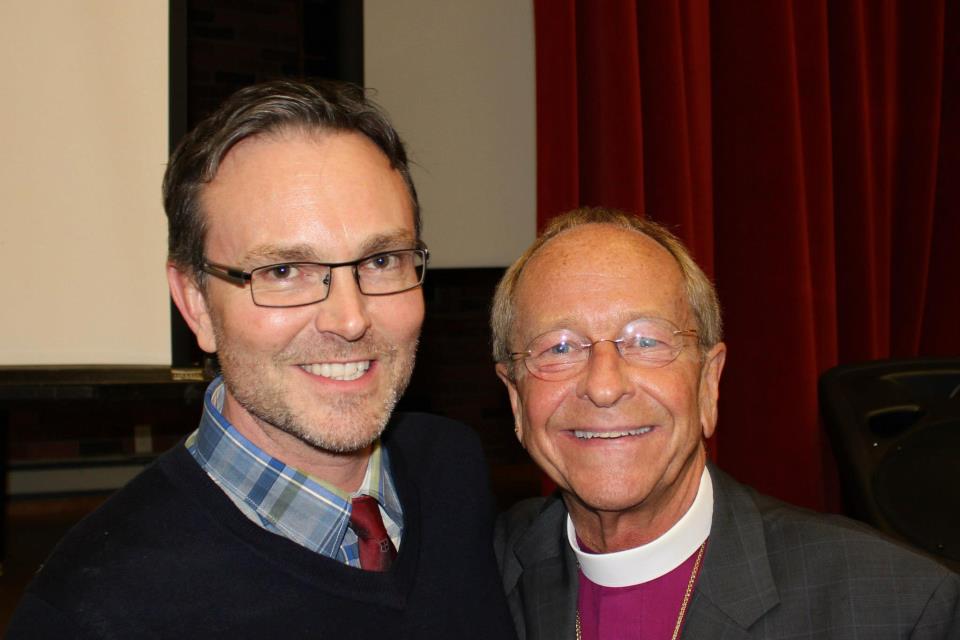
47985_10200301350709797_307221521_nI got to meet and spend some quality time with one of my heroes, Bishop Gene Robinson. (story/interview to follow)

But I also got to meet and spend some quality time with dedicated Montana people who care about equality in our state. Some became even more strongly convinced after watching “Diversity Day” and “Love Free Or Die” presented in local churches.

Even I- a committed partner of the ACLU and the Fair Is Fair Campaign- became inspired after hearing Bishop Robinson speak about the need for Christian compassion and understanding in the face of fear and unintentional ignorance about LGBTIQ persons.

“Our job is to make this an issue of compassion and justice, not theology”, Bishop Robinson said. “We have to make the issue of fairness one that brings a face to mind whenever we talk about equality. This is about people.”

But being inspired is only as good as the actions it produces.

I want to encourage you to bolster the ACLU’s Fair Is Fair campaign by taking your inspiration and desire for justice and take action- by becoming a member.

My family belongs because we believe in the work of the ACLU. We believe it is important to support a coalition of organizations to bring full equality to all Montanans- but that only works if we all come together. The Montana ACLU is helping to make that happen, and I’m proud to be a supporting member.

I hope you’ll join us.

~Greg

MainLogo21

At INTERCHANGE: “Scripture and Science and Sex, OH MY!”

6cafa7f65ae286b6d782da379ac5af04Evangelical Christian and LGBTIQ ally, Kathy Baldock, is confirmed for INTERCHANGE on Saturday June 29th at the Bozeman Public Library.

You may remember Kathy from last year’s Montana Pride Celebration- she was the one leading the contingent of people wearing T-shirts that said “Hurt by Church? Get a Str8 Apology Here.”

She also led the counter protest against the “Christian” on the ladder during the parade.

When I asked Kathy what she hoped to give us at this workshop, she said, “I want people to realize that the limits of scripture and science and human knowledge have to always be tempered by human experience. In the six years of engaging in dialogue with the straight Evangelical and Protestant communities, I have learned what works to bring understanding on the issue of homosexuality and the Bible. I want to help you find the way to productive conversations through Scripture, science, reasoning and discussion techniques.”

Kathy Baldock, of Canyonwalker Connections, represents the journey many Evangelical Christians are considering as they try to reconcile what the have been told about the LGBTQ community and what they are experiencing  in relationship with gay and transgender friends. The tension of “How do I understand what the Bible says?” with “How do I accurately represent Jesus?” is creating conflict in the conservative church. From her own life, Kathy will share how she has been able to guide people with their personal questioning in a new way to a fuller understand of the message of God’s inclusion of His LGBT children.

This presentation is sponsored by Gallatin Valley PFLAG.

You Don’t Want To Miss This: Big Gay Weekend In Billings

Bishop Gene Robinson is a pioneer, and I’m really looking forward to meeting him- this is a big deal for Montana.

I’m also excited about Gregory Hinton’s play about the Missoula non-discrimination ordinance. It promises to be an informative, enlightening and inspirational weekend for everyone interested in equality. I will be in Billings Friday through Sunday- I hope to see you there!


Sermon 4.07.13

The outline of my sermon yesterday from Living Waters United Methodist Church, Belgrade. Scripture: Acts 5.27-32

Most of us want to be liked.

That in and of itself isn’t anything new- it’s a fairly universal trait.

Most of us also want to stay out of trouble.

Again, simply human.

But when being liked and staying out of trouble aren’t an option when standing up for the truth… Well, that can be a real problem can’t it?

Let’s listen again to the scripture for today.

When the temple police had brought Peter and the apostles, they had them stand before the council. The high priest questioned them, saying, “We gave you strict orders not to teach in this Name, yet here you have filled Jerusalem with your teaching and you are determined to bring this Man’s blood on us.” But Peter and the apostles answered, ‘We must obey God rather than any human authority.”

 That’s what we heard today. What we didn’t hear is the passage that came after that.

When they heard this, they were enraged and wanted to kill them.

A Pharisee in the council named Gamaliel spoke on their behalf, reminding the council of others who had come and gone before them, all claiming to have been sent by God-all of whom had failed.

And then Gamaliel gave the council this advice:

“So in the present case, I tell you, keep away from these men and let them alone; because if this plan or this undertaking is of human origin, it will fail butt if it is of God, you will not be able to overthrow them—in that case you may even be found fighting against God!’

They were convinced by him. Then when they had called in the apostles, they had them flogged. Then they ordered them not to speak in the name of Jesus, and let them go.

They left the council, they rejoiced that they were considered worthy to suffer dishonor for the sake of the Name.  And every day in the temple and at home they did not cease to teach and proclaim Jesus as the Messiah.

Talk about getting into trouble.

Talk about not being liked.

But what did these disciples do?

They did something all heroes do- they trusted their hearts. They followed their conscience. These men and women preached the Gospel of a God who is in love with us.

And most of them died for it.

Often very cruel deaths.

Just to do the right thing. To proclaim love.

Today I want to ask a very simple question:

“When should we choose love?”

Seems simple doesn’t it?

And yet, we make decisions every day that are not loving.

We can exclude people, we can hoard things, we can lock our doors and load our guns in fear, we can drink too much, we can eat too much, we can lie to ourselves, we can lie to others- sometimes simply to stay out of trouble or to be liked by the right people.

Well, the Jesus who died on the cross, rose from the dead and sent his disciples into the world to proclaim a crazy, loving God doesn’t want us to let the world get in the way of love.

That’s what these disciples knew. That’s why they stood in fear of their lives in front of the courts, why they suffered scourging- just like Jesus- why they refused to deny love.

Because they saw love, risen from the dead.

And so have we.

You know it, in your hearts, you see it every day. Love risen from the dead. You can even create it if you like.

You’ve seen a child’s face- crushed by disappointment- restored to life by a word of encouragement and love.

All you have to do is restore someone’s hope.

All you have to do is not deny anyone their dignity.

All you have to do is trust that we are more than our fears.

All you have to do is open your heart- and your mouth and eyes and ears and hands and feet will follow.

Just open your heart.

Let us ask our God to give us eyes to see the opportunities to build the Kingdom of God- right here, right now.

And when you feel that feeling rising up in you, the one that says, “I want to be liked, I want to stay out of trouble”, the one that wants to close your heart down, will you know what to do?

I think we do.

We stop and recognize the choice in front of us: To be open or closed; to be loving or cruel.

So, when do we choose love?

Every time we can.

Today’s Must See: Alfredo’s Fire

“It was the Italian Stonewall, absolutely, the Italian Stonewall…”


About The Film

ALFREDO’S FIRE is a powerful and timely documentary that tells the forgotten story of Alfredo Ormando, a gay Italian writer who set himself on fire at the Vatican to protest the Church’s condemnation of homosexuality.

As Pope Benedict XVI resigns this month, the time is ripe for dialogue aimed at building a more open and inclusive Church, in the hope that no more lives are extinguished by the effects of religious intolerance.

With successful backing, the film will be finished in the next few months. We expect it to premiere in a major film festival in the U.S. and in conjunction with Italy’s National Pride celebration, this year in Alfredo’s hometown of Palermo.

For more information about the project visit: www.alfredosfire.com

Alfredo’s Story

On January 13, 1998 Alfredo Ormando, a 39-year old Italian writer, arrived in Rome just as the sun was rising. After a long journey from his native Sicily, he found his way to the empty plaza of St. Peter’s Square and, facing the entrance to the Basilica, knelt down as if to pray. He made a rapid hand gesture and suddenly was engulfed in flames. Before the Church and God, Alfredo Ormando had lit himself on fire.

Not long afterwards, and overlooking the spot where Alfredo had set himself aflame, Pope John Paul declared that “homosexual acts are against the laws of nature.” Pope Benedict XVI has even more vehemently advanced anti-gay rhetoric and policies.

Shaped by Alfredo’s manuscripts and letters, as well as rich cinematography, and provocative interviews with Alfredo’s friends, family and intimate companions, our film reveals Alfredo’s longing and the struggle to reconcile his own faith and sexuality.

My Story

As someone who has similarly struggled to reconcile his sexuality and spirituality, I became obsessed with Alfredo’s story and his choice of fire. Alfredo’s gesture was simultaneously a self-annihilation, an expression of pent-up passion and rage, a communion with God, and a dramatic “coming out.”

When Alfredo lit himself on fire at the Vatican, he hoped that his protest would be witnessed everywhere. Instead, his story was silenced by the Church and downplayed by the media. In death, as in life, he was made invisible. With our film, I want his light to reach millions worldwide. It is a flame by which to remember, witness, and come out of the dark.

Watch the video here.

Here I am, Lord

As a disenfranchised Catholic, I cannot help but be intrigued and even a little hopeful about Pope Benedict XVI’s resignation.  I do not like Benedict even though I love the church.  I grew up Catholic, was both an altar and choir boy, and even considered becoming a priest.  I can’t imagine how that would have turned out.

English: Pope Benedict XVI in Italy

English: Pope Benedict XVI in Italy (Photo credit: Wikipedia)

Nonetheless, the American/Roman Catholic culture became my culture.  My friends were Catholic.  We attended the Catholic grade school and church at the corner of my street.  I later went to a Catholic high school and college (University of Dayton).  I especially loved the new music in the church, and played and sang those songs in a church music group for years.  I even came to appreciate the deep meaning and spiritual significance of the Mass and other Catholic traditions.

I miss those parts of being Catholic because they are so much a part of who I am.  However, like so many others, I can no longer tolerate both the fact of clergy child sexual abuse, and the church hierarchy’s cover up of the same.  Neither can I abide the church’s homophobic positions, philosophy, and teaching.  Did you ever notice when Benedict has discussed these, he does not refer to scripture, nor even mention Jesus, let alone his teachings about love and lack of judgment.  Perhaps this is because the gospels, ostensibly, have also sanctioned the power of the Vicar of Rome, the Successor of St. Peter (“I say to you that you are Peter, and upon this rock I will build my church; and the gates of Hades will not overpower it,” Matthew 16:18, New American Standard Bible (©1995), emphasis added), as well as his minions, to assess judgment upon sinners.

Purportedly, this power, conferred by Jesus himself in John 20:23, New American Standard Bible (©1995)  (“If you forgive the sins of any, their sins have been forgiven them; if you retain the sins of any, they have been retained”) takes precedent in the minds of the Church over Jesus’ direct order:  “This is my commandment, that you love one another, just as I have loved you” John 15:12, New American Standard Bible (©1995).  And, what about this rather direct admonishment?  “Do not judge and you will not be judged; and do not condemn, and you will not be condemned. . . .”  Luke 6:37, New American Standard Bible (©1995).

I have never heard an explanation for this elevation of one of Jesus’ principles over that of others, and would love to read the apologetics which justifies this doctrine promulgated by the self perpetuating (and protecting) hierarchical system known as the church.  But, that is perhaps another matter.

Be that as it may, apparently not all church members agree with these judgmental policies.  “Equally Blessed, an LGBT-inclusive Catholic group, issued a statement upon Benedict’s announcement and said members were ‘grateful that Pope Benedict XVI had the foresight and humility to resign his office for the sake of the church to which he has given his life.’

The organization added that the Roman Catholic Church now has the opportunity to change the church and overturn oppressive, homophobic policies.

‘We pray for a pope who is willing to listen to and learn from all of God’s people. We pray for a pope who will realize that in promoting discrimination against LGBT people, the church inflicts pain on marginalized people, alienates the faithful and lends moral credibility to reactionary political movements across the globe. We pray for a pope who will lead the church in looking the sexual abuse scandal squarely in the eye and make a full report on the complicity of the hierarchy in the sexual trauma inflicted on children around the world. We pray for a pope who is willing to make himself vulnerable on behalf of the voiceless, the poor, the marginalized and the oppressed.’”  http://www.advocate.com/politics/religion/2013/02/11/pope-benedict-xvi-announces-resignation.

I wish I could be as genial and hopeful, but, sadly, I must acknowledge as have others that many of the Cardinals who will select Benedict’s successor (and from whose ranks he will be chosen) were handpicked by Benedict himself.  Thus, it is very likely that they share his views and support his policies.

I pray from the depths of my soul for a pope who will truly believe these words from a popular Catholic hymn*:

I, the Lord of sea and sky,
I have heard my people cry.
Who will bear my light to them?
Whom shall I send?

Here I am Lord, Is it I Lord?
I have heard you calling in the night.
I will go Lord, if you lead me.
I will hold your people in my heart

*Written by Daniel Schutte and recorded by Daniel O’Donnell in 1981 after Vatican Council II. Its words are based on Isaiah 6:8 and 1 Samuel 3. The song was then published by North American Liturgy Resources which later was purchased by New Dawn Music, a subsidiary of Oregon Catholic Press. It’s been used at many Papal Masses.  From Wikipedia, the free encyclopedia (Citations omitted).