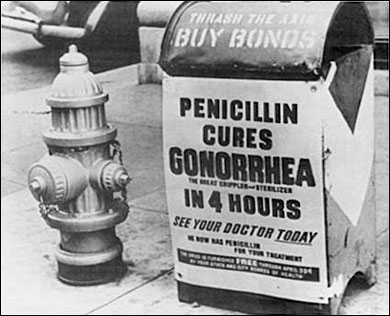
Gonorrhea: Not So Easy To Kill Anymore

Not anymore. . .

Think if you get the clap, you can just go get a shot or take a pill to be cured?

Not so fast, bucko. There’s now another reason to protect yourself:

Today, the Centers for Disease Control and Prevention (CDC) outlined laboratory trends from 2000-2010 that show growing resistance of gonorrhea to antimicrobials.  Gonorrhea, a sexually transmitted disease (STD), is a major cause of pelvic inflammatory disease, ectopic pregnancy, and infertility and can facilitate HIV transmission. (Press release, National Coalition of STD Directors)

Yep. Gonorrhea. It used to be a serious disease, before antibiotics made it easy to treat. Now that we’ve been taking antibiotics for everything, resistance is setting in and we’re running out of effective drugs to cure it.

…cephalosporin antibiotics are the last line of defense for treating the disease, as the bacteria has developed resistance to all other antibiotics.  The highest level of resistance to cephalosporins, regardless of sexual partner, was found in the Western region of the United States, particularly Hawaii and California, as well as in men who have sex with men in all regions.

“This new data outlines what state and local health departments have been seeing on the ground—that highly untreatable gonorrhea is near,” stated William Smith, Executive Director of the National Coalition of STD Directors. “There are currently no new drugs in development for this infection.  If this last class of drugs fails we will have no definitive treatment options for gonorrhea.  We call on researchers, government, and partners in industry to make the development of new, effective drug treatments for gonorrhea a public health priority,” continued Smith.

This is a big deal.

It’s important for sexually active persons to be screened for all STD/STI’s at least every six months, or more often if you have many sexual partners and/or have had unprotected sex- and that includes oral- gonorrhea can easily infect the throat. And, remember, any STD/STI increases the risk of contracting/spreading HIV. From the CDC:

Untreated gonorrhea can cause serious and permanent health problems in both women and men.

In women, gonorrhea is a common cause of pelvic inflammatory disease (PID). About 750,000 women each year in the United States develop PID. The symptoms may be quite mild or can be very severe and can include abdominal pain and fever. PID can lead to internal abscesses (pus-filled “pockets” that are hard to cure) and long-lasting, chronic pelvic pain. PID can damage the fallopian tubes enough to cause infertility or increase the risk of ectopic pregnancy. Ectopic pregnancy is a life-threatening condition in which a fertilized egg grows outside the uterus, usually in a fallopian tube.

In men, gonorrhea can cause epididymitis, a painful condition of the ducts attached to the testicles that may lead to infertility if left untreated.

Gonorrhea can spread to the blood or joints. This condition can be life threatening. In addition, people with gonorrhea can more easily contract HIV, the virus that causes AIDS. HIV-infected people with gonorrhea can transmit HIV more easily to someone else than if they did not have gonorrhea. (emphasis mine)

We’ve taken the cure for granted for too long. So- be careful out there.

Full article here.

Know Any Closeted Gay/Bi MT Men?

We want to know about your/their lives! A grad student at the U of M is working on a very worthwhile project to help us understand the reality of men in Montana who have sex with men (MSM) but are not out or do not identify as gay or bi. This is important work, so if you can assist us, it would be greatly appreciated. 

~

I am a researcher with the University of Montana collecting information about sexual health attitudes and behaviors. Specifically, I am interested in understanding more about men who are closeted or not open about having sex with other men.

I am looking to anonymously interview men who have sex with other men who live in Montana and are between the ages of 18 and 69.

I realize what a personal topic this is, so I want to emphasize that this study is completely ANONYMOUS. If you would be willing to participate in this study, you can contact me at (406) 552 – 2115 or amee1.schwitters@umconnect.umt.edu orum.menshealthsurvey@gmail.com. We can then arrange a time to conduct the (one) interview over the telephone or we can meet in person. The interviews will be audio recorded and then typed into a word processor. The audio will then be destroyed. Your name will NOT be associated with this study in any way, nor will your location or any identifying information be mentioned. As an incentive for your participation, I would like to offer you $25.00.

This study has been approved by the University of Montana Institutional Review Board (IRB 63-10) expires 03-2012 (A copy of the approved IRB application can be provided). Again, if you are interested or even potentially interested in participating in this study, please contact me at (406) 552 – 2115 or amee1.schwitters@umconnect.umt.edu or um.menshealthsurvey@gmail.com.

Thank you for your consideration.
Amee Schwitters, MPH
PhD Candidate
University of Montana
Department of Anthropology

Study: Bullying Leads To Dangerous Risks For LGBT Youth

A new study in The Journal Of School Health gives another reason to protect school-age LGBT’s from bullying and threats of violence. This is the first study to examine school victimization in adolescence in relation to physical and mental health in later life- and the results are not surprising:

“We now have evidence of the lasting personal and social cost of failing to make our schools safe for all students. Prior studies have shown that school victimization of LGBT adolescents affects their health and mental health. In our study we see the effects of school victimization up to a decade later or more. It is clear that there are public health costs to LGBT-based bullying over the long-term,” said lead author, Stephen T. Russell, Ph.D., Distinguished Professor, University of Arizona.

Those public health costs include higher suicide attempts, increased risk of contracting STD’s (including HIV), and greater levels of anxiety and depression- mostly due to decreased levels of self-worth directly related to victimization.

Key Research Findings:

  • LGBT young adults who reported high levels of LGBT school victimization during adolescence were 5.6 times more likely to report having attempted suicide, 5.6 times more likely to report a suicide attempt that required medical care, 2.6 times more likely to report clinical levels of depression, 2.5 times more likely to have been diagnosed with a sexually transmitted disease, and nearly 4 times more likely to report risk for HIV infection, compared with peers who reported low levels of school victimization.
  • Gay and bisexual males and transgender young adults reported higher levels of LGBT school victimization than lesbian and bisexual young women.
  • LGBT young adults who reported lower levels of school victimization reported higher levels of self-esteem, life satisfaction and social integration compared with peers with higher levels of school victimization during adolescence.

This provides substantial scientific evidence to create safer environments for our youth. Please share with school administrators, teachers and parents.

San Francisco State University. “School bullying, violence against LGBT youth linked to risk of suicide, HIV infection.” ScienceDaily, 16 May 2011. Web. 17 May 2011.

Low Vitamin D Levels Associated With Rapid HIV Progression

From AIDSMeds.com:

HIV-positive people with very low vitamin D levels were more likely to develop AIDS and to die than people with higher vitamin D levels, according to a study published online January 25 in the journal AIDS.

Low vitamin D levels have been found in numerous studies in HIV-negative people to be associated with serious illnesses, including cardiovascular disease, cancer, diabetes and kidney failure. What’s more, a number of recent studies have found that the proportion of people with HIV who have low vitamin D levels is quite high, with fewer than a quarter in some studies having ideal levels.

…and so it’s always a good idea to have your Vitamin D level checked regularly with your doctor, whether you’re HIV+ or not. More on Vitamin D can be found here.

And  read the full story from AIDSMeds.com here. 

End The Ban On HIV+ Organ Donation?

When I was diagnosed with HIV, a friend said “You’re an organ donor aren’t you? You’d better change that.”

I agreed, and changed my driver’s license organ donor status (goodbye, little red heart!). But in the back of my mind I wondered “Why couldn’t I donate to other HIV+ people should they need it? Surely having an infected organ and a few more years of life would be worth it.” Especially now, when HIV (unlike, say Hepatitis C) is a very medically treatable disease. Not a picnic, but neither is renal failure

Is it worse to have HIV than having to undergo weekly dialysis? Or to have a heart that works, or a liver, etc.? And if you already have HIV and need an organ, does it make sense that HIV+ donors be excluded?

Now it seems the feds are starting to think about the same things. According to The New York Times, The Centers For Disease Control And Prevention are about to issue new guidelines that will allow the study of HIV+ organ donation and transplantation.

It’s about time. Literally.

What do you think? If it were about saving your life, would you accept an HIV+ organ?

Squared Away

Friends,
Insurance. Check.
New doctor. Check.
Medications. Check.
Happy. Double check.

It’s all going great, and it looks like things will be done well and (almost) as easily as of old. ADAP came through, and EIP came through which give me insurance and covers my doctor and meds. I had labs drawn today, but unless something changes, I’ll be getting labs drawn once every 6 months and have complete and total access to medical care.
And I’m healthy- all things considered. Thanks for the thoughts, prayers, energy, love, whatever you want to call it. I’m deeply appreciative.

Let me know when I can return the favor.

NYT Weighs In On Montana’s Medical Marijuana Snafu

Kirk Johnson of the New York Times covers the economic angle of repealing Montana’s medical marijuana referendum:

Questions about who really benefits from medical marijuana are now gripping Montana. In the Legislature, a resurgent Republican majority elected last fall is leading a drive to repeal the six-year-old voter-approved statute permitting the use of marijuana for medical purposes, which opponents argue is promoting recreational use and crime.

If repeal forces succeed — the House last month voted strongly for repeal, and the Senate is now considering it — Montana would be the first to recant among the 15 states and the District of Columbia that have such laws.

In Bozeman, a college and tourism town north of Yellowstone National Park, construction jobs and tax collections dried up just as the marijuana business was blossoming; residents and politicians here say the interconnection of economics and legal drugs would be much more complicated to undo.

Something the morality economy-geared legislature seems to be forgetting. For those with few options, marijuana can be an excellent idea. I do not use it myself, but I know people who have benefitted greatly- with pain management issues, insomnia, low appetite and nausea- all issues persons with chronic illness such as HIV can have as a result of legally prescribed medication. It makes sense that this relief also be legally prescribed.

If it becomes illegal and you knew it had helped you, would you break the law?