Tonight: Montana PBS to Air Inlaws & Outlaws!

Some good news for Montana- Inlaws and Outlaws will be screened on Montana PBS tonight.

inlawsFrom the director, Drew Emery:

Montana friends!
Set your DVRs for Sunday night 6/9 10:30 pm: your local PBS station is airing our marriage documentary Inlaws & Outlaws — along with our story update: Just Marriage.

If you believe in love… and equality, please do pass on the word to friends & family!

Drew was in Montana last year, sharing the film with audiences in Helena and Bozeman. It’s an opportunity to see what love looks like up close.

Grab your peeps and watch this- it’s amazing.

Banning Same-sex Marriage Has Psychological Toll

Fascinating stuff from Shankar Vadantam at NPR:

As the country awaits two important Supreme Court decisions involving state laws on same-sex marriage, a small but consistent body of research suggests that laws that ban gay marriage — or approve it — can affect the mental health of gay, lesbian and bisexual Americans. When several states passed laws to prohibit same-sex marriage, for example, the mental health of gay residents seemed to suffer, while stress-related disorders dropped in at least one state after gay marriage was legalized.

Here’s the research trail:

Beginning around 2004, several states banned gay marriage. Just before that series of bans, the National Institutes of Health happened to conduct a massive survey of 43,093 Americans. The questions elicited detailed information about respondents’ mental health. (To validate what people reported about themselves, psychiatrists also interviewed samples of the people in the survey, and their medical diagnoses closely matched the findings of the survey.)

Soon after the wave of state bans on gay marriage, in 2004 and 2005, the NIMH conducted a second round of interviews, managing to reach 34,653 of the original respondents. (That’s a high rate compared with most polls and surveys.)

Mark Hatzenbuehler, a psychologist at Columbia University who studies the health effects of social policies, analyzed the data gathered before and after the bans to determine how the mental health of people who identified themselves as gay, lesbian or bisexual had changed in those states.

Hatzenbuehler and his colleagues Katie McLaughlin, Katherine Keyes and Deborah Hasin published their analysis in 2010 in the American Journal of Public Health.

“Lesbian, gay and bisexual individuals who lived in the states that banned same-sex marriage experienced a significant increase in psychiatric disorders,” Hatzenbuehler says.

“There was a 37 percent increase in mood disorders,” he says, “a 42 percent increase in alcohol-use disorders, and — I think really strikingly — a 248 percent increase in generalized anxiety disorders.”

To put those numbers in perspective, although Hatzenbuehler did find more than a doubling in the rate of anxiety disorders in states that eventually banned gay marriage, in absolute numbers he found that anxiety disorders went from being reported among 2.7 percent to 9.4 percent of gay, lesbian and bisexual people.

The million-dollar question is whether the laws, and the debates around them, were responsible for the change in mental health. To help answer that question, Hatzenbuehler and his colleagues looked at comparable groups and experiences.

“We showed the psychiatric disorders did not increase in lesbian, gay and bisexual populations in states that didn’t debate and vote on same-sex marriages,” Hatzenbuehler says. “There were also no increases — or much smaller increases — among heterosexuals living in the states that passed same-sex marriage bans.”

Hatzenbuehler has also found, in a study conducted in Massachusetts, that gay men experienced fewer stress-related disorders after that state permitted gay marriage.

In a study tracking the health of 1,211 gay men in Massachusetts, Hatzenbuehler found that the men visited doctors less often and had lower health treatment costs after Massachusetts legalized same-sex marriage. When the researchers examined the diagnostic codes doctors were giving the men, they saw a decrease in disorders that have been linked to stress, such as hypertension, depression and adjustment disorders.

Hatzenbuehler says he thinks stress associated with gay-marriage debates was the “X factor.” He says the quantitative data is backed by what gays, lesbians and bisexuals told the surveyors. “They reported multiple stressors during that period,” Hatzenbuehler says. “They reported seeing negative media portrayals, anti-gay graffiti. They talked about experiencing a loss of safety and really feeling like these amendments and these policies were really treating them as second-class citizens.”

Today, about three-dozen states ban gay marriage and about a dozen have passed laws thatapprove it. Some states have laws that permit civil unions but ban gay marriage.

It’s unclear how or whether the upcoming Supreme Court decisions involving the constitutionality of same-sex marriage will affect the mental and physical health of gays and lesbians nationally.

It’s likely that many gay, lesbian and bisexual people would see an upholding of same-sex marriage bans as an example of prejudice. But it’s also possible the debate around the Supreme Court decisions could have different effects on gays than a local debate involving friends and neighbors.

Hatzenbuehler says his larger point is really that policymakers, judicial leaders and ordinary citizens need to remember that social policies are also health policies.


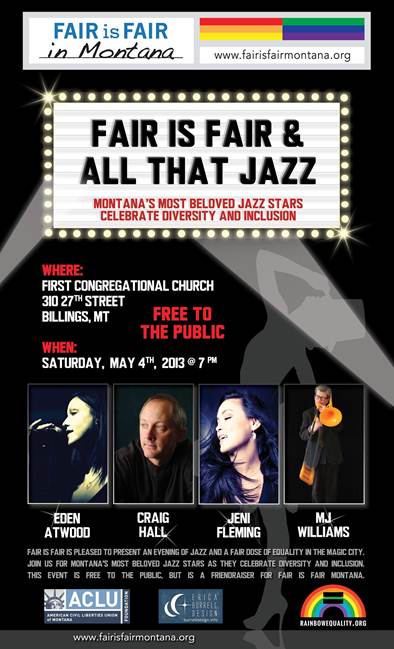
Fair Is Fair And All That Jazz

I hope you’ll join me May 4th in Billings for an amazing night of all-stars!

image001

Baucus Continues Fight Against DOMA

I have to be honest, last year when Max Baucus announced his support for marriage equality, I was surprised. I didn’t expect him to be the first statewide elected Democrat in Montana to take this step. Since this time, Max has continued to impress me with his commitment to pursuing full equality for LGBT Montanans.

Last month, when the US Supreme Court heard cases on LGBT relationships, Baucus announced that he would sign-on as a cosponsor of the DOMA repeal bill in the Senate. And this past weekend he sent out an email to his campaign email list asking everyone on the list to stand up for marriage equality. The email read:

The federal government shouldn’t interfere in people’s private lives. And it shouldn’t legislate who can and cannot enter into a loving, committed relationship.

But that’s exactly what it does right now. The Defense of Marriage Act (DOMA) denies federal benefits to same-sex couples, even if they’re legally married in their own states.

It’s not fair. And there’s a growing movement to see DOMA overturned. For the first time, a majority of Senators are standing up for marriage equality. And I wanted to give you the opportunity to join us.

It’s time to overturn the Defense of Marriage Act. Click here to add your name in support of marriage equality.

In Montana, we believe in personal freedom. We believe the government shouldn’t interfere in the people’s private business.

Overturning DOMA will give same-sex couples, married legally in their states, equal rights under federal law. Add your name.

Thank you for your support to help end marriage discrimination.

It’s great to see a US Senator that has Max’s prominence take such a strong stand and make such a commitment to equality for all Montanans. I quickly signed on to his petition.

Also of note, while Max is standing up for equality for all Montanans, his Republican opponents have doubled-down on their bigotry.

Marriage vs. Matrimony

45571_437227589704214_4180767_n

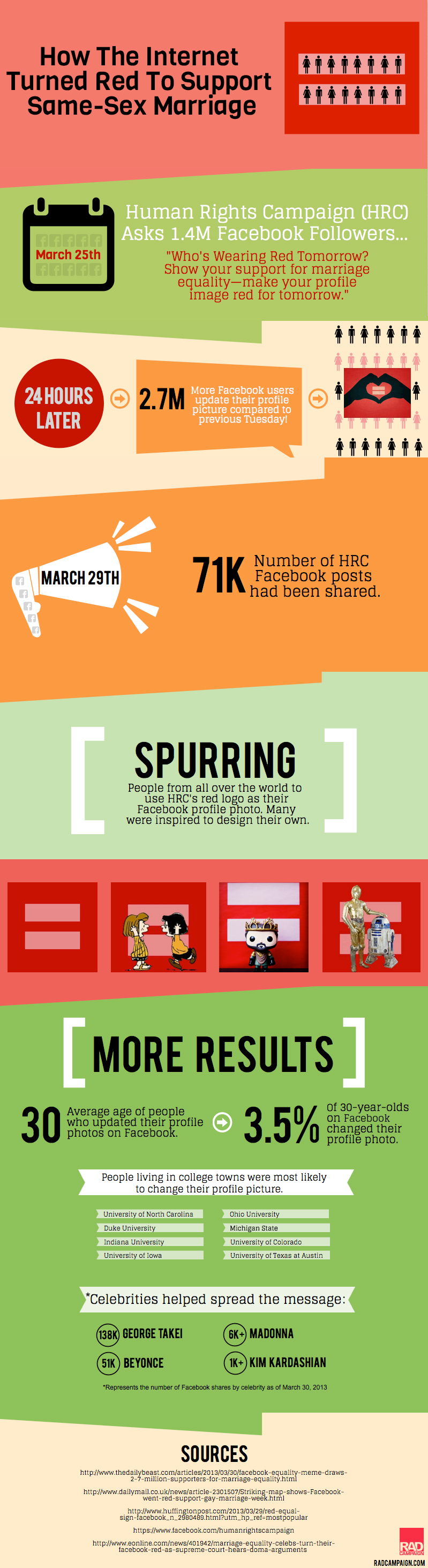
How the Internet Turned Red to Support Marriage

rad-equality

Odawa Indian tribe hosts Michigan’s first legal same-sex marriage

In case you missed it:

Tim LaCroix, 53, of Boyne City, and his longtime partner Gene Barfield, 60, of Boyne City are married at the government headquarters complex of the Little Traverse Bay Bands of Odawa Indians on Friday March 15, 2013 in Harbor Springs.
Tim LaCroix, 53, of Boyne City, and his longtime partner Gene Barfield, 60, of Boyne City are married at the government headquarters complex of the Little Traverse Bay Bands of Odawa Indians on Friday March 15, 2013 in Harbor Springs. / Ryan Garza/Detroit Free Press

ByJohn Carlisle

Detroit Free Press Columnist

The groom wore a black sweater. The other groom wore a red one.

Tim LaCroix, 53, and Gene Barfield, 60, were in the enrollment office this morning (March 15th) at the Little Traverse Bay Band of Odawa Indians government facility.

The couple took turns filling out an application to get married, paid the $15 fee and received a marriage license. Both smiled nervously.

It was a historic day. Not just for them and not just for the tribe that LaCroix belongs to, but for Michigan too.

The two men were about to be the first same-sex couple to be legally married in this state.

Last year, the Odawa tribal council debated a resolution to recognize gay marriage, but the measure failed by one vote. When it was reintroduced, the language was changed to require at least one spouse to be a tribal citizen, and that swayed support. On March 2, it passed by a 5-4 vote.

All that was needed was the signature of tribal chairman Dexter McNamara, whose veto would have required a difficult 7-2 council majority to override.

McNamara not only signed it, but also asked to perform the wedding ceremony.

“I’ve always felt that either you believe in equal rights or you are prejudiced,” McNamara said. “We don’t have a dividing line in this tribe. Everyone deserves to live the lives of their choice.”

Out of 500 federally recognized tribes in the country, and a dozen in Michigan, the Odawa tribe became the first ever to legalize gay marriage in the state and only the third in the nation.

And because of tribal sovereignty, neither the state’s constitutional amendment prohibiting gay marriage nor the federal Defense of Marriage Act can stop them.

“This is their turf,” Barfield said, standing in the tribal offices. “They have their own government, they have their own police force, they have their own rules and regulations. They’re very big on respect, and for them to say to us ‘We respect your relationship and your prerogative to define it as you choose’ is really special.”

“I’m so proud of my tribe for doing this,” LaCroix added. “I just can’t say enough.”

The couple met in 1983 while both were on active duty in the Navy. They live in northern Michigan, where they garden, assemble model railroads and share two dogs and a cat.

“We’ve been partners for 30 years in the way people use the word ‘partner’ for a same sex couple,” Barfield said. “Now we’re not going to be partners anymore. We’re going to be spouses.”

They wanted to get married at the signing ceremony for the statute, which gave them barely two weeks to prepare.

They hastily ordered cupcakes for the impromptu reception to follow. They found a tribal member to perform a traditional ceremony, alongside the secular one. They made little pouches of tobacco to hand out in a nod to tribal custom. And they invited friends and family from this small-town region.

About three dozen guests filled the seats arranged in the lobby this morning. There were relatives from both sides, beefy tribal members, employees who work in the building and wanted to wish the couple well, and a contingent from the hardware store where LaCroix works.

“We’re just all giddy over it,” said Kathy Hughes, his longtime coworker. “They’re like family to us.”

Once McNamara signed the bill, tribe communications coordinator Annette VanDeCar acknowledged it was a controversial decision.

“I’ll be honest,” she told the crowd. “There are people in our community that aren’t supportive of what is happening today, but that’s OK. We as Indians are taught to respect people as individuals, and as individual people have the right to decide what is best for them.”

For this couple, a few tweaks were necessary in both the paperwork and the ceremony, like changing the word “wife” in the vows and on the license application to “spouse.” But it otherwise was a standard civil ceremony.

The chairman read the vows, and LaCroix went first in repeating them.

For better or for worse, to love and to cherish, from this day forward.

“I do,” he said.

Then came Barfield’s turn, and his composure melted a little. As he read the vows, his voice began to crack and his eyes grew moist. All the while, he looked at LaCroix with a beam of a smile.

“I do.”

They exchanged rings, and the chairman pronounced them married. They punctuated the ceremony with a brief kiss and a long, long hug.

Then they repeated it with a tribal ceremony using the sage, the feathers, the maple branch and the drum that were carefully laid out on a table.

There were no activist speeches, no protesters — only a crowd witnessing a wedding that was unlike any they’d ever seen, but was really no different than any other.

“We’re just so excited for them,” Hughes said. “They’ve been together 30 years. It’s longer than a lot of marriages have lasted.”

John Carlisle is a columnist and can be reached at jcarlisle@freepress.com or 313-222-6582.

Catholics Participate in Prayer Service and Demonstration at Supreme Court

New Ways Ministry staff at the marriage equality demonstration outside the Supreme Court:  Sister Jeannine Gramick, Bob Shine, Francis DeBernardo.

New Ways Ministry staff at the marriage equality demonstration outside the Supreme Court: Sister Jeannine Gramick, Bob Shine, Francis DeBernardo.

From New Ways Ministry Blog:

Yesterday the Supreme Court heard oral arguments on two marriage equality cases.   The historic day began with an interfaith prayer service at the Church of the Reformation, a Lutheran congregation just behind the Supreme Court building.

The service, entitlted “A Prayer for Love and Justice,” featured prayers and rituals from a wide variety of faith traditions–Christian, Buddhist, Jewish, Muslim, pagan, Native American–were all represented as part of the service.  Catholics were represented by Sister Jeannine Gramick of New Ways Ministry and Rev. Joseph Palacios, who ministers at Dignity/Washington.   The event was organized by the United for Marriage coalition.

Following the prayer service, participants processed to the Supreme Court building and joined the demonstration of thousands of people there who support marriage equality.  Among those in the crowd were Jackie and Buzz Baetz, a Catholic couple from Monkton, Maryland, who displayed a sign showing Catholic support for marriage equality.

New Ways Ministry staff also participated in the demonstration outside the court building.


Share this:

Still Wearing Red?

tumblr_inline_mkbku2uIVq1qz4rgp

You should- the arguments to strike down the Defense of Marriage Act are being heard today. So if you changed your Facebook profile photo yesterday (and most of mine did) don’t change it yet! One of my friends has vowed to keep his red equality pic up until they hand down the decisions.

For a good brief on the impact of DOMA, see today’s Washington Post.

And if you don’t have your facebook pic changed yet- feel free to borrow from yesterday’s post.

Stand For Marriage Today


rally_mainimage-600x400-liveupdates


Supporters of marriage equality will gather outside the Supreme Court on the first day of hearings: March 26 at 8:30 a.m. in Washington, D.C. Together we will show the nation that we believe all Americans deserve to be treated fairly and equally under the law — no matter who they love.

Wear red, share this graphic as your facebook profile pic:

hrc