HIV In Montana: It’s Not Classified

One of two new Montana public service message targeting men who have sex with men- check back tomorrow for the second:

This short point of view video targeting Montana’s MSM population looks at the Classified Personal ads and points out some HIV facts that should not be classified and offers some excellent reasons to get tested (checked) for HIV. It also directs viewers to getcheckedmt.org , a resource to find the nearest HIV testing location in Montana.

This creative project was created by Laura Dybdal and Jason Gutzmer as part of Montana’s HIV Social Marketing Campaign.

Related articles

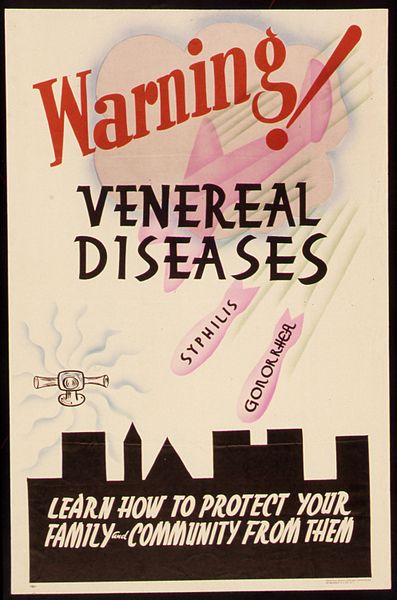
America’s Most-infested STD States

From Men’s health comes this story about gonorrhea, chlamydia and syphilis- HIV is mysteriously absent- and some cool graphics:

In celebration of STD Awareness Month, we gathered data from the 2010 Center for Disease Control’s annual report to give you the breakdown on which states have the highest STD rates, and incorporated some need-to-know info about each of the leading culprits that are spreading across the U.S.

Today’s free PDF: The Great Men’s Health Sex Survey

Gonorrhea

What to Look Out For: Gonorrhea often shows up within 10 days of infection, but typically there are no symptoms early on. Given time, though, it’ll raise it’s ugly head—discharge from the penis (and vagina for women), frequent urination, and discomfort during urination. As a bonus, it can also lead to epididymitis in men, which can cause infertility.

How it spreads: Gonorrhea is caused by bacteria and is transmitted through semen and vaginal secretions during intercourse. According to the CDC, it’s the second-most reported infectious disease with nearly 356,000 infections in 2007, but it’s estimated that about twice as many new cases actually occur but are undiagnosed and unreported.

Treatable? Yes, with antibiotics. [But something to keep in mind: Researchers recently discovered a new strain of gonorrhea, H014, that can’t be killed with current antibiotics. So playing it on the safe side makes even more sense.]

Excellent information, nonetheless. For Chlamydia and Syphilis info, Click Here.

Facebook: The Next Tool In Fighting STD’s?

Makes sense to me.

Salon.com: 

Imagine being able to download a Facebook app that would alert you to your sexually transmitted infection risk based on your friend’s status updates. This may sound far-fetched, and it still is, but as some researchers shift their focus to risk among friend groups, as opposed to just sexual partners, social networks are rapidly becoming a tool to prevent the spread of  (Sexually Transmitted Infection) STIs.

Peter Leone, a professor of medicine at the University of North Carolina’s Center for Infectious Diseases, is one of those experts. Earlier this month, he spoke at an international health conference and underscored the importance of exploring such possibilities. Real-world social networks — in other words, a person’s circle of friends and sexual partners — have already proved to be strong predictors of STI risk, he says. It follows that sites like Facebook, which convene all of those real-world connections in one virtual setting, have huge potential in this arena.

Leone found that when sexual partners of patients newly diagnosed with HIV came in for testing, 20 percent turned up HIV-positive. It might seem counter-intuitive to extend the targeted test circle to those a newly diagnosed patient is merely friends with, but people in the same social circle often sleep with the same people, and might engage in similar risk-related behavior. Instead of looking at people within a particular at-risk demographic, this approach allows them to target known clusters of infection.

Makes you think of the people on your “Close Friends” list a bit differently, doesn’t it?

Full story here

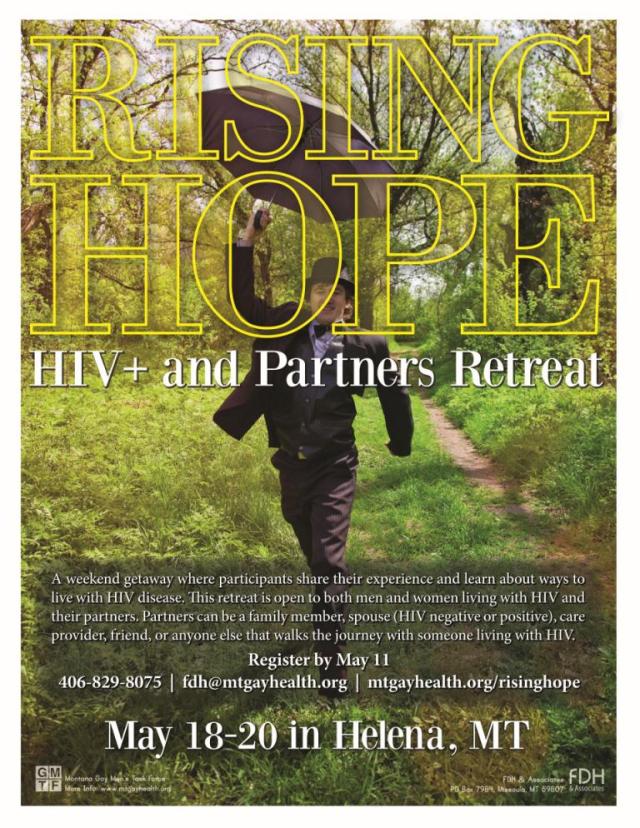
HIV+ and Partners Retreat

Montana does something that, to my knowledge, is not done anywhere else in the U.S.- we invite HIV+ persons and their partners/support persons to learn about coping and living with HIV. It’s a fantastic weekend filled with information, activity, relaxation, community and support, and I’ve been part of it for five years now.

I highly recommend it. Out-of-staters welcome. To check it out and/or register, click the pic below.

Missoula County Sees Spike In HIV Infection

HIV infection has increased unexpectedly in Missoula County- 12 new cases in five months- almost half the number of all reported cases in Montana last year.

From The Missoulian:

“We tend to see small numbers of new cases every year, but to have this many new cases – at this count 12 – documented in a five-month period is an unusually high number,” Missoula City-County Health Department Director Ellen Leahy said on Wednesday. “Twelve cases in one county in five months is an outbreak.”

HIV causes acquired immune deficiency syndrome or AIDS, a debilitating and sometimes fatal disease. It is spread by unprotected sexual contact or infected blood transfer, such as sharing infected hypodermic needles. Leahy said all the Missoula cases appeared to stem from sexual activity.

The announcement was made after consulting with many community groups, including Partnership Health Center, the Montana Gay Men’s Task Force and the Open Aid Alliance. Open Aid director Christa Weathers said the decision to publicize the outbreak was a hard one, because health officials depend on people self-reporting their condition to track the disease’s spread.

“It’s hard to issue a public health risk without creating alarm, or without pointing fingers at any group of people,” Weathers said. “It’s a great opportunity to remind people this is a risk and why testing is so important. But we don’t want to discourage anyone who may know they may need to get tested, but they’re afraid to come in and then this hits the media and they’re gone.”

So far, all the confirmed cases are adult males. But Leahy warned that women who don’t consider themselves members of a high-risk group for HIV infection have also been exposed.

“It’s sexually spread, but it’s time to remind ourselves – you really cannot know if you’re infected unless you’ve been tested,” Leahy said. “We recommend health clinics regularly offer HIV testing to sexually active patients. Rather than presume someone is in a risk group, it’s risk behavior, not membership in any group, that they need to think about.”

Several of my sources say the newly-infected persons are young men who simply didn’t practice safe sex, thinking “It’s Montana- I’m not at risk”. These men, mostly in their twenties, I’m told, will now have a lifetime of medication, stigma and health issues to deal with. It saddens me.

Today is a good day to be tested. For a list of Montana free Rapid HIV Testing sites, click here.

If you’re in Bozeman, call AIDS Outreach 406-451-5718 (the number in the link above is incorrect) or go to AIDSOutreachMT.org

Young Men’s Retreat In One Word: AMAZING

I had the privilege to spend the weekend with 14 young gay/bi men from across the state of Montana for a weekend of fun, education, fun, community building, fun, discussion and did I say, fun?

Whenever I go away for the weekend I have a lot to catch up on- thus the reason for no posts for the last two days. But I wanted to say that being around these guys, watching their enthusiasm for life, their interest in making life better for young gay men in the state and the strength and energy they brought to (and hopefully took home from) this weekend, energized me and gave me renewed energy to do what I do.

It might sound sappy, but I don’t care. This retreat was the best I’ve ever been involved in- and the (I want to call them kids, but I don’t want to sound condescending) participants made me realize that the future is in pretty good hands.

That’s excellent, because I’m not getting any younger.

Special thanks to FDH and Associates (David Herrera, Chantz Thilmony) and the Montana Gay Men’s Task Force for their dedication to the wellness, safety and education of gay/bi men in Montana. And to Bernie Kneefe for being the Den Mother.

If you’re a young gay/bi man who wants to be involved in this next year- go here. They’ll hook you up.

Analysis: Why some people do not receive continuous HIV medical care

by Chris Morley

Only 42% of the people diagnosed with HIV in the USA receive continuous HIV medical care after their diagnosis (seeing their HIV doctor at least every six months), according the the first national study in the USA.

  • 28% had a gap of at least one year between HIV medical check ups
  • 31% let 7-12 months pass between their appointments.

Who are the people missing care some of the time and what are their reasons? What are the consequences and what might be done to reduce the harm?

Over 17,000 adults attending 12 clinics within the HIV Research Network across the country, were surveyed by the Perelman School of Medicine, Pennsylvania, who reported their findings in the online journal AIDS in March 2012. This summary is based on a report in Medical News Today.

Why continuous HIV care is better

  • People with HIV whose health is regularly monitored and treated are less likely to become sick
  • People receiving continuous treatment are far less infectious and this very significantly reduces the spread of HIV
  • Regular attendance cuts total health costs by preventing serious health problems from developing that require expensive hospital treatment.

So regular, frequent HIV care means better longer term health for the person with HIV, fewer new people becoming infected, and lowers HIV health costs.

Who’s more likely to attend regularly for HIV care?

  • Patients who begin treatment on Medicare, not private insurance
  • Older patients
  • Men infected through sex with men
  • White patients
  • Women
  • People with very low CD4 counts (or an AIDS diagnosis) on starting care.

Sometimes missing care

So we may assume that the people more likely to have gaps in their care (of over 6 months) will broadly be the mirror image:

  • People with private insurance
  • People without healthcare insurance
  • Younger people, including those infected by mother to baby transmission
  • People infected through Injecting Drug Use
  • Heterosexually infected people, most especially Heterosexual Men
  • African Americans, Hispanic people, Native Americans, other ethnic minorities and migrants

At risk of missing HIV care

The researchers themselves suggest that HIV healthcare providers should treat the following people as at risk of not attending as regularly as they should:

  • Symptomless people, who may think they are well enough to skip appointments
  • People with depression, anxiety, or with difficulties accepting their diagnosis, or with other mental health conditions
  • People using substances (alcohol, drugs)
  • People with practical difficulties in their lives: poverty or debts, long working hours or low wages, unable to take time off, poorly housed, with childcare responsibilities, with travel problems
  • People with other health conditions and disabilities
  • People who move home or district, especially if this is often
  • People who have changed doctors
  • People jailed, or otherwise institutionalised.

Future work

The study authors suggest standard criteria should be developed to decide the  appropriate gaps between appointments for people in different circumstances. Some people will need personalised care plans based on the stage of their HIV illness, and their particular social circumstances.

More studies are needed to pinpoint the times when some people are more likely to fail to appear for appointments, and to identify what works to ensure people do attend every time.

Using insurance records data may help track people through changing situations and help establish which are the patterns that lead to increased risk of missing continuous HIV medical care.

Other research and experience in other countries

With 68% of the people with HIV in this US study not attending for HIV check-ups and care at least once in every six months, the USA appears to have one of the worst national HIV care regular attendance records in the developed world. This is the first national USA study of HIV care attendance but other countries have been tracking HIV healthcare non-attendance for some years.

The USA can therefore benefit from using other countries’ experience to  help  understand better what is happening, and consider adopting solutions that have already been found to reduce the numbers missing HIV  appointments.

For example, in Northern France, 13% disappeared for at least 12 months immediately after their diagnosis, and over half of those returned after an average lapse of 19 months; but almost half of those returnees by then had a dangerously low CD4 count of under 200, and another one quarter returned and were then given an AIDS diagnosis.

3/4 of those who dropped out suffered serious health and life expectancy consequences. There was a more-than-fivefold increase in the chance of dying in the year after return, compared with people who had stayed in care.

Suggested ACTIONS for healthcare and clinical staff

  • Tell people, when giving the positive test result, that coming to ALL your appointments and taking treatment as recommended, keeps most people well, with a near normal life expectancy. That it is really important to come, even when you feel very well and have no symptoms.
  • AND the people who miss their appointments are five times more likely to die within the next 12 months than those who keep their appointments.
  • Do everything you can to obtain a wide range of ways to contact people, and permission to use all these, with discretion.
  • Send SMS text reminders a day or so before the appointment.
  • Quickly and rigorously follow up all people who don’t attend.
  • Strongly encourage people newly diagnosed to become an active user of a community HIV project as soon as possible. This is because contact with and seeing other people like themselves who are living well with HIV is immensely reassuring and supportive and also improves mental and physical well-being. It counters the  stigma and isolation of living with HIV. It provides a safe space to talk about HIV. The clinic’s messages will be  reinforced by what other people living with HIV and community volunteers and staff say. Clinic staff giving a positive diagnosis must understand that most people getting their HIV diagnosis will remember only fragments of the important information they are told by the clinic. The shock of diagnosis means many mishear and misinterpret the limited amount they do remember.

In London, UK, where free HIV treatment for all is provided through the National Health Service, a study at London’s King’s College Hospital found that 40% of the patients seen at least once between 1995 and 2005, were not seen at all during 2006. Crosschecks with the national anonymised HIV database held by the Health Protection Agency, found half (20%) were using another HIV clinic, a small number had died, but more than 1 in 5 (over 20%) of all their patients were completely missing from  HIV care throughout the snapshot year of 2006.

Compare that 20% missing with the 68% missing in the USA.

There are a wide range of studies from British and other countries’ HIV clinics using different measures, finding various levels of loss, a variety of common causes, and making a range of suggestions for action. A 20% attrition rate is about average.

Some hospitals are clearly better at retaining patients than others; some HIV clinics have many people with complex problems and needs; in the bigger cities where there is a choice of HIV treatment centres, there is some ‘churn’, people going to another hospital without telling the first, because they have moved or wanted a change.

There is a wealth of detailed information, exploration of the reasons people disappear, and suggestions for ways to reduce the loss of people from HIV care, in this detailed report of experiences in London and Manchester, UK

Lost to care: the mystery of the disappearing patients in HIV Treatment Update.

This is the most thorough resource available, incorporating lessons from a range of European studies. Reading and acting on the various findings is recommended.

Other useful papers 

Reaching Lost to Care Populations Clinical Infectious Diseases 2006, full text free online.

High rate of loss to clinical follow up among African HIV-infected patients attending a London clinic: a retrospective analysis of a clinical cohort. Journal of Int AIDS Soc. 2010, abstract.

Many Black, HIV-Infected Women in Mississippi Are Lost to Care After Giving Birth Interview with Aadai Rana MD The Body, 2008, with weblinks to two other resources 8

Differences and disadvantages in the USA

There are a number of reasons why it is more likely many people will miss HIV care appointments in the USA than in other countries. These help explain why only 42% of US people with HIV attend HIV clinic at least once every six months. This low rate of regular attendance means that HIV clinics in the USA must work very much harder to reduce the 68% of no shows.

  • US health care is often excellent but without doubt the most expensive in the world. Large numbers of people have no health insurance, or inadequate health insurance; there are problems accessing and with  inadequate funding for the public healthcare programs, Medicare and Medicaid.
  • HIV is an expensive healthcare condition to treat.
  • Co-infections and other co-morbidities are common, compounding treatment complexity, treatment adherence, and increasing health costs.
  • Distances to HIV treatment centres and travel difficulties may be considerable.
  • HIV stigma and discrimination seems particularly rife in many parts of the USA. There are no international data comparisons available yet, although the international HIV Stigma Index will help answer this need. Lambda Legal carried out a USA HIV stigma survey within US healthcare in 2009 and publish a factsheet detailing discrimination and stigma in HIV healthcare and elsewhere.

These and possibly other factors contribute significantly to the high rate of missed HIV appointments and loss to HIV care in the USA.

~Chris Morley is a community HIV policy and practice expert based in NW England. He researched and co-authored for the UK’s HIV Treatment Update: Lost to care: the mystery of the disappearing patients.

He’s worked on a wide range of English national and regional HIV policy and practice issues including

  • making free HIV treatment available to all migrants
  • ending the prosecution of people living with HIV for HIV transmission
  • promoting the use of HIV treatment as part of the HIV prevention toolkit
  • developing support for gay men living with HIV on using HIV treatment to prevent onward transmission
  • making gay men’s HIV prevention work friendly and relevant to gay men living with HIV
  • combating HIV stigma and discrimination
  • supporting teenagers and children living with HIV in the care system
  • readying adult HIV services for older teenagers to transfer
  • developing services for older people living with HIV

HIV Diminishes Lung Function

We know that uncontrolled HIV can lead to a host of problems (see illustration). You can now count breathing among them.

English: Main symptoms of acute HIV infection....

Image via Wikipedia

A new study has shown that if you have untreated HIV, you are much more prone to a rapid decline in lung function. Because we know that smoking negatively affects lung function, this finding adds urgency to the message that persons with HIV will benefit greatly from not smoking.

The study seems to corroborate soft-tissue organ damage by unchecked HIV, and is yet another argument buttressing early treatment and lowering viral levels among persons with HIV disease. From AIDSMEDS:

Though the study results from a Johns Hopkins University School of Medicine team note that people living with HIV—particularly those with viral loads not being kept in check with antiretroviral (ARV) therapy—have reduced lung strength and a more rapid loss of pulmonary function compared with HIV-negative controls, the researchers also point out that cigarette smoking was very common in the cohort studies and remains an important risk factor to contend with.

As explained by Michael Drummond, MD, of Johns Hopkins during his introductory remarks, HIV infection has been shown to increase the risk of obstructive lung diseases (OLD), such as emphysema and chronic bronchitis—both under the umbrella of chronic obstructive pulmonary disease (COPD)—and asthma.

According to a study reported in 2000, there was a greater prevalence of emphysema—documented using chest X-rays—in smokers living with HIV. And in a 2006 study, HIV infection was found to independently increase the risk of a COPD diagnosis by 47 percent.

More recently, in a study authored by Drummond and his colleagues in 2011, an HIV viral load in excess of 200,000 copies was associated with a 3.4-fold increase in the odds of having an OLD diagnosis using gold-standard pulmonary function tests. The cohort has enrolled more than 4,000 injection drug users, roughly a quarter of whom are people living with HIV.

People with uncontrolled HIV infection had a loss in lung function at a sharply higher rate than both HIV-negative people and those with good viral control. It means that if you smoke, you’re just going to make that loss of lung function happen faster. I quit smoking almost three years ago. In fact, I wrote about it right here.

There were a lot of reasons. But mostly,  I quit because I wanted to consciously choose a healthy life. And I wanted to be able to credibly help others to do that, too. These facts from Nancy Reynolds study on HIV and smoking helped bring me out of the smokers’ corner for good:

  • The lungs of a person with HIV are more susceptible to cancer, emphysema, pneumonia,acute bronchitis and tuberculosis. This risk increases dramatically among HIV+ smokers.
  • The incidence of cancers, especially lung and cervical cancer are higher among HIV+ smokers and develop at a significantly younger age than the general population.
  • And the biggie: Smokers with HIV negate some of the effects of antiretroviaral medications by smoking. Thus, HIV+ smokers had a 36% greater chance of developing an AIDS-defining condition and a 53% higher risk of dying than HIV+ persons who did not smoke.

In the last few years after I quit smoking, my health has steadily improved. My cardiac function increased. My CD4 counts went up. My bilirubin counts went down- so did my bad cholesterol. All good things. I can exercise more without gasping, and I look good (if I do say so myself).

So, again, I’ll make a plea: I don’t want to be one of those newly-converted who scowls every time somebody lights up a cigarette. I really don’t. I understand how much fun smoking is, and how complicated. I just want you to have the facts. The very disturbing facts.

And maybe, if you’re a Person With HIV, they’ll hit you like they did me and you’ll improve the quality and length of your life. Just maybe.

And if you know someone who’s HIV+ who still smokes, show them this article- and ask them if they need support to quit. There are a lot of resources out there- and a lot of good reasons to choose from.

Even more now.

ZZZZZZZZ- You Need More Sleep

In my role as a therapist, I hear people complain about lack of sleep inability to fall asleep, fatigue and mental grogginess. It’s simple- we’re not getting enough sleep. Persons with chronic illness- including HIV- are especially susceptible and will benefit greatly from enhanced sleep hygiene.
Below is a helpful infographic Ken found on sleep:

You Need More Sleep
Created by: MedicalBillingAnd CodingCertification.net

Montana Gay-Friendly Health and Mental Health Providers

Looking for a doctor who isn’t freaked out by your sexuality? Or a dentist that will work with you if you have HIV? Or a therapist that has experience with gay couple’s therapy?

The Montana Gay Men’s Task Force has a list of gay-friendly healthcare providers for the State of Montana which they have compiled through a referral and questionnaire network. The providers listed have also given their assent to be on the list.

Check it out here.

Oh, and if you have a fabulous healthcare professional who isn’t listed- you can help them get on the list here.