World AIDS Day is December 1st, and we’ve planned an event to commemorate 30 years of HIV/AIDS- I hope to see you there.

World AIDS Day is December 1st, and we’ve planned an event to commemorate 30 years of HIV/AIDS- I hope to see you there.
 Secretary of State Hillary Clinton today called for a new approach to ending HIV– treatment as prevention.
Clinton said the answer was clear.
“If we take a comprehensive view of our approach to the pandemic, treatment doesn’t take away from prevention. It adds to it,” she said. “So let’s end the old debate over treatment versus prevention and embrace treatment as prevention.”
You said it sister.
This administration has made HIV treatment and prevention a priority- in a way no other administration ever had the courage or the moral fiber to do. Just another reason not to go back to the Draconian Health Nightmare that was the Bush Administration by electing another Republican administration….
 I’ve written that the Feds’ HIV budget has been released. It’s not all good news.
From The Michigan Messenger:
The federal government Monday announced more than $1.89 billion in funding to states to fight the HIV epidemic with access to care and with more cash for the failing AIDS Drug Assistance Program.
According to an HHS press release, $813 million of that money will go directly to the ADAP programming. An additional $8,386,340 will be issued as a supplement to 36 states and territories currently facing a litany of unmet needs and access issues. The additional money is designed to help those programs reduce or eliminate their waiting lists. They also released an additional $40 million to assist states and territories currently refusing coverage for people in need to reduce the number of people waiting.
ADAP provides access to the costly anti-retroviral medications that have turned HIV into a more manageable disease since its appearance 30 years ago. The drugs can cost tens of thousands of dollars a year in the U.S. The program also assists in paying for drugs to treat opportunistic infections that HIV positive persons can suffer as a result of diminished immune functions.
The ADAP Advocacy Association shows that as of Sept. 22, 10 states had waiting lists totaling nearly 9,000 people awaiting access to the life saving medications:
ADAPs with Waiting Lists
(8,785 individuals in 10 states*, as of September 22, 2011)Florida: 4,098 people
Georgia: 1,732 people
Idaho: 37 people
Louisana: 1,112 people
Montana: 28 people
North Carolina: 354 people
Ohio: 9 people
South Carolina: 367 people
Utah: 59 people
Virginia: 989 peopleIn addition to funding ADAP programming, the feds also announced millions in funding for direct medical care as well as programming to assist minorities — who are particularly hard hit by the epidemic — in accessing medical care for the infection.
Kudos to all the activists and HIV care advocates who worked hard for this- and for those of you who signed our petition….
From Science Daily:
Researchers at Weill Cornell Medical College and GHESKIO (Groupe Haitien d’Etude du Sarcome de Kaposi et des Infections Opportunistes) have shown that early treatment of HIV not only saves lives but is also cost-effective.
And the recommended blood levels of T-cells as markers to start treatment is creeping up:
Before 2009, the World Health Organization (WHO) recommended waiting to initiate antiretroviral therapy (ART) for HIV until a patient’s CD4+ T cells fall below 200 cells per cubic millimeter. But in that year, a randomized clinical trial completed by Weill Cornell researchers at the GHESKIO clinic in Port-au-Prince, Haiti, demonstrated that early ART decreased mortality by 75 percent in HIV-infected adults with a CD4 cell count between 200 and 350 cells/mm3. As a result, the WHO now recommends that ART is started in HIV-infected people when their CD4 cell count falls below 350 cells/mm3.
I spent the weekend with 30 HIV+ Gay men in the mountains outside of Helena, Montana. They ranged in age from their early twenties to their mid sixties. It was like every other gathering of gay men in many respects- with one exception: we talked a lot about our health- and our medications.
Mostly about the reliability of receiving these life-saving meds.
It creates a lot of stress for us. The meds are expensive, they have side-effects, they are sometimes mailed from pharmacies with in a day or two of our running out. It often requires us to hound our caseworkers to get what we need- every month, in some cases.
As in most cases with issues of efficiency, increased funding will help. But Congress always needs to be hounded in order to give the HIV+ the kind of funding we actually need. The kind of funding that other medically disabled get almost automatically.
We don’t even have enough money to take care of those waiting to be admitted to government programs that people already qualify for.
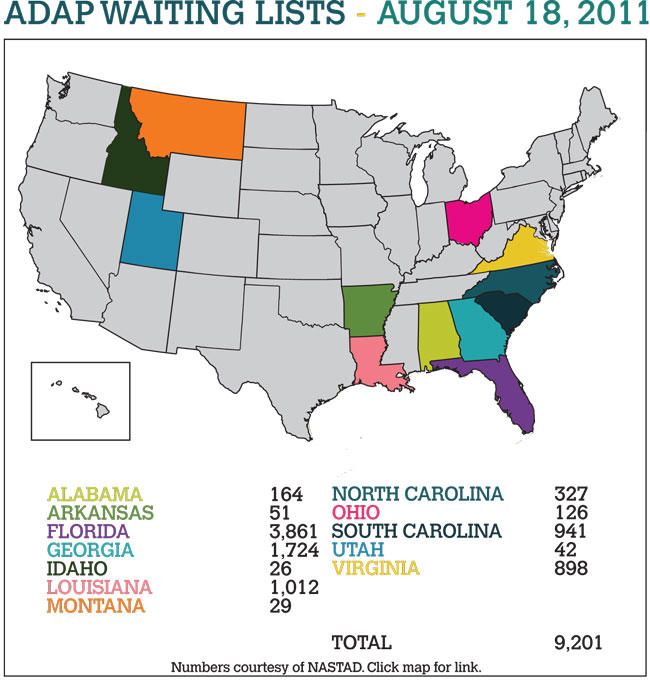
Thus The Waiting List for the AIDS Drug Assistance Program. It needs to end- and you can help. Click the link below the map.

SIGN THE PETITION TO END ADAP WAITING LISTS HERE
From NAPWA’s Positive Voice Newsletter:
We’re beginning to think we’re trapped in the movie Groundhog Day.
Week after week, the waiting list numbers hover just over 9,000. Week after week, Congress doesn’t – and can’t – act. Week after week, Florida alone accounts for nearly half the waiting list numbers, and Florida doesn’t act.
Assuming an annual medications cost of $15,000 per ADAP recipient per year, $135 million a year in new ADAP funds would be enough to make this national disgrace go away. That’s less than four one-thousandths of a percent of the federal budget. If the will were there, the money could be found.
$60 million would do the job in Florida – not very much, even in Florida’s $70 billion state budget. But Florida doesn’t even seem to be spending the money already available effectively. Just before Labor Day, the Orlando Sentinel reported health officials for Orlando County and three neighboring central Florida counties had underspent their Ryan White funds by a half-million dollars – about six percent of the total $9 million, which suggests a certain lack of commitment to serving the people Ryan White funds are meant to help. And it’s a pity the unused funds couldn’t have been put to other uses, instead of just being help for possible use next year. They could have paid for drugs for more than thirty central Floridians currently on the ADAP waiting list.
Here are the latest waiting list numbers from our friends at NASTAD:

Hey friends,
I’m working with Project Inform to help with HIV Advocacy in the State of Montana. One of our projects is to work with Congress to increase ADAP (AIDS Drug Assistance Program) funding. Currently, there are over 9,200 people waiting for permanent funding to access these life-saving medications.
We can do better. And your signatures can help make a difference.
Won’t you take a minute and sign the petition here? The letter to accompany the signatures is below.
Thank you- ten seconds can make a real difference.
Dear Chairman Rehberg:
The undersigned individuals and organizations in Montana are writing to urge your support for increased funding for AIDS Drug Assistance Programs (ADAPs) in the Fiscal Year 2012 Labor-HHS-Education Appropriations bill. ADAPs need at least a $106 million increase to continue to serve the thousands of new clients entering the programs every year. As you are aware, ADAPs provide HIV-related medications to under insured and uninsured individuals living with HIV/AIDS in the United States. They are a lifeline for people who would otherwise be unable to get treatment they need to stay healthy and productive. We thank you for your past support for ADAP and are especially appreciative of the $50 million increase to ADAPs in Fiscal Year 2011. However, ADAP waiting lists continue to grow at an astronomical rate.
In January of this year, there were 4,200 people on waiting lists. As of August 26, 2011 the number more than doubled to 9,141people in 12 states – including 28 people in Montana – waiting for lifesaving medication. Nineteen ADAPs, including 11 with current waiting lists, have instituted additional cost containment measures since April 1, 2011 such as reduced formularies and enrollment caps. Additionally, ten ADAPs are considering implementing new or additional cost-containment measures by the end of ADAPs current fiscal year (March 31, 2012).
Because of your leadership role on the House Labor-HHS Appropriations Subcomittee, you are in a unique position to help secure this badly needed increase in ADAP funding to help people with HIV in Montana and around the country. While we understand the gravity of the U.S. fiscal situation, we need to ensure that people with HIV and AIDS receive the vital medications that keep them alive. Again we ask that you do everything possible to ensure an increase of at least $106 million to help solve this ADAP crisis.
Sincerely,
 An analysis of epidemiological data by the Centers for Disease Control has arrived at a startling conclusion: as many as 4 out of 10 persons diagnosed with HIV do not remain in care.
Despite all the medical evidence which advocates early HIV treatment for a healthy life, people are still not accessing care. The specific reasons are unclear, but the National HIV Treatment Guidelines are very clear: Persons with HIV are to be tested for Viral Load and CD4 counts ever 3-4 months, unless they are considered “virus-suppressed” (usually with an undetectable viral load and normal CD4 count with no medication changes over a period of time), then it is every 6-12 months.
So, what’s happening?
In surveillance data from 13 regions, only 59% of people recently diagnosed with HIV had had a test for viral load or CD4-positive T-cell count within the previous year, according to Irene Hall, PhD, head of the CDC’s HIV incidence and case surveillance branch.
The finding implies that the remaining 41% are not under a physician’s continuing care, Hall said in a teleconference during the 2011 National HIV Prevention Conference in Atlanta.
The two tests are a “marker for being in care,” Hall told MedPage Today.
Maybe it’s time to start talking seriously about barriers to proper care, including discrimination, poverty, cultural issues and race.
At a time when we know treatment is prevention, it’s important that the members of our communities who are HIV infected receive the care they need.
I’m wondering if it’s about support. Many of the people in my HIV+ support groups help each other with their health care- talking honestly about issues, sharing resources- even giving each other rides to doc or lab visits. They stay on their meds, talk realistically about their health, exercise, pay closer attention to nutrition and reducing stress. They do it because they have people they can speak to honestly about their disease- people who know firsthand what it’s like. And, for the most part, they’re having incredible, fulfilling lives.
In my experience, it’s the people who are trying to deal with HIV on their own who don’t do so well.
Depression and fear can play an enormous part in healthcare apathy- and it’s a well-documented fact that fear and depression are alleviated by concern and compassion from family and friends- and involvement with others who share similar circumstances.
So, in the interest of trying to understand this better, I have a couple of questions:
Do you know anyone (maybe it’s you) with HIV who is not getting care for their disease? What can be done to get them into care?
I’d like to follow up with your responses- so feel free to contact me at Dgsma@hotmail.com if you are uncomfortable leaving a response in the thread.
Simple Changes to Dating Websites Could Decrease Spread of HIV and Sexually Transmitted Diseases

A study released today recommends eight ways to reduce transmission of HIV and other sexually transmitted diseases (STDs) among men who meet male sex partners online.
Owners of popular dating and “hook-up” websites and users of those websites, along with HIV and STD program directors, agreed that a few simple measures could have a major impact on the spread of sexually transmitted diseases.
Among the online measures supported by a majority of those surveyed:
• Including “safe sex” as a profile option and allowing users to search for partners by such characteristics
• Providing directories of STD testing locations
• Sending automatic reminders to get an HIV/STD test at regular intervals chosen by users
• Having chat-rooms and other areas for HIV+ men looking for other HIV+ men
• Providing e-cards to notify partners of a potential exposure to STDs
• Posting videos that show men discussing safe sex, HIV status, and related issues
• Providing access to sexual health experts
“Finding sex and love online is here to stay,” said Dan Wohlfeiler, one of the study’s authors working with the California HIV/STD Prevention Training Center for this project. “This shows how we can work with the website owners to turn the internet into a force for the health of their users.”
In California, gay and bisexual men who were diagnosed with syphilis or gonorrhea most frequently reported the Internet as where they met sex partners.
More than 3000 users, 82 state and local HIV and STD Program directors and 18 owners of dating and “hook-up “ websites completed the survey.
Jen Hecht, Education Director at STOP AIDS Project and co-author, said “Since all three groups agree these strategies are important, can be done, and would be used, we need to be getting them online now.”
The study also found a number of strategies with less support. Website owners expressed skepticism about health department staff going online to notify users that they might have been exposed to an STD. In contrast, a majority of HIV and STD prevention directors and users thought this strategy was important. The authors are planning follow-up meetings with owners to further understand their concerns.“We have rising rates of STDs among gay and bisexual men and turning that around means everyone needs to take responsibility for their sexual health,” said Bill Smith, Executive Director of the National Coalition of STD Directors (NCSD). “This study shows how public health professionals, as well the users and owners of sex seeking websites, can band together to make a real difference in securing the sexual health of gay men.”
The study, entitled “How Can We Improve HIV and STD Prevention Online for MSM” funded by amfAR, the Foundation for AIDS Research, was co-authored by H. Fisher Raymond and Willi McFarland at the San Francisco Department of Public Health. The results have been posted today at http://www.stopaids.org/online.
 From Eternity To Here