Rehberg Votes To Harass Gay People

The U.S. House yesterday purposelessly voted to stop the Obama administration from going against the Defense Of Marriage Act- even though, officially, the administration is still enforcing the law. Essentially- and obviously- this is an attempt to countermand Obama and Biden’s personal positions on the issue of marriage equality. From The Washington Blade:

In a 245-171 vote, House lawmakers approved the amendment, introduced by freshman Rep. Tim Huelskamp (R-Kansas), as part of Commerce-Justice-Science appropriations legislation. The amendment reads, “None of the funds made available under this Act, may be used in contravention of the Defense of Marriage Act.”

Ian Thompson, legislative representative for the American Civil Liberties Union, said the amendment in effect does nothing because although the Justice Department is no longer defending DOMA in court, the Obama administration is still enforcing it.

“The Huelskamp Amendment is a solution in search of a problem,” Thompson said. “While there are multiple legal challenges to DOMA working their way through the federal courts, it is still binding. This amendment serves absolutely no purpose other than to score political points at the expense of gay and lesbian couples.

After the Obama administration declared DOMA unconstitutional, the Justice Department filed legal briefs against the anti-gay law and sent Justice Department attorneys to argue against the statute in court during oral arguments. However, the administration continues to enforce the statute, which prohibits federal recognition of same-sex marriage.

According to Roll Call newspaper, Huelskamp had initially planned an amendment that would barred the use of funds for arguing against DOMA in court — which, if passed into law, would have had real impact. Huelskamp ultimately didn’t press forward with that amendment.

Huelskamp reportedly said he introduced the amendment not only because the Justice Department stopped defending DOMA in court, but also because of Vice President Joe Biden’s endorsement of same-sex marriage Sunday on NBC’s “Meet the Press.”

“The most immediate reason was the comments of the vice president of the United States,” Huelskamp was quoted as saying. “Stating his position is fine, but you tie that together with the issues with the lawsuit in California in which, essentially, the attorney general walked away from DOMA and said, ‘I’m not going to defend that.’”…

Drew Hammill, a spokesperson for House Minority Leader Nancy Pelosi (D-Calif.), said House Republicans “voted to tie the hands of the Obama administration with respect to their efforts to end discrimination against America’s families.”

“House Republicans continue to plant their feet firmly on the wrong side of history,” Hammill said. “Republican leaders refuse to bring up a bipartisan bill to reauthorize the Violence Against Women Act that includes critical domestic violence protections for the LGBT community, and Speaker Boehner continues his legal boondoggle to use taxpayer funds to defend the indefensible Defense of Marriage Act in court, including cases involving the families of our men and women of our U.S. Armed Forces.”

Hammill added, “These discriminatory actions only serve to advance fundamental unfairness in our society and are against the principles of liberty and equality that our country is built upon.” (emphases mine)

Harassment. Of course Denny Rehberg- who once told a friend of mine, “There aren’t any gay people in Yellowstone County”- voted for the measure. Click the roll call link above for votes. Full Blade story here.

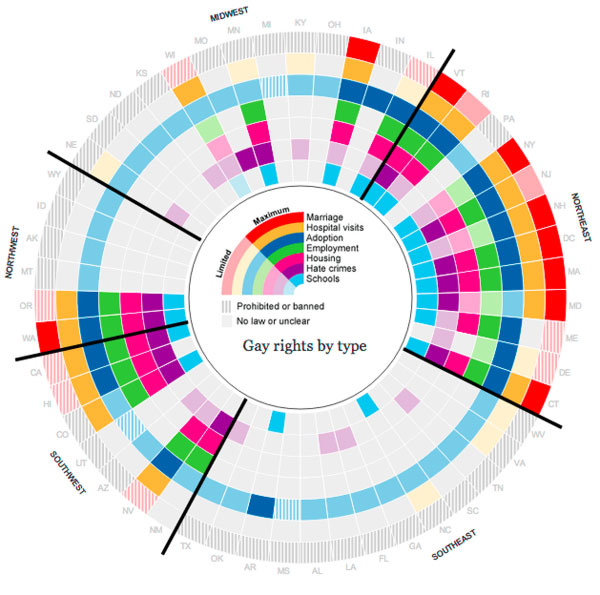
Where Is It Best To Be LGBT in the US?


Click pic for story


Some Startling HIV Facts

…from The CDC’s Annual Report from the Division of HIV/AIDS Prevention (DHAP), Accelerating Progress, Investing for Impact. This report provides an overview of some of the HIV prevention activities conducted and supported by the Centers for Disease Control and Prevention (CDC) during late 2010 to the end of 2011.

Too few Americans with HIV are getting the testing, treatment, and care they need to stay healthy and prevent transmission to others.

Surprisingly, only 28% of all HIV-infected persons are considered to have HIV under control ( viral load less than 200/ml). That’s not enough.

Percentage of HIV-infected Individuals Engaged in Selected Stages of the Continuum of HIV Care, 2010-11

All HIV positive individuals- 100%

Aware of their infection- 80%

Linked to HIV care- 62%

Retained in HIV care- 41%

Receive antiretroviral therapy- 36%

Have their virus under control*- 28%

*Plasma viral load < 200 cells/ml

Source: MMWR  60(47);1618-1623


History Lesson: Rachel Maddow Spotlights AIDS Activist Organization ACT UP

Rachel Maddow highlighted the group ACT UP (AIDS Coalition To Unleash Power) on its 25th birthday- and reveals that she was part of the work.

I remember ACT UP- and I remember the malaise and apathy they remedied. When the government and elected officials didn’t act, activists and mothers and lesbians held them accountable.  A healthy reminder of where we’ve been- may we never return.

Vodpod videos no longer available.

Sisters Get A Facebook Solidarity Page

You may have heard that the Vatican is investigating U.S. Sisters for being, as someone I know said, “Ridiculously outside the mission of the church- they’re the only ones getting it right”.

Now the sisters have a new Facebook page for people to express their solidarity with them in the face of this hierarchical end run.

“Support Our Catholic Sisters- shaping faith, shaping lives” is the title of this page. Its mission is described thusly:

Women religious have inspired countless lives in remarkable ways. Let’s mobilize the Catholic community in support of our Catholic sisters.
For most Catholics, our sisters are our most precious resource within the church. They’ve taught us and our children in schools. They’ve run our hospitals. They ministered to us in our parishes. They’ve encouraged us in good times and bad. Perhaps more than any other group within the church, they’ve shaped our faith.They have helped us so much over the years. Now they are in need of expressions of our support and gratitude.

The Vatican last week ordered an umbrella organization representing 80 percent of the sisters of America, the Leadership Conference of Women Religious, to reform its programs to conform more closely to the official teachings of the church or face further disciplinary actions.

To oversee the reform process, the Vatican has appointed Seattle Archbishop Peter Sartain and given him wide-ranging power to oversee and direct LCWR as he reviews and revises the organization’s policies.

The women say they were “stunned” by this Vatican directive and to be the objects of these directives. As sisters across the country begin to discern what these changes mean for their lives, Support our Catholic Sisters aims to harness the stories, testimonials and actions planned on behalf of the sisters and report these to you.

We want Support our Catholic Sisters to be shared widely to build support for these wonderful women.

How has one or more Catholic sisters changed your life? Use Support our Catholic Sisters to post your testimonial and those of your family members and friends. Help us tell your stories. Post short essays, photos and/or videos telling us what a particular sister has meant to your life.

Are you organizing a prayer service or vigil? Are you part of a letter writing campaign? Share with us the details here.

We want to report the actions of our Catholic communities as they express their support and affection for the women have set exemplary examples, shaping consciences and faith lives for so many years.

I’ve “liked” it- simply because bullying in any form is repugnant to me. Go here and “Like” it too.

Study: Preventative HIV Dosing Could Be Cost-Effective

Science Daily reports that giving preventative doses of the HIV drug Truvada to high-risk groups could prove to be cost-effective:

A once-a-day pill to help prevent HIV infection could significantly reduce the spread of AIDS, but only makes economic sense if used in select, high-risk groups, Stanford University researchers conclude in a new study.

The researchers looked at the cost-effectiveness of the combination drug tenofovir-emtricitabine, which was found in a landmark 2010 trial to reduce an individual’s risk of HIV infection by 44 percent when taken daily. Patients who were particularly faithful about taking the drug reduced their risk to an even greater extent — by 73 percent.

The results generated so much interest that the Stanford researchers decided to see if it would be cost-effective to prescribe the pill daily in large populations, a prevention technique known as pre-exposure prophylaxis, or PrEP. They created an economic model focused on men who have sex with other men, or MSM, as they account for more than half of the estimated 56,000 new infections annually in the United States, according to the Centers for Disease Control and Prevention.

“Promoting PrEP to all men who have sex with men could be prohibitively expensive,” said Jessie Juusola, a PhD candidate in management science and engineering in the School of Engineering and first author of the study. “Adopting it for men who have sex with men at high risk of acquiring HIV, however, is an investment with good value that does not break the bank.”

Although getting Congress to pass this- the same Congress who killed needle-exchange- is far from realistic. Even though (maybe even especially because) it makes sense.

America’s Most-infested STD States

From Men’s health comes this story about gonorrhea, chlamydia and syphilis- HIV is mysteriously absent- and some cool graphics:

In celebration of STD Awareness Month, we gathered data from the 2010 Center for Disease Control’s annual report to give you the breakdown on which states have the highest STD rates, and incorporated some need-to-know info about each of the leading culprits that are spreading across the U.S.

Today’s free PDF: The Great Men’s Health Sex Survey

Gonorrhea

What to Look Out For: Gonorrhea often shows up within 10 days of infection, but typically there are no symptoms early on. Given time, though, it’ll raise it’s ugly head—discharge from the penis (and vagina for women), frequent urination, and discomfort during urination. As a bonus, it can also lead to epididymitis in men, which can cause infertility.

How it spreads: Gonorrhea is caused by bacteria and is transmitted through semen and vaginal secretions during intercourse. According to the CDC, it’s the second-most reported infectious disease with nearly 356,000 infections in 2007, but it’s estimated that about twice as many new cases actually occur but are undiagnosed and unreported.

Treatable? Yes, with antibiotics. [But something to keep in mind: Researchers recently discovered a new strain of gonorrhea, H014, that can’t be killed with current antibiotics. So playing it on the safe side makes even more sense.]

Excellent information, nonetheless. For Chlamydia and Syphilis info, Click Here.

A Catholic’s Easter Lament: Dogmatic Tone-deaf (Seattle) Bishops

Joel Connelly, who has written about the official church’s anti-gay craziness before, now addresses the move by Seattle’s Catholic bishops to use churches as places to gather signatures for Referendum 74, which seeks to rollback marriage equality in the state of Washington. Excerpt:

A painful truism of this Holy Week, Christianity’s most important days of the year:  Moral leadership in America’s Catholic Church is starting to flow from lay persons in pews and priests who deal with human problems, not prelates on thrones wearing white, red and purple hats.

Just look around to events from Rome to Berlin, and from Worcester, Mass., to Seattle.

In the Archdiocese of Seattle, our bishops issued a letter saying parishes will become signature-gathering centers for Referendum 74, a ballot measure designed to roll back same-sex marriage.  But the state’s marriage equality law was sponsored by a Catholic state senator and signed into law by a Catholic governor.

Archbishop Sartain and Bishop Elizondo talk about treating all persons with “respect, sensitivity and love,” but then urge support for a campaign put together by the National Organization for Marriage — an outfit that wants to “drive a wedge” between blacks and gays, “sideswipe” President Obama and make opposition to marriage equality “an identity marker” for young Latinos.

Connelly correctly identifies the root of all moral teaching: experience. The authentic experience of human beings who want nothing more than to live authentic lives is the only thing behind marriage equality and relationship recognition. The only thing. Most people care little for the dogma behind the teaching- especially, as in the case of thoughtful Christians, it doesn’t match their experience.

A key lesson:  Moral authority is earned.  It is not  simply acquired when a bishop/cardinal/Pope is installed.   The American (and Irish, and Dutch, and Belgian , etc.) hierarchy has forfeited a lot of that authority through its handling of the priest sex-abuse scandal. The despair is mitigated by the good works and wise words from  those in the pews. As Pope Benedict XVI used a Holy Thursday sermon to tell priests to obey orders, Medina, Wash., lay Catholic Melinda Gates was speaking from conscience about contraception at a conference in Berlin.

Contraceptives are not a code for abortion, she said, nor an invitation to promiscuous sex.  “We are talking about giving women the power to save their own lives and their children’s lives — and to give their families the best possible future,” said Gates, talking of the need for birth control in the developing world. Gates discussed the instruction in faith she received from sisters in a Catholic high school:  “In the tradition of great Catholic scholars, the nuns also taught us to question received teachings.  One of the teachings most of my classmates and I questioned was the one saying birth control was a sin.”

She didn’t question lessons on service, and giving back, and social justice, worthy grounding for the future co-chair of the Bill & Melinda Gates Foundation.

Read it all here, and then forward it to everyone you know.

Stutz: Daines Fundraising Is Politics-As Usual

Rob Stutz, Democratic candidate for United States Congress, announced today that Steve Daines, whose fundraising tactics were highlighted this week on the national radio program This American Life, represents politics-as-usual, not the best interests of the people of Montana. Daines, the presumptive Republican nominee in Montana’s US House race, has held numerous fundraising events in Washington DC requesting donations of $500, $1,000, and even $2,500 from PACs (political action committees) for special interest groups. Two of these events, one of which was featured in the radio program, were held in March 2012.

“Montanans want a new approach in Congress,” Stutz said. “We are looking for a Representative who will stand up to special interest groups, not a Representative who wants $2,500 to wine, dine, and rub elbows with special interest groups on Capitol Hill.”

Stutz does not accept any campaign money from special interest PACs and does not sign any pledges for special interest groups. The Stutz for Congress campaign posted a graph on www.RobStutz.com showing that Stutz has accepted $0 of special interest money and that Daines has accepted over $100,000 of special interest money through 2011. Fundraising reports for the first quarter of 2012 must be filed by April 15.

“I put people first in my campaign.” Stutz said that “Montanans want a Representative who walks the walk when it comes to working for people rather than for special interest groups. Abraham Lincoln said it best — government should be ‘of the people, by the people, for the people.'”

“While disappointing that Mr. Daines wants DC lobbyists to support his race, it is not surprising. Since announcing, Daines’ strategy has been to try and buy the US House seat.” Montana Democrats are pushing back against special interests — Stutz does not take special interest money or sign special interest pledges, Senator Tester has proposed a constitutional amendment to overturn the Citizens United decision, and Attorney General Bullock has fought in court to uphold Montana’s law limiting special interest spending.

Stutz said, “If you are tired of the influence of special interests on Congress, support my campaign and send a message that enough is enough. Working together, we the people of Montana can get Congress back on track and working for us.” Stutz emphasizes that people of any financial means can and should have a voice in politics. Stutz for Congress provides a page on www.RobStutz.com that suggests free and low-cost grassroots ideas for anyone who wants to get involved in the race.

This American Life radio program (Daines discussed at 5:00) — http://podcast.thisamericanlife.org/podcast/461.mp3

Stutz for Congress graph comparing PAC money receipts by Stutz and Daines through December 31, 2011 — http://robstutz.com/images/uploaded/PAC%20Money%20%28small%29.png

Stutz for Congress page providing free and low-cost ways to participate in the race — http://robstutz.com/pages/137/free_and_low_cost_ideas

Daines’ invitation for a March 22, 2012, fundraiser at the Associated General Contractors (AGC) of America Townhouse in Washington DC requesting $2,500 PAC money from hosts — http://politicalpartytime.org/party/30175/#invite

Daines’ invitation for a March 21, 2012, fundraiser at R.B. Murphy and Associates in Washington DC requesting $2,500 PAC money from hosts — http://politicalpartytime.org/party/30188/#invite

Daines’ invitation for a December 8, 2011, fundraiser at the Capitol Hill Club in Washington DC requesting $1,000 PAC money from attendees — http://politicalpartytime.org/party/29809/#invite

Daines’ invitation for a June 21, 2011, fundraiser with Denny Rehberg at Eastgate in Washington DC requesting $1,000 per PAC — http://politicalpartytime.org/party/26972/#invite

Daines’ invitation for a March 2, 2011, fundraiser at the Capitol Hill Club in Washington DC requesting $1,000 per PAC — http://politicalpartytime.org/party/25352/#invite

Analysis: Why some people do not receive continuous HIV medical care

by Chris Morley

Only 42% of the people diagnosed with HIV in the USA receive continuous HIV medical care after their diagnosis (seeing their HIV doctor at least every six months), according the the first national study in the USA.

  • 28% had a gap of at least one year between HIV medical check ups
  • 31% let 7-12 months pass between their appointments.

Who are the people missing care some of the time and what are their reasons? What are the consequences and what might be done to reduce the harm?

Over 17,000 adults attending 12 clinics within the HIV Research Network across the country, were surveyed by the Perelman School of Medicine, Pennsylvania, who reported their findings in the online journal AIDS in March 2012. This summary is based on a report in Medical News Today.

Why continuous HIV care is better

  • People with HIV whose health is regularly monitored and treated are less likely to become sick
  • People receiving continuous treatment are far less infectious and this very significantly reduces the spread of HIV
  • Regular attendance cuts total health costs by preventing serious health problems from developing that require expensive hospital treatment.

So regular, frequent HIV care means better longer term health for the person with HIV, fewer new people becoming infected, and lowers HIV health costs.

Who’s more likely to attend regularly for HIV care?

  • Patients who begin treatment on Medicare, not private insurance
  • Older patients
  • Men infected through sex with men
  • White patients
  • Women
  • People with very low CD4 counts (or an AIDS diagnosis) on starting care.

Sometimes missing care

So we may assume that the people more likely to have gaps in their care (of over 6 months) will broadly be the mirror image:

  • People with private insurance
  • People without healthcare insurance
  • Younger people, including those infected by mother to baby transmission
  • People infected through Injecting Drug Use
  • Heterosexually infected people, most especially Heterosexual Men
  • African Americans, Hispanic people, Native Americans, other ethnic minorities and migrants

At risk of missing HIV care

The researchers themselves suggest that HIV healthcare providers should treat the following people as at risk of not attending as regularly as they should:

  • Symptomless people, who may think they are well enough to skip appointments
  • People with depression, anxiety, or with difficulties accepting their diagnosis, or with other mental health conditions
  • People using substances (alcohol, drugs)
  • People with practical difficulties in their lives: poverty or debts, long working hours or low wages, unable to take time off, poorly housed, with childcare responsibilities, with travel problems
  • People with other health conditions and disabilities
  • People who move home or district, especially if this is often
  • People who have changed doctors
  • People jailed, or otherwise institutionalised.

Future work

The study authors suggest standard criteria should be developed to decide the  appropriate gaps between appointments for people in different circumstances. Some people will need personalised care plans based on the stage of their HIV illness, and their particular social circumstances.

More studies are needed to pinpoint the times when some people are more likely to fail to appear for appointments, and to identify what works to ensure people do attend every time.

Using insurance records data may help track people through changing situations and help establish which are the patterns that lead to increased risk of missing continuous HIV medical care.

Other research and experience in other countries

With 68% of the people with HIV in this US study not attending for HIV check-ups and care at least once in every six months, the USA appears to have one of the worst national HIV care regular attendance records in the developed world. This is the first national USA study of HIV care attendance but other countries have been tracking HIV healthcare non-attendance for some years.

The USA can therefore benefit from using other countries’ experience to  help  understand better what is happening, and consider adopting solutions that have already been found to reduce the numbers missing HIV  appointments.

For example, in Northern France, 13% disappeared for at least 12 months immediately after their diagnosis, and over half of those returned after an average lapse of 19 months; but almost half of those returnees by then had a dangerously low CD4 count of under 200, and another one quarter returned and were then given an AIDS diagnosis.

3/4 of those who dropped out suffered serious health and life expectancy consequences. There was a more-than-fivefold increase in the chance of dying in the year after return, compared with people who had stayed in care.

Suggested ACTIONS for healthcare and clinical staff

  • Tell people, when giving the positive test result, that coming to ALL your appointments and taking treatment as recommended, keeps most people well, with a near normal life expectancy. That it is really important to come, even when you feel very well and have no symptoms.
  • AND the people who miss their appointments are five times more likely to die within the next 12 months than those who keep their appointments.
  • Do everything you can to obtain a wide range of ways to contact people, and permission to use all these, with discretion.
  • Send SMS text reminders a day or so before the appointment.
  • Quickly and rigorously follow up all people who don’t attend.
  • Strongly encourage people newly diagnosed to become an active user of a community HIV project as soon as possible. This is because contact with and seeing other people like themselves who are living well with HIV is immensely reassuring and supportive and also improves mental and physical well-being. It counters the  stigma and isolation of living with HIV. It provides a safe space to talk about HIV. The clinic’s messages will be  reinforced by what other people living with HIV and community volunteers and staff say. Clinic staff giving a positive diagnosis must understand that most people getting their HIV diagnosis will remember only fragments of the important information they are told by the clinic. The shock of diagnosis means many mishear and misinterpret the limited amount they do remember.

In London, UK, where free HIV treatment for all is provided through the National Health Service, a study at London’s King’s College Hospital found that 40% of the patients seen at least once between 1995 and 2005, were not seen at all during 2006. Crosschecks with the national anonymised HIV database held by the Health Protection Agency, found half (20%) were using another HIV clinic, a small number had died, but more than 1 in 5 (over 20%) of all their patients were completely missing from  HIV care throughout the snapshot year of 2006.

Compare that 20% missing with the 68% missing in the USA.

There are a wide range of studies from British and other countries’ HIV clinics using different measures, finding various levels of loss, a variety of common causes, and making a range of suggestions for action. A 20% attrition rate is about average.

Some hospitals are clearly better at retaining patients than others; some HIV clinics have many people with complex problems and needs; in the bigger cities where there is a choice of HIV treatment centres, there is some ‘churn’, people going to another hospital without telling the first, because they have moved or wanted a change.

There is a wealth of detailed information, exploration of the reasons people disappear, and suggestions for ways to reduce the loss of people from HIV care, in this detailed report of experiences in London and Manchester, UK

Lost to care: the mystery of the disappearing patients in HIV Treatment Update.

This is the most thorough resource available, incorporating lessons from a range of European studies. Reading and acting on the various findings is recommended.

Other useful papers 

Reaching Lost to Care Populations Clinical Infectious Diseases 2006, full text free online.

High rate of loss to clinical follow up among African HIV-infected patients attending a London clinic: a retrospective analysis of a clinical cohort. Journal of Int AIDS Soc. 2010, abstract.

Many Black, HIV-Infected Women in Mississippi Are Lost to Care After Giving Birth Interview with Aadai Rana MD The Body, 2008, with weblinks to two other resources 8

Differences and disadvantages in the USA

There are a number of reasons why it is more likely many people will miss HIV care appointments in the USA than in other countries. These help explain why only 42% of US people with HIV attend HIV clinic at least once every six months. This low rate of regular attendance means that HIV clinics in the USA must work very much harder to reduce the 68% of no shows.

  • US health care is often excellent but without doubt the most expensive in the world. Large numbers of people have no health insurance, or inadequate health insurance; there are problems accessing and with  inadequate funding for the public healthcare programs, Medicare and Medicaid.
  • HIV is an expensive healthcare condition to treat.
  • Co-infections and other co-morbidities are common, compounding treatment complexity, treatment adherence, and increasing health costs.
  • Distances to HIV treatment centres and travel difficulties may be considerable.
  • HIV stigma and discrimination seems particularly rife in many parts of the USA. There are no international data comparisons available yet, although the international HIV Stigma Index will help answer this need. Lambda Legal carried out a USA HIV stigma survey within US healthcare in 2009 and publish a factsheet detailing discrimination and stigma in HIV healthcare and elsewhere.

These and possibly other factors contribute significantly to the high rate of missed HIV appointments and loss to HIV care in the USA.

~Chris Morley is a community HIV policy and practice expert based in NW England. He researched and co-authored for the UK’s HIV Treatment Update: Lost to care: the mystery of the disappearing patients.

He’s worked on a wide range of English national and regional HIV policy and practice issues including

  • making free HIV treatment available to all migrants
  • ending the prosecution of people living with HIV for HIV transmission
  • promoting the use of HIV treatment as part of the HIV prevention toolkit
  • developing support for gay men living with HIV on using HIV treatment to prevent onward transmission
  • making gay men’s HIV prevention work friendly and relevant to gay men living with HIV
  • combating HIV stigma and discrimination
  • supporting teenagers and children living with HIV in the care system
  • readying adult HIV services for older teenagers to transfer
  • developing services for older people living with HIV