Monday Weirdness 5/6/11

Because you needed to know:

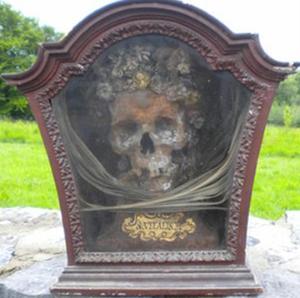
The severed head of the patron saint of genital diseases is off to Los Angeles – after it was sold at a County Meath antiques auction.

Photo Courtesy The Irish Times

An unnamed Californian phone bidder successfully won the head of St Vitalis of Assisi for $5,000.
The bizarre item sold in Duleekis reportedly the head of 14th-century Italian saint who became a hermit in later life after years of promiscuity as a youngster.

Following his death in 1370, the Benedictine monk became known as the patron saint of those suffering from genital disease.

The skull of the saint, enshrined in an antique glass case, had been on display in the hallway of a period mansion in County Louth for many years.

Weird. That’s all I’m going to say- too many things crashing together in my head…
Full story here.

Limitations of Clergy Sexual Abuse Report

I haven’t gotten through the report itself yet, but there has been some welcome clarification on one point:

The researchers conclude that there is no causative relationship between either celibacy or homosexuality and the sexual victimization of children in the Church. Therefore, being celibate or being gay did not increase the risk of violating children. So, blaming the clergy abuse crisis in the Catholic Church on gay men or celibacy is unfounded.

Psychologists (and LGBT persons) have realized that this was the case, and despite their protestations, certain bishops and Cardinals have placed the responsibility for the sex abuse scandal squarely in the laps of gay priests. Not so. Completely refuted and repudiated.

Hopefully, for the last time.

Yeah, you’re right. Religious homophobes are unlikely to let this go….

The NCR has an excellent synopsis- and gives a critical eye:

Release of the John Jay College study on the causes of sexual abuse by Catholic priests signals the end of the U.S. bishops’ five-year, $1.8 million inquiry into the institution they govern and the priests in their charge. But the new study hardly quiets the fundamental questions that have dogged the church and its leaders since the crisis was first publicized in the mid-1980s.

The conclusions of the study were immediately challenged by victims of abuse, their advocates, and those who maintain an enormous archive of documentation related to the scandal. Among the reasons they say the report should be approached with caution or skepticism:

  • Questions persist about the reliability of the basic data that underpins both the most recent study, as well as one on the nature and scope of the scandal that was released in 2004, because the researchers relied principally on reporting by bishops. The reliability of such reporting is called into question on a number of fronts and was most recently challenged by a grand jury report that claimed that officials of the Philadelphia archdiocese had not reported dozens of credibly accused priests. Doubts about the reliability of the numbers were even given credibility by one of the John Jay researchers in a recent interview.
  • The conclusion that priests’ behavior was influenced by and reflected turmoil in American culture during the 1960s and 1970s is called into question, or at least qualified, say experts, given revelations of similar widespread scandals in the United Kingdom and several European countries. The dimensions of the scandal in those countries surfaced in recent months, at a point when the John Jay researchers were concluding research on the U.S. church.
  • The lack of any in-depth look at institutional dynamics, particularly clerical/hierarchical culture, an element some think is integral to understanding why and how abuse of children was covered up and tolerated for so many years.

Beyond the limited dimensions of the study — it covered the years 1950 through 2010 and concentrated on the behavior of priests — questions persist about the bishops’ role in protecting perpetrators and shuffling abusive priests.

Read the full story here. And when you hear that this crisis was precipitated by gay priests- you can comfortably tell anyone spreading this lie that they’re full of shit.

Shades of Hunthausen?

Bishop Richard Morris’ (of Toowomba, Australia) removal by Pope Benedict XIV has some muscle memory for those of us who suffered through the Hunthausen shakedown. Heavy-handed tactics on the part of the papacy toward Hunthausen, one of the most Christ-like bishops I’ve ever known, still stings. A reminder from Richard McBrien:

The removal of Bishop William Morris from the pastoral care of the Australian diocese of Toowoomba, Queensland, where he has been bishop since 1993, is reminiscent of two other cases: that of Bishop Jacques Gaillot of the diocese of Evreux, Normandy, France, in 1995, where he had been bishop for 12 years, and the effective removal of Archbishop Raymond Hunthausen from the archdiocese of Seattle in 1986, where he had been archbishop since 1975.

I say “effective removal” because, although Hunthausen was not removed as such, a younger bishop was installed over him, with authority that no longer belonged to the archbishop.

That younger bishop is now an archbishop himself and a cardinal as well: Donald Wuerl, who also heads the U.S. Bishops’ Committee on Doctrine, which just issued a condemnation of Sr. Elizabeth Johnson’s 2007 book, Quest for the Living God. Johnson is a Sister of St. Joseph and is a Distinguished Professor of Theology at Fordham University in New York.

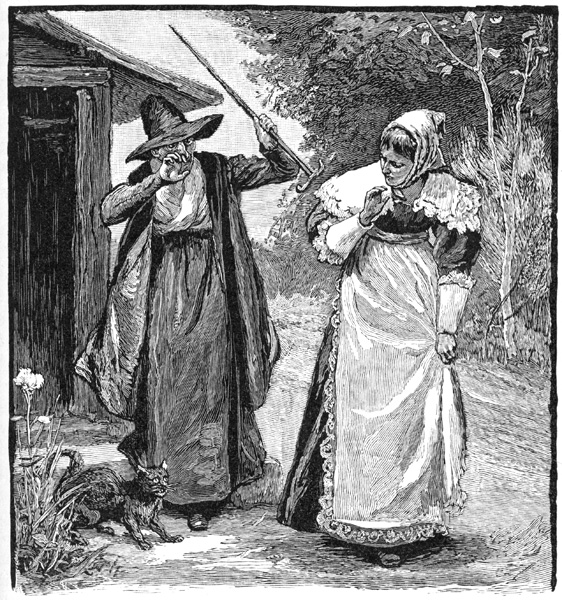
This is just getting creepy. Even discussion is being forbidden. Witch hunt, anyone?

Full article here.

Catholics Becoming Protestants

Jesuit Thomas Reese, former editor of the magazine America– and someone I respect greatly, is sharing some of his concerns about the “New Exodus” in the Catholic Church.

Any other institution that lost one-third of its members would want to know why.

And why not the Catholic Church?

…the U.S. bishops have never devoted any time at their national meetings to discussing the exodus. Nor have they spent a dime trying to find out why it is happening.

Thankfully, although the U.S. bishops have not supported research on people who have left the church, the Pew Center has.

…One of the reasons there is such disagreement is that we tend to think that everyone leaves for the same reason our friends, relatives and acquaintances have left. We fail to recognize that different people leave for different reasons. People who leave to join Protestant churches do so for different reasons than those who become unaffiliated. People who become evangelicals are different from Catholics who become members of mainline churches.

An excellent article- well worth the read. If you’re like me, you may recognize many people you know, or even yourself. Full article here.

Update: This may also be part of the reason.

Catholics And Marriage Equality

There has always been a strong sense of social justice in the catholic tradition- especially in the minds of the people in the pews. The great advocates of social reform and justice more often come from the laity and monks and nuns- persons more in touch arguably, with the gospel and real life in general. Mother Theresa, Dorothy Day, Francis of Assisi, all railed against the marginalization of human beings- creating real social change in the world. Bishop Oscar Romero and Pope John XXIII were the exception more than the rule.

So, it was with a lot of hope that I read this:

Last month, the Public Religion Research Institute, a nonprofit group, reported that 74 percent of American Catholics surveyed supported the rights of same-sex couples to marry or form civil unions (43 percent and 31 percent, respectively). The telephone survey asked more than 3,000 adults to choose among three options: whether gay couples should be allowed to marry, should be allowed to form civil unions or should receive no legal recognition. By comparison, 16 percent of white evangelical Christians approved of same-sex marriages; 24 percent approved of civil unions. Among the general public, those rates climb to 37 and 27 percent, respectively — still lower than among Catholics.

Catholics have always had a great sense of the social justice elements of issues- a strong sense of the suffering of humanity, I believe. They take the mandate of service very literally- the Sermon on the Mount and the Corporal Works of Mercy were always stressed in my own religious upbringing.

Evangelical Christians are more likely to struggle with fundamentalism on this and other issues, citing (often unclear or inconsistent) scripture passages, and tending to ignore social science or scientific evidence in favor of the bible.

I do know one thing: Last week, at my mother’s Catholic funeral, I introduced my partner to everyone I knew and grew up with in that little church and we were received with nothing but warmth.

Nothing but.

If only the leadership would get it- and all those gay clergy (and bishops!) would share their experience- we might have a shot at addressing reality….

No matter- the people in the pews have always been ahead of the curve. It’ll happen eventually.
Beatification of Pope John Paul II

The  only Pope I ever met, served Mass for- and who touched my face more than once, is now being moved closer to sainthood– with the current Pope’s gratitude for his predecessor doing most of the heavy lifting in the past 40 years, apparently.

I really liked the man personally, and found him to be very kind and genuine in every encounter we had (hence the photo- I love that he was playful). Being a liberal, I would have liked him to be more like myself, but don’t we all want that?

But, more to the point, this beatification is an excellent sleight of hand- especially with the church fighting for survival in so many places. John Paul’s popularity and personal charisma is such a stark contrast to the man in the chair now, that I can’t help but think this will backfire.

Maybe it’s the fight that’s the problem. The church always did have a weakness for warlike metaphor….