Why HIV Testing and Treatment Are Still Issues

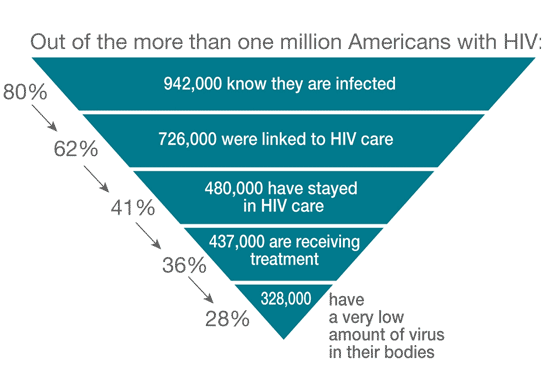
A key concept for anyone considering the success of anti-HIV treatment in improving the health of individuals and in preventing onward transmission in their communities is the ‘treatment cascade’ or ‘care continuum’. This shows how, at every stage, patients are not retained in the healthcare system or are unable to access the medical care they need.

(Source)

Specifics: Obamacare and HIV

click for more info

From Think Progress By Tara Culp-Ressler

new brief from the Kaiser Family Foundation reports that President Obama’s health care reform represents a significant step forward for Americans with HIV, helping to expand health insurance to many HIV-positive individuals who would be “otherwise unable to access affordable and stable health care coverage.” Representing hugely important tactics to continue addressing the HIV/AIDS epidemic, several of Obamacare’s provisions will have a directly positive impact on the estimated 1.1 million Americans who live with the HIV virus:

  • Obamacare will prevent insurance companies from denying HIV-positive Americans coverage simply based on their HIV status. The health care reform law prohibits insurance companies from discriminating based on pre-existing conditions, including HIV. Before Obamacare, Americans living with HIV often struggled to find insurance companies willing to take them on — according to the Kaiser Family Foundation, just 13 percent of HIV-positive individuals were covered under private insurance in 2010.
  • Obamacare’s expansion of the Medicaid program helps low-income Americans with HIV who otherwise wouldn’t qualify for coverage. Over 40 percent of HIV-positive Americans accessed their health insurance through the Medicaid program in 2010, and expanding Medicaid even further will extend additional coverage to this community. Furthermore, under Obamacare, HIV-positive individuals do not have to have to be diagnosed with AIDS as a precursor to qualifying for Medicaid coverage. Although this was an old eligibility requirement for the program, the health reform law ensures the states that accept Obamacare’s Medicaid expansion will not have to impose this restriction on Americans living with the HIV virus.
  • HIV-positive Americans will no longer reach limits on the amount of treatment their insurance companies are willing to cover. Obamacare eliminates lifetime coverage caps and phases out annual limits, which will help all Americans with chronic conditions — including the Americans who rely on treatment for HIV infections — continue to be able to afford the care they need without reaching an arbitrary cut-off set by their insurance companies.
  • HIV testing will likely be covered under Obamacare. This year, the U.S. Preventive Services Task Force is expected to recommend routine HIV screenings as a part of regular preventative care, similar to a routine blood pressure test. Since the health reform law requires insurers to cover the preventive services recommended by the Preventative Services Task Force, a new standard for HIV testing could ensure that it becomes a standard part of annual check-ups. The Centers for Disease Control estimates that about 20 percentof the total population of Americans who are infected with HIV don’t know they have the virus, so regular tests that don’t incur an out-of-pocket expense could help encourage more Americans to learn their status.
  • Since Obamacare helps close the prescription drug coverage gap for Medicare beneficiaries, HIV-positive individuals will be more likely to afford their drug treatments for the virus. By closing the “donut hole,” or the gap in coverage for expensive prescription drugs under the Medicare program, Obamacare will help ensure that older Americans living with HIV aren’t unable to afford any of the 26 antiretroviral drug treatments that can be used to combat HIV infections. Twelve percent of Americans with HIV relied on Medicare for their health coverage in 2010, and that number may rise significantly as the population of HIV-positive Americans continues to age.
  • Obamacare increases resources for HIV research and prevention. The health care reform law allocates $10 billion over ten years for a new fund that focuses on prevention, wellness, and public health activities. In 2010, $30 million from that fund was awarded to the Centers for Disease Control for HIV prevention activities, including new investments in HIV surveillance and testing among high-risk populations.

Car Crashes Knocked Off By Suicide

From WebMD:

Suicide has overtaken car crashes as the leading cause of injury-related deaths in the U.S.

English: Skull and crossbones

English: Skull and crossbones (Photo credit: Wikipedia)

While public health efforts have curbed the number of car fatalities by 25% over the last decade, a new study shows suicide deaths rose by 15% during the same period.

“Comprehensive and sustained traffic safety measures have apparently substantially diminished the motor vehicle traffic mortality rate, and similar attention and resources are needed to reduce the burden of other injury,” researcher Ian Rockett, PhD, MPH of West Virginia University and colleagues write in theAmerican Journal of Public Health.

“Contrasting with disease mortality, the injury mortality rate trended upward during most of that decade,” write the researchers.

The top five leading causes of injury-related deaths were:

  1. Suicide
  2. Motor vehicle crashes
  3. Poisoning
  4. Falls
  5. Homicide

Researchers say the findings demonstrate that suicide is now a global public health issue.

And I would remind readers that LGBT youth attempt suicide at four times the rate of their peers. Notably because of intolerance, shame and fear perpetuated by ignorant institutions and people- sadly, many of them “Christians”.  So here’s a not-so-gentle reminder:

“…but whoever causes one of these little ones who believe in Me to stumble,
it would be better for him to have a heavy millstone hung around his neck,
and to be drowned in the depth of the sea.” ~Matthew 18.6

Bozeman Gay/Bi Men’s Group Starts October 9

We’re starting registration for our Fall Group! This is an amazing opportunity for personal and community growth, and we’d love to have any Gay/bi men from the Bozeman area call to talk with Laura about the particulars. Info below:

8-Week Gay/Bi Men’s Process Group

This group begins October 9, 2012
Tuesday evenings, 6:30-8 pm, in Bozeman, MT

Laura Bailey, MS LCPC, and
D Gregory Smith, MA, LMHCA, SMS
FacilitatorsThis 8-week group will explore
Dating ~ Relationships ~ Being Out ~ Mental Health
Community ~ Substance Use ~ Being Healthy
~Whatever You Need To Talk About!
~FREE, SAFE AND CONFIDENTIAL~PARTICIPATION IS LIMITED TO 8 MEMBERS.
If you would like to participate,
please contact Laura Bailey
406-539-8890

HIV-positive Women Find Support In Dating Again


Being HIV-positive is a challenge. Being HIV-positive and single is often a nightmare. We all want to love and be loved, but the barriers- social and psychological- for HIV-positive persons are high. From The Seattle Times:


Like many women with HIV/AIDS, Nicole Price worried about love and life, post-diagnosis. She now counsels HIV-positive women on forging romantic relationships, knowing each time out that disclosing one’s status can be a deal-breaker.


In 2000, Nicole Price’s ex-boyfriend fell ill. They had recently ended a five-year relationship, so she went to see him in the hospital. He had AIDS.

English: HIV positive dating

She got tested. She was 24.

“It was the longest two weeks of my life,” said Price, now 37. We thought we would get back together because we both had it.”

At the time of her diagnosis, Price was using meth and living in California when her mother, a Bothell resident, learned about a Seattle-based support group for HIV-positive women.

Within two years, she packed her bags for Bothell for a fresh start.

Like many women with HIV/AIDS, Price worried about love and life, post-diagnosis. Once she settled here, she became increasingly involved with the support group, BABES Network-YWCA, eventually rising to program manager. Price now counsels HIV-positive women on forging romantic relationships, knowing each time out that disclosing one’s status can be a deal-breaker.

“They can stop having sex altogether and never do it again,” Price said. “Some of our women have chosen to be in a lesbian relationship. Actually quite a few of our women have. I think they feel that betrayal. They feel like maybe they got betrayed, and now they have issues when it comes to men.”

Trusting a sexual partner and dealing with rejection are regular topics at BABES.

Through peer counseling, support groups, educational lectures and retreats, BABES tackles the challenge of maintaining relationships — especially romantic ones — after testing positive. Women take part in mock disclosures, an exercise meant to ease the stress of telling a partner about being HIV-positive.

“I encourage women to date when they’re ready. I ask them questions to see if they’re ready. When do you want to disclose your status? Are you ready for the response?” said Brenda Higgins, a BABES peer advocate.

“I’m never ready for the response I’m getting,” she added. “There’s really no way of preparing someone with that.”


Read the full story here

Raging Against The Hate Machine

In light of this:

“the Republican platform included language rejecting not just same-sex marriage but also the watered-down alternative that many elected officials find more palatable: civil unions. The GOP platform committee also defeated a proposed amendment that said all Americans should be treated “equally under the law” as long as they’re not hurting anyone else.”

I present this:

Hard Truths (About Gay Men & HIV)

From NAPWA’s Positive Voice Newsletter:

National Gay Men’s HIV/AIDS Awareness Day – NGMHAAD – is coming September 27, three months to the day after National HIV Testing Day, and hard on the heels of July’s landmark International AIDS Conference (IAC) in Washington, D.C. We have two messages this year: Be aware, know your risk, and, Let’s end this epidemic! Because we matter – and we can.

Speaker after speaker at IAC returned to this year’s good but challenging news: yes, we still need more science to stamp out HIV – more and better antivirals, an effective vaccine, and a functional cure – but we already have all the biomedical tools we need to make new HIV infections a thing of the past. The hard part is reaching “key populations” – groups with high rates of existing infections and new infections because they have been marginalized, stigmatized, denied civil rights, and excluded from health care.

NGMHAAD is for one of those “key populations:” this country’s men who have sex with men (MSM). NAPWA founded NGMHAAD in 2008 because we want them to know the epidemic isn’t over. We want them to know how high their HIV risk really is – because so many are already infected, and too many don’t know it. And we want them to know that we’ve come a long way since AIDS was first reported in 1981, and even further since Stonewall, but stigma is still driving this epidemic and gay men don’t have to take it anymore.

So let’s look at some numbers and see what that the gay men’s HIV epidemic looks like in the U.S.

The July 28 issue of The Lancet opened an admirable series of articles on HIV among gay men worldwide with a look at epidemiology, and reported that HIV prevalence among men who have sex with men in its North American region is a jaw-dropping 15.4% – almost one in six. The real prevalence may be a little lower – The Lancet assumes that only 3.7% of American men are MSM, a number we think is too low, and raising the estimated number of MSM would reduce the calculated prevalence a little – but it’s still clear that prevalence is breathtakingly higher among MSM than in the rest of the population.

Let’s calculate just how much higher.

About 251 million Americans are 15 or older. If 5 percent of the men are MSM, we have 6.3 million MSM and 245 million “others” 15-and-older in this country. We’re all familiar with the CDC’s estimates that 1.2 million Americans are living with HIV, and 60% of them are MSM. That gives us 480,000 infections in 245 million “others,” for a prevalence of 0.2% – one in five hundred. It also gives us 720,000 infections in 6.3 million American MSM, for a prevalence of 11.5% – just shy of one in eight. HIV prevalence among American MSM is almost 60 times what it is in the rest of the population.

That means HIV-negative MSM who are active with partners whose status they don’t know are at much higher risk than many realize. So the first and most important message of National Gay Men’s Awareness Day is – simply – be aware. Know your status. Know your risk. If you aren’t absolutely sure you know your own and your partner’s status, keep your condoms handy.

In September 10’s Positive Voice, we’ll write about how we got to where we are and what’s needed to deal with the MSM epidemic on the ground. Why near-universal testing is so important when prevalence is already so high. The need to confront stigma and talk frankly about sex in communities where this is deeply uncomfortable. The need for pride and love. The need to have culturally competent and welcoming health care for MSM.

And in the September 24 issue, just three days before NGMHAAD, we’ll remember the quarter-million (at least) American MSM who have died of AIDS and examine our responsibility as their survivors to demand action to end this epidemic once and for all. Now that we can, we must.
Red Ribbons And Mosquitos

Yesterday, a friend sent me the following:

“Today I saw this headline:

West Nile Outbreak Largest Ever, 41 dead

and it made me think of this:

Rare Cancer Seen In 41 Homosexuals

…and wondering about what makes a disease a crisis versus a judgment. The number of victims was the same.”

Indeed.

And to further the irony, the famous speech given by Mary Fisher to the Republican National Convention in 1992- 11 years after the rise of “gay cancer” was highlighted in a feature by the New York Times today:

TWENTY years ago this month, Mary Fisher took the stage of the Republican National Convention at the Houston Astrodome and delivered a 13-minute prime-time speech that was seen by many as a sharp rebuke of her party’s negligence in the face of the growing AIDS epidemic.

Mary Fisher in 1992 made what is considered one of the best American speeches of the 20th century.

Ms. Fisher, a mother of two young children who had worked in Gerald Ford’s White House, addressed the delegates as someone who was H.I.V. positive herself. “Tonight, I represent an AIDS community whose members have been reluctantly drafted from every segment of American society,” she said. “I am one with a black infant struggling with tubes in a Philadelphia hospital.” She added, “I am one with the lonely gay man sheltering a flickering candle from the cold wind of his family’s rejection.”

It was a speech that was both surprising and poignant. Few, including Ms. Fisher herself, expected that she would survive a disease that had already killed more than 150,000 Americans by the summer of 1992.

But Mary Fisher is still alive — and still taking issue with her political party.

As she should. The discrimination and loathing that prevented government intervention is still with us. It’s made itself known in issues of women’s health, gender inequity, transgender rights and the House defense of DOMA.

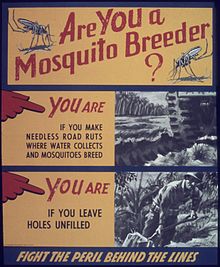
However, West Nile will probably not become the epidemic that AIDS did. Because mosquitos don’t discriminate.

They bite everyone.


With Resistance to Treatment Rising, CDC Updates Gonorrhea Treatment Guidelines

From The National Coalition Of STD Directors:

Today, the Centers for Disease Control and Prevention (CDC) released updated guidelines for the treatment of the sexually transmitted disease gonorrhea, which is a major cause of pelvic inflammatory disease, ectopic pregnancy, and infertility and can facilitate HIV transmission.[i]  CDC estimates there are more than 700,000 gonorrhea infections each year in the United States.  The updated guidelines were published in CDC’s Morbidity and Mortality Weekly Report. 

The change marks an end to CDC exclusively recommending oral antibiotic treatment as the first line of defense for gonorrhea, and now instead recommends that infections be treated with the injectable antibiotic ceftriaxone in combination with one of two other oral antibiotics, either doxycycline or azithromycin.  This change in treatment has significant implications for clinical service delivery and infected patients alike, as the simple act of taking pills is replaced by an administered injection by a certified health professional.

“We applaud the CDC’s preemptive strike of changing recommended treatment and with the intention of extending the life of the last effective drug,” said William Smith, Executive Director of the National Coalition of STD Directors (NCSD). “However, the rising resistance of gonorrhea to our last line of defense against it must be a clarion call to policymakers and private industry alike to invest in the research and development pipeline for new antibiotics and more sophisticated diagnostics…and quickly.  We desperately need additional options to meet the challenges of this infection,” continued Smith.

Last summer, the CDC sounded the alarm on gonorrhea’s rising resistance to antimicrobials. This report outlined that we are on the verge of a highly untreatable gonorrhea epidemic as   gonorrhea has developed resistance to every class of antibiotics put up against it and there is no new drug in the pipeline.  Documented increases in resistance throughout the U.S. are what has prompted the CDC to make the current recommended treatment change.

Full presser here.

Join NAPWA (and me) For Free

Infected/Affected by HIV/AIDS?

Join the National Association of People With AIDS (NAPWA). NAPWA is doing amazing work advocating for people HIV infected- and affected. It’s important that they have people from rural areas in their membership, so if you are HIV+ and live in Montana (or other rural areas) I would encourage you to join. From their mission statement:

Founded as a 501(c)(3) charitable organization in 1983, NAPWA advocates for the lives and dignity of all people living with HIV/AIDS, especially the more than a million Americans who live with it today. We want the epidemic to end, and we want life to be better for people with HIV until it does.

They are offering- for the first time ever- a free one year membership. To join me as a NAPWA member, click here:  http://www.napwa.org/freemembership