Secretary Clinton On HIV: “Embrace Treatment As Prevention”

Secretary of State Hillary Clinton today called for a new approach to ending HIV– treatment as prevention.

Clinton said the answer was clear.

“If we take a comprehensive view of our approach to the pandemic, treatment doesn’t take away from prevention. It adds to it,” she said. “So let’s end the old debate over treatment versus prevention and embrace treatment as prevention.”

You said it sister.

This administration has made HIV treatment and prevention a priority- in a way no other administration ever had the courage or the moral fiber to do. Just another reason not to go back to the Draconian Health Nightmare that was the Bush Administration by electing another Republican administration….

Full text and video here

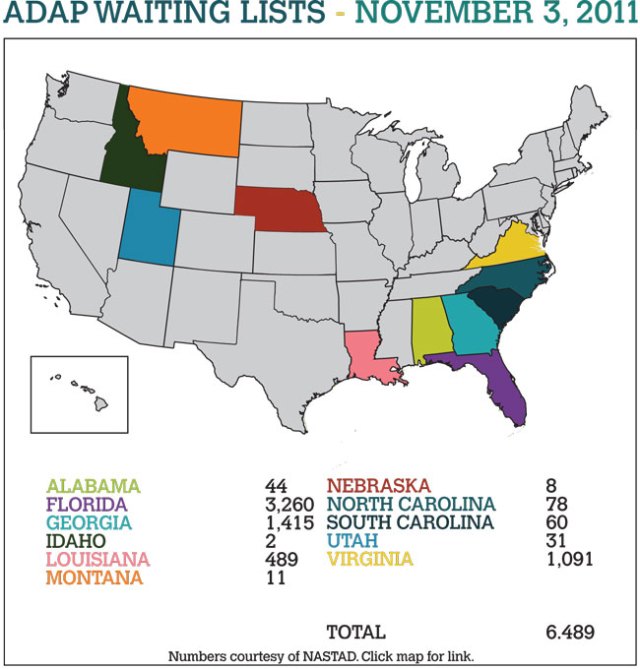
AIDS Drug Assistance Program Numbers, 11/03/11


From The NAPWA Positive Voice Newsletter:

The waiting lists numbers keep coming down – a little. The federal government released $1.8 billion to support federal-state HIV partnerships, with $813 million earmarked specifically for ADAP programs with waiting lists.

The release of funds is slow, though, and the four states that account for almost the entire waiting list – Florida, Georgia, Virginia, and Louisiana – aren’t stepping up to the plate to match the additional federal money.

The waiting list states say they can’t afford it. We visited Florida’s ADAP debate in the October 24 Positive Voice. Let’s turn in this issue to Georgia.

Georgia Public Broadcasting reports the state’s waiting list numbers have fallen by about 300, from roughly 1,700 to 1,400, with $3 million in new federal funds. Eliminating the waiting list altogether, state officials say, would cost $15 million the state doesn’t have.

Time for a reality check….

Georgia’s proposed 2012 budget is $20 billion. The $15 million that would eliminate the waiting list amounts to 0.075% – less than one-tenth of one percent – of that budget. Even in a period of state financial stress, with an expected five percent deficit, the needed $15 million is so minuscule that spending it or not spending it to end the waiting list has no material impact on the state’s budget crisis. But Georgia’s political conversation continues to be dominated by proposals to lower higher-income and corporate tax rates and “pay” for the cuts by cutting services and shifting tax burdens to middle and lower-income Georgians.

Georgia’s $15 million we can’t is really a $15 million we don’t want to. And the future cost of this year’s $15 million we don’t want to will be a lot more than $15 million.

Here are the latest waiting list numbers from our friends at NASTAD:

Hope for MT? : Commonwealth Countries Asked To Decriminalize Gays

Leaders of Commonwealth countries will be asked to decriminalise homosexuality to help to stop the spread of HIV, an Australian official has said.

Forty-one of the 53 Commonwealth countries – including Uganda, Zimbabwe and Ghana – still criminalise gay sex and HIV campaigners say such laws are seriously hampering safe sex initiatives.

The 2011 Commonwealth Heads of Government Meeting (CHOGM) will be held in Perth, Australia from 28-30 October.

CHOGM 2011 will bring together more than 50 world leaders representing approximately one-quarter of the world’s countries and one-third of the world’s population. The meetings originated with the of the leaders of the self-governing colonies of the British Empire in 1887- and still has great influence in setting human rights policy throughout the world.

Sodomy laws in the US were invalidated by The U.S. Supreme Court in the ruling of Lawrence vs. Texas in 2003. However, several states- including Montana- still keep these shameful and impotent laws on the books- despite reasonable efforts to remove them– presumably as a slap in the face to the “Uppity Gays”. And yes, I will mention (Again!) that the Official Montana Republican Platform still calls for the criminalization of homosexual acts.

Will this meeting in Australia have an effect in Montana?

Probably not- at least not directly. I suspect this will not be seen as a discussion of human rights, but as a discussion of disease and epidemics- at least at first. And if the last legislative session is any indication, the zenophobes in charge of Montana’s legislative agenda will see it as unimportant (and non-applicable) world politics that don’t apply here.

But any progress is good progress- and this is progress- this discussion has never happened at this world level before- and it eventually filters through. Even to Montana.

I just hope I live to see it.

Feds to Release 1.89 Billion for ADAP, HIV Care

From The Michigan Messenger:

The federal government Monday announced more than $1.89 billion in funding to states to fight the HIV epidemic with access to care and with more cash for the failing AIDS Drug Assistance Program.

According to an HHS press release, $813 million of that money will go directly to the ADAP programming. An additional $8,386,340 will be issued as a supplement to 36 states and territories currently facing a litany of unmet needs and access issues. The additional money is designed to help those programs reduce or eliminate their waiting lists. They also released an additional $40 million to assist states and territories currently refusing coverage for people in need to reduce the number of people waiting.

ADAP provides access to the costly anti-retroviral medications that have turned HIV into a more manageable disease since its appearance 30 years ago. The drugs can cost tens of thousands of dollars a year in the U.S. The program also assists in paying for drugs to treat opportunistic infections that HIV positive persons can suffer as a result of diminished immune functions.

The ADAP Advocacy Association shows that as of Sept. 22, 10 states had waiting lists totaling nearly 9,000 people awaiting access to the life saving medications:

ADAPs with Waiting Lists
(8,785 individuals in 10 states*, as of September 22, 2011)

Florida: 4,098 people
Georgia: 1,732 people
Idaho: 37 people
Louisana: 1,112 people
Montana: 28 people
North Carolina: 354 people
Ohio: 9 people
South Carolina: 367 people
Utah: 59 people
Virginia: 989 people

In addition to funding ADAP programming, the feds also announced millions in funding for direct medical care as well as programming to assist minorities — who are particularly hard hit by the epidemic — in accessing medical care for the infection.

Kudos to all the activists and HIV care advocates who worked hard for this- and for those of you who signed our petition….

New Microbicide May Block HIV From Entering Cells

H I V

More good news on the HIV research front.

From Science Daily:

University of Utah researchers have discovered a new class of compounds that stick to the sugary coating of the AIDS virus and inhibit it from infecting cells — an early step toward a new treatment to prevent sexual transmission of the virus. 

Development and laboratory testing of the potential new microbicide to prevent human immunodeficiency virus infection is outlined in a study set for online publication in the journal Molecular Pharmaceutics.

…”Most of the anti-HIV drugs in clinical trials target the machinery involved in viral replication,” says the study’s senior author, Patrick F. Kiser, associate professor of bioengineering and adjunct associate professor of pharmaceutics and pharmaceutical chemistry at the University of Utah.

“There is a gap in the HIV treatment pipeline for cost-effective and mass-producible viral entry inhibitors that can inactivate the virus before it has a chance to interact with target cells,” he says.

As scientists learn more about how HIV attaches to CD4 cells, there will be more and possibly less problematic ways to treat and prevent HIV infection.

Full story here.

Another Reason To Start HIV Meds Early

From Science Daily:

Researchers at Weill Cornell Medical College and GHESKIO (Groupe Haitien d’Etude du Sarcome de Kaposi et des Infections Opportunistes) have shown that early treatment of HIV not only saves lives but is also cost-effective.

And the recommended blood levels of T-cells as markers to start treatment is creeping up:

Before 2009, the World Health Organization (WHO) recommended waiting to initiate antiretroviral therapy (ART) for HIV until a patient’s CD4+ T cells fall below 200 cells per cubic millimeter. But in that year, a randomized clinical trial completed by Weill Cornell researchers at the GHESKIO clinic in Port-au-Prince, Haiti, demonstrated that early ART decreased mortality by 75 percent in HIV-infected adults with a CD4 cell count between 200 and 350 cells/mm3. As a result, the WHO now recommends that ART is started in HIV-infected people when their CD4 cell count falls below 350 cells/mm3.

Full story here.

TAKE ACTION!

I spent the weekend with 30 HIV+ Gay men in the mountains outside of Helena, Montana. They ranged in age from their early twenties to their mid sixties. It was like every other gathering of gay men in many respects- with one exception: we talked a lot about our health- and our medications.

Mostly about the reliability of receiving these life-saving meds.

It creates a lot of stress for us. The meds are expensive, they have side-effects, they are sometimes mailed from pharmacies with in a day or two of our running out. It often requires us to hound our caseworkers to get what we need- every month, in some cases.

As in most cases with issues of efficiency, increased funding will help. But Congress always needs to be hounded in order to give the HIV+ the kind of funding we actually need. The kind of funding that other medically disabled get almost automatically.

We don’t even have enough money to take care of those waiting to be admitted to government programs that people already qualify for.

Thus The Waiting List for the AIDS Drug Assistance Program. It needs to end- and you can help. Click the link below the map.


SIGN THE PETITION TO END ADAP WAITING LISTS HERE   

ADAP Watch, 9.12.11

From NAPWA’s Positive Voice Newsletter:

We’re beginning to think we’re trapped in the movie Groundhog Day.


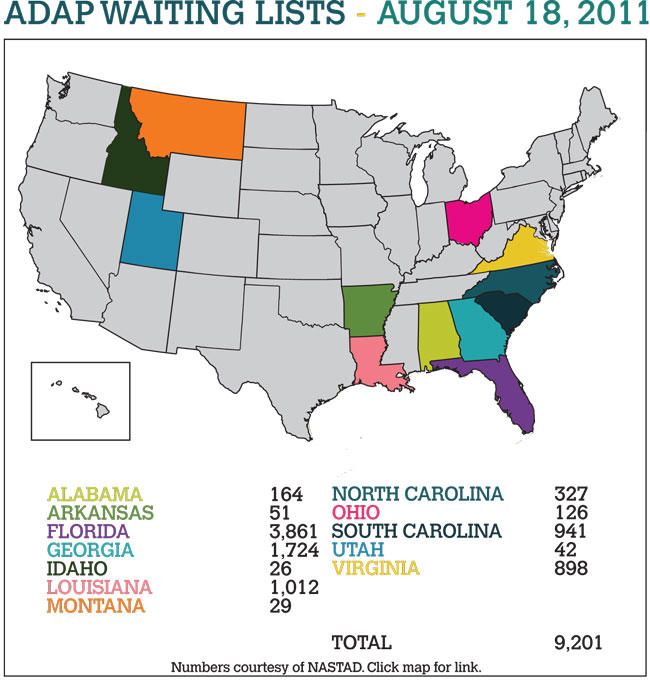
Week after week, the waiting list numbers hover just over 9,000. Week after week, Congress doesn’t – and can’t – act. Week after week, Florida alone accounts for nearly half the waiting list numbers, and Florida doesn’t act.


Assuming an annual medications cost of $15,000 per ADAP recipient per year, $135 million a year in new ADAP funds would be enough to make this national disgrace go away. That’s less than four one-thousandths of a percent of the federal budget. If the will were there, the money could be found.


$60 million would do the job in Florida – not very much, even in Florida’s $70 billion state budget. But Florida doesn’t even seem to be spending the money already available effectively. Just before Labor Day, the Orlando Sentinel reported health officials for Orlando County and three neighboring central Florida counties had underspent their Ryan White funds by a half-million dollars – about six percent of the total $9 million, which suggests a certain lack of commitment to serving the people Ryan White funds are meant to help. And it’s a pity the unused funds couldn’t have been put to other uses, instead of just being help for possible use next year. They could have paid for drugs for more than thirty central Floridians currently on the ADAP waiting list.


Here are the latest waiting list numbers from our friends at NASTAD:

Sign the petition to end the waiting list here.


ADAP Crisis Makes Local News


An excellent story by Jessica Mayrer of the Missoula Independent highlights the National HIV Drug Crisis- and Montana’s link:

Montanans who can’t afford HIV drugs have recourse. The federally funded AIDS Drug Assistance Program provides medicine at no cost. What worries Smith and his clients is the fact that the program isn’t meeting demand. In January, 4,200 people nationally were waiting for entry into ADAP. At the end of August, that number grew to 9,200. ADAP now provides drugs to 107 of Montana’s 532 known HIV-positive patients, according to the state Department of Public Health and Human Services. In Montana, 28 people now await ADAP assistance. That’s up from 21 last year.

Full story here.

And if you haven’t signed the petition to Denny Rehberg, go here.


Montana Petition To End ADAP Waiting Lists.


Hey friends,

I’m working with Project Inform to help with HIV Advocacy in the State of Montana. One of our projects is to work with Congress to increase ADAP (AIDS Drug Assistance Program) funding. Currently, there are over 9,200  people waiting for permanent funding to access these life-saving medications. 

We can do better. And your signatures can help make a difference.

Won’t you take a minute and sign the petition here? The letter to accompany the signatures is below.

Thank you- ten seconds can make a real difference.


Dear Chairman Rehberg:

The undersigned individuals and organizations in Montana are writing to urge your support for increased funding for AIDS Drug Assistance Programs (ADAPs) in the Fiscal Year 2012 Labor-HHS-Education Appropriations bill.   ADAPs need at least a $106 million increase to continue to serve the thousands of new clients entering the programs every year.  As you are aware, ADAPs provide HIV-related medications to under insured and uninsured individuals living with HIV/AIDS in the United States. They are a lifeline for people who would otherwise be unable to get treatment they need to stay healthy and productive. We thank you for your past support for ADAP and are especially appreciative of the $50 million increase to ADAPs in Fiscal Year 2011. However, ADAP waiting lists continue to grow at an astronomical rate.

In January of this year, there were 4,200 people on waiting lists. As of August 26, 2011 the number more than doubled to 9,141people in 12 states – including 28 people in Montana – waiting for lifesaving medication. Nineteen ADAPs, including 11 with current waiting lists, have instituted additional cost containment measures since April 1, 2011 such as reduced formularies and enrollment caps. Additionally, ten ADAPs are considering implementing new or additional cost-containment measures by the end of ADAPs current fiscal year (March 31, 2012).

Because of your leadership role on the House Labor-HHS Appropriations Subcomittee, you are in a unique position to help secure this badly needed increase in ADAP funding to help people with HIV in Montana and around the country. While we understand the gravity of the U.S. fiscal situation, we need to ensure that people with HIV and AIDS receive the vital medications that keep them alive. Again we ask that you do everything possible to ensure an increase of at least $106 million to help solve this ADAP crisis.


Sincerely,