Red Ribbons And Mosquitos

Yesterday, a friend sent me the following:
“Today I saw this headline:

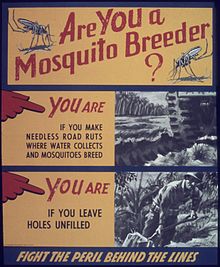
West Nile Outbreak Largest Ever, 41 dead

and it made me think of this:

Rare Cancer Seen In 41 Homosexuals

…and wondering about what makes a disease a crisis versus a judgment. The number of victims was the same.”

Indeed.

And to further the irony, the famous speech given by Mary Fisher to the Republican National Convention in 1992- 11 years after the rise of “gay cancer” was highlighted in a feature by the New York Times today:

TWENTY years ago this month, Mary Fisher took the stage of the Republican National Convention at the Houston Astrodome and delivered a 13-minute prime-time speech that was seen by many as a sharp rebuke of her party’s negligence in the face of the growing AIDS epidemic.

Mary Fisher in 1992 made what is considered one of the best American speeches of the 20th century.

Ms. Fisher, a mother of two young children who had worked in Gerald Ford’s White House, addressed the delegates as someone who was H.I.V. positive herself. “Tonight, I represent an AIDS community whose members have been reluctantly drafted from every segment of American society,” she said. “I am one with a black infant struggling with tubes in a Philadelphia hospital.” She added, “I am one with the lonely gay man sheltering a flickering candle from the cold wind of his family’s rejection.”

It was a speech that was both surprising and poignant. Few, including Ms. Fisher herself, expected that she would survive a disease that had already killed more than 150,000 Americans by the summer of 1992.

But Mary Fisher is still alive — and still taking issue with her political party.

As she should. The discrimination and loathing that prevented government intervention is still with us. It’s made itself known in issues of women’s health, gender inequity, transgender rights and the House defense of DOMA.

However, West Nile will probably not become the epidemic that AIDS did. Because mosquitos don’t discriminate.

They bite everyone.


National Gay Men’s HIV Testing Awareness Day

(click for more info)

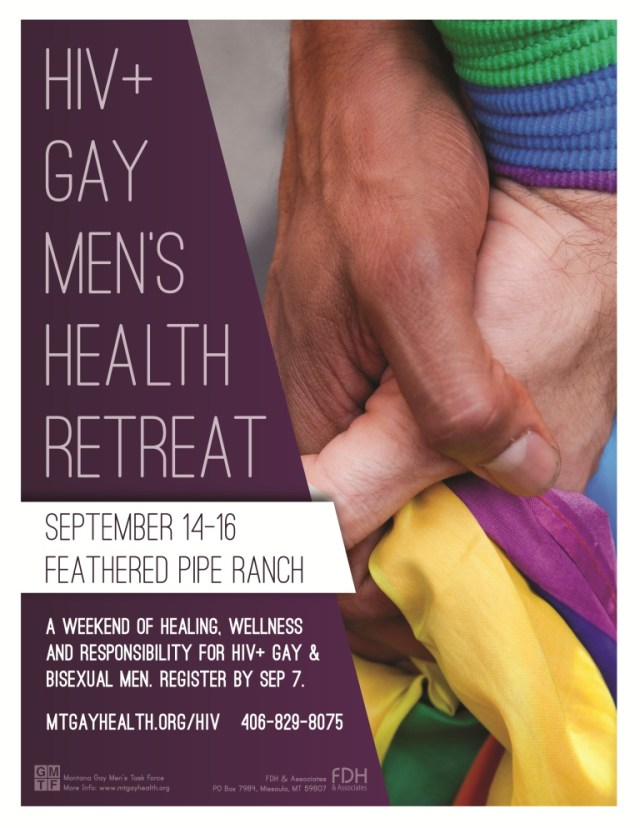
HIV Gay/Bi Men’s Health Retreat

When:  September 14 – 16, 2012

Where:  Helena, MT

Cost:  FREE

Registration Deadline:  September 7, 2012

• Experienced facilitators and educators • Great workshops on accessing resources  • Safe and confidential space

To Register, CLICK HERE, or if you have Questions, call:

FDH & Associates ● 406.829.8075 Or email: fdh@mtgayhealth.org

HIV Home Test A “Double Edged Sword”

Kudos to Great Falls Tribune Reporter Michael Beall for writing about the newly approved Rapid HIV Home Test- and asking Montanans in the field what they think about it.

Greg Smith, the executive director of AIDS Outreach in Bozeman, said he and others have mixed feelings about the U.S. Food and Drug Administration’s decision to approve the first over-the-counter HIV test kits.

English: Logo of the U.S. Food and Drug Admini...

English: Logo of the U.S. Food and Drug Administration (2006) (Photo credit: Wikipedia)

“I think it’s great that people will have access to testing,” said Smith, who was diagnosed with HIV in 2007. “But my concern is that they wouldn’t have the support that we offer in community-based testing situations.”

The OraQuick test is similar to the OraSure tests health clinics use and detects the presence of HIV in saliva. It returns results within 20 to 40 minutes.

The test is as simple as swabbing the upper and lower gums and inserting the test stick into a solution.

But Smith said the home test is a double-edged sword.

“On one hand, information is great, but on the other we need to provide that information so that it’s received well,” he said. “We want that support there.”

Trisha Gardner, City County Health Department community health education specialist, said reviews of the test are overwhelmingly positive, but she’s concerned because those who take the tests at home and test positive won’t have someone there to help them know what to do next. At the same time, she knows how important testing is to stopping the spread of the disease.

“You can’t do anything to control the spread of it if you don’t know you have it,” Gardner said. “People will be more likely to (get tested) because they don’t have to go in anywhere. They don’t have to be seen.”

Full story here.

Olympic Awareness

From AIDS Healthcare Foundation’s Facebook page:

I love that they’re different sizes…

Join NAPWA (and me) For Free

Infected/Affected by HIV/AIDS?

Join the National Association of People With AIDS (NAPWA). NAPWA is doing amazing work advocating for people HIV infected- and affected. It’s important that they have people from rural areas in their membership, so if you are HIV+ and live in Montana (or other rural areas) I would encourage you to join. From their mission statement:

Founded as a 501(c)(3) charitable organization in 1983, NAPWA advocates for the lives and dignity of all people living with HIV/AIDS, especially the more than a million Americans who live with it today. We want the epidemic to end, and we want life to be better for people with HIV until it does.

They are offering- for the first time ever- a free one year membership. To join me as a NAPWA member, click here:  http://www.napwa.org/freemembership

Most HIV-Positive Americans Lack Regular Medical Care

English: Enterprise Performance Life Cycle

English: Enterprise Performance Life Cycle (Photo credit: Wikipedia)

From Betsy McKay of the Wall Street Journal comes this from the recently concluded International AIDS  Conference in Washington DC:

HIV Data (1990, 2000, 2010)

HIV Data (1990, 2000, 2010) (Photo credit: cmdelaserna)

More than half of the people diagnosed with the HIV virus in the U.S. aren’t getting treatment for their infection, the U.S government said (Friday).

African-Americans and younger people are least likely to be receiving regular treatment, meaning that programs to keep them under a doctor’s care aren’t working or aren’t plentiful enough, according to a report by the Centers for Disease Control and Prevention.

While 81% of those African Americans estimated to be infected are diagnosed, only 29% get ongoing care, and just 21% are “virally suppressed,” or have their virus controlled by a regular regimen of antiretroviral, or ARV, drugs. Among Americans ages 25 to 34, 72% of those infected are diagnosed, but 28% get care and a mere 15% are virally suppressed.

Overall, an estimated 1.1 million Americans are infected with HIV. Only 46% of those who are diagnosed with HIV get regular treatment, while a quarter of all those estimated to be infected are virally suppressed.

“We’ve got to do better,” says Jonathan Mermin, director of the CDC’s division of HIV/AIDS Prevention.

The data were released at the XIX International AIDS Conference in Washington, D.C.

The challenge is to find ways to make HIV testing more widespread, and then make it easier to link those who are diagnosed directly into care — and to make sure they stay there, says Mermin.  “I want to make the healthy choice the easy choice,” he says.

And therein lies the challenge. The easy choice is sometimes pretending the choices don’t even exist….

Read the rest here. 

English: IPSF HIV/AIDS Campaign Logo

English: IPSF HIV/AIDS Campaign Logo (Photo credit: Wikipedia)


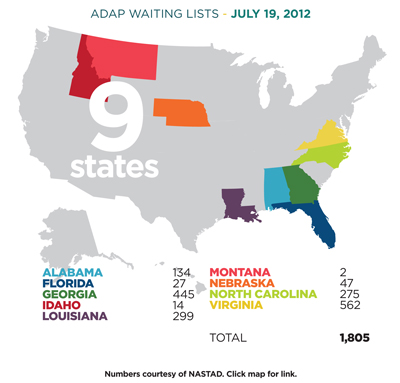
ADAP Watch 7.19.12

From NAPWA:

The Administration has pledged new money to end the waiting lists, but they will linger for some time. Making sure that everyone who needs ART drugs can get them is an obvious first step towards ending this country’s HIV/AIDS epidemic, but when the waiting lists are gone, we’ll have to move on to the hard work of changing attitudes towards people with HIV and ensuring access to health care for all Americans, not just those living with HIV.

It was grimly entertaining, explaining to Conference delegates from Canada and Germany what ADAP is and why we have waiting lists, when it’s so obviously better public health policy and so obviously more fiscally prudent to treat everyone with HIV who wants treatment. After she got past her initial disbelief, a German delegate gently suggested that there are better ways to handle this sort of thing. We wouldn’t need ADAPs, let alone have ADAP waiting lists, if we had a rationally designed national health care system.

Here are the latest numbers from our friends at NASTAD:

HIV In Prison

FYI:

  • More than 2 million people are incarcerated in jails and prisons in the United States.
  • People who are incarcerated are at increased risk for acquiring and transmitting HIV.
  • The correctional setting is often the first place incarcerated men and women are diagnosed with HIV and provided treatment.

People who are incarcerated are at increased risk for acquiring and transmitting HIV and other infections. Correctional health, public health, and community-based organizations need to improve HIV prevention and care for incarcerated populations through 1) routine HIV screening and voluntary HIV testing within prisons and jails and 2) other effective prevention strategies, including those that address inmates’ transition back into the community. Correctional institutions can be important partners in preventing and treating HIV to protect and improve inmate and community health.

More here.

Gay Men’s Wives, Homophobia and HIV

(click for source)

Discrimination and homophobia are often more prevalent in rural areas. Outreach workers in Montana know that there are certainly barriers for men to being tested for HIV. One of the most significant is the fear of being harshly judged, labelled and dismissed. It’s one of the reasons some gay/bi men get married to women and start families- they want to be ‘normal’- even though they already are. The sense of shame and guilt can be overpowering- and it’s adding fuel to the fire as far as HIV is concerned.

Rural outreach workers have known this for years- it may be one of the reasons that HIV is spreading so rapidly in the south. It’s almost certainly one of the reasons that HIV is spreading in the African American population. But we haven’t paid much attention- at least scientifically- to this issue. Now it looks as if science is actually catching up to reality. From The Sobering Truth About HIV Among MSM by Gregory Trotter, Chicago AIDS Foundation blog (July 25):

The idea of “turning the tide” against the AIDS epidemic will prove to be no more than a slogan if more is not done to address the growing number of gay/bisexual men infected with HIV worldwide, experts said today.

Speaking at an afternoon press conference today, a panel of experts presented new research – recently published in a series in the medical journal, The Lancet – that confronted the reality of HIV prevalence among MSM (men who have sex with me).  The series concluded that, in addition to medical and scientific advances, more must be done to eradicate the cultural and societal impediments of homophobia and discrimination. Until that happens, ending the AIDS epidemic is unlikely, said Chris Beyrer, a professor at Johns Hopkins Bloomberg School of Public Health. (emphasis mine)

We routinely encounter discrimination in dealing with MSM in Montana- some of whom do not openly identify as gay. In fact, some are married- with children- and do not plan on leaving their families. But they’re having sex with other men- and some are not using condoms with their wives. “If I did, she’d know I was having sex with someone else,” one client told me.

The fear of being exposed for these men is great. One man told me, “I can’t afford to be seen as gay. It would kill me- it would kill my wife.”  Shame from society, churches and social groups abut being gay have forced men to create false lives. But they haven’t stopped sexual behavior. This type of internalized shame is not uncommon here- and the wives of these men could be put at risk as a result.

Shame, homophobia and discrimination are fueling the epidemic- so are apathy and denial (see my essay Gay Men Are Flunking The Test). Part of me wonders when we’re going to start seeing a rise in HIV infection among rural women- the wives of gay/bi men. Back to Mr Trotter:

On average, MSM are 19 times more likely to be infected with HIV than the general population in low- and middle-class countries, according to Dr. Kevin Fenton, director of the National Center for HIV/AIDS.

Many African countries do not accurately report numbers of MSM and some do not even acknowledge they have MSM among their population, said Paul Semugoma,  Uganda physician who serves on the steering committee for the Global Forum on MSM &HIV (MSMGF).

Homophobia is rampant in such countries, he said.

“If we don’t start solving these impediments for MSM, we’re not going to do much about the epidemic,” Semugoma said.

In a recent study in Jamaica, 82% of Jamaicans self-identified as homophobic, largely out of fear of HIV prevalence among gay/bi men, said Maurice Tomlinson, legal advisor on marginalized groups for AIDS-Free World, an international advocacy group.

Such homophobia has engendered a climate where gay men are afraid to buy condoms for themselves, Tomlinson said. Their female friends often buy condoms for them, he said, but refuse to buy lube, as that would imply a female “deficiency.”

And so many gay/bisexual Jamaicans use petroleum jelly, saliva or even hairspray as a lubricant, he said.

“In those cases, it would be better if they used nothing at all,” Tomlinson said.

To learn more about how HIV affects MSM throughout the world and possible solutions to problem, read the full series in The Lancet titled HIV in Men Who Have Sex with Men.”