Study: Preventative HIV Dosing Could Be Cost-Effective

Science Daily reports that giving preventative doses of the HIV drug Truvada to high-risk groups could prove to be cost-effective:

A once-a-day pill to help prevent HIV infection could significantly reduce the spread of AIDS, but only makes economic sense if used in select, high-risk groups, Stanford University researchers conclude in a new study.

The researchers looked at the cost-effectiveness of the combination drug tenofovir-emtricitabine, which was found in a landmark 2010 trial to reduce an individual’s risk of HIV infection by 44 percent when taken daily. Patients who were particularly faithful about taking the drug reduced their risk to an even greater extent — by 73 percent.

The results generated so much interest that the Stanford researchers decided to see if it would be cost-effective to prescribe the pill daily in large populations, a prevention technique known as pre-exposure prophylaxis, or PrEP. They created an economic model focused on men who have sex with other men, or MSM, as they account for more than half of the estimated 56,000 new infections annually in the United States, according to the Centers for Disease Control and Prevention.

“Promoting PrEP to all men who have sex with men could be prohibitively expensive,” said Jessie Juusola, a PhD candidate in management science and engineering in the School of Engineering and first author of the study. “Adopting it for men who have sex with men at high risk of acquiring HIV, however, is an investment with good value that does not break the bank.”

Although getting Congress to pass this- the same Congress who killed needle-exchange- is far from realistic. Even though (maybe even especially because) it makes sense.

Stem Cells: Killing HIV

From Science Daily:

Human Immunodeficiency Virus (public domain)

Expanding on previous research providing proof-of-principal that human stem cells can be genetically engineered into HIV-fighting cells, a team of UCLA researchers have now demonstrated that these cells can actually attack HIV-infected cells in a living organism.

The study, published April 12 in the journal PLoS Pathogens, demonstrates for the first time that engineering stem cells to form immune cells that target HIV is effective in suppressing the virus in living tissues in an animal model, said lead investigator Scott G. Kitchen, an assistant professor of medicine in the division of hematology and oncology at the David Geffen School of Medicine at UCLA and a member of the UCLA AIDS Institute.

“We believe that this study lays the groundwork for the potential use of this type of an approach in combating HIV infection in infected individuals, in hopes of eradicating the virus from the body,” he said.

Full story here.

U.S. Episcopal Presiding Bishop On Gay Clergy and Contraception

From Queering The Church:


In the Catholic Church, US bishops have been in a froth over health care funding for contraception – even though the overwhelming majority of ordinary Catholics have been practising birth control for decades. In the UK and Australia as well as the US, Catholic bishops are mobilizing against marriage equality – even though most Catholics support it. Just a handful of Catholic bishops are grudgingly acknowledging that there could be value in alternative legal recognition for same –  sex partnerships, while most Catholics just do not see these relationships as even a matter of morality at all.

In the Anglican / Episcopal church, where governance is more democratic and leadership is more in touch with their members, things are different. The English church has a formal working group engaged in studying the issues around human sexuality, which has just announced the appointment of expert advisers to assist its work, and the US Episcopal Church is even further ahead. There, says the presiding bishop, “it’s a done deal”

NEW YORK — The movement toward legalizing same-sex marriage and the acceptance of gay people as clergy and lay members of religious groups is “a done deal” that represents “phenomenal” progress, the top figure in the Episcopal Church told The Huffington Post during a recent visit to its newsroom.

In an hour-long conversation with HuffPost staffers, the Most Rev. Katharine Jefferts Schori, presiding bishop of the Episcopal Church, touched upon subjects that ranged from her views on how to interpret scripture and challenges that face the church as its demographics change to debates over contraception and the relationship between religion and science. Read more of this post


Facebook: The Next Tool In Fighting STD’s?

Makes sense to me.

Salon.com: 

Imagine being able to download a Facebook app that would alert you to your sexually transmitted infection risk based on your friend’s status updates. This may sound far-fetched, and it still is, but as some researchers shift their focus to risk among friend groups, as opposed to just sexual partners, social networks are rapidly becoming a tool to prevent the spread of  (Sexually Transmitted Infection) STIs.

Peter Leone, a professor of medicine at the University of North Carolina’s Center for Infectious Diseases, is one of those experts. Earlier this month, he spoke at an international health conference and underscored the importance of exploring such possibilities. Real-world social networks — in other words, a person’s circle of friends and sexual partners — have already proved to be strong predictors of STI risk, he says. It follows that sites like Facebook, which convene all of those real-world connections in one virtual setting, have huge potential in this arena.

Leone found that when sexual partners of patients newly diagnosed with HIV came in for testing, 20 percent turned up HIV-positive. It might seem counter-intuitive to extend the targeted test circle to those a newly diagnosed patient is merely friends with, but people in the same social circle often sleep with the same people, and might engage in similar risk-related behavior. Instead of looking at people within a particular at-risk demographic, this approach allows them to target known clusters of infection.

Makes you think of the people on your “Close Friends” list a bit differently, doesn’t it?

Full story here

National Catholic Reporter Supports Bishops Call To Rethink Sexuality

From New Ways Ministry Blog
 

Bishop Robinson

New Ways Ministry’s Seventh National Symposium in Baltimore two weeks ago continues to make headlines.   The National Catholic Reporter (NCR) has editorialized in support of Bishop Geoffrey Robinson’s call to re-think the Catholic Church’s official teaching on sexuality, which he made during a talk at the Symposium.  An NCR columnist, Eugene Kennedy, the renowned psychologist and church observer, has also praised the Australian bishop’s proposal.

After summarizing Bishop Robinson’s main points (which can be read in the same newspaper’s article about the talk), the NCR editorial notes:

“Robinson is not the first to articulate the need for a responsible reexamination of sexual ethics, one that takes seriously the radical call to selfless love, but the addition of a bishop’s voice adds new dimension to the conversation. By rebuilding Christian morality in the area of sexuality in the way Robinson suggests, we will achieve a teaching that can better challenge the message about sexuality trumpeted by the dominant culture in television, music and advertising, a sexuality that idolizes self-gratification and that puts ‘me’ before ‘you.’ By placing the needs of the other first, our sexual ethic would reject sexual violence — physical and psychological, the idolatry of self-gratification, the objectification of people, and the trivializing of sex when it is separated from love.”

The NCR rightly points out that Robinson’s approach is not one of a wild-eyed radical:

“In the end, Robinson is making a profoundly traditional suggestion about sexuality, because what he proposes is rooted in genuine personal responsibility. He writes: ‘Many would object that what I have proposed would not give a clear and simple rule to people. But God never promised us that everything in the moral life would be clear and simple. Morality is not just about doing right things; it is also about struggling to know what is the right thing to do. … It is about taking a genuine personal responsibility for everything I do.’ ”

The tradition that Robinson is following is the tradition of Jesus in the Scriptures:

“Robinson’s take on sexuality — that it deserves deeper consideration than the narrow, rule-bound approach that has evolved in Christian circles — takes us to the heart of the radical approach Jesus took toward human relationships.”

NCR columnist Eugene Kennedy has also praised Bishop Robinson’s proposal.  In an essay entitled “Bishop Robinson and the redemption of eros,” Kennedy writes:

“Bishop Robinson’s purpose is, in fact, that set out by Pope John XXIII as his reason for convening Vatican II, “To make the human sojourn on earth less sad.”

“Indeed, in urging a much needed review of what and how the church teaches about human sexuality, Bishop Robinson draws on themes central to Vatican II. The first of these is found in placing the reality of the human person rather than the abstraction of natural law as the central reference point in church teachings and papal pronouncements about marriage and sexual activity.

“The second is found in the shift from an emphasis on objective acts to subjective intentions and dispositions in making judgments on the badness or goodness of how people behave. This rightfully emphasizes the impact that our actions or omissions have on other persons rather than on the ire that has idled within so many church leaders who have been so preoccupied with sin. . . .

“Robinson’s convictions on the need for a thorough examination of the church’s teaching on sexuality are significant in themselves but also because he has found a way to speak about this essential matter from within the church, even if in the mannered traditional way that dialogue moves, however slowly, toward a wider circle of prelates.”

After Bishop Robinson spoke at the Symposium, many people told me that they felt something new and remarkable had taken place. One person told me that it felt  like a new chapter had been opened in the church’s discussion on sexuality.  His talk offered not only hope, but a way forward that people felt was authentically human and authentically Catholic.His experience as the Australian Bishops’ Conference coordinator of pastoral responses to that nation’s sexual abuse crisis transformed his thinking on how Catholicism approached sexuality and how that approach can be improved.  As was evident from the style and content of his talk, Bishop Robinson had one three things that more bishops should emulate:  he opened his ears, his mind, and his heart.
 
–Francis DeBernardo, New Ways Ministry

Gonorrhea And The Antibiotic Wake-up Call

I’ve been talking about this for a while now, but it’s now being seriously discussed in the mainstream media.

From the Los Angeles Times:

Linezolid

Image via Wikipedia

On the growing roster of antibiotic-resistant diseases, gonorrhea is the one that has most recently captured the attention of public health officials. Writing in the New England Journal of Medicine, researchers at the U.S. Centers for Disease Control and Prevention warned last week that 1.7% of certain types of gonorrhea infections show little response to treatment, even with cephalosporins, the last line of antibiotic defense.

At this point, no matter what happens with cephalosporins, resistant gonorrhea is on its way to winning out over available antibiotics, making it one of many worrisome bacterial strains, such as total-drug-resistant tuberculosis and MRSA,or methicillin-resistant Staphylococcus aureus. Resistant infections are emerging faster than new antibiotics. According to the nonprofit Pew Health Group, from 1935 to 1968, 13 classes of antibiotics were created; since 1968, there have been only two. Antibiotics are hard to develop and the profit margin on them is low because, unlike antidepressants or medications for high blood pressure, they’re not usually taken on a long-term basis.

The demand for such classes of antibiotics is clearly growing- but outside of one of the board members of Merck or Abbott or Pfizer gets untreatable gonorrhea or MRSA- you can bet it won’t happen without a struggle.

Full story here.

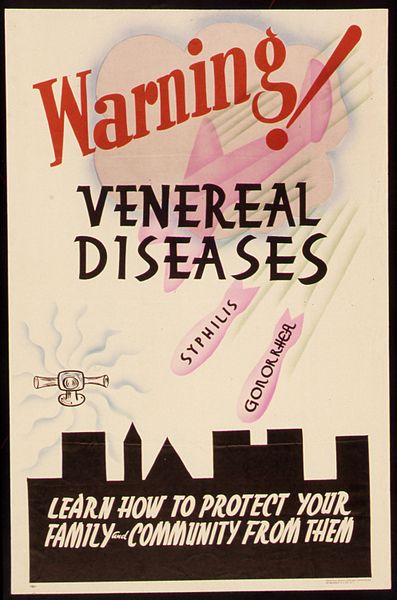
Warning! Gonorrhea Threat Is Real

HIV isn’t the only reason to use condoms. From Tim Horn:

"WARNING - VENEREAL DISEASES" - NARA...

The last line of therapeutic defense against gonorrhea is losing its strength, according to an editorial published February 9 in the The New England Journal of Medicine. With no new antibiotics effective against the sexually transmitted infection (STI) on the horizon, Gail Bolan, MD, of the U.S. Centers for Disease Control and her fellow authors are worried about an upswing in gonorrhea samples showing to be less susceptible to cephalosporins—the only class of drugs still widely effective against the bacteria.

“It is time to sound the alarm,” the authors state. “During the past 3 years, the wily gonococcus has become less susceptible to our last line of antimicrobial defense, threatening our ability to cure gonorrhea and prevent severe [associated illnesses].”

Gonorrhea, caused by the bacteria Neisseria gonorrhoeae, is the second most commonly reported communicable disease in the United States, with more than 600,000 new cases reported annually. Typically spread through sexual activity, it disproportionately affects vulnerable populations such as minorities who are marginalized because of their race, ethnicity or sexual orientation.

Untreated gonorrhea can cause serious and permanent health problems in both women and men. Gonorrhea is a common cause of pelvic inflammatory disease (PID), affecting roughly 750,000 women every year in the United States. It can be painful and may lead to internal abscesses—pus-filled “pockets” that are hard to cure. PID can also lead to fallopian tube damage and ultimately cause infertility or increase the risk of ectopic pregnancy.

In men, gonorrhea can cause epididymitis, a painful condition of the ducts attached to the testicles that may lead to infertility if left untreated.

Gonorrhea can also spread to the blood or joints, which can be life threatening. Additionally, gonorrhea can make it easier to either transmit or become infected with HIV. 

…[the increased resistances] Bolan and her colleagues note, were most pronounced in the western United States (up to 3.6 percent) and among men who have sex with men (up to 4.7 percent).

Hartford Archdiocese To Offer Abstinence Groups For Gays


Morality

Image by tdietmut via Flickr

The Hartford Courant reports today that:

The Hartford Archdiocese wants gays and lesbians to practice abstinence in the new year.

On Tuesday, the archdiocese announced it was launching a local chapter of a national ministry called Courage “to support men and women who struggle with homosexual tendencies and to motivate them to live chaste and fruitful lives in accordance with Catholic Church teachings.”

In a press release, the archdiocese stated that its Office of Diaconate director, Robert Pallotti, had been working to establish an area program for more than four years. The Courage ministry is based in Norwalk, led by the Rev. Paul Check of the Bridgeport Diocese, and claims to have more than 100 chapters around the country.

Gay attraction is not the sin, the ministry preaches — only when one acts on those feelings is it immoral.

This teaching is based on the “natural law” argument: that sex is only appropriate when it is procreative- as shown/proven in/by the natural world- i.e. animals in nature.

Problem is, it’s a fallacy. Sexual activity is not limited to procreation in nature- nor is it limited to opposite-sex activity. See this article: Homosexual Behavior In Animals. It also goes against an important part of Catholic theology, which says that intercourse has two purposes: procreation and the promotion of conjugal love between the partners.When there is only one half of this equation being promoted, the limitation of marriage to young, fertile, childbearing-able couples is the only appropriate response.

That leaves out sterile, aged or sexually dysfunctional persons from the benefits of marriage- and that’s obviously not the case. Any two opposite sex persons can be married in the church, regardless of their ability or intention to bear children.

Gay feelings are not immoral, the church says, acting on them is.

Hmmph.

Let me see if I follow. So these non-immoral feelings are natural, and are a consequence of creation by God. By this equation God is a torturer, since the naturally created feelings are there to be felt but not acted on?

It’s a simplistically flawed argument, and I don’t buy it.

Full story here.

Janus, Chaz, Hillary, The Military, Barack, Science And HIV

Français : Demi-statère de Rome, tête de Janus...

Image via Wikipedia

(Also Published on LGBTQNation)
Janus was the Roman God of Thresholds, of transition, of beginnings and ending. He is often depicted with two faces, one for looking forward and one for looking back. January, the beginning month of the new year is named for Janus, and so, it’s natural that humans take this time to look back- and look forward- at the approach of the New Year.

As I take a look back, I’m very grateful for some amazing things that have happened this year in the U.S.- things that I never thought would happen in my lifetime- including:

All good stuff.

But what I am finding amazing is the conspicuous absence or light mentions in the LGBT media about the dramatic advances in HIV treatment and prevention in the “best of” roundups this year. A year when there have arguably been more advances in treatment, prevention and scientific breakthroughs than in any other year in the 30 since AIDS was discovered. A year when top government officials committed time, money and policy to ending this disease. A year when Science magazine called the HPTN 052 Study the scientific breakthrough of the year.

It’s puzzling.

Are we getting complacent about HIV? Are we in denial about the very real danger it still poses to our community? Do people understand that having HIV is difficult- creating financial, medical, emotional and social problems that can be devastating for people, families and communities?

It seems so.

I am, like I said, grateful for all the things listed above. I am grateful for Chaz and trans representation. I am grateful for relationship rcognition. I am grateful for advances in employment nondiscrimination. I am grateful that my government is taking LGBT rights seriously. I am especially grateful that the elected administration of this land is treating HIV like it should be treated- as a disease, a viral infection- and not as some Divine Punishment inflicted on the sexually and socially repugnant dregs of society. That is a big deal.

In fact it’s huge.

So why did we miss it?

“The Race To End AIDS”

On Today’s Morning Edition from NPR, a story about HIV Treatment As Prevention:

AIDS Awareness

2011 has been a momentous year in the 30-year-old AIDS pandemic.

The big breakthrough was the discovery that antiviral drugs can prevent someone who’s infected with HIV from passing the virus to others. It’s nearly 100 percent effective. That led President Obama to declare earlier this month that the U.S. will expand HIV treatment in hard-hit countries by 50 percent.

As recently as last year, many of those experts were saying that just giving more people with HIV more drugs would never work. “For every one person that was put on antiretroviral therapy or treatment, we would have two to three new infections identified,” Dr. Eric Goosby, U.S. Global AIDS coordinator, says.

It looked like a losing game, but not anymore.

The new research shows that antiviral drugs not only save the lives of infected people, they also stop people from spreading the virus and causing new infections, if the drugs can be given early enough after someone gets infected. The new strategy is called “treatment as prevention.”

“So we suddenly are looking at a moment where we can treat our way out of the epidemic,” Goosby says. “That’s the turning point that we’re looking at.” Still, it’ll take decades to end AIDS, according to experts. But many say the world has to be much more aggressive about treating HIV.

But just the fact that this is being reported on and is being taken seriously is a big deal.

You can read and/or listen to the whole story here