Eulogy

“Life is difficult.”

With these three words begin a book called The Road Less Traveled by Scott Peck. It is a book that literally has helped me change my life- and the lives of countless others.

Today, especially, these words ring true.

Life is difficult for us- who have to try and make sense out of the pain and frustration and difficulties that he faced almost constantly.

Life is difficult for parents, teachers, family members and friends who may feel as powerless as I have felt this past week.

Life is difficult when pain overcomes all the loving words and gestures of family, of friends of therapist, of rabbis and priests- life is especially difficult then.

But how does this happen? How can we address it?

I wish I knew.

My faith tells me that we are all- all of us doing the best we can from our particular point of consciousness. My heart knows this to be true, but my brain often needs more evidence. It keeps telling me that I failed. Some of your brains may be saying the same thing.

He struggled with depression, gender identity and, quite frankly, with being an adolescent- a difficult enough endeavor without adding on the extra baggage. And I thought things were going okay- not perfectly, but there are wonderful parents here offering support and encouragement, supportive professionals taking an interest in helping, friends who do what friends do- remind us that no matter what it seems like, we are not alone. I hoped- I prayed- that he would be okay. Would come through this process with the perspective of a champion- a champion who addressed each struggle as skillfully as possible and never (or seldom) gave in to fear.

Here’s the problem- I’m always underestimating fear. I’m always underestimating the power that potential futures have of paralyzing, shutting down, creating a reaction instead of inviting a thoughtful response. Fear drives us out of our minds and out of our hearts. It’s a powerful thing. It can take the truth and twist it. It can take love and make it insufficient. Fear can make us question the unquestionable- knowing that there is never a satisfying answer- but still, trying to do SOMETHING.

And for a kid who kept things tightly held, who was a perfectionist, whose beauty was seen by everyone else- but not by the one who most needed it- fear was the final distortion.

He knew it- we talked about it- but there was still a desire to be more than just “good enough”- he wanted to be stunning. And those of us who love him saw that stunning quality. We can still see it.

Life is difficult. This is one of the greatest truths. It is a great truth because once we see this truth, we transcend it. Once we truly know life is difficult- once we truly understand and accept it- then life is no longer as difficult. Because once it is accepted, the fact that life is difficult no longer matters. It’s something everyone has to deal with. It’s not just me. Or you. Or them. It’s us.

Peck ends his book with this:

“The universe, this stepping-stone, has been laid down to prepare the way for us. But we ourselves must step across it, one by one. Through grace we are helped, and through grace we know we are being welcomed. What more can we ask?”

I believe he is being helped, he is being welcomed- and yet most importantly for us today- he is being dearly missed. Because that’s the only way to respond to the loss of beauty in our world.

And how have we failed?

We can’t if we loved.

Debunking the Trans* Bathroom Myth

NonDiscrim-Banner


Today, GLAAD released a media guide for journalists covering stories related to LGBT nondiscrimination, in collaboration with a coalition of state and national LGBT advocacy organizations. Debunking the “Bathroom Bill” Myth – Accurate Reporting on LGBT Nondiscrimination: A Guide for Journalists comes after the defeat of the Houston Equal Rights Ordinance (HERO) in late 2015, as well as bills in both Georgia and South Dakota which threaten to harm transgender people. The guide will be useful for media outlets following the 85 nondiscrimination and anti-LGBT bills that are on the horizon across the country.

“Anti-LGBT activists are viciously putting a target on our children’s backs by using fearmongering and misinformation in a desperate attempt to legalize discrimination,” said Sarah Kate Ellis, GLAAD President & CEO. “Accurate reporting is crucial to provide voters with the realities of these bills. This guide will help media tell the real story of transgender-inclusive nondiscrimination ordinances.”

“It’s imperative that the media fairly and accurately report on the discrimination faced by transgender people and the importance of laws which provide protections for them in housing, employment, and public spaces. Alarmist attempts to frighten voters into rejecting fair treatment for trans people must be challenged by journalists well armed with the facts,” said Nick Adams, Director of Programs for Transgender Media at GLAAD.

Nondiscrimination ordinances were recently in the national spotlight surrounding the late 2015 repeal of HERO, which outlawed discrimination against many communities, including the transgender community. In the successful campaign to repeal the ordinance, opponents used misinformation and exploited outdated stereotypes and fears about transgender people, falsely suggesting that the law would put women and children at risk. Making matters worse, many local news outlets repeated these messages, often without questioning the validity of the claims, thereby providing free airtime and a veneer of legitimacy to claims that were easily proved false.

Debunking the “Bathroom Bills” Myth – Accurate Reporting on LGBT Nondiscrimination: A Guide for Journalists provides background on these ordinances, highlights the importance of fair and accurate reporting, points out the fallacies of so-called “Bathroom Bills,” and details the impact of media-amplified myths and misinformation during the HERO campaign. Other helpful resources include best practices for media coverage in addition to terms, definitions, and pitfalls to avoid. The guide was developed in collaboration with Equality California, Freedom for All Americans, the Gill Foundation, the Movement Advancement Project (MAP), the National Center for Transgender Equality (NCTE), and the Transgender Law Center (TLC).

Brace Yourself, Montana!

pride tour FB event cover photo

#prideimpactMT

GiGi’s Message Problem

…is wonderfully summarized by Don Pogreba over at Intelligent Discontent:

In stops in Butte and Ekalaka, Gianforte repeated his refusal to offer a substantive comment on Right to Work, no doubt because he simply doesn’t want to tell the truth: that he will certainly sign any Right to Work legislation authored by a Republican Legislature. The audio from Butte is incredibly dishonest. Asked repeatedly if he would sign Right to Work legislation, Mr. Gianforte kept retreating into a political non-answer about “not making it a priority” before wandering off to a talking point about his high school football days. Seriously.

Read the rest here.

946145_10206833585051573_2385702998508139697_n

He’s hoping no one will notice how extreme he is, but I don’t think Montanans are that intolerant or stupid.

And if you want an excellent overview of this “scientist”‘s definitely un-science-y views on biology, sexuality and psychology, go here.

Or here.

Or here.

This man would be a disaster for Montana.


Tolerance

What is it about the “Other” that is so threatening?

In the wake of violent tragedy, can we just put down our own egos for a second and respond to pain, suffering and confusion with true compassion?

Can we?

Some of us can, I guess. But the rhetoric from leaders who wish to respond to violence with even more violence is in direct contradiction to the words of Jesus- and I can’t wrap my head around how they twist “turn the other cheek” and “love your neighbor as yourself” and “those who live by the sword will die by the sword” into “Fight back or you’ll look weak” and “Hit hard, hit fast” and “Give everyone a gun” and still call themselves Christians.

It’s confusing, and I think we have to call it what it is- vengeful and hateful and xenophobic.

Period.

I’m tired of tolerating this rhetoric from “Christians”.

Anybody else?

June Becomes Even More Beautiful

My sermon from today at Living Waters UMC:

(Mark 5. 21-43) The gospel today says much to us about faith.

The faith of Jairus- a man who, out of love, calls Jesus to help.

The faith of the woman in the crowd- who dared, out of the desire to cease her suffering-

to touch the robe of Jesus as he passed by.

Have you ever wondered what it would be like to have such faith?

Or are you a person of that faith now?

If you already have that faith, you can relax, because I won’t be talking directly to you this morning- but you can help me if I stumble.

I don’t think that will be very many of you.

I know, because I’m not sure I have that kind of faith.

I would like to believe as an ordained person, a professional Christian, that I have some sort of leg up on that faith, but it’s just not true.

I believe, but I’m not sure if it’s always faith.

I have many things that get in the way of that simple trust that God is greater than I am.

Fear does that.

Gets in the way.

Love of money gets in the way.

Anger and resentment and cynicism and pain- they all can keep me from trusting that God has things under control- or at least- like a parent watching a child make a huge mess and then helping them clean it up- God is still waiting with us to see how much of a mess we make before he has to step in again.

This week has been a particularly significant one for me. June usually is- with Gay Pride and my ordination anniversary and it’s such a beautiful time to be in Montana. June is beautiful, but it became even more beautiful for me in the last week, because there were three additional  things of major significance that happened in my life.

Because of chronic illness and preexisting conditions, I am subsidized in my healthcare by the Federal government. There was a chance that it could be taken away from me by the Supreme Court. But, in a move that allowed my soul and my family to rest more easily at night, those subsidies were preserved.

I seriously did not know what I (or tens of thousands of Montanans) would do if the decision were not in our favor.

But it was.

And I knew I would handle what I had to if necessary, but it felt like a wind of grace blowing through my life.~

Like you, I watched the news in horror to learn of the Charleston Massacre in an African Methodist Episcopal church. During a bible study. By a man who was embraced by that congregation as a seeker- before he shot at them- causing death and destruction and injury to a peaceful place dedicated to Christ Emmanuel “God with us”. That’s what Emmanuel means- God with us. It didn’t seem like God was with them, did it? ~

I am a man whose relationship was not acknowledged legally across our country until Friday morning. And I have to say, that for the first time in my life, I feel like a full citizen of these United States- even though many people still hate me for what I am without ever caring about who I am. I feel grace in the affirmation of my dignity by the court we hold Supreme in this land.~

Three different and yet enormously important moments in my life packed into a few short days. Sometimes when I think about it, I feel a little giddy, drunk with the craziness of this week.

Right now you might be saying, “Two of those things were really good for you, Greg- but the other one, the shooting was very horrible. How can you put them together?”

Fair question.

Notice I didn’t say they were all happy moments- they were significant.

Significant is the daughter of a murdered mother looking at the killer and saying “I forgive you.”

Significant is the amount of compassion that allowed a symbol of oppression to be swiftly removed as an accessory to murder.

Significant is a nation that mourned the good people who lost their lives for trying their best to have faith in a world that so seldom supports it.

Significant when the President of the United States gives perhaps the best sermon I have heard in my life to a grieving nation and especially a grieving race of Americans who have been particularly plagued with violence, oppression and prejudice.

Like I said, significant.

If you haven’t seen that eulogy offered by President Obama, I officially recommend it. And I’d like to quote a few lines from it, because it gets right to the point of the message today. We can have all the faith we want- but without grace- we are nothing.

“Blinded by hatred, the alleged killer could not see the grace surrounding Reverend Pinckney and that Bible study group — the light of love that shone as they opened the church doors and invited a stranger to join in their prayer circle. The alleged killer could have never anticipated the way the families of the fallen would respond when they saw him in court — in the midst of unspeakable grief, with words of forgiveness. He couldn’t imagine that.

The alleged killer could not imagine how the city of Charleston, under the good and wise leadership of Mayor Riley — how the state of South Carolina, how the United States of America would respond — not merely with revulsion at his evil act, but with big-hearted generosity and, more importantly, with a thoughtful introspection and self-examination that we so rarely see in public life.

Blinded by hatred, he failed to comprehend what Reverend Pinckney so well understood — the power of God’s grace.

This whole week, I’ve been reflecting on this idea of grace. The grace of the families who lost loved ones. The grace that Reverend Pinckney would preach about in his sermons. The grace described in one of my favorite hymnals — the one we all know: Amazing grace, how sweet the sound that saved a wretch like me. I once was lost, but now I’m found; was blind but now I see.

According to the Christian tradition, grace is not earned. Grace is not merited. It’s not something we deserve. Rather, grace is the free and benevolent favor of God — as manifested in the salvation of sinners and the bestowal of blessings. Grace.

As a nation, out of this terrible tragedy, God has visited grace upon us, for he has allowed us to see where we’ve been blind. He has given us the chance, where we’ve been lost, to find our best selves. We may not have earned it, this grace, with our rancor and complacency, and shortsightedness and fear of each other — but we got it all the same. He gave it to us anyway. He’s once more given us grace. But it is up to us now to make the most of it, to receive it with gratitude, to prove ourselves worthy of this gift.”

At some point, my friends, we have to allow our imperfect faith to meet God’s perfect grace.

And we have to believe that our feeble attempts to love will be assisted by the Grace of God and become an offering of sweetness and peace and substance and good.

That’s the story of the gospel today.

Even when we but try, God meets us in the person of Jesus Christ and offers us help with the power of the Holy Spirit.

He has raised those from the dead we have thought were lost forever.

He has alleviated our suffering- and the suffering of many throughout the world, because we have simply -with whatever small faith we possess- reached out to touch his garment.

So maybe this Gospel isn’t about faith after all.

Maybe it’s just simply about God’s grace- which is just another word for love- about God’s grace being unstoppable.

That’s what we call the Gospel, the Good News. God’s crazy love for us is unstoppable.

Amen

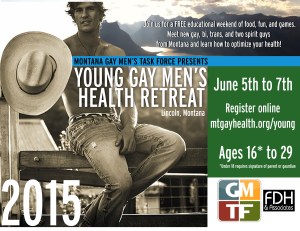
Young Men’s Retreat!

ff783595-7766-4494-87ac-3132e5200acb

Click pic to register!

HIV Testing Training March 9-11 Bozeman

18percent

Bozeman Registration Information

(1/2 day) HIV/STD/HCV Update,

(1/2 day) OraQuick Rapid Test &

(2 days) HIV CTRS Training

(Counseling Testing and Referral Services)

March 9th – March 11th, 2015

8:00 a.m. – 5:00 p.m. each day

C’mon Inn 406-587-3555

Room Block:  DPHHS HIV Training

Bozeman, Montana

Register for the CTRS Conference by March 4th!!!

Register Here:

https://aetcnec.virtualforum.com/pifidform.cfm?erid=45460&sc=936088&aetccode=11

Marginalization

Sermon to the Unitarian Universalist Fellowship of Bozeman, 1.25.15

Good morning- it’s so great to be back here!

I’d like to continue with Nina’s theme from last week.

Dr King and Bayard Rustin are heroes for standing up for their race- a springboard for civil rights. They were the precursors of Stonewall, the feminist movement, Occupy Wall Street, It Gets Better- and much more.

Marginalization.

It means not being part of the body- on the margins.

Marginalize: “to put or keep (someone) in a powerless or unimportant position within a society or group.”

There are many ways to marginalize and be marginalized.

Socially. Economically. Politically. Physically. Ideologically. Theologically, Spiritually. Religiously. Scientifically. Literarily. Geographically. Hygienically. Racially. By almost any reason human beings can think of.

There’s a psychological principle that’s used to keep people in their place.

It’s very effective- and it’s become so commonplace that most of us don’t realize that it’s happening. And it’s all around us.

It’s called shame. And it’s a killer.

Shame is used by persons or institutions in power to promote powerlessness. It’s often confused with guilt, but it’s very different.

Guilt is a feeling that arises inside from trespassing a value. I feel bad.

Shame comes from the outside and it’s a judgment “You are bad”

We can internalize this shame, believing it ourselves, that because someone or something in power thinks we’re bad, their authority is accepted and we believe it ourselves.

Does this make sense?

Guilt can often be helpful because it helps us define our values- keeps us from doing things against what we believe and hold dear.

I have never found shame to be helpful.

Shame is what often brings young people to hurt or even kill themselves. Shame is disguised as bullying. Shame is disguised as wealth. Shame is disguised as political or religious power. Shame tells us that we aren’t who we “should” be.

I want you to be very clear about the disease of shame in our world. I want you to be able to recognize it so that you can avoid it in your own lives and can counter it when you see it in the world around you.

And I’ll give you the best example I know. Every time you hear a “should” or shouldn’t”, you’re more than likely about to hear a shaming statement or question.

You should know better. You shouldn’t act that way. You shouldn’t complain. You should sit down and be quiet. You shouldn’t ask for what you need. You shouldn’t rock the boat.

Does that make sense?

Which brings us back to marginalization.

What are some of the reasons people are marginalized in our world?

What are some of the ways people are marginalized in our country?

What are particular ways people are marginalized in Bozeman, Montana?

In the US we have a particular social theory called capitalism that was supposed to equalize all people who worked for a living. The theory is that if you work hard, you will be able to thrive.

It is sadly and deeply untrue at this point in our history.

The minimum wage cannot support a family of four unless both parents work over 40 hours a week.

People who have millions- perhaps billions- of dollars in this country have never worked a hard day in their lives. They simply were born into the “right” families. Families of wealth, power and influence. Sounds a lot like Feudal Europe.

I don’t think that this was how it was supposed to work.

We have enshrined wealth in this country, further marginalizing the poor, the disenfranchised, the disadvantaged. Some to the point of despair.

As spiritual people, it is not our job to create despair; it is in fact, the opposite of our job.

There once was a group of people who “were together and had all things in common. They would sell their property and possessions and divide them among all according to each one’s need.” They cared for the widow and the orphan with great care and “They were of one heart and one mind and no one claimed that any of his possessions was his own, but they had everything in common.”

Any guesses?

These quotes are from the book of the Acts of the Apostles- they describe the early Christian community.

Sounds a lot like socialism doesn’t it?

Oops- I said the S word.

All spiritual traditions recognize the marginalized as a part of their mission- and all spiritual traditions recognize the importance of restoring humanity to every human being.

In my tradition, we believe God is in love with every human being- not just those with wealth or power or prestige.

Our job is to bring humanity back to the forefront.

Our job is to see those on the margins and bring them in. Our job is to speak for them when they can’t speak for themselves. Our job is to bring the truth of systems of government and society to the surface- if they don’t serve all equally, they don’t serve at all.

And God is here for everybody.

Despite what some of those in power would have us believe.

What I Learned In Therapy

This is written by a patient and shared with permission.

I feel like I could make this a super duper short thing, a medium thing, or a super looong thing. I’m going to aim for some happy medium, though.

For the tl;dr crowd, here is the distillation of what I learned and what I apply in challenging moments: Ask yourself: What do I want? Be honest (about what you want). Be kind (to yourself and others). Tell the truth.

“Once we lose our fear of being tiny, we find ourselves on the threshold of a vast and awesome universe which dwarfs – in time, in space, and in potential – the tidy anthropocentric proscenium of our ancestors.” ~ Carl Sagan

By the end of 2010 I was a worn-out husk of a human. I’d managed to leave my job gracefully, but not without paying a price. I’d lost all my self-confidence. I didn’t trust myself. I thought I was just exhausted and needed to rest. But after two years, it became apparent that rest wasn’t the only thing I needed.

I knew I was having problems when I was interpreting everything with the same level of fear. It didn’t matter what it was. My internal sense of things was waaaay off, but I could only tell by extrapolation. So I found a therapist.

There were many things that I worked on over the almost two years I worked with G:

Read the rest here.