Train To Do HIV Rapid Testing and Counseling!

Here’s an opportunity to do some good:

.

FREE 3-day Training!!!
.

HIV/STD/HCV Update,
OraQuick Rapid Test, and
HIV CTRS Training
(Counseling Testing and Referral Services)
.
February 26  28, 2013
.
Please register by February 15!!!
Hampton Inn, Great Falls, MT

Click here for more info: CTRS Training February 2013

And if you’re interested in becoming a testing associate for AIDS Outreach, please email info@aidsoutreachmt.org

CDC: HIV Cases Decline for Black Women, Increase for Gay Men

Some disturbing news. From Reuters:

The CDC reported that the number of new cases of HIV among black women declined 21 percent between 2008 and 2010, while the incidence of HIV among young gay and bisexual men rose by 22 percent in the same time frame. The rate of HIV infections among black women remains 20 times higher than the number of new cases in white women, and HIV-infected black women account for 70 percent of HIV incidence among all women. Men who have sex with men comprised almost two-thirds of all new HIV infections in 2010.

Joseph Prejean, chief of the Behavioral and Clinical Surveillance Branch in CDC’s Division of HIV/AIDS Prevention, attributed the decline in new HIV cases among black women to HIV testing and the success of HIV

Drugs

Drugs (Photo credit: Images_of_Money)

awareness campaigns. “Treatment advances” for AIDS may have caused young men to underestimate their risk and the health threat posed by HIV”, said Prejean. Although anti-retroviral treatment prolongs life, HIV-infected individuals can expect to take medicine for the rest of their lives, at an estimated lifetime cost of $400,000. (emphasis mine)

Young black men who have sex with men have the highest HIV incidence of any population group within the United States. An earlier CDC report stated that 26 percent of new HIV cases occurred among young people age 13 to 24. Half of HIV-infected young people do not know their HIV status, reported CDC Director Thomas Frieden, MD.

Read the full article here.

HIV Patients Lose More Years To Smoking Than HIV

Bad news for people with HIV who smoke: you’re losing twice as many years of your life by continuing your habit. And that’s not all. You’re also going to die at three times the rate of non-smokers with HIV….

Smoking

Smoking (Photo credit: Wikipedia)

From Science Daily:

Among HIV patients receiving well-organized care with free access to antiretroviral therapy, those who smoke lose more years of life to smoking than to HIV, according to a Danish study published in Clinical Infectious Diseases and available online. The findings highlight the importance of smoking cessation efforts in the long-term, integrated care of patients infected with HIV.

Marie Helleberg, MD, of Copenhagen University Hospital and colleagues estimated the effect of smoking on mortality, risk of death, and life expectancy, and the number of life years lost to smoking compared to years lost to HIV among nearly 3,000 HIV-infected patients treated in Denmark from 1995 to 2010. They also compared mortality associated with smoking between HIV patients and the country’s background population. Where HIV care is integrated and antiretroviral therapy is available at no cost, “more than 60 percent of deaths among HIV patients are associated with smoking,” rather than HIV, Dr. Helleberg said.

Estimated life expectancy differed significantly based on smoking status. A 35-year-old HIV patient who currently smokes had a life expectancy of 62.6 years, compared to 78.4 years for a nonsmoker infected with HIV. The loss of years of life associated with smoking was twice as high as that associated with HIV among HIV-infected patients. In addition, researchers found the excess mortality of HIV-infected smokers to be three times higher than that of individuals not infected with HIV.

Quitting smoking-along with increased exercise- are the two things people with HIV can do to extend their lives and overall health. I quit over three years ago. And yeah, it’s not easy. But it’s worth it.

So if you need a New Year’s resolution, it’s staring you right in the face. And if you need help, it’s readily available here.

Read the full article at Science Daily 

Fact:

Click for data

Presidential Proclamation for World AIDS Day 2012

WORLD AIDS DAY, 2012

– – – – – – –

BY THE PRESIDENT OF THE UNITED STATES OF AMERICA

A PROCLAMATION

On World AIDS Day, more than 30 years after the first cases of this tragic illness were reported, we join the global community once more in standing with the millions of people who live with HIV/AIDS worldwide. We also recommit to preventing the spread of this disease, fighting the stigma associated with infection, and ending this pandemic once and for all.

In 2010, my Administration released the National HIV/AIDS Strategy, our Nation’s first comprehensive plan to fight the domestic epidemic. The Strategy aims to reduce new infections, increase access to care, reduce health disparities, and achieve a more coordinated national response to HIV/AIDS here in the United States. To meet these goals, we are advancing HIV/AIDS education; connecting stakeholders throughout the public, private, and non-profit sectors; and investing in promising research that can improve clinical outcomes and reduce the risk of transmission. Moving forward, we must continue to focus on populations with the highest HIV disparities — including gay men, and African American and Latino communities — and scale up effective, evidence-based interventions to prevent and treat HIV. We are also implementing the Affordable Care Act, which has expanded access to HIV testing and will ensure that all Americans, including those living with HIV/AIDS, have access to health insurance beginning in 2014.

These actions are bringing us closer to an AIDS-free generation at home and abroad — a goal that, while ambitious, is within sight. Through the President’s Emergency Plan for AIDS Relief (PEPFAR), we are on track to meet the HIV prevention and treatment targets I set last year. We are working with partners at home and abroad to reduce new infections in adults, help people with HIV/AIDS live longer, prevent mother-to-child transmission, and support the global effort to eliminate new infections in children by 2015. And thanks to bipartisan action to lift the entry ban on persons living with HIV, we were proud to welcome leaders from around the world to the 19th International AIDS Conference in Washington, D.C.

Creating an AIDS-free generation is a shared responsibility. It requires commitment from partner countries, coupled with support from donors, civil society, people living with HIV, faith-based organizations, the private sector, foundations, and multilateral institutions. We stand at a tipping point in the fight against HIV/AIDS, and working together, we can realize our historic opportunity to bring that fight to an end.

Today, we reflect on the strides we have taken toward overcoming HIV/AIDS, honor those who have made our progress possible, and keep in our thoughts all those who have known the devastating consequences of this illness. The road toward an AIDS-free generation is long — but as we mark this important observance, let us also remember that if we move forward every day with the same passion, persistence, and drive that has brought us this far, we can reach our goal. We can beat this disease. On World AIDS Day, in memory of those no longer with us and in solidarity with all who carry on the fight, let us pledge to make that vision a reality.

NOW, THEREFORE, I, BARACK OBAMA, President of the United States of America, by virtue of the authority vested in me by the Constitution and the laws of the United States do hereby proclaim December 1, 2012, as World AIDS Day. I urge the Governors of the States and the Commonwealth of Puerto Rico, officials of the other territories subject to the jurisdiction of the United States, and the American people to join me in appropriate activities to remember those who have lost their lives to AIDS and to provide support and comfort to those living with this disease.

IN WITNESS WHEREOF, I have hereunto set my hand this twenty-ninth day of November, in the year of our Lord two thousand twelve, and of the Independence of the United States of America the two hundred and thirty-seventh.

BARACK OBAMA

Study: Access to HIV Services for Gay Men Worldwide Stunted By Homophobia

Global study finds homophobia, comfort with service provider, and community engagement make significant impact on access to condoms, lubricant, HIV testing, and HIV treatment

A large-scale study of gay men and other men who have sex with men (MSM), conducted by the Global Forum on MSM & HIV (MSMGF), indicates that only one third of MSM can easily access condoms, lubricant, HIV testing, and HIV treatment. Combining a multi-lingual online survey and focus group discussions, the study suggests that structural barriers like homophobia play a significant role in blocking access to HIV services for MSM, while greater comfort with service providers and community engagement are associated with higher levels of service access.

The MSMGF’s study aimed to identify barriers and facilitators that affect access to HIV services for MSM. The online survey conducted this summer included 5779 men from 165 countries.  In addition, the MSMGF collaborated with African Men for Sexual Health and Rights (AMSHeR) to conduct focus group discussions with a total of 71 MSM across five cities in South Africa, Kenya, and Nigeria.

Of men who participated in the online survey, only 35% reported that condoms were easily accessible, 21% reported easy access to lubricant, 36% reported easy access to HIV testing, and 42% reported easy access to HIV treatment. Levels of access differed across low-, lower-middle-, upper-middle- and high-income countries, with reduced access to services more commonly reported in lower-income countries.
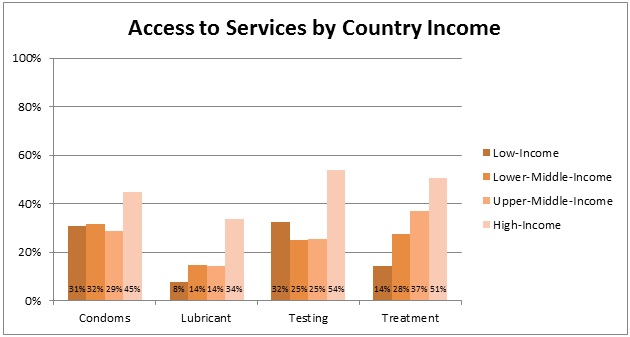
Percent of MSM reporting that condoms, lubricant, HIV testing, and HIV treatment
are easily accessible
(organized by country income level using World Bank country income classifications)

“Such poor levels of access at the global level are unacceptable,” said Dr. George Ayala, Executive Director of the MSMGF. “The differences in access by country income level are especially important to note as the Global Fund moves into a new funding model where countries are grouped into bands by income level. Even in upper-middle-income countries, MSM still have extremely low access to services. Without targeted funding to MSM and other key populations, the new funding model may continue to deteriorate levels of access for the groups most affected by HIV.”

The MSMGF research team also conducted analyses to identify barriers (factors associated with lower access) and facilitators (factors associated with higher access) that impact the ability of MSM to obtain condoms, lubricant, HIV testing, and HIV treatment.

Adjusting for country income, greater access to condoms, lubricants and HIV testing were associated with less homophobia, greater comfort with health providers, and more community engagement. Among participants living with HIV, higher access to HIV treatment was associated with less homophobia and greater comfort with service providers.  Greater access to lubricants and greater access to HIV testing were also associated with less outness (the degree to which others know of one’s sexual orientation) and fewer negative consequences as a result of being out, respectively.

“As we collectively forge ahead into the new territory of treatment-based prevention, it is clear that many of the old challenges remain,” said Noah Metheny, Director of Policy at the MSMGF. “Addressing structural barriers remains essential to realizing the potential of HIV interventions for MSM, and it becomes more important with each new prevention and treatment option that is made available. Investments in the development of new interventions must be accompanied by efforts to increase access.”

The quantitative data from the online survey was supplemented with qualitative data from focus group discussions, helping to place barriers and facilitators in the broader context of the sexual health and lived experiences of MSM. Focus group discussion participants identified barriers and facilitators that were highly consistent with those found in the online survey, and many participants explained the ways that structural barriers at the policy, cultural, and institutional levels cascade down through the community and individual levels to block access to services for MSM.

Focus group discussion participants described how structural barriers like stigma, discrimination, and criminalization force MSM to hide their sexual behavior from health care providers, employers, landlords, teachers, and family members in order to protect themselves and maintain a minimum livelihood. The inability of MSM to reveal their sexual behavior to health care providers was linked to misdiagnosis, delayed diagnosis, and delayed treatment, leading to poor health prognosis and higher risk of transmitting HIV and other sexually transmitted infections to partners.

Conversely, focus group discussion participants explained that the negative consequences of structural barriers were moderated by the existence of safe spaces to meet other MSM, safe spaces to receive services, access to competent mental health care, and access to comprehensive health care. Participants described MSM-led community based organizations as safe spaces where they could celebrate their true selves, receive respectful and knowledgeable health care, and in some cases receive mental health services.

“The study’s findings underscore the urgent need to improve access to essential HIV services for gay men and other MSM worldwide,” said Dr. Ayala. “Interventions must both disrupt the negative effects of barriers and bolster the protective effects of facilitators. Study participants clearly indicated that community engagement and community-based organizations are central to moderating barriers and facilitating service access. Successfully addressing HIV among MSM will require a real effort to address structural barriers, and the findings from this study suggest that investing in MSM-led community-based organizations may be the best way to do that.”

Agreed. MSM-led community-based organizations must continue to work tirelessly to eliminate fear, shame, stigma and ignorance. They are all still very much with us.

And they’re killing us.

Related articles

Clinicians Asked To Screen All Patients For HIV

The US Preventive Services Task Force (USPSTF) strongly recommends that clinicians screen all people aged 15 to 65 years for HIV infection, according to a draft recommendation statement posted online November 20. The statement also recommends HIV screening for all pregnant women, including those who present at the time of labor, and for younger adolescents and older adults who are at increased risk.

“The draft recommendation reflects new evidence that demonstrates the benefits of both screening for and earlier treatment of HIV,” task force member Douglas K. Owens, MD, said in a USPSTF news release. “Because HIV infection usually does not cause symptoms in the early stages, people need to be screened to learn if they are infected. People who are feeling well and learn they are infected with HIV can begin treatment earlier, reduce their chances of developing AIDS and live longer and healthier lives.”

Although US prevalence of HIV infection is nearly 1.2 million and annual incidence is about 50,000, nearly one quarter of those infected are unaware that they are HIV-positive. Since the first reports of AIDS in 1981, more than 1.1 million people have been diagnosed with AIDS and nearly 595,000 have died from it.

Combined antiretroviral therapy (ART) has been shown to reduce the likelihood of HIV transmission, and earlier initiation of treatment lowers the risk for AIDS-related complications.

In issuing this recommendation, the task force hopes to improve and maintain the health of persons who are already infected with HIV, to delay the onset of AIDS, and to lower the risk for HIV transmission.

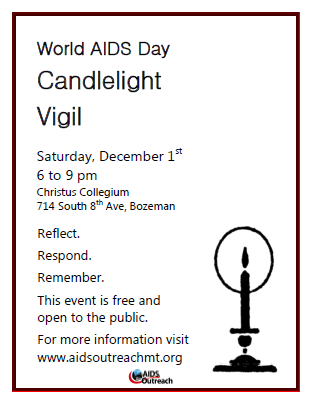
World AIDS Day Candlelight Vigil

(click for link to Facebook Event page)

AIDS Vote 2012

What is AIDS Vote 2012?

This is an important election year especially as we consider where we are with the HIV & AIDS epidemic.AIDS Vote 2012 is a national awareness-raising and education campaign designed to inform candidates and voters of the public policies necessary to advancing the fight against HIV/AIDS. We demand a country in which the lives and health of individuals, workers, families and communities are prioritized over ideology and the interests of the wealthy and corporations. We have the science, the treatments, and the resources to end theHIV epidemic, but do we have the political will?

If elected, how would they fight HIV/AIDS?

What will the next President of the United States, whomever he will be, do to help combat AIDS/HIV both domestically and abroad? Click here for more information on both candidates stances on the issue as well as their plans for future AIDS funding.

Your vote matters!

One of the most important rights we enjoy as citizens of our state and nation is the right to vote. Click herefor information regarding how and where to register to vote in the state of Montana.

(Thanks to Open AID Alliance)

Cognitive Training Beneficial For People With HIV

From Science Daily:

As more effective antiretroviral therapy has evolved over the past 30 years, HIV/AIDS has shifted from an acute to a chronic condition. But as patients live longer, research indicates that they are experiencing cognitive impairments at a higher rate than people without the disease.

A new study by researchers at the University of Alabama at Birmingham, published online Oct. 15, 2012 in the Journal of the Association of Nurses in AIDS Care, shows that cognitive training exercises can help — improving mental processing speed and the ability to complete daily tasks in middle-age and older adults with HIV.

“Today, more than 25 percent of people living with HIV in the United States are older than 50,” says the study’s lead author, David Vance, Ph.D., associate professor in the UAB School of Nursing, associate director of the UAB Center for Nursing Research and scientist in the UAB Edward R. Roybal Center for Research on Applied Gerontology. “Thirty to 60 percent of adults living with HIV experience cognitive problems at some point in the illness, a condition known as ‘HIV-associated neurocognitive disorders.’ It’s imperative for people with HIV and their treatment teams be proactive in addressing cognitive problems as they emerge, because without treatment these issues — which mimic premature aging — can lead to difficulties in working and living independently.”

 Full story here.