Discrimination In Helena: The Left-Handed And The Bald

You may remember Helena City Commissioner Dan Ellison’s flap over his “abstention” in the non-discrimination measure currently considered in Helena. In the Independent Record he ranted and squirmed publicly, comparing LGBTQ persons to the “bald and left-handed” in seeking protection from discrimination- while he unabashedly sought publicity at their expense.

First of all, WTF? This is the argument of an idiot, completely unaware of the difficulties LGBTQ persons face in this state- partly because of the ignorance of persons creating policy such as, say, Dan Ellison.

Second of all, the satire is deservedly starting. Helena Vigilante’s Shane Castle:

Fabulous! You can Email Mr Ellison here.  Maybe enlighten him a little.

Another Reason To Vote For Jon Tester

HIV Home Test A “Double Edged Sword”

Kudos to Great Falls Tribune Reporter Michael Beall for writing about the newly approved Rapid HIV Home Test- and asking Montanans in the field what they think about it.

Greg Smith, the executive director of AIDS Outreach in Bozeman, said he and others have mixed feelings about the U.S. Food and Drug Administration’s decision to approve the first over-the-counter HIV test kits.

English: Logo of the U.S. Food and Drug Admini...

English: Logo of the U.S. Food and Drug Administration (2006) (Photo credit: Wikipedia)

“I think it’s great that people will have access to testing,” said Smith, who was diagnosed with HIV in 2007. “But my concern is that they wouldn’t have the support that we offer in community-based testing situations.”

The OraQuick test is similar to the OraSure tests health clinics use and detects the presence of HIV in saliva. It returns results within 20 to 40 minutes.

The test is as simple as swabbing the upper and lower gums and inserting the test stick into a solution.

But Smith said the home test is a double-edged sword.

“On one hand, information is great, but on the other we need to provide that information so that it’s received well,” he said. “We want that support there.”

Trisha Gardner, City County Health Department community health education specialist, said reviews of the test are overwhelmingly positive, but she’s concerned because those who take the tests at home and test positive won’t have someone there to help them know what to do next. At the same time, she knows how important testing is to stopping the spread of the disease.

“You can’t do anything to control the spread of it if you don’t know you have it,” Gardner said. “People will be more likely to (get tested) because they don’t have to go in anywhere. They don’t have to be seen.”

Full story here.

Surging US Catholic Support For Marriage Equality

By Terence Weldon, Queering The Church

Marriage Equality USA logo

Marriage Equality USA logo (Photo credit: Wikipedia)

New research by the Pew Forum on religion and public life has confirmed once again that the tide of opinion is moving inexorably in favour of gay marriage. In 2oo4, supporters were outnumbered by opponents, by almost two to one (30% to 61%), but supporters now outnumber opponents, by 48% to 44%.  The age split confirms that support will continue to grow: the only groups still opposed are those over 50, and the youngest is in favour by 63% to 32%.  All this is familiar.

What is new in this poll, is its focus on the impact of President Obama’s declared support last May for the principle of marriage equality. Overall, Pew reports that there has been very little change in support since before the announcement – but that it has strengthened support in his Democratic base, and hardened opposition among his Republican opponents. This shift among Democratic voters (especially liberal Democrats) could have a beneficial impact on the gay marriage ballots this November in the Democratic and Democratic leaning states of Maine, Maryland, Washington and Minnesota, and has been widely reported on in the major news media (see for instance,Huffington PostSF Gate at the San Francisco Chronicle, or Seattle Post PI).

The strength of the Pew Forum research organization, as its name implies, is in its focus on religion and religious attitudes, and the extensive historical database of strictly comparable results, which is what I want to focus on here.

Catholics strongly support gay marriage.

First, note that Catholic overwhelmingly support gay marriage, by 58% to 33% – a margin of 25%, and identical for both White and Hispanic Catholic groups. This degree of support is greater than that shown by any other Christian grouping (Jews and other faiths are not identified), it is substantially higher than that for the population as a whole).

This degree of support by Catholics, exceeding that for other groups, has now been well – established in numerous polls. It has also been previously noted that the growth in Catholic support has exceeded that in other groups. Just how dramatic that growth has been, can be seen by comparing the latest results with those from August / September 2010.  Then, Catholic support for gay marriage was at 46% –  a plurality over opposition of just 4%. That plurality has now grown from 4% to 25%, in less than two years.

 Read the rest here.

Olympic Awareness

From AIDS Healthcare Foundation’s Facebook page:

I love that they’re different sizes…

Join NAPWA (and me) For Free

Infected/Affected by HIV/AIDS?

Join the National Association of People With AIDS (NAPWA). NAPWA is doing amazing work advocating for people HIV infected- and affected. It’s important that they have people from rural areas in their membership, so if you are HIV+ and live in Montana (or other rural areas) I would encourage you to join. From their mission statement:

Founded as a 501(c)(3) charitable organization in 1983, NAPWA advocates for the lives and dignity of all people living with HIV/AIDS, especially the more than a million Americans who live with it today. We want the epidemic to end, and we want life to be better for people with HIV until it does.

They are offering- for the first time ever- a free one year membership. To join me as a NAPWA member, click here:  http://www.napwa.org/freemembership

Most HIV-Positive Americans Lack Regular Medical Care

English: Enterprise Performance Life Cycle

English: Enterprise Performance Life Cycle (Photo credit: Wikipedia)

From Betsy McKay of the Wall Street Journal comes this from the recently concluded International AIDS  Conference in Washington DC:

HIV Data (1990, 2000, 2010)

HIV Data (1990, 2000, 2010) (Photo credit: cmdelaserna)

More than half of the people diagnosed with the HIV virus in the U.S. aren’t getting treatment for their infection, the U.S government said (Friday).

African-Americans and younger people are least likely to be receiving regular treatment, meaning that programs to keep them under a doctor’s care aren’t working or aren’t plentiful enough, according to a report by the Centers for Disease Control and Prevention.

While 81% of those African Americans estimated to be infected are diagnosed, only 29% get ongoing care, and just 21% are “virally suppressed,” or have their virus controlled by a regular regimen of antiretroviral, or ARV, drugs. Among Americans ages 25 to 34, 72% of those infected are diagnosed, but 28% get care and a mere 15% are virally suppressed.

Overall, an estimated 1.1 million Americans are infected with HIV. Only 46% of those who are diagnosed with HIV get regular treatment, while a quarter of all those estimated to be infected are virally suppressed.

“We’ve got to do better,” says Jonathan Mermin, director of the CDC’s division of HIV/AIDS Prevention.

The data were released at the XIX International AIDS Conference in Washington, D.C.

The challenge is to find ways to make HIV testing more widespread, and then make it easier to link those who are diagnosed directly into care — and to make sure they stay there, says Mermin.  “I want to make the healthy choice the easy choice,” he says.

And therein lies the challenge. The easy choice is sometimes pretending the choices don’t even exist….

Read the rest here. 

English: IPSF HIV/AIDS Campaign Logo

English: IPSF HIV/AIDS Campaign Logo (Photo credit: Wikipedia)


Alaska Lt. Governor Files To Change Driver’s Licenses To Include Gender Identity

Some good news out of Alaska:

Alaska Lt. Governor Mead Treadwell has filed a new regulation that governs changes to driver’s licenses and will allow transgender individuals to correct the gender marker on their licenses without undergoing major surgery. The regulation takes effect August 11. The American Civil Liberties Union and the ACLU of Alaska had challenged the surgery requirement as a violation of an individual’s right to privacy.

“We appreciate the work of the Department of Motor Vehicles and the Lt. Governor’s office in crafting a regulation that recognizes the important and legitimate needs of transgender Alaskans,” said Jeffrey Mittman, executive director of the ACLU of Alaska. “All Alaskans must be able to obtain a driver’s license that accurately reflects their gender and avoids disclosure of sensitive personal information unrelated to their ability to safely drive a motor vehicle. The government should never needlessly intrude into mandating specific medical procedures.”

The ACLU filed its challenge on behalf of a transgender woman, K.L., whose United States passport and work documents all identify her as female. After initially securing a change to the gender on her driver’s license, she was told that her new license would be revoked unless she submitted proof of having surgery.

“I am humbled and grateful for this decision,” said K.L. “It is my prayer that this victory will make a difference in the lives of transgender people.”

Many transgender persons are treated for a condition called gender dysphoria. Although the American Psychiatric Association agrees that surgery is medically necessary treatment for some, it is not required for everyone with the condition. Treatment for gender dysphoria varies from individual to individual, and many can be effectively treated without surgery.

Additionally, such surgery is beyond the means of many people and is potentially dangerous for some individuals. The State Department no longer requires transgender people to have surgery before it will correct the gender marker on passports, and a growing number of states have stopped requiring surgery for changing the gender marker on a driver’s license.

“The previous requirement had nothing to do with accepted medical standards and demonstrated a callous lack of understanding of what it means to be transgender,” said John Knight, staff attorney with the ACLU Lesbian Gay Bisexual and Transgender Project. “The government should not be in the business of dictating anyone’s medical care, especially when it comes to requiring surgery that may not be available, desired, or medically necessary.”

More information on this case can be found at: www.aclu.org/lgbt-rights/kl-v-state-alaska-department-administration-division-motor-vehicles

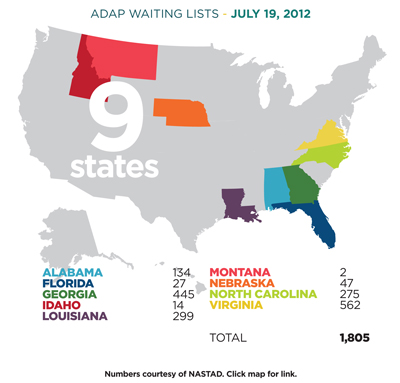
ADAP Watch 7.19.12

From NAPWA:

The Administration has pledged new money to end the waiting lists, but they will linger for some time. Making sure that everyone who needs ART drugs can get them is an obvious first step towards ending this country’s HIV/AIDS epidemic, but when the waiting lists are gone, we’ll have to move on to the hard work of changing attitudes towards people with HIV and ensuring access to health care for all Americans, not just those living with HIV.

It was grimly entertaining, explaining to Conference delegates from Canada and Germany what ADAP is and why we have waiting lists, when it’s so obviously better public health policy and so obviously more fiscally prudent to treat everyone with HIV who wants treatment. After she got past her initial disbelief, a German delegate gently suggested that there are better ways to handle this sort of thing. We wouldn’t need ADAPs, let alone have ADAP waiting lists, if we had a rationally designed national health care system.

Here are the latest numbers from our friends at NASTAD:

HIV In Prison

FYI:

  • More than 2 million people are incarcerated in jails and prisons in the United States.
  • People who are incarcerated are at increased risk for acquiring and transmitting HIV.
  • The correctional setting is often the first place incarcerated men and women are diagnosed with HIV and provided treatment.

People who are incarcerated are at increased risk for acquiring and transmitting HIV and other infections. Correctional health, public health, and community-based organizations need to improve HIV prevention and care for incarcerated populations through 1) routine HIV screening and voluntary HIV testing within prisons and jails and 2) other effective prevention strategies, including those that address inmates’ transition back into the community. Correctional institutions can be important partners in preventing and treating HIV to protect and improve inmate and community health.

More here.