Remembering Fatal Homophobia

In an excellent Op-Ed in the New York Times this morning, we are reminded that homophobia isn’t simple ignorance- in some parts of the world- as in the author’s Uganda- it’s fatal:

English: No Homophobia logo

Image via Wikipedia

The way I see it, homophobia — not homosexuality — is the toxic import. Thanks to the absurd ideas peddled by American fundamentalists, we are constantly forced to respond to the myth — debunked long ago by scientists — that homosexuality leads to pedophilia. For years, the Christian right in America has exported its doctrine to Africa, and, along with it, homophobia. In Uganda, American evangelical Christians even held workshops and met with key officials to preach their message of hate shortly before a bill to impose the death penalty for homosexual conduct was introduced in Uganda’s Parliament in 2009. Two years later, despite my denunciation of all forms of child exploitation, David Bahati, the legislator who introduced the bill, as well as Foreign Minister Henry Okello Oryem and other top government officials, still don’t seem to grasp that being gay doesn’t equate to being a pedophile.

Please read the rest here.

LGBT Student Congressional Internships Available

Shaping future political leaders is always important, shaping future LGBT political leaders is vital- it assures that the voices of LGBT persons will be involved in the political processes that have a direct impact on our lives.

If you are a student interested in political process, this could be you next summer:

For college students, an internship is key to gaining experience, insight and perspective. And for those interested in politics, an internship on Capitol Hill is a privileged opportunity to connect with our nation’s leaders and learn firsthand about the federal legislative process.For LGBT young people, it’s also a chance to witness the impact LGBT members of Congress are having each day – and learn about the barriers they’ve overcome along the way.Last summer we launched the Victory Congressional Internship to develop the next generation of out public leaders.

College students can apply for the Summer 2012 session until February 6, 2012.

Hear about the experiences of our inaugural class of outstanding LGBT college students:

Apply today for this intensive leadership program and an internship with an LGBT-friendly member of Congress.Not a college student or can’t participate this summer? Help spread the word about this incredible opportunity:
Share on Facebook  Share on Facebook    Retweet  Retweet
Paid for and authorized by the Gay & Lesbian Victory Institute.
Contributions or gifts are tax-deductible to the fullest extent of the law.
1133 15th Street, NW, Suite 350, Washington, DC 20005

‘Montanans With HIV’ makes the paper

Map of USA with Montana highlighted
Image via Wikipedia

The Great Falls Tribune yesterday did a featured story on HIV in Montana with several sidebars on testing and the classification of the disease from AIDS to HIV stages 1-3. Along with Trisha Gardner of the Cascade County Health Department, Dean Wells of the Yellowstone AIDS Project and an anonymous man living with HIV in Great Falls, I was interviewed for the piece, which, among other things, focused on the stigma of persons living with HIV in the state.

Excerpt:

On average, about 20 Montanans are diagnosed with the disease every year, said Trisha Gardner, community health education specialist and HIV case manager at the Cascade City-County Health Department.

“The number of newly diagnosed cases has held pretty steady every year,” Gardner said.

Overall, the number of people in Montana living with HIV is increasing because they are living longer, she said.

While that number is on the rise, most in Montana never publicly disclose they have HIV, Gardner said.

“They don’t have to,” she said. “For the most part it’s kept a pretty private issue.”

Many who live with the disease in Montana fear losing their jobs, friends or family, and even becoming a social outcast.

“My view is that the stigma definitely reduced over the years, but it’s still there,” said Dean Wells, executive director of the Yellowstone AIDS Project in Billings. “Many of our clients live in fear of someone finding out about it.”

John, a pseudonym because he fears losing his livelihood, was diagnosed with HIV eight and a half years ago.

Trying to be honest and open after his diagnosis, John told his employer.

“It wasn’t a week later, they asked me to find another job,” he said.

Fear and stigma is still with us but there’s a lot of hope in current HIV treatment and prevention.
The key is to get tested. HIV unsuppressed in the body does damage- sometimes very significant damage- which  cannot be reversed by treatment.

HIV 2fer: Early Treatment Works and Truvada Prevents

HIV DataToday’s HIV News shelf is crowded. Two stories on the HIV front involve good news about early HIV treatment and Pre-Exposure Prophylaxis(PrEP) to reduce infection rates among high-risk persons.

A study (popularly known as the Setpoint Study) finds that people newly-infected with HIV-1 who immediately start anti-retroviral therapy are more likely to have beneficial medical outcomes than those who wait until CD4 counts fall below medically acceptable levels (currently 350-500 depending who you talk to).

“This is very welcome news,” said Frank J. Oldham, NAPWA President and CEO. “The study supplies scientific confirmation of something we at NAPWA have always believed: the closer we can come to bringing all people living with HIV into treatment, and the earlier they start treatment, the better. We already knew this is true for populations as a whole: more and earlier treatment means fewer new infections. Now we know that – on the whole – it’s also better for individuals already infected.”

The news on the HIV front just keeps getting better. The setpoint study follows on the heels of a groundbreaking study which provides proof of HIV treatment as prevention: HIV-infected persons on medication with undetectable viral levels are 96% less likely to pass on the virus.

It also accompanies Gilead’s application to offer Truvada as the first drug marketed to prevent HIV:

Gilead Sciences Inc. announced that it has submitted a supplemental New Drug Application (sNDA) to the U.S. Food and Drug Administration (FDA)for the approval of once-daily Truvada (emtricitabine/tenofovir disoproxil fumarate) for pre-exposure prophylaxis (PrEP) to reduce the risk of HIV-1 infection among uninfected adults. Truvada was approved by the FDA in 2004 for the treatment of HIV-1 infection and is currently the most-prescribed antiretroviral treatment in the United States.

If the sNDA is approved, Truvada would be the first agent indicated for uninfected individuals to reduce the risk of acquiring HIV through sex, a prevention approach called PrEP. The sNDA is based on the results of two large placebo-controlled trials of Truvada as PrEP, sponsored by the U.S. National Institutes of Health (NIH) and the University of Washington. Several other clinical studies support the use of Truvada for HIV risk reduction.

“The data from these large-scale clinical trials suggest that Truvada may have a role to play in meeting the urgent public health need to reduce new HIV infections,” said John C. Martin, PhD, Chairman and Chief Executive Officer of Gilead Sciences. “Gilead is proud to have played a part in helping to define the use of Truvada as a potential new prevention tool and we commend the many institutions, investigators and study volunteers for their commitment to advancing this important area of research.”

Truvada is not currently labeled to reduce the risk of infection, it is labeled only for HIV treatment.

This could be an important step in slowing HIV. Around 50,000 people are still being infected with HIV every year in the U.S. according to the CDC. More than half of new infections (61%) occur among men who have sex with men, and nearly a quarter (23%) occur among women.

If Truvada can be given to high-risk persons (which includes negative partners in a sero-discordant relationship) and insurance companies will pay for it, it may, along with the groundswell of early treatment science, start a trend of slowing the progression of HIV in this country.

But only if we can get more high-risk people in for testing and treatment….

When was your last HIV test?

Wanted: Members For Montana’s HIV Community Planning Group

Are you interested in community service? Do you want to help shape Montana’s HIV policies, treatment strategies and prevention interventions?

English: The Red ribbon is a symbol for solida...

I have a challenge for you.

Montana’s Community Planning Group for the Prevention of HIV (CPG) needs active community voices from around the state to provide valuable input and experience regarding HIV/AIDS in Montana. I have been active in this group for the last four years, and I would encourage anyone interested to apply- especially if you are involved with HIV education, prevention, treatment and/or are a person living with HIV. From the DPHHS Website:

The Community Planning Group (CPG) is an advisory group instrumental in the planning and implementation of HIV prevention interventions in Montana. CPG helps ensure that target populations are represented in the planning of state prevention efforts. The CPG consists of 36 members and is coordinated by the Montana Department of Public Health and Human Services HIV/STD Section.

Membership in the CPG requires a firm commitment.  The following is a basic outline of what this commitment entails:

  • Attend and actively participate in all CPG meetings to the fullest extent of your ability.  This usually includes 4 meetings each year. Meetings typically include a full day on a Friday and a half day on a Saturday.  Travel expenses are paid.
  • Speak for your Community Representation to the benefit of the community group.  Each member is assigned to represent a specific community group and needs to be able and willing to do so.
  • Actively participate in a workgroup.  Workgroups conduct business and meet during and possibly outside of the full CPG meetings as needed.  This work is usually conducted through e-mail or phone conferences, but may occasionally include a meeting that requires travel.

Our challenge has always been getting broad community representation from all communities affected by HIV in Montana. I’m asking you to consider this opportunity- and/or passing it on to someone you think would make a good representative.

Please click on the application link below for more information. We’d love to have you!

CPG Application 2011              Application Deadline is January 16

MT Democrats: Rehberg’s Standing Against Jobs And Tax Relief

From The Montana Democratic Party press release:

Ted Dick, the executive director of the Montana Democratic Party, released this statement following news that despite an earlier agreement, the U.S. House of Representatives now plans to vote against a bipartisan payroll tax holiday extension.

“This week, as Montanans look forward to time with their families and hope for the future, they will wonder why Congressman Dennis Rehberg continues to be an out-of-touch Grinch who refuses to stand with Montana.  Instead of working together to create Montana jobs and provide tax relief for middle-class families, Congressman Rehberg is choosing to stand on the side of his party bosses in Washington–against the Keystone Pipeline, against creating jobs and against middle-class tax relief.”

The U.S. Senate overwhelmingly approved the bipartisan payroll tax holiday Saturday with a vote of 89-10.  The measure includes specific language by Montana’s two U.S. Senators to require a quicker decision on the future of the Keystone XL pipeline–while protecting private property rights.  The Keystone Pipeline will create thousands of jobs.

ADAP Watch 12/19/11

From NAPWA:

President Obama called for the end of AIDS on World AIDS Day. But achieving that in America requires more public sector funding than Congress has provided to date, and the political climate for more funding is brutal.


We could make a classic business Republican argument for more funds: the increases would be trivial in the context of a $3.5 trillion federal budget, and the rate of return on investment would be as high as it gets – reduced public sector health care costs in future years, and improved private sector productivity. It cost next to nothing (in context) this year, and it pays back big for years to come. 


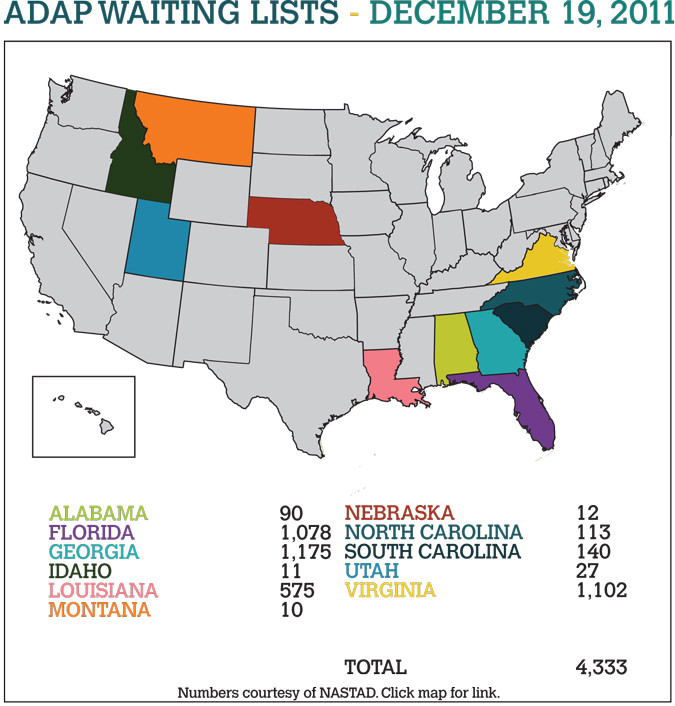
With recent additional federal money, ADAP waiting list numbers have come down some over the past month, but more than 4,000 Americans are still on wait lists. Ninety percent of them are in four Southern states, Florida, Georgia, Louisiana, and Virginia. All four are having financial difficulties in this economy, but the millions of dollars they would have to spend to eliminate their waiting lists are insignificant in multibillion dollar budgets, and spending the millions or not will not make their difficult positions materially any worse or any better.


Here are the latest numbers from our friends at NASTAD:

ADAP Waiting List for 12/15/11

The waiting list continues- up 59 persons in 2 weeks:

Tea-Bagged

This is a two-parter, hang with me….

So, I was alerted to the anti-gay bigoted video posted by James Knox on his Facebook page this week- and I decided to post a screenshot:

 Here’s the link to the video:

http://www.youtube.com/watch?feature=player_embedded&v=JdytVMJ-Erg

It’s factually skewed, scientifically dubious and slickly, homophobically, fucked up (and so is that cigar, I might add). Watch it (or as much of it as you can) and then hit “Dislike”. I was feeling pretty upset about it, and the fact that these people will do almost anything to advance their disturbing agenda when I got an alert from one of my friends about another internet site.

I thought “Oh no- not more crap to wade through,” but then I clicked the link and it totally reversed the ennui I was feeling.

In fact it may be one of the greatest, best things of all time.

Behold:

I don’t know who’s responsible, but I wanted to thank them for one of the most enjoyable 45 minutes I’ve spent in a long time.
Click on the screenshot for the link and have fun!

8 Tips To Lower Holiday Stress

I wrote this a few years ago- but I think it’s still good information- so I revised a few things and thought I’d offer it again (Also published on The Bilerico Project)

Feeling stressed and/or depressed lately? You’re not alone. The Holiday Season is reported to be “problematic” for about forty-five percent of the general population, and there may be added concerns for LGBTIQ persons.

A Christmas tree inside a home.

There is often so much pressure to be joyous and to share “the most wonderful time of the year”. It can be especially hard for those of us who feel wounded by the various Ghosts of Christmas/Hanukkah/Kwanzaa Past. Family and work dynamics can be hard at the best of times, during the holiday season it can reach a torturous crescendo:

“I can’t stand so-and-so, and they’re going to be at Grandma’s for dinner.”

“I do not want to go to Midnight Mass with the family, but I’m more upset by the thought of dealing with the fallout of not going.”

“I just know that Bible-thumper at work thinks I’m going to hell. The office party is always a nightmare.”

“I’m going to have to fend off all the questions of why I’m not married.”

“If they knew the truth, I’d be fired (disowned, disgraced, etc.).”

“I don’t have enough money for gifts. Shopping is so much pressure. I feel inadequate compared to….”

“I’m bringing my partner, and this is the first time. I’m worried that they’ll say or do hurtful things.”

Yep. All familiar. But there are some things to keep in mind when dealing with the stresses of the Holiday Season….

First, remember, you’re not alone.

“Forced fun” with co-workers, family and extended circles of families and friends happens to everybody. Many people, straight, gay and otherwise feel that they aren’t part of the celebration because they don’t feel particularly festive or “in the Christmas spirit”. The pressure to have fun, be nice and ignore grudges and difficulties can result in the completely opposite effect.

Not out to family, co-workers or friends? This can dramatically increase holiday stress. Maintaining a front and keeping secrets is hard- especially at a time of year that focuses on kindness and generosity. Constantly protecting yourself can be exhausting. Constantly worrying about safety, acceptance, integrity and livelihood is excruciating- especially at a holiday party.

It can be even worse if you’ve been rejected by your family or friends because of your sexuality or gender identity.

For many of us, our day-to-day lives are lived with people who care for and support us emotionally. We’ve created our own families. We’ve created routines that encourage and nurture us. We’ve developed our own beliefs

The holidays can totally upset that.

Even the mentally healthiest among us can be challenged by relatives and parents, regardless of acceptance or support. Ram Dass once said, “If you think you’re enlightened, go spend a week with your parents.”

And even if we are out, during the holidays we’re often surrounded by people who may be biologically related or who share the same work, but who do not support us, or who are even openly hostile. Whether this is true or simply a suspicion or feeling, it still causes anxiety, which in turn causes increased stress levels- often leading to some very depressing thoughts. A very slippery slope mentally….

What to do? If your particular situation seems to be causing problematic stress or depression, please seek out professional help. But for those relatively-minor-once-a-year issues, below are a few suggestions I have found helpful.  Please feel free to add your own:

  • Be aware of your anxiety. Notice when your tension levels are rising, and let yourself feel them. Feelings never hurt anybody- the actions resulting from those feelings are the real kicker, and quite often those actions happen because feelings are so bottled up that the pressure forces an explosion. Often, simply noticing and naming the anxiety can calm it.
  • Breathe. Under stress, the breath is often shallow, keeping oxygen levels at a minimum which just adds more stress. As simple as it sounds, three deep, conscious breaths can bring instant relief, slowing the heart rate, reducing hypertension- and anxiety levels.
  • “Is that true?” That question has been my lifesaver in many situations. My brain can run amok with fantasies of what people will say or do in response to me- things that I can’t possibly know for certain. Anxiety levels rise in the face of uncertainty. This simple question slows my thoughts and brings me back to the facts.
  • Be here now. Most stress involves either the past or the future- both are perspective distortion agents. Staying in the here and now reduces stress.
  • Resist the urge to self-medicate. Most people eat and drink more and exercise less than they normally would at this time of year.  If you’re prone to depression already, (and even if you’re not) a hangover and love handles won’t help. Plus, alcohol, a depressant, may seem to help for a while, but usually worsens depression and stress symptoms later on. It also reduces inhibitions, making hurt feelings, disagreements and fights much more likely.
  • Give yourself an out. If you have to spend an extended amount of time with family, work some down time into the schedule. Removing yourself from the situation can be vital, and it can be done gracefully. “I just need some alone time” is something that almost anyone will respect. There are lots of reasons to be alone- get creative. A short walk, a hot shower, a nap, an AA meeting, or even extended time behind the locked door of a bathroom can do amazing things to renew self-confidence, perspective and energy.
  • Remember, this is temporaryMost of us can survive anything for a few days. If you’re in a situation that you feel you may not be able to handle well, by all means, get out! But if staying will do less damage to yourself and others than leaving, remembering the finite nature of the visit may help.
  • Take care of yourself. You know what you need to do to be healthy. Eat well, exercise, hydrate, rest, play and give yourself permission to be human.

No matter what the situation, my greatest stressor is this:

Worrying about something I have little or no control over.

Recognizing that is key.

People are going to think what they think, and my thoughts or actions will probably not change that- especially in the short amount of time I have to spend with them during the holiday season. Whether they approve of me or not is none of my business. My business is to be happy, honest, kind, and healthy.

And I can do it. I do it by knowing myself and taking care of myself- even under the pressure of Midnight Mass.