Study: Access to HIV Services for Gay Men Worldwide Stunted By Homophobia

Global study finds homophobia, comfort with service provider, and community engagement make significant impact on access to condoms, lubricant, HIV testing, and HIV treatment

A large-scale study of gay men and other men who have sex with men (MSM), conducted by the Global Forum on MSM & HIV (MSMGF), indicates that only one third of MSM can easily access condoms, lubricant, HIV testing, and HIV treatment. Combining a multi-lingual online survey and focus group discussions, the study suggests that structural barriers like homophobia play a significant role in blocking access to HIV services for MSM, while greater comfort with service providers and community engagement are associated with higher levels of service access.

The MSMGF’s study aimed to identify barriers and facilitators that affect access to HIV services for MSM. The online survey conducted this summer included 5779 men from 165 countries.  In addition, the MSMGF collaborated with African Men for Sexual Health and Rights (AMSHeR) to conduct focus group discussions with a total of 71 MSM across five cities in South Africa, Kenya, and Nigeria.

Of men who participated in the online survey, only 35% reported that condoms were easily accessible, 21% reported easy access to lubricant, 36% reported easy access to HIV testing, and 42% reported easy access to HIV treatment. Levels of access differed across low-, lower-middle-, upper-middle- and high-income countries, with reduced access to services more commonly reported in lower-income countries.
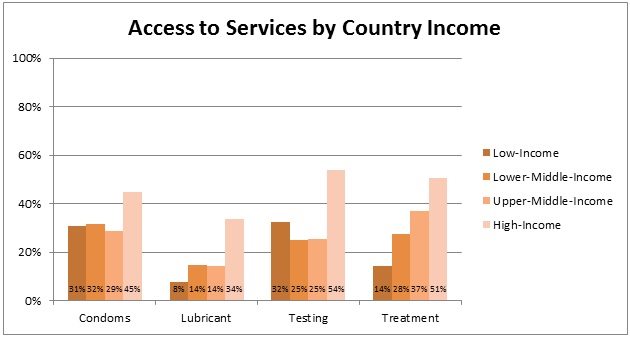
Percent of MSM reporting that condoms, lubricant, HIV testing, and HIV treatment
are easily accessible
(organized by country income level using World Bank country income classifications)

“Such poor levels of access at the global level are unacceptable,” said Dr. George Ayala, Executive Director of the MSMGF. “The differences in access by country income level are especially important to note as the Global Fund moves into a new funding model where countries are grouped into bands by income level. Even in upper-middle-income countries, MSM still have extremely low access to services. Without targeted funding to MSM and other key populations, the new funding model may continue to deteriorate levels of access for the groups most affected by HIV.”

The MSMGF research team also conducted analyses to identify barriers (factors associated with lower access) and facilitators (factors associated with higher access) that impact the ability of MSM to obtain condoms, lubricant, HIV testing, and HIV treatment.

Adjusting for country income, greater access to condoms, lubricants and HIV testing were associated with less homophobia, greater comfort with health providers, and more community engagement. Among participants living with HIV, higher access to HIV treatment was associated with less homophobia and greater comfort with service providers.  Greater access to lubricants and greater access to HIV testing were also associated with less outness (the degree to which others know of one’s sexual orientation) and fewer negative consequences as a result of being out, respectively.

“As we collectively forge ahead into the new territory of treatment-based prevention, it is clear that many of the old challenges remain,” said Noah Metheny, Director of Policy at the MSMGF. “Addressing structural barriers remains essential to realizing the potential of HIV interventions for MSM, and it becomes more important with each new prevention and treatment option that is made available. Investments in the development of new interventions must be accompanied by efforts to increase access.”

The quantitative data from the online survey was supplemented with qualitative data from focus group discussions, helping to place barriers and facilitators in the broader context of the sexual health and lived experiences of MSM. Focus group discussion participants identified barriers and facilitators that were highly consistent with those found in the online survey, and many participants explained the ways that structural barriers at the policy, cultural, and institutional levels cascade down through the community and individual levels to block access to services for MSM.

Focus group discussion participants described how structural barriers like stigma, discrimination, and criminalization force MSM to hide their sexual behavior from health care providers, employers, landlords, teachers, and family members in order to protect themselves and maintain a minimum livelihood. The inability of MSM to reveal their sexual behavior to health care providers was linked to misdiagnosis, delayed diagnosis, and delayed treatment, leading to poor health prognosis and higher risk of transmitting HIV and other sexually transmitted infections to partners.

Conversely, focus group discussion participants explained that the negative consequences of structural barriers were moderated by the existence of safe spaces to meet other MSM, safe spaces to receive services, access to competent mental health care, and access to comprehensive health care. Participants described MSM-led community based organizations as safe spaces where they could celebrate their true selves, receive respectful and knowledgeable health care, and in some cases receive mental health services.

“The study’s findings underscore the urgent need to improve access to essential HIV services for gay men and other MSM worldwide,” said Dr. Ayala. “Interventions must both disrupt the negative effects of barriers and bolster the protective effects of facilitators. Study participants clearly indicated that community engagement and community-based organizations are central to moderating barriers and facilitating service access. Successfully addressing HIV among MSM will require a real effort to address structural barriers, and the findings from this study suggest that investing in MSM-led community-based organizations may be the best way to do that.”

Agreed. MSM-led community-based organizations must continue to work tirelessly to eliminate fear, shame, stigma and ignorance. They are all still very much with us.

And they’re killing us.

Related articles

Cognitive Training Beneficial For People With HIV

From Science Daily:

As more effective antiretroviral therapy has evolved over the past 30 years, HIV/AIDS has shifted from an acute to a chronic condition. But as patients live longer, research indicates that they are experiencing cognitive impairments at a higher rate than people without the disease.

A new study by researchers at the University of Alabama at Birmingham, published online Oct. 15, 2012 in the Journal of the Association of Nurses in AIDS Care, shows that cognitive training exercises can help — improving mental processing speed and the ability to complete daily tasks in middle-age and older adults with HIV.

“Today, more than 25 percent of people living with HIV in the United States are older than 50,” says the study’s lead author, David Vance, Ph.D., associate professor in the UAB School of Nursing, associate director of the UAB Center for Nursing Research and scientist in the UAB Edward R. Roybal Center for Research on Applied Gerontology. “Thirty to 60 percent of adults living with HIV experience cognitive problems at some point in the illness, a condition known as ‘HIV-associated neurocognitive disorders.’ It’s imperative for people with HIV and their treatment teams be proactive in addressing cognitive problems as they emerge, because without treatment these issues — which mimic premature aging — can lead to difficulties in working and living independently.”

 Full story here.

Participate! Study about LGB persons In the Workplace

Received today:

My name is Paul Battle, I am a doctoral student at Oakland University working on my dissertation.   I am currently compiling research on the work experiences of lesbian, gay and bisexual individuals.  I hope that learning more about the work experiences of lesbian, gay and bisexual individuals will help improve work experiences and counseling education.

Participants should be over the age of 18 and currently be employed.  To participate in the study please click on this link: http://www.surveymonkey.com/s/Workplaceidentity

FDA Approves new HIV Treatment

English: Logo of the .

The FDA approved “the Quad”- a four-medication-in-one-pill treatment for controlling HIV. Two of the medications comprising Stribild, tenofovir and emtricitabine, have been previously combined and sold under the brand name Truvada (itself approved a few weeks ago as a preventative or prophylactic for HIV, see related articles below).

Two of the medications are new, and – as a condition of approval- will require greater testing in women and children, as well as studying possibilities and occasions of resistance.

This is good news.

Simplifying regimens is a helpful strategy in helping keep HIV-infected persons faithful to their medication schedules, a key in effectively treating HIV. Cost is yet to be determined- and most HIV regimens cost in excess of $18,000.00 a year (mine cost $24k).

Still no picnic- but good news for those who need a simpler med schedule.

Most HIV-Positive Americans Lack Regular Medical Care

English: Enterprise Performance Life Cycle

English: Enterprise Performance Life Cycle (Photo credit: Wikipedia)

From Betsy McKay of the Wall Street Journal comes this from the recently concluded International AIDS  Conference in Washington DC:

HIV Data (1990, 2000, 2010)

HIV Data (1990, 2000, 2010) (Photo credit: cmdelaserna)

More than half of the people diagnosed with the HIV virus in the U.S. aren’t getting treatment for their infection, the U.S government said (Friday).

African-Americans and younger people are least likely to be receiving regular treatment, meaning that programs to keep them under a doctor’s care aren’t working or aren’t plentiful enough, according to a report by the Centers for Disease Control and Prevention.

While 81% of those African Americans estimated to be infected are diagnosed, only 29% get ongoing care, and just 21% are “virally suppressed,” or have their virus controlled by a regular regimen of antiretroviral, or ARV, drugs. Among Americans ages 25 to 34, 72% of those infected are diagnosed, but 28% get care and a mere 15% are virally suppressed.

Overall, an estimated 1.1 million Americans are infected with HIV. Only 46% of those who are diagnosed with HIV get regular treatment, while a quarter of all those estimated to be infected are virally suppressed.

“We’ve got to do better,” says Jonathan Mermin, director of the CDC’s division of HIV/AIDS Prevention.

The data were released at the XIX International AIDS Conference in Washington, D.C.

The challenge is to find ways to make HIV testing more widespread, and then make it easier to link those who are diagnosed directly into care — and to make sure they stay there, says Mermin.  “I want to make the healthy choice the easy choice,” he says.

And therein lies the challenge. The easy choice is sometimes pretending the choices don’t even exist….

Read the rest here. 

English: IPSF HIV/AIDS Campaign Logo

English: IPSF HIV/AIDS Campaign Logo (Photo credit: Wikipedia)


HIV In Prison

FYI:

  • More than 2 million people are incarcerated in jails and prisons in the United States.
  • People who are incarcerated are at increased risk for acquiring and transmitting HIV.
  • The correctional setting is often the first place incarcerated men and women are diagnosed with HIV and provided treatment.

People who are incarcerated are at increased risk for acquiring and transmitting HIV and other infections. Correctional health, public health, and community-based organizations need to improve HIV prevention and care for incarcerated populations through 1) routine HIV screening and voluntary HIV testing within prisons and jails and 2) other effective prevention strategies, including those that address inmates’ transition back into the community. Correctional institutions can be important partners in preventing and treating HIV to protect and improve inmate and community health.

More here.

Let’s Talk About Sex

“Sex Is the Question,” is an engaging and important survey regarding the sexual practices of gay and bisexual men. This entirely confidential survey is sponsored by the Center for Disease Control, and will be used by state and local health departments to better understand the HIV epidemic among gay and bisexual men and potentially create new techniques to reverse the trend. “Sex Is the Question” is the largest survey ever attempted by a US federal agency for gay and bisexual men, and it will only take you a few minutes to complete. Do you want another great reason to take the survey? For every completed survey, “Sex Is the Question” will make a monetary donation to the It Gets Better Project.

How can you take the survey? Just click on this link. After you complete the survey, you will also have the opportunity to invite your friends to participate, and a donation will be made to the It Gets Better Project for each of your friends who completes the survey too. In addition, “Sex is the Question” is not just a survey. It is the first study of its kind to provide immediate feedback to its participants by incorporating videos and other interactive tools. At the end of the survey, you will be presented with personalized insight and comparisons based on your answers. Thank you for your consideration! With you support, we can help put an end to HIV once and for all, and in doing so, support a terrific organization.

Medicaid Expansion Likely To Lower Deaths

Medicaid expansion under the Affordable Care Act is contentious- mostly because Republicans don’t want to give President Obama any credit- for anything. But if this study, reported today by the New York Times, is any indication, not going forward could be deadly.

Senate Passes Insurance Industry Aid Bill

Senate Passes Insurance Industry Aid Bill (Photo credit: Mike Licht, NotionsCapital.com)

Into the maelstrom of debate over whether Medicaid should cover more people comes a new study by Harvard researchers who found that when states expanded their Medicaid programs and gave more poor people health insurance, fewer people died.

The study, published online Wednesday in The New England Journal of Medicine, comes as states are deciding whether to expand Medicaid by 2014 under the Affordable Care Act, the Obama administration’s health care law. The Supreme Court ruling on the law last month effectively gave states the option of accepting or rejecting an expansion of Medicaid that had been expected to add 17 million people to the program’s rolls.

Seems fairly reasonable. So why would anyone reject the expansion?

Medicaid expansions are controversial, not just because they cost states money, but also because some critics, primarily conservatives, contend the program does not improve the health of recipients and may even be associated with worse health. Attempts to research that issue have encountered the vexing problem of how to compare people who sign up for Medicaid with those who are eligible but remain uninsured. People who choose to enroll may be sicker, or they may be healthier and simply be more motivated to see doctors.

The New England Journal study reflects a recent effort by researchers to get around that problem and allow policy makers to make “evidence-based decisions,” said Katherine Baicker, an investigator on the study who served on former President George W. Bush’s Council of Economic Advisers.

“I think it’s a very significant study in part because of the paucity of studies that have really looked at health outcomes of insurance coverage,” said Karen Davis, the president of the Commonwealth Fund, a nonpartisan research foundation. “Actual mortality studies are few and far between. This is a well-done study: timely, adds to the evidence base, and certainly should raise concern about the failure to expand Medicaid coverage to people most at risk of not getting the care that they need.”

A Republican-appointed official calling this “evidence based”- will it be enough? Probably not. But the evidence is still there:

“So often you hear, ‘Oh well, poor people just shoot each other, and that’s why they have higher mortality rates,’ ” said Diane Rowland, executive vice president of the Kaiser Family Foundation, a nonprofit group. “In the midst of many claims about what Medicaid does and doesn’t do, it actually shows that it cannot only be beneficial for health, but in preventing some of the premature deaths of the uninsured.”

Janet M. Currie, director of the Center for Health and Well-Being at Princeton, said the new study, combined with the Oregon research, should help transform the Medicaid debate into one about dollars, rather than over whether covering poor people improves health.

“This says, well there is benefit to giving people insurance,” Dr. Currie said. “Maybe you don’t want to pay the cost, but you can’t say there’s no benefit.”

Gay Men Are Flunking The Test

Also published on Bilerico.com

Yesterday, I posted an article about  a press release by the Journal Of The American Medical Association:

“…all adult patients, regardless of CD4 cell count, should be offered antiretroviral therapy (ART), according to an article in the July 25 issue of JAMA, a theme issue on HIV/AIDS. Other new recommendations include changes in therapeutic options and modifications in the timing and choice of ART for patients with an opportunistic illness such as tuberculosis.”

This follows the “treatment as prevention” model, based on the scientific research that people with HIV on antiretroviral therapy- with an undetectable viral load- are 96% less likely to pass on the virus.
us-statistics-2.jpgThis seems to be very good news. If you have HIV, you should find out early, get on meds and you’ll have a better chance of living a longer healthier life.

So what’s the problem? The problem is twofold:

  1. People at risk aren’t being tested: 20-25% of all HIV-infected people don’t know they have it.
  2. People at risk are still not being tested: Gay and Bisexual men of all races are the most severely affected by HIV

That’s not a typo- they’re basically the same reason, but there’s a difference. Any guesses?

Hint: It’s probably why most gay men won’t even read this article.

20-25% of all people with HIV don’t know they have it. Why not?

Here’s my take: Denial is one of the strongest mechanisms in the human psyche. It is fed by lack of information, by avoidance and by a strong desire for an alternative reality. If you’ve had unprotected sex, you’ve probably engaged in the process of denial. You’ve probably downplayed the risk, probably lied to yourself a little. You may have even gone over and over it in your mind, seizing every opportunity to deny the possibility of trouble.

“He looked okay”; “He didn’t seem sick”; “He pulled out”; “He would have told me if he had HIV”, etc, etc, and etc.

Well, we all know where that goes…. As individuals, we’re not facing facts. If we were, we’d be getting tested.

us-statistics-1.jpgGay and Bi men of all races are the most severely affected by HIV. Of course. We know that. Don’t we?

Again, denial applies. Gay and Bi men aren’t talking about HIV anymore. Our friends aren’t dying, so there’s no reason to be concerned. People with HIV aren’t out- aren’t well-known in our communities. Why? I was once told “You don’t need to harp about HIV all the time- it’s not that big of a deal.” Except that it is.

HIV has complicated my life in ways many people can’t believe. I am on catastrophic health insurance through the state- almost three times as expensive as my partner’s insurance. I get assistance for my meds- which cost about $25,000 a year- but (crazily), I can’t make more than $30,300 and still qualify for the program. I have joint pain, sleep issues, battles with depression, fatigue and a body that is aging at several times the normal rate– most probably due to inflammation- the hallmark of HIV disease. And yet, if I talk about this to friends or family, I’m seen as a whiner or someone trying unnecessarily to worry people I care about. It’s the “shut up- at least you’re not dying” defense. I know several HIV+ people who haven’t told anyone of their status, mostly because it’s “uncomfortable”.

No shit.

As a community, we’re not facing facts. If we were, we’d be talking to our friends about the importance of maintaining our health. We’d be talking about the hard reality of HIV.

But we’re not. Denial still holds sway, both individually and as a community. We’re lying to ourselves- we’re lying to each other- and infection rates stay the same.

We have a chance to change this trend. But only if everyone with HIV starts treatment, gets into care. This recommendation of the AMA may help with that. But it’s not up to doctors, nurses and social workers, it’s up to us.

We’re being tested, both as individuals and as a community. The problem is, we’re flunking.

Because we’re not showing up.

(Images source)

“All Adult HIV Patients Should Be Offered Antiretroviral Therapy”

From Science Daily:

Included in the 2012 International Antiviral Society-USA panel recommendations for human immunodeficiency virus (HIV) patient care is that all adult patients, regardless of CD4 cell count, should be offered antiretroviral therapy (ART), according to an article in the July 25 issue of JAMA, a theme issue on HIV/AIDS. Other new recommendations include changes in therapeutic options and modifications in the timing and choice of ART for patients with an opportunistic illness such as tuberculosis.

Melanie A. Thompson, M.D., of the AIDS Research Consortium of Atlanta, presented the findings of the article at a JAMA media briefing at the International AIDS Conference.

Journal of the American Medical Association

Journal of the American Medical Association (Photo credit: Wikipedia)

“Since the first antiretroviral drug was approved 25 years ago, improvements in the potency, tolerability, simplicity, and availability of ART have resulted in dramatically reduced numbers of opportunistic diseases and deaths where ART is accessible,” according to background information in the article. “New trial data and drug regimens that have become available in the last 2 years warrant an update to guidelines for ART in HIV-infected adults in resource-rich settings.”

The benefit of suppressing the virus, in my opinion, is greater than the possible toxicity of medication and navigating possible side effects. We know that as long as HIV is in the body, unchecked, it’s doing damage. It’s more likely than possible that people who start antiretroviral therapy early will have less problems with secondary conditions (joint pain, arthritis, memory problems) as they progress in their lives. I think this is tremendous news.

Full Story Here.