“All Adult HIV Patients Should Be Offered Antiretroviral Therapy”

From Science Daily:

Included in the 2012 International Antiviral Society-USA panel recommendations for human immunodeficiency virus (HIV) patient care is that all adult patients, regardless of CD4 cell count, should be offered antiretroviral therapy (ART), according to an article in the July 25 issue of JAMA, a theme issue on HIV/AIDS. Other new recommendations include changes in therapeutic options and modifications in the timing and choice of ART for patients with an opportunistic illness such as tuberculosis.

Melanie A. Thompson, M.D., of the AIDS Research Consortium of Atlanta, presented the findings of the article at a JAMA media briefing at the International AIDS Conference.

Journal of the American Medical Association

Journal of the American Medical Association (Photo credit: Wikipedia)

“Since the first antiretroviral drug was approved 25 years ago, improvements in the potency, tolerability, simplicity, and availability of ART have resulted in dramatically reduced numbers of opportunistic diseases and deaths where ART is accessible,” according to background information in the article. “New trial data and drug regimens that have become available in the last 2 years warrant an update to guidelines for ART in HIV-infected adults in resource-rich settings.”

The benefit of suppressing the virus, in my opinion, is greater than the possible toxicity of medication and navigating possible side effects. We know that as long as HIV is in the body, unchecked, it’s doing damage. It’s more likely than possible that people who start antiretroviral therapy early will have less problems with secondary conditions (joint pain, arthritis, memory problems) as they progress in their lives. I think this is tremendous news.

Full Story Here.

Infographic: Ending The Drug War Will Help End AIDS

From Jag Davies, Drug Policy Alliance in today’s Huffington Post:

Throughout the world, research has consistently shown that drug criminalization forces people who use drugs away from public health services and into hidden environments where HIV risks become significantly elevated. Mass incarceration of nonviolent drug offenders also plays a major role in spreading the pandemic, as inhumane conditions and lack of HIV prevention or treatment measures in prison lead to HIV outbreaks and AIDS cases behind bars – and among families and communities once those imprisoned are released.

Yet in countries where addiction is treated as a health issue, the fight against HIV/AIDS is being won. New HIV infections in countries such as Australia, Germany and Switzerland have been virtually eliminated among people who use drugs, just as mother-to-child HIV transmission has been eliminated in countries that make medicines for pregnant women accessible.

In the United States, however, the federal government has resisted evidence-based HIV prevention strategies — costing us hundreds of thousands of lives and billions of dollars. Congress re-instated a longstanding ban last December that prohibits using federal funds for syringe access programs — a move that will cost thousands of more lives in years to come.

Money talks- just remind your politicians that the money they are not spending on “immorality” is costing the taxpayers 1000x the amount in the long run…

Guest Post: People Living with HIV Can Increase Physical Health and Quality of Life through Exercise

By Jim Rollince, GymSource

Adhering to a rigid exercise program can seem intimidating to a person who has been diagnosed with HIV.  Because this particular disease is so varied in how it affects each person who has it, people with HIV are often at various stages of physical health and emotional health.  Sometimes, the disease can seemingly lie dormant for years.  Other times, the disease can attack and leave a person feeling extremely ill, mentally depleted, and exhausted of nearly all energy.  Exercise is one way that a person who has HIV can fight back and take positive steps to regaining strength and increasing his or her overall health.

Increased Cardio Health Benefits Stem from Consistent Exercise Routines

It is well known that physical exercise can greatly improve cardio health.  In many situations, healthy hearts equal healthy bodies.  Many people are able to fight diseases through consistent exercise programs.  While beginning with a rigorous exercise program may not be feasible for an HIV patient who is fighting severe symptoms of the disease, beginning with a mild program and then steadily increasing it can result in wonderful improvements on the way the person feels each day.

Setting up home gym equipment is an ideal way to be prepared to exercise any time there is free time to do so.  If an HIV patient is working full time or part time, going to regular doctor visits, and taking care of other responsibilities, a home gym may be the best solution to find time to exercise.  Using a treadmill, an exercise bike, and an elliptical machine can result in tremendous health benefits and improved heart conditions.  Improving the heart and blood circulation throughout the body will make the person feel physically stronger and this can have a great and lasting impact on how well the person is physically able to cope with the disease.

Remain Committed to Regular Fitness Activities for Increased Health

The US National Library of Medicine provides an online medical journal that details numerous benefits that people who have been diagnosed with HIV or AIDS can gain from committing to regular exercise sessions.  Psychological benefits, increased circulation, easier breathing, and stronger muscles are all potential benefits a person can gain by committing to exercise on a regular basis.

Getting outside during nice weather and taking advantage of warm and pleasant weather to hike, swim, or go biking with friends is an ideal way to enjoy exercise and socialization at the same time.  When time is short, the individual can take advantage of fitness equipment at home to get in a few minutes of treadmill jogging or working out on an elliptical.  Every time a person engages in physical activity, the body will respond by increasing metabolism and potentially increasing levels of energy.

AIDS Vaccine Possible Before End Of This Decade, HIV Scientist Says

From The New Civil Rights Movement:

HIV Particle

HIV Particle (Photo credit: AJC1)

A vaccine to protect against the Human Immunodeficiency Virus (HIV) and AIDS may be available before the end of this decade, a leading HIV research scientist says. RV144 may be the answer to fighting HIV/AIDS.

“We’re really working as fast as we can,” said Colonel Nelson Michael, director of the U.S. Military HIV Research Program at the Walter Reed Army Institute of Research, “who expects large-scale effectiveness studies to start in 2016,” according to a report in Reuters:

The hope is to have at least 50 percent effectiveness, a level that mathematical modelers say could have a major impact on the epidemic. Michael thinks this might be the pathway for getting the first HIV vaccine licensed, possibly by 2019.

Exciting news- Read the rest here

AIDS Drug Assistance Program (ADAP) Watch 7/1/12

From NAPWA:

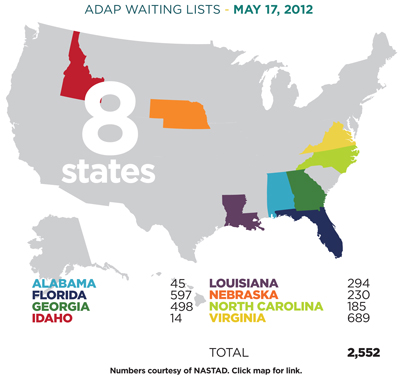
The waiting list numbers continue steady, just over 2,000, down from 9,000 in September of last year.

Coming off another National HIV Testing Day, we have to wonder how some states can encourage their citizens to get tested but not help them get lifesaving medicines if they test positive.

We also wonder what kind of cost analyses the waiting list states are doing. The cost of clearing the waiting lists completely just isn’t that great. Virginia has just under 600 PLWHA on its waiting list. If drugs cost $15,000 for one ADAP beneficiary for one year, drugs for 600 will cost $9 million – and we just don’t believe $9 million can’t be found in an $85 billion fiscal 2013 Virginia state budget. PLWHA on Virginia’s and other states’ waiting lists will cost the public sector a lot more if they don’t get drugs that can keep them from progressing to AIDS.

Here are the latest numbers from our friends at NASTAD:

Paying For Negative HIV Tests

Michael J. Coren writes a fascinating article about HIV: if health isn’t a good enough reason to protect yourself from HIV and STD’s, maybe money is.

Excerpt:

Scientists at MIT’s Poverty Lab recently published findings in BMJ Open that tested that theory in Tanzania. They used payments known as conditional cash transfers (CCTs)–known to encourage socially desirable behavior elsewhere in areas like such as school enrollment and medical check-ups–to deter risky sex among young people (18 to 30-year-olds) in Tanzania.

As much as 5% of Tanzania’s population is infected with HIV/AIDS. Although rates have declined there during the last five years, the country’s sub-Saharan neighbors are not so lucky. Just 10 sub-Saharan countries account for more than one-third of people infected with HIV worldwide; an equal proportion of new cases also occur there. It’s clear controlling existing infections is not enough; cheap and effective prevention is needed.

The MIT researchers asked about 2,000 participants to receive tests for four common STIs–chlamydia, gonorrhea, trichomonas, and M. genitalium–every four months during the course of a year. If results were negative, participants were paid $10, $20, or nothing depending on the experimental group. If positive, participants were treated, but did not receive cash. The STIs served as a proxy for HIV infection risk from sex, since payments were not contingent on HIV status, given the stigma attached to the infection in many communities.

Read the results here.

Infographic: Fitness

I’m enjoying the current trend of infographics- they’re like filmstrips- only digital.

Here’s one on fitness that Ken recommended to me because I’ve been having a hard time keeping a regular workout schedule (Click pic for larger):

The Anatomy of a Fitness Routine - Vibram Five Fingers

Can’t talk. I’m off to the gym. For my birthday.

ADAP Watch

From NAPWA: Recently released supplemental federal funding is slowly bringing state waiting lists down – 2,552 this week. Regional disparities are troubling, though. Ninety percent of Americans on ADAP waiting lists are in the South. The only non-Southern state with comparable numbers is Nebraska. The South is where HIV is spreading fastest, and providing HIV drugs to those who need them would help prevent new infections.

Here are the latest numbers from our friends at NASTAD:

HIV Is In Montana- It’s No Bull

The second video in the Montana social marketing campaign for HIV Awareness:

This HIV prevention animation targeting the MSM population is a playful look at a young bull elk that is looking for a relationship in Montana. As the party music plays he searches the herd for another bull who has been “Checked” (tested) for HIV. This is a creative project that was created by Laura Dybdal and Amber Bushnell as a part of Montana’s HIV Prevention Social Marketing Campaign. It also directs viewers to getcheckedmt.org, a resource to find the nearest HIV testing location in Montana.

The first one was posted yesterday….

Some Startling HIV Facts

…from The CDC’s Annual Report from the Division of HIV/AIDS Prevention (DHAP), Accelerating Progress, Investing for Impact. This report provides an overview of some of the HIV prevention activities conducted and supported by the Centers for Disease Control and Prevention (CDC) during late 2010 to the end of 2011.

Too few Americans with HIV are getting the testing, treatment, and care they need to stay healthy and prevent transmission to others.

Surprisingly, only 28% of all HIV-infected persons are considered to have HIV under control ( viral load less than 200/ml). That’s not enough.

Percentage of HIV-infected Individuals Engaged in Selected Stages of the Continuum of HIV Care, 2010-11

All HIV positive individuals- 100%

Aware of their infection- 80%

Linked to HIV care- 62%

Retained in HIV care- 41%

Receive antiretroviral therapy- 36%

Have their virus under control*- 28%

*Plasma viral load < 200 cells/ml

Source: MMWR  60(47);1618-1623