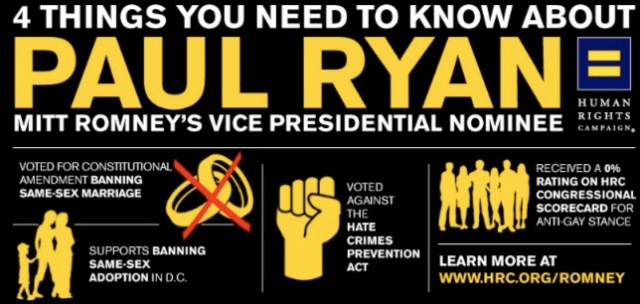
Romney And Ryan: Gay Facts


(Click pics for full articles by The Human Rights Campaign)

Gay Men Are Flunking The Test

Also published on Bilerico.com

Yesterday, I posted an article about  a press release by the Journal Of The American Medical Association:

“…all adult patients, regardless of CD4 cell count, should be offered antiretroviral therapy (ART), according to an article in the July 25 issue of JAMA, a theme issue on HIV/AIDS. Other new recommendations include changes in therapeutic options and modifications in the timing and choice of ART for patients with an opportunistic illness such as tuberculosis.”

This follows the “treatment as prevention” model, based on the scientific research that people with HIV on antiretroviral therapy- with an undetectable viral load- are 96% less likely to pass on the virus.
us-statistics-2.jpgThis seems to be very good news. If you have HIV, you should find out early, get on meds and you’ll have a better chance of living a longer healthier life.

So what’s the problem? The problem is twofold:

  1. People at risk aren’t being tested: 20-25% of all HIV-infected people don’t know they have it.
  2. People at risk are still not being tested: Gay and Bisexual men of all races are the most severely affected by HIV

That’s not a typo- they’re basically the same reason, but there’s a difference. Any guesses?

Hint: It’s probably why most gay men won’t even read this article.

20-25% of all people with HIV don’t know they have it. Why not?

Here’s my take: Denial is one of the strongest mechanisms in the human psyche. It is fed by lack of information, by avoidance and by a strong desire for an alternative reality. If you’ve had unprotected sex, you’ve probably engaged in the process of denial. You’ve probably downplayed the risk, probably lied to yourself a little. You may have even gone over and over it in your mind, seizing every opportunity to deny the possibility of trouble.

“He looked okay”; “He didn’t seem sick”; “He pulled out”; “He would have told me if he had HIV”, etc, etc, and etc.

Well, we all know where that goes…. As individuals, we’re not facing facts. If we were, we’d be getting tested.

us-statistics-1.jpgGay and Bi men of all races are the most severely affected by HIV. Of course. We know that. Don’t we?

Again, denial applies. Gay and Bi men aren’t talking about HIV anymore. Our friends aren’t dying, so there’s no reason to be concerned. People with HIV aren’t out- aren’t well-known in our communities. Why? I was once told “You don’t need to harp about HIV all the time- it’s not that big of a deal.” Except that it is.

HIV has complicated my life in ways many people can’t believe. I am on catastrophic health insurance through the state- almost three times as expensive as my partner’s insurance. I get assistance for my meds- which cost about $25,000 a year- but (crazily), I can’t make more than $30,300 and still qualify for the program. I have joint pain, sleep issues, battles with depression, fatigue and a body that is aging at several times the normal rate– most probably due to inflammation- the hallmark of HIV disease. And yet, if I talk about this to friends or family, I’m seen as a whiner or someone trying unnecessarily to worry people I care about. It’s the “shut up- at least you’re not dying” defense. I know several HIV+ people who haven’t told anyone of their status, mostly because it’s “uncomfortable”.

No shit.

As a community, we’re not facing facts. If we were, we’d be talking to our friends about the importance of maintaining our health. We’d be talking about the hard reality of HIV.

But we’re not. Denial still holds sway, both individually and as a community. We’re lying to ourselves- we’re lying to each other- and infection rates stay the same.

We have a chance to change this trend. But only if everyone with HIV starts treatment, gets into care. This recommendation of the AMA may help with that. But it’s not up to doctors, nurses and social workers, it’s up to us.

We’re being tested, both as individuals and as a community. The problem is, we’re flunking.

Because we’re not showing up.

(Images source)

The Right To Kill 2

After the Gabrielle Giffords shooting, I wrote a piece called The Right To Kill.

I basically said that the insanity of “rights” over the safety of human life has come home to roost. The events in Aurora, preceded by shootings in Tulsa, Seattle, Oakland, Chardon, have brought a little attention to the deadliest shooting crimes in U.S. history– and the world ranking of the United States in terms of gun-related murders (4th highest). Nothing is changing. In fact, it’s probably just getting worse. Joe the Plumber blamed the holocaust on gun control. The American Family Association blames the murders on “liberal churches“- I know- I couldn’t believe it either. Except that I do. Any tragedy to bring the collection money rolling in is fair game for crazy pastors.

And that’s the problem. Crazy people who act out in public seem to give permission to crazy people in charge of congregations and political positions permission to act out, too. To act out with ideology front and center. Not compassion, ideology. And fear. Like I said, crazy. And people believe them. Instead of statistics. Instead of science. Instead of facts.

Roger Ebert, writing for the New York Times, has one of the most eloquent summaries of the Aurora shooting that I’ve read so far. From We’ve Seen This Movie Before:

That James Holmes is insane, few may doubt. Our gun laws are also insane, but many refuse to make the connection. The United States is one of few developed nations that accepts the notion of firearms in public hands. In theory, the citizenry needs to defend itself. Not a single person at the Aurora, Colo., theater shot back, but the theory will still be defended.

I was sitting in a Chicago bar one night with my friend McHugh when a guy from down the street came in and let us see that he was packing heat.

“Why do you need to carry a gun?” McHugh asked him.

“I live in a dangerous neighborhood.”

“It would be safer if you moved.”

This would be an excellent time for our political parties to join together in calling for restrictions on the sale and possession of deadly weapons. That is unlikely, because the issue has become so closely linked to paranoid fantasies about a federal takeover of personal liberties that many politicians feel they cannot afford to advocate gun control.

I’ve no doubt that posturing will constipate any real discussion of this issue- but Ebert adds a final, jarring note to his piece:

Immediately after a shooting last month in the food court of the Eaton Centre mall in Toronto, a young woman named Jessica Ghawi posted a blog entry. Three minutes before a gunman opened fire, she had been seated at the exact place he fired from.

“I was shown how fragile life was,” she wrote. “I saw the terror on bystanders’ faces. I saw the victims of a senseless crime. I saw lives change. I was reminded that we don’t know when or where our time on Earth will end. When or where we will breathe our last breath.”

This same woman was one of the fatalities at the midnight screening in Aurora. The circle of madness is closing.

Indeed. And it’s closing in on all of us.

~

Public Pride Parades Around The World

An exploration of Pride Parades as indictors of liberty from Good.is:

Click for larger version

Infographic: HIV Epicenter, Southern U.S.

click to see larger (readable) version

Courtesy AIDS United

HIV In Montana: It’s Not Classified

One of two new Montana public service message targeting men who have sex with men- check back tomorrow for the second:

This short point of view video targeting Montana’s MSM population looks at the Classified Personal ads and points out some HIV facts that should not be classified and offers some excellent reasons to get tested (checked) for HIV. It also directs viewers to getcheckedmt.org , a resource to find the nearest HIV testing location in Montana.

This creative project was created by Laura Dybdal and Jason Gutzmer as part of Montana’s HIV Social Marketing Campaign.

Related articles

Instant Gratification Has Made Us Impatient

Take a look at this infographic which illustrates how impatient the Google Society has become:
Instant America
Created by: Online Graduate Programs
Thanks, Tony Shin!

Kaiser Permanente Announces HIV Challenge

When healthcare gets it right, I think it’s important to notice.
Contrary to the HMO stereotype, Kaiser Permanente has taken on the challenge of HIV and instituted policies and guidelines for the effective care and treatment of persons with HIV- to dramatic effect:

English: The Ordway Building, One Kaiser Plaza...

Image via Wikipedia

Kaiser Permanente announced (January 26th) the Kaiser Permanente HIV Challenge to help health care providers nationwide improve health equity for people living with HIV by increasing access to HIV care and improving health outcomes.

The HIV Challenge was announced at the Center for Medicare & Medicaid Innovation Care Innovations Summit in Washington, D.C. ( www.hcidc.org ).

Kaiser Permanente, the nation’s largest nonprofit health care provider, has treated more than 60,000 people since the HIV epidemic emerged 30 years ago, and has reduced disparities among its current HIV population of more than 20,000 people by working to meet or exceed the objectives of the U.S. National HIV / AIDS Strategy.

The crux of the HIV Challenge (kp.org/hivchallenge) is to challenge other private health care providers and public and community health clinics to increase the number of HIV-positive people getting effective treatment by sharing Kaiser Permanente’s toolkit of clinical best practices, provider and patient education materials, mentoring, training and health IT expertise.

(Watch the excellent video series about Kaiser’s HIV Challenge here)

HIV is still an epidemic in the United States, with 56,000 people becoming infected each year and more than 1.1 million Americans living with HIV, but one in five people with HIV don’t know they are infected.

“The organizations presenting challenges here today are pushing the best minds in the country to create a better health care system. They represent exciting solutions to help address some of the nation’s most urgent health needs,” said CMS Acting Administrator Marilyn Tavenner.

Health care disparities are gaps in the quality of care associated with inequities encountered by racial, ethnic, poor and marginalized groups. The HIV Challenge is part of Kaiser Permanente’s larger work to identify, measure, research and eliminate disparities in health and health care in the United States. To learn more go to kp.org/healthdisparities.

“Too many people are unaware they have HIV because access to effective prevention and care is insufficient,” said Michael Horberg, MD, director of HIV/AIDS for Kaiser Permanente, executive director of research for Mid-Atlantic Permanente Medical Group, and a member of the Presidential Advisory Council on HIV/AIDS. “People with HIV need to get into treatment because quality HIV treatment prevents others from getting infected. Patients on effective therapy and better case management are living longer and more productive lives. However, quality HIV treatment requires effort.”

Kaiser Permanente has demonstrated excellence in HIV clinical care outcomes with:

  • HIV mortality rates that are half the national average
  • 94 percent median treatment adherence among patients regularly in care and on antiretroviral therapy
  • No disparities among its black and Latino HIV-positive patients for both mortality and medication rates, compared to a 15 percent higher rate in the United States for mortality and for medication
  • 89 percent of its HIV-positive patients are in HIV-specific care within 90 days, compared to 50 percent in the U.S. within one year
  • 69 percent of all its HIV-positive patients have maximal viral control compared to 19 percent to 35 percent nationally

As part of its HIV Challenge effort, Kaiser Permanente is sharing these best practices and tools for private health care providers and community health clinics to replicate: quality improvement programs that measure gaps in care; testing, prevention and treatment guidelines; how to set up multi-disciplinary care team models that emphasize the “medical home” so HIV specialists, care managers, clinical pharmacists and providers work together; and education for both the provider and patient.

For more details on the HIV Challenge, to download the best-practices toolkit and to watch videos of success stories in setting up HIV clinics and reducing disparities, go to: kp.org/hivchallenge

“Our success in the treatment of patients with HIV/AIDS results from the excellence of our clinicians, our advanced IT systems, our integrated delivery system and our effective coordination across specialties,” said Robert Pearl, MD, chief executive officer and executive medical director of The Permanente Medical Group and Mid-Atlantic Permanente Medical Group. “In the same way that we have reduced the chances of our patients dying from cardiovascular disease and cancer significantly below the national averages, we have achieved outstanding clinical outcomes for our patients with HIV/AIDS.”

The National HIV/AIDS Strategy ( http://www.aids.gov/federal-resources/policies/national-hiv-aids-strategy/ ) calls for increased testing so that all Americans can know their HIV status, increased access to culturally sensitive prevention messages, community-targeted prevention and condom and clean needle access. NHAS also calls for improving access to quality HIV care because HIV medications not only improve individuals’ health and extend their life expectancy, they also reduce their risk of transmitting HIV to others. A recent scientific study found that effectively treating HIV patients with antiretroviral medications reduces HIV transmission by 96 percent. The study, known as HPTN 052, found that treating people with antiretroviral drugs before they are symptomatic can reduce the amount of virus in the blood sufficiently to reduce the risk of sexual transmission of HIV to an uninfected partner.

The Kaiser Permanente HIV Challenge is part of Kaiser Permanente’s ongoing research of HIV and HIV treatment. Published Kaiser Permanente research studies include:

  • A study that found there are no disparities by race or ethnicity in risk of AIDS and death among HIV-infected patients in a setting of similar access to care, despite lower anti-retroviral therapy adherence among Latinos and blacks compared to whites.
  • A study that found HIV-infected patients are at increased risk for cancer as a result of both their impaired immune system and lifestyle factors, such as smoking.
  • A study that found 17 measures, such as screening and prevention for infections and monitoring of antiretroviral therapy, should be adopted uniformly to improve the quality of HIV care and treatment nationwide.
  • A study that found that cholesterol medications can work well among certain HIV patients who are at risk for cardiovascular disease.

About the Care Innovations Summit:

Sponsored jointly by the Department of Health and Human Services, the Centers for Medicare & Medicaid Services, Health Affairs, and the West Wireless Health Institute, the Care Innovations Summit brings together more than 1,000 health care leaders, entrepreneurs, innovators, government officials, and finance experts to stimulate investment in a high-quality, sustainable health care system. Made possible by the Affordable Care Act and the Obama Administration’s commitment to open government, the Summit represents a new opportunity for industry and government to work together to help spur innovation in the public and private sectors to improve health care quality as never before and lower costs through improvement.

About Kaiser Permanente

Kaiser Permanente is committed to helping shape the future of health care. We are recognized as one of America’s leading health care providers and not-for-profit health plans. Founded in 1945, our mission is to provide high-quality, affordable health care services and to improve the health of our members and the communities we serve. We currently serve 8.9 million members in nine states and the District of Columbia. Care for members and patients is focused on their total health and guided by their personal physicians, specialists and team of caregivers. Our expert and caring medical teams are empowered and supported by industry-leading technology advances and tools for health promotion, disease prevention, state-of-the art care delivery and world-class chronic disease management. Kaiser Permanente is dedicated to care innovations, clinical research, health education and the support of community health. For more information, go to: http://www.kp.org/newscenter .

For more information:
Danielle Cass, danielle.x.cass@kp.org, 510-267-5354
Farra Levin, farra.r.levin@kp.org, 510-267-7364

SOURCE Kaiser Permanente

STUDENT NON DISCRIMINATION ACT NEEDED TO PROTECT GLBT YOUTH FROM BULLYING

Kathy Baldock, www.canyonwalkerconnections.com

Casey, sixteen and gay, was being bullied by two students at his high school in Ohio. His youth pastor, a friend of mine, helped to secure a restraining order to protect him, but the principal downgraded the severity with a weaker solution.  He let Cody come to the office five minutes before classes ended and stay until five minutes after they started; Casey would then be safe from bullying in the hall-passing time.  One of Casey’s bullies was still in class with him.  Did this principal create a safe learning environment and protect Casey from abuse?  Why did it even get this far?  Why was there no policy in place to protect this child from bullying due to his sexual orientation or even his perceived sexual orientation?

No gay, lesbian, bisexual or transgender (glbt) child in public schools in the United States is federally protected from bullying and harassment for their sexual orientation or gender identity. Shocked?  This is true.  No Child Left Behind (2001), soon to be re-authorized after ten years in the updated Elementary and Secondary Education Re-Authorization 2011 (ESEA), made it out of committee in October 2011 without the bipartisan support it needed to include protection for glbt students.   Currently, students are protected from bullying for: race, sex, religion, disabilities and national origin, but not sexual orientation and gender identity.

When the ESEA is brought to the floor of the Senate in either December or January, there is a push to attach the Student Non-Discrimination Act HR 4350 (SNDA) to it. SNDA includes comprehensive federal prohibitions against discrimination in public schools based on actual or perceived sexual orientation or gender identity.  It would forbid schools with public funding to discriminate against glbt students or ignore harassing behaviors.

The bill was re-introduced, having not been added in committee in ESEA, by Sen. Al Franken (D-MN) and Rep. Jared Polis (D-CO). (watch the video, grab a tissue.)  Co-sponsored by 34 senators, it needs the approval of 60 senators to attach it to the ESEA before going to the House for a vote before it becomes law.

“Is it needed?” you may ask.  Only 13 states have laws protecting glbt students from harassment at school; this is not a surprising statistic when you also realize that 15 states do not even include sexual orientation and gender identity on the “hate crimes” list; in 29 states you can still be fired for being gay; and in 34 states you can be fired for being trans.

Come on, it is really necessary to pass another law?  Lots of kids are bullied in school; that is “just the way it is.”  Research shows highly rejected glbt youth were at a very high risk for health and mental problems when they become young adults.  Highly rejected glbt youth were:

  • More than 8 times as likely to attempt suicide
  • Nearly 6 times as likely to report high levels of depression
  • More than 3 times as likely to use illegal drugs and
  • More than 3 times as likely to be at high risk for HIV and sexually transmitted diseases *

Knowing that the primary socializing institutions for children and youth are families, schools and faith communities, should we not try to make those places safer for children?  This is not just a “family issue” forglbt youth.  Many of them are not even out in their own families.  As mysterious as that may seem, the biggest loss a child fears is family rejection so many will delay coming out to their own parents.  Churches are wellknown sources of anti-gay rhetoric, leaving many children thinking they have only one protected place: school.

Now is the time to voice to your senators and representative  that it is their duty as public servants to serve the most vulnerable of their constituents: glbt children.  Tell them to get on record now in support of the Senate bill and the version that comes to the House.  Any senator or representative that votes against the protection of vulnerable children should not hold that position of trust.

I am a Mom too, with two straight, adult children.  I am a straight, Evangelical Christian compelled by my faith to stand for justice and against oppression.  The argument of some conservative family groups and lobbies against this bill is the fear that this bill will “victimize people of faith by turning religiously-based, anti-gay comments into ‘thought crimes’ ” (Rep. John Kline R-MN).  This is fear-based rhetoric.  Anti-discrimination laws punish actions, not opinions or beliefs.

Who should care and act on this now:

  • Parents of glbt children.  There are over 350 chapters of Parents and Friends of Gays and Lesbians (PFLAG) with over 200,000 members nationwide.  Be the advocates you already are and tell your families and friends to insist on the addition of the SNDA in the ESEA.
  • Educators who see the crises and have no guidelines under which to operate when they witness bullying of glbt students.  School boards will take seriously the loss of federal funding should they not enforce the law.
  • Members of the glbt community know the damage many of them suffered for being gay or perceived as gay.
  • Christians are to take seriously the mandates of our faith to fight injustice and stand against oppression (oh, and toss in a good dose of helping the poor) Isaiah 58. A Christian who would consider blocking the protection of a child needs to consider deeply the examples of Jesus.
  • Any parent that understands the difficulty of peer bullying in schools.  Consider that the children that may not be yours suffer it more profoundly; look at those stats again for rejection of glbt youth.  Teach your children well.
  • Conservative family groups need to hold to their own missions—protecting families which include glbt youth.  The irony of Family Research Council ignoring family research and producing policies directly impacting the health and mental wellness of glbt youth is glaring.  Focus on the Family really does need to focus on families and help families with glbt youth.  Concerned Women for America should be concerned about the children of women in America.  Excluding glbt children from the mission statements of those organizations shows severe bias which places religious beliefs over a higher calling of caring for the families and children that even the names of their organizations imply.
  • Any person with even a modicum of wisdom that understands that all children desire the comforts of love, acceptance and security. Healthy children grow into healthy adults and build healthy societies.

Bottom line: who should care that the Student Non-Discrimination Act (SNDA) be voted into law as part of the Elementary and Secondary Education Re-Authorization Act (ESEA)?  All of us. Partisan politics drives me crazy.  When I see a vote that goes right down party lines, I know the public servants are voting to maintain power and money balances and have succumb to party/special interest groups pressure.  Voting for the protection of children is not a partisan issue.  Every public servant in this country should be protecting the least of these.

And what has become of Casey? Along with his youth pastor, PFLAG stepped in to protect this child. The school administration knows they are being watched and are more cautious. This is what ESEA will do for all children and in all schools; it will strengthen the federal law to include the protection glbt students against bullying.  And, after five years of blocking a Gay Student  Alliance (GSA), Casey’s school now has one and he is the president. He is safer.

Apply pressure and make your voice heard now.  There are 90 million children in this country under 18 years of age, including approximately 4.5 million that are glbt.  Speak up for their safety and insist that the non-inclusion of SNDA at the committee level be corrected when ESEA comes to Senate vote in December or January.  Insist and speak up for Casey and other glbt students.

RECAP:

Contact your senators and representatives and tell them that it is essential that the SNDA (HR 4350) become part of ESEA when it comes for vote in the Senate in December or January.  It will expand the protection from bullying based on: religion, sex, national origin and disabilities to include protection for sexual orientation and gender identity for glbt students. And stay on them, especially the Republicans who may be resistant to approve it. And big kudos to Al Franken, thank him too. 


*Family Acceptance Project, Dr. Caitlin Ryan, “Supportive Families, Healthy Children: Helping Families with Lesbian, Gay, Bisexual & Transgender Children” (2009)


WSJ Profiles Dramatic Increase In Montana Same-Sex Couples

The Wall Street Journal profiles the statistical rise of same-sex couples in the United States- especially outside of the LGBT mainstream cities like New York, Los Angeles, San Francisco and Washington DC. This increase in same-sex couples is happening  extremely quickly in rural places- including Montana:

The Census Bureau doesn’t ask people about their sexual orientation. But since 1990, respondents have had the option to identify themselves as living with a same-sex partner. This group grew by half nationwide between 2000 and 2010, figures released this week show….The number of self-identified gay couples rose by nearly 90% in Montana, Nevada and West Virginia, for instance, while California, New York and Washington, D.C., saw increases of 40% or less, according to Mr. Gates’s analysis of the data. (emphasis mine)

Yep, looks like we’re here to stay. And there are increasingly more of us- probably due to more of us coming out earlier and feeling less threatened in our hometowns. All good news.

Polls suggest wider acceptance of gays nationwide. About 46% of people oppose gay marriage today, for instance, down from 65% in 1996, according to the Pew Research Center.

Montana native Ken Spencer, 46 years old, said he has seen the shift firsthand. Growing up, he said, he believed that “if you were gay, you had to leave Montana.” He kept his homosexuality a secret for years.

But gay people have become more visible in the state, with this year’s Montana Pride celebration in Bozeman drawing about 2,000 people, up from a few hundred in 2002.

Mr. Spencer said he identified himself as living with his same-sex partner for the first time in 2010. (My emphasis)

Yep, that’s my guy….

Ken and I made a conscious decision to stay in Montana and work for awareness and equality, just as many of you have chosen to do. We were born here, we like it here and we’re not going to be driven out by ignorance and fear. And neither should anyone else.

And, with these statistics, it’s looking like we’re all doing a fairly good job….