ADAP Watch 7.19.12

From NAPWA:

The Administration has pledged new money to end the waiting lists, but they will linger for some time. Making sure that everyone who needs ART drugs can get them is an obvious first step towards ending this country’s HIV/AIDS epidemic, but when the waiting lists are gone, we’ll have to move on to the hard work of changing attitudes towards people with HIV and ensuring access to health care for all Americans, not just those living with HIV.

It was grimly entertaining, explaining to Conference delegates from Canada and Germany what ADAP is and why we have waiting lists, when it’s so obviously better public health policy and so obviously more fiscally prudent to treat everyone with HIV who wants treatment. After she got past her initial disbelief, a German delegate gently suggested that there are better ways to handle this sort of thing. We wouldn’t need ADAPs, let alone have ADAP waiting lists, if we had a rationally designed national health care system.

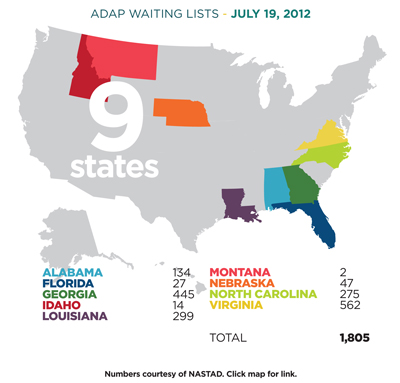
Here are the latest numbers from our friends at NASTAD:

HIV In Prison

FYI:

  • More than 2 million people are incarcerated in jails and prisons in the United States.
  • People who are incarcerated are at increased risk for acquiring and transmitting HIV.
  • The correctional setting is often the first place incarcerated men and women are diagnosed with HIV and provided treatment.

People who are incarcerated are at increased risk for acquiring and transmitting HIV and other infections. Correctional health, public health, and community-based organizations need to improve HIV prevention and care for incarcerated populations through 1) routine HIV screening and voluntary HIV testing within prisons and jails and 2) other effective prevention strategies, including those that address inmates’ transition back into the community. Correctional institutions can be important partners in preventing and treating HIV to protect and improve inmate and community health.

More here.

Let’s Talk About Sex

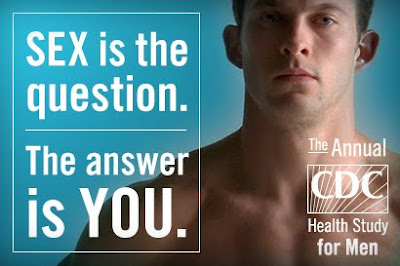
“Sex Is the Question,” is an engaging and important survey regarding the sexual practices of gay and bisexual men. This entirely confidential survey is sponsored by the Center for Disease Control, and will be used by state and local health departments to better understand the HIV epidemic among gay and bisexual men and potentially create new techniques to reverse the trend. “Sex Is the Question” is the largest survey ever attempted by a US federal agency for gay and bisexual men, and it will only take you a few minutes to complete. Do you want another great reason to take the survey? For every completed survey, “Sex Is the Question” will make a monetary donation to the It Gets Better Project.

How can you take the survey? Just click on this link. After you complete the survey, you will also have the opportunity to invite your friends to participate, and a donation will be made to the It Gets Better Project for each of your friends who completes the survey too. In addition, “Sex is the Question” is not just a survey. It is the first study of its kind to provide immediate feedback to its participants by incorporating videos and other interactive tools. At the end of the survey, you will be presented with personalized insight and comparisons based on your answers. Thank you for your consideration! With you support, we can help put an end to HIV once and for all, and in doing so, support a terrific organization.

“All Adult HIV Patients Should Be Offered Antiretroviral Therapy”

From Science Daily:

Included in the 2012 International Antiviral Society-USA panel recommendations for human immunodeficiency virus (HIV) patient care is that all adult patients, regardless of CD4 cell count, should be offered antiretroviral therapy (ART), according to an article in the July 25 issue of JAMA, a theme issue on HIV/AIDS. Other new recommendations include changes in therapeutic options and modifications in the timing and choice of ART for patients with an opportunistic illness such as tuberculosis.

Melanie A. Thompson, M.D., of the AIDS Research Consortium of Atlanta, presented the findings of the article at a JAMA media briefing at the International AIDS Conference.

Journal of the American Medical Association

Journal of the American Medical Association (Photo credit: Wikipedia)

“Since the first antiretroviral drug was approved 25 years ago, improvements in the potency, tolerability, simplicity, and availability of ART have resulted in dramatically reduced numbers of opportunistic diseases and deaths where ART is accessible,” according to background information in the article. “New trial data and drug regimens that have become available in the last 2 years warrant an update to guidelines for ART in HIV-infected adults in resource-rich settings.”

The benefit of suppressing the virus, in my opinion, is greater than the possible toxicity of medication and navigating possible side effects. We know that as long as HIV is in the body, unchecked, it’s doing damage. It’s more likely than possible that people who start antiretroviral therapy early will have less problems with secondary conditions (joint pain, arthritis, memory problems) as they progress in their lives. I think this is tremendous news.

Full Story Here.

President’s Welcome Video To International AIDS Conference 2012

Some history and a commitment to continue progress:

The Right To Kill 2

After the Gabrielle Giffords shooting, I wrote a piece called The Right To Kill.

I basically said that the insanity of “rights” over the safety of human life has come home to roost. The events in Aurora, preceded by shootings in Tulsa, Seattle, Oakland, Chardon, have brought a little attention to the deadliest shooting crimes in U.S. history– and the world ranking of the United States in terms of gun-related murders (4th highest). Nothing is changing. In fact, it’s probably just getting worse. Joe the Plumber blamed the holocaust on gun control. The American Family Association blames the murders on “liberal churches“- I know- I couldn’t believe it either. Except that I do. Any tragedy to bring the collection money rolling in is fair game for crazy pastors.

And that’s the problem. Crazy people who act out in public seem to give permission to crazy people in charge of congregations and political positions permission to act out, too. To act out with ideology front and center. Not compassion, ideology. And fear. Like I said, crazy. And people believe them. Instead of statistics. Instead of science. Instead of facts.

Roger Ebert, writing for the New York Times, has one of the most eloquent summaries of the Aurora shooting that I’ve read so far. From We’ve Seen This Movie Before:

That James Holmes is insane, few may doubt. Our gun laws are also insane, but many refuse to make the connection. The United States is one of few developed nations that accepts the notion of firearms in public hands. In theory, the citizenry needs to defend itself. Not a single person at the Aurora, Colo., theater shot back, but the theory will still be defended.

I was sitting in a Chicago bar one night with my friend McHugh when a guy from down the street came in and let us see that he was packing heat.

“Why do you need to carry a gun?” McHugh asked him.

“I live in a dangerous neighborhood.”

“It would be safer if you moved.”

This would be an excellent time for our political parties to join together in calling for restrictions on the sale and possession of deadly weapons. That is unlikely, because the issue has become so closely linked to paranoid fantasies about a federal takeover of personal liberties that many politicians feel they cannot afford to advocate gun control.

I’ve no doubt that posturing will constipate any real discussion of this issue- but Ebert adds a final, jarring note to his piece:

Immediately after a shooting last month in the food court of the Eaton Centre mall in Toronto, a young woman named Jessica Ghawi posted a blog entry. Three minutes before a gunman opened fire, she had been seated at the exact place he fired from.

“I was shown how fragile life was,” she wrote. “I saw the terror on bystanders’ faces. I saw the victims of a senseless crime. I saw lives change. I was reminded that we don’t know when or where our time on Earth will end. When or where we will breathe our last breath.”

This same woman was one of the fatalities at the midnight screening in Aurora. The circle of madness is closing.

Indeed. And it’s closing in on all of us.

~
Truvada Approved For HIV Prevention

The first-ever daily pill to help prevent against HIV was approved Monday by U.S. regulators for use in uninfected adults who are at risk for getting the virus that causes AIDS.
Truvada, made by Gilead Sciences in California, has been on the market since 2004 and was approved by the Food and Drug Administration for a new use as a tool to help ward off HIV in otherwise healthy people, in combination with safe sex and regular testing.
The pill as pre-exposure prophylaxis has been hailed by some AIDS experts as a potent new tool against human immunodeficiency virus, but some health care providers are concerned it could encourage risky sex behavior.
In addition, the regimen is estimated to cost around $14,000 per year, making it out of reach of many.

The National Association of People With AIDS  (NAPWA) strongly supports today’s move by the United States Food and Drug Administration to approve use of Truvada (emtricitabine/ tenofovir disoproxil fumarate) for pre-exposure prophylaxis (PrEP) to reduce the risk of sexually acquired HIV-1 infection.

“It’s time for people at high risk of HIV infection to be empowered to protect themselves and others,” said Frank J. Oldham, Jr., NAPWA’s President and CEO. “Today’s approval of Truvada for HIV prevention gives them an important new tool to do that.

“PrEP is not a final solution to the spread of HIV,” Oldham continued, “but it can be one tool, and a very useful one, in a well stocked toolkit of prevention measures. We urge all Americans to assess their HIV risk realistically and use condoms if they are at risk, but we thank the FDA for approving Truvada for PrEP for those who cannot or will not.”

Truvada is one of the pills I take every day- if it can prevent anyone from getting HIV- it should. The “how” is still being determined.


10 Things Most Americans Don’t Know About America

Mark Manson gives some perspective to our sometimes myopic view of the United States:

Imagine you have a brother and he’s an alcoholic. He has his moments, but you keep your distance from him. You don’t mind him for the occasional family gathering or holiday. You still love him. But you don’t want to be around him.

This is how I lovingly describe my current relationship with the United States. The United States is my alcoholic brother. And although I will always love him, I don’t want to be near him at the moment.

I know that’s harsh, but I really feel my home country is not in a good place these days. That’s not a socio-economic statement (although that’s on the decline as well), but rather a cultural one.

I realize it’s going to be impossible to write sentences like the ones above without coming across as a raging prick, so let me try to soften the blow to my American readers with an analogy:

You know when you move out of your parents’ house and live on your own, how you start hanging out with your friends’ families and you realize that actually, your family was a little screwed up? Stuff you always assumed was normal your entire childhood, it turns out was pretty weird and may have actually fucked you up a little bit. You know, dad thinking it was funny to wear a Santa Claus hat in his underwear every Christmas or the fact that you and your sister slept in the same bed until you were 22, or that your mother routinely cried over a bottle of wine while listening to Elton John.

The point is we don’t really get perspective on what’s close to us until we spend time away from it. Just like you didn’t realize the weird quirks and nuances of your family until you left and spent time with others, the same is true for country and culture. You often don’t see what’s messed up about your country and culture until you step outside of it.

Some of this may not be easy reading, but the perspective is accurate for many- I strongly encourage you to read the rest here.

The Affordable Care Act & LGBT Persons

In 10,000 Same Sex Couples Magazine, an excellent overview of the benefits of the ACA for LGBT persons. Excerpt:

Nondiscrimination protection measures have been included in the Affordable Care Act, and significantly, by 2014, insurance companies will not be able to deny coverage based on pre-existing conditions such as HIV or transgendered medical history.

Increased services for preventive care and HIV testing and treatment have been included in the ACA.  As insurance companies will no longer be able to cancel or deny coverage based on pre-existing conditions, Americans living with HIV will have better access to care and to life-saving drugs, whereas currently, an estimated 25% of the 1.2 million Americans living with HIV in the United States have no health insurance coverage. Many of those living with HIV without insurance, or with insurance but consistently fearful of having it canceled due to a pre-existing condition, have been forced to pay out of pocket or seek other methods of treatment.

LGBTQ Activist Chris Barnett of San Francisco says: “I’ve been fortunate to have health coverage all my years of living with HIV, so pre-existing condition has thankfully never directly affected me. Though I must say, in my early years with this, late ’80s to early ’90s, I was fearful of using my insurance for fear of being redlined, so I paid for early treatment out of pocket, or found medical studies.”

As most states in America fail to recognize same-sex relationships, healthcare through a spouse’s workplace is not an option for many LGBTQ Americans. This often results in a high number of citizens forced to pay high prices for private insurance or to forgo having any insurance at all due to cost.  With ACA’s expansions to the affordability and accessibility of healthcare, more LGBTQ Americans will be able to be covered.

Read the rest here.

AIDS Drug Assistance Program (ADAP) Watch 7/1/12

From NAPWA:

The waiting list numbers continue steady, just over 2,000, down from 9,000 in September of last year.

Coming off another National HIV Testing Day, we have to wonder how some states can encourage their citizens to get tested but not help them get lifesaving medicines if they test positive.

We also wonder what kind of cost analyses the waiting list states are doing. The cost of clearing the waiting lists completely just isn’t that great. Virginia has just under 600 PLWHA on its waiting list. If drugs cost $15,000 for one ADAP beneficiary for one year, drugs for 600 will cost $9 million – and we just don’t believe $9 million can’t be found in an $85 billion fiscal 2013 Virginia state budget. PLWHA on Virginia’s and other states’ waiting lists will cost the public sector a lot more if they don’t get drugs that can keep them from progressing to AIDS.

Here are the latest numbers from our friends at NASTAD: