Catholics Defend The President

St. Peter's Basilica at Early Morning

Image via Wikipedia

It seems as if the Obama Administration’s rule change requiring that contraception (to those who want it) be insurance-paid commodities was seen to be a nuclear missile aimed directly at St. Peter’s in Rome.

But mostly just by the bishops…. The fuss! The hierarchy’s view of sexuality is- and has always been, about 160 years behind science- and popular understanding, not to mention practice. Humanae Vitae was the most dismal failure, in my opinion, to come out of the era of the Second Vatican Council. The chain attached to a wall in a room that no longer existed. (see below)

And some people realize that. In The Boston Globe today, Joan Vennochi says that the hierarchy is manufacturing a war against the president:

Last Sunday, the Catholic Church declared war on President Obama. Republican Senator Marco Rubio of Florida quickly took up the cause, signaling the outlines of a serious religious rumble to come in 2012.

The president should be ready for the fight, knowing that on this one he is right.

At Sunday Mass, Catholic parishioners across the country were read letters denouncing the Obama administration’s recent decision to require religiously affiliated hospitals, colleges, and charities to offer health insurance coverage to employees for contraception and the “morning-after pill.’’ On Monday, Rubio, a Republican star who is often mentioned as a VP candidate, introduced a bill that would override the Obama policy by allowing religious institutions that morally oppose contraception to refuse to cover it.

But not all employees of Catholic institutions are Catholics. Why should their employers impose their religious beliefs on them and deny coverage for birth control and other medical care? As long as those Catholic institutions are getting taxpayer money, they should follow secular rules. That’s the Obama administration’s argument, and it makes sense.

But if truth is a casualty of war, reason is an even more specific casualty of culture war. Obama can’t let the other side frame the argument, which it is already doing in typically ferocious fashion.

…Obama isn’t trying to undermine Catholicism. He’s telling Catholic leaders they can’t regulate the beliefs of those of other faiths.

Keith Soko in The National Catholic Reporter agrees that a war is brewing but it may be one-sided:

But which Catholics would really be against providing access to contraceptives in health care coverage for women? Is it the 90-some percent of Catholic married couples of child-bearing age who use contraceptives? Is it the 98 percent of sexually active Catholic women who use contraceptives? No, it is not.

So who would it be? It must be a small minority.

One, of course, is the U.S. bishops and the rest of the Catholic hierarchy, including the Vatican. They are all men. In 1968, Pope Paul VI published the “birth control encyclical” called Humanae Vitae (“Of Human Life”), which affirmed the Catholic church’s opposition to contraception. This was in spite of the pope’s own commission, which voted 75 out of 90 in favor of changing the church’s teaching and allowing contraception for married couples. Immediately, Catholic theologians issued a statement arguing against the document’s methods and conclusions. Years later, the long pontificate of Pope John Paul II began, with him reaffirming the “official” Catholic teaching against contraception, despite the fact that most Catholic theologians disagreed and most Catholics rejected the teaching.

So, the bishops are taking moral “high ground”- which is designed to… well, what, exactly?  Soko gives us some insight:

If the U.S. bishops and the conservative Catholic and Christian media are going to appeal to “conscience,” then they better allow for the well-informed consciences of Catholics and non-Catholics who work at Catholic institutions to make their own decisions.

No one is forcing Catholics to use contraception. It is merely stating that they should have access to contraception. Many Catholic theologians have argued that it is a fair and just decision that respects the ability of Catholic and other women to follow their own consciences and make decisions as responsible adults about their own health care and that of their families.

And they also must respect the well-informed consciences of professors at academic universities whose job is the pursuit of knowledge and truth, and for some, the pursuit of justice as well. This includes Catholic theologians who are trying to give advice on improving the church. Since the bishops and others have introduced this into the public arena, they need to respect the consciences and expertise of those voices without the threat of job loss or excommunication.

This is not a question of teaching Catholic doctrine in a classroom; this is wrestling with public policy in a democratic and pluralistic society, and that can get messy. And Catholic teaching has in the past acknowledged that public policy and morality are two separate things. Everything that Catholic teaching argues is immoral is not illegal, as that would not always be practical public policy.

Which Catholics are really against providing contraceptive coverage? My guess is not many, but they are vocal. And probably most of them would be men. Men controlling women. History marches backward.

The bishops are always decrying “cafeteria catholicism”- for the way some pick and choose what they’d like to believe and practice. You gotta believe the whole package, they say. But their use of conscience is carefully controlled and shifty- picky and choosy, if you will. But not according to them.

Credibility, boys, credibility. The people will notice.

 “It is now quite lawful for a Catholic woman to avoid pregnancy
by a resort to mathematics,
though she is still forbidden to resort to physics and chemistry.”
~H.L. Mencken

Komen Foundation Cuts Funding To Planned Parenthood

In a surprising (or maybe not) press release yesterday, The Susan G Komen Foundation announced it is cutting off funding to the breast cancer screenings and education programs run by Planned Parenthood. The New York Times:

The move will halt financing to 19 of Planned Parenthood’s 83 affiliates, which received nearly $700,000 from the Komen foundation last year and have been receiving similar grants since at least 2005.

Planned Parenthood contends that the Komen foundation is yielding to longstanding pressure from anti-abortion groups, which Komen denies.

A spokeswoman for the Komen foundation, Leslie Aun, told The Associated Press that the main factor in the decision was a new rule adopted by Komen that prohibits grants to organizations being investigated by local, state or federal authorities. Ms. Aun told The A.P. that Planned Parenthood was therefore disqualified from financing because of an inquiry being conducted by Representative Cliff Stearns, Republican of Florida, who is looking at how Planned Parenthood spends and reports its money.

After the A.P. article was posted on Tuesday afternoon, the Komen foundation declined to make Ms. Aun or another staff member available to discuss the Planned Parenthood decision. The foundation issued a statement saying it was seeking to “strengthen our grants program” and had “implemented more stringent eligibility and performance criteria.”

The statement added, “While it is regrettable when changes in priorities and policies affect any of our grantees, such as a longstanding partner like Planned Parenthood, we must continue to evolve to best meet the needs of the women we serve and most fully advance our mission.”

Cecile Richards, the president of Planned Parenthood, said that the decision “came so abruptly in the face of a long, good, working relationship with Komen” and that the change in financing criteria “was written specifically to address the political pressure that they’ve been under.”

Planned Parenthood’s press release on the action stated that

Planned Parenthood’s quality, accessibility and affordability make it a leader in identifying breast cancer early when there is the best chance of successful treatment. Nationwide, Planned Parenthood doctors and nurses provide nearly 750,000 breast cancer screenings annually, offering risk assessments, breast exams, breast health information and education, and diagnostic and surgical referrals.

Led by a generous $250,000 gift from Amy and Lee Fikes’ foundation, Planned Parenthood has established a Breast Health Emergency Fund to provide immediate funding to ensure that Planned Parenthood health centers can continue to provide breast cancer screenings and care that had previously been supported by Komen.

Amy and Lee Fikes said: “Our family is saddened that the far right has relentlessly and successfully pressured the Susan G. Komen for the Cure Foundation to cut funding for breast screening, referral, and education support to low-income women who, until now, have been able to depend on the partnership between Komen and Planned Parenthood for their health. In response to this disappointing news, our family foundation has granted $250,000 to establish a Breast Health Fund at Planned Parenthood, so that their health centers across the country can continue to put the real needs of women ahead of right wing ideology. We encourage others to join us in replacing the funds lost, so that no woman’s health is imperiled by Komen’s unfortunate decision.”

Some have seen a connection between the hiring of Karen Handel, a Georgia gubernatorial candidate who ran on an aggressively anti-abortion platform and the cut of funding to Planned Parenthood- which also provides abortions at some of its sites. Laura Bassett writes that

 Handel wrote in her campaign blog that she “do[es] not support the mission of Planned Parenthood.”

“During my time as Chairman of Fulton County, there were federal and state pass-through grants that were awarded to Planned Parenthood for breast and cervical cancer screening, as well as a ‘Healthy Babies Initiative,'” Handel wrote. “Since grants like these are from the state I’ll eliminate them as your next Governor.” She also wrote that she opposes stem cell research and supports crisis pregnancy centers, which are unregulated, Christian-run operations whose main mission is to convince pregnant women not to have abortions.

After Handel lost the gubernatorial primary, Susan G. Komen for the Cure named her to be its senior vice president in April 2011.

Komen’s Race For The Cure has become one of the most successful fundraising events in the U.S., with races in virtually every market. On the blogosphere and Twitter, there is chatter about boycotts, protests and closer scrutiny of Komen’s funds. We’ll see if it has any teeth.

Dissatisfaction With Candidates Growing Among Republicans

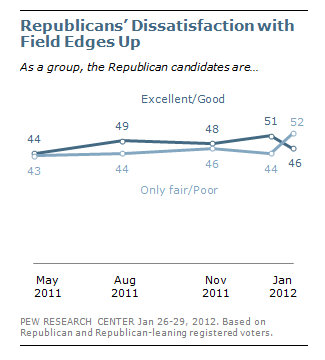
The Pew Research Center has released a new report showing that Republican voters are becoming increasingly unhappy with the field of candidates- the majority (52%) giving them a “fair” or lower rating.

Click graph for link

By comparison, just 46% of Republican voters have positive opinions of the GOP field, according to the latest survey by the Pew Research Center for the People & the Press, conducted Jan. 26-29 among 1,006 adults, including 341 Republican and Republican-leaning registered voters. In early January, shortly before the New Hampshire primary, 51% gave the field excellent or good ratings while 44% rated the candidates collectively as only fair or poor.

That survey showed that GOP voters’ ratings of the field are far less positive than were opinions of the Republican field in 2008. At about this point four years ago, 68% of Republican and GOP-leaning voters rated the field as excellent or good. (See “GOP Voters Still Unenthused about Presidential Field,”Jan. 9, 2012.)

A Tale Of Two Polls

…from The Montana Democrats:

The red "GOP" logo used by the party...

Image via Wikipedia

Dennis Rehberg’s supporters tonight are pushing a new GOP poll about Montana’s 2012 Senate race.  But a second poll released today—conducted by the same GOP polling firm—tells a much different story.

The first poll, conducted by the firm Public Opinion Strategies for Karl Rove’s secretive organization American Crossroads, shows questionable and uncharacteristic results for the race between Jon Tester and Congressman Dennis Rehberg.

The second poll released today, also conducted by Public Opinion Strategies, has much different results.  It shows the race much closer—well within the margin of error.

“Montanans don’t trust Crossroads or Dennis Rehberg, so why would they believe numbers from a firm that can’t even decide which numbers are accurate,” said Ted Dick, executive director of the Montana Democratic Party.  “Congressman Rehberg believes secrecy and unlimited corporate spending belong in Montana’s elections, and he and his allies will stop at nothing to try to influence the people of our state.”

Fascinating.

ADAP Waiting List 1/26/12

Kaiser Permanente Announces HIV Challenge

When healthcare gets it right, I think it’s important to notice.
Contrary to the HMO stereotype, Kaiser Permanente has taken on the challenge of HIV and instituted policies and guidelines for the effective care and treatment of persons with HIV- to dramatic effect:

English: The Ordway Building, One Kaiser Plaza...

Image via Wikipedia

Kaiser Permanente announced (January 26th) the Kaiser Permanente HIV Challenge to help health care providers nationwide improve health equity for people living with HIV by increasing access to HIV care and improving health outcomes.

The HIV Challenge was announced at the Center for Medicare & Medicaid Innovation Care Innovations Summit in Washington, D.C. ( www.hcidc.org ).

Kaiser Permanente, the nation’s largest nonprofit health care provider, has treated more than 60,000 people since the HIV epidemic emerged 30 years ago, and has reduced disparities among its current HIV population of more than 20,000 people by working to meet or exceed the objectives of the U.S. National HIV / AIDS Strategy.

The crux of the HIV Challenge (kp.org/hivchallenge) is to challenge other private health care providers and public and community health clinics to increase the number of HIV-positive people getting effective treatment by sharing Kaiser Permanente’s toolkit of clinical best practices, provider and patient education materials, mentoring, training and health IT expertise.

(Watch the excellent video series about Kaiser’s HIV Challenge here)

HIV is still an epidemic in the United States, with 56,000 people becoming infected each year and more than 1.1 million Americans living with HIV, but one in five people with HIV don’t know they are infected.

“The organizations presenting challenges here today are pushing the best minds in the country to create a better health care system. They represent exciting solutions to help address some of the nation’s most urgent health needs,” said CMS Acting Administrator Marilyn Tavenner.

Health care disparities are gaps in the quality of care associated with inequities encountered by racial, ethnic, poor and marginalized groups. The HIV Challenge is part of Kaiser Permanente’s larger work to identify, measure, research and eliminate disparities in health and health care in the United States. To learn more go to kp.org/healthdisparities.

“Too many people are unaware they have HIV because access to effective prevention and care is insufficient,” said Michael Horberg, MD, director of HIV/AIDS for Kaiser Permanente, executive director of research for Mid-Atlantic Permanente Medical Group, and a member of the Presidential Advisory Council on HIV/AIDS. “People with HIV need to get into treatment because quality HIV treatment prevents others from getting infected. Patients on effective therapy and better case management are living longer and more productive lives. However, quality HIV treatment requires effort.”

Kaiser Permanente has demonstrated excellence in HIV clinical care outcomes with:

  • HIV mortality rates that are half the national average
  • 94 percent median treatment adherence among patients regularly in care and on antiretroviral therapy
  • No disparities among its black and Latino HIV-positive patients for both mortality and medication rates, compared to a 15 percent higher rate in the United States for mortality and for medication
  • 89 percent of its HIV-positive patients are in HIV-specific care within 90 days, compared to 50 percent in the U.S. within one year
  • 69 percent of all its HIV-positive patients have maximal viral control compared to 19 percent to 35 percent nationally

As part of its HIV Challenge effort, Kaiser Permanente is sharing these best practices and tools for private health care providers and community health clinics to replicate: quality improvement programs that measure gaps in care; testing, prevention and treatment guidelines; how to set up multi-disciplinary care team models that emphasize the “medical home” so HIV specialists, care managers, clinical pharmacists and providers work together; and education for both the provider and patient.

For more details on the HIV Challenge, to download the best-practices toolkit and to watch videos of success stories in setting up HIV clinics and reducing disparities, go to: kp.org/hivchallenge

“Our success in the treatment of patients with HIV/AIDS results from the excellence of our clinicians, our advanced IT systems, our integrated delivery system and our effective coordination across specialties,” said Robert Pearl, MD, chief executive officer and executive medical director of The Permanente Medical Group and Mid-Atlantic Permanente Medical Group. “In the same way that we have reduced the chances of our patients dying from cardiovascular disease and cancer significantly below the national averages, we have achieved outstanding clinical outcomes for our patients with HIV/AIDS.”

The National HIV/AIDS Strategy ( http://www.aids.gov/federal-resources/policies/national-hiv-aids-strategy/ ) calls for increased testing so that all Americans can know their HIV status, increased access to culturally sensitive prevention messages, community-targeted prevention and condom and clean needle access. NHAS also calls for improving access to quality HIV care because HIV medications not only improve individuals’ health and extend their life expectancy, they also reduce their risk of transmitting HIV to others. A recent scientific study found that effectively treating HIV patients with antiretroviral medications reduces HIV transmission by 96 percent. The study, known as HPTN 052, found that treating people with antiretroviral drugs before they are symptomatic can reduce the amount of virus in the blood sufficiently to reduce the risk of sexual transmission of HIV to an uninfected partner.

The Kaiser Permanente HIV Challenge is part of Kaiser Permanente’s ongoing research of HIV and HIV treatment. Published Kaiser Permanente research studies include:

  • A study that found there are no disparities by race or ethnicity in risk of AIDS and death among HIV-infected patients in a setting of similar access to care, despite lower anti-retroviral therapy adherence among Latinos and blacks compared to whites.
  • A study that found HIV-infected patients are at increased risk for cancer as a result of both their impaired immune system and lifestyle factors, such as smoking.
  • A study that found 17 measures, such as screening and prevention for infections and monitoring of antiretroviral therapy, should be adopted uniformly to improve the quality of HIV care and treatment nationwide.
  • A study that found that cholesterol medications can work well among certain HIV patients who are at risk for cardiovascular disease.

About the Care Innovations Summit:

Sponsored jointly by the Department of Health and Human Services, the Centers for Medicare & Medicaid Services, Health Affairs, and the West Wireless Health Institute, the Care Innovations Summit brings together more than 1,000 health care leaders, entrepreneurs, innovators, government officials, and finance experts to stimulate investment in a high-quality, sustainable health care system. Made possible by the Affordable Care Act and the Obama Administration’s commitment to open government, the Summit represents a new opportunity for industry and government to work together to help spur innovation in the public and private sectors to improve health care quality as never before and lower costs through improvement.

About Kaiser Permanente

Kaiser Permanente is committed to helping shape the future of health care. We are recognized as one of America’s leading health care providers and not-for-profit health plans. Founded in 1945, our mission is to provide high-quality, affordable health care services and to improve the health of our members and the communities we serve. We currently serve 8.9 million members in nine states and the District of Columbia. Care for members and patients is focused on their total health and guided by their personal physicians, specialists and team of caregivers. Our expert and caring medical teams are empowered and supported by industry-leading technology advances and tools for health promotion, disease prevention, state-of-the art care delivery and world-class chronic disease management. Kaiser Permanente is dedicated to care innovations, clinical research, health education and the support of community health. For more information, go to: http://www.kp.org/newscenter .

For more information:
Danielle Cass, danielle.x.cass@kp.org, 510-267-5354
Farra Levin, farra.r.levin@kp.org, 510-267-7364

SOURCE Kaiser Permanente

Montana Young Gay Men’s Retreat

An awesome opportunity for young gay/bi men in Montana to feel less isolated, learn about themselves and make some awesome friends!

Click pic for registration link.


Lesbian Healthcare Study

I like to help students out- especially when it involves greater understanding of our community.  Please pass along to others who may qualify.

Icon from Nuvola icon theme for KDE 3.x.

LESBIAN RESEARCHER SEEKING PARTICIPANTS FOR STUDY ON LESBIANS’ EXPERIENCES WITH HEALTHCARE PROFESSIONALS
My name is Melissa St. Pierre and I am a lesbian doctoral student from the University of Windsor (ON, Canada).  I am looking for women who are interested in participating in a research study.  You can participate if:

You are a lesbian.

You are 16 years or older and live in Canada
OR
You are 18 years or older and live in the United States

Chance to win 1 of 5 $100 cash prizes!

This study has received clearance from the University of Windsor’s Research Ethics Board.

To find out more, go to: http://www.uwindsor.ca/lesbianhealthstudy. Questions?  Prefer to fill out a paper survey?  Contact me at stpier4@uwindsor.ca or at 519-253-3000 ext. 4703.

Tester vs Rehberg: Who Works Harder?

While the question may seem inflammatory and derisive, it’s totally fair. And The Montana Democrats have done their homework:

Location map of Montana, USA

Image via Wikipedia

How did Jon Tester and Congressman Dennis Rehberg spend the month of January?  The difference couldn’t be more obvious.

Jon Tester traveled thousands of miles across the Treasure State, holding dozens of meetings and public events attended by more than 1,000 Montanans from across the political spectrum—discussing everything from online safety to consumer protection to job creation in Montana.

As for Dennis Rehberg?  Not counting plenty of interviews with newspapers, TV and radio stations, Rehberg’s only public event was a political news conference announcing his Senate bid—surrounded Republican legislators known for comparing women to cattle and birther bills.

“Unlike Jon Tester, Congressman Dennis Rehberg thought January was vacation time,” said Ted Dick, Executive Director of the Montana Democratic Party.  “After 35 years in politics, Congressman Rehberg has he’s lost touch with Montana, and his decisions are so irresponsible he apparently doesn’t want to face the music at home.”

Not including press interviews, political events, or “work” in Washington, here’s what Congressman Dennis Rehberg did in January:

January 12

  • Addressed Sentinel Kiwanis Club (Missoula)
  • (Rehberg also held political press conference in Helena during which he filed for U.S. Senate surrounded by Montana lawmakers)
January 19
  • Addressed Montana Chamber of Commerce (Helena)
Not including press interviews, political events, or work in Washington, here’s what Jon Tester did in January:

January 2:

  • Visited U.S. Government class at Harlem High School (Harlem)
  • Hosted Economic Development Roundtable (Harlem)
  • Met with Fort Belknap Tribal Council (Fort Belknap)
  • Visited U.S. Government class at Rocky Boy High School (Box Elder)
  • Held Veterans Roundtable (Box Elder)
January 4:
  • Visited Black Coffee Roasters (Missoula)
  • Met with local realtors (Missoula)
  • Met with Ravalli and Missoula Counties Suicide Task Force (Missoula)
  • Held roundtable with Missoula Head Start (Missoula)
  • Visited U.S. Government class at Sentinel High School (Missoula)
  • Met with Lance Corporal Tomy Parker, U.S. Marine Corps (Ronan)
January 5:
  • Addressed Daybreak Rotary (Kalispell)
  • Met with Mayor John Muhlfeld and City Council (Whitefish)
  • Toured Whitefish Care and Rehabilitation Center (Whitefish)
  • Met with Sheriff Chuck Curry (Kalispell)
  • Hosted online safety forum with Facebook (Kalispell)
  • Hosted online safety forum with Facebook (Billings)
January 6:
  • Visited Social Studies class at Skyview High School (Billings)
  • Met with Rocky Mountain College President Michael Mace and Greg Kohn (Billings)
  • Met with regional tribal leaders to discuss Indian health care (Billings)
  • Hosted roundtable discussion with Billings Chamber of Commerce on energy (Billings)
  • Met with Central Labor Council (Billings)
January 9
  • Met with the School Administrators of Montana (Helena)
  • Met with the Montana Rural Education Association (Helena)
  • Met with the Montana School Board Association (Helena)
  • Met with the Independent Insurance Agents of Montana (Helena)
January 10
  • Met with the National Federation of Independent Businesses (Helena)
  • Met with the Montana Bankers Association (Helena)
  • Met with the Montana Realtors Association (Helena)
January 11
  • Hosted roundtable discussion with Holly Petraeus Helena community leaders (Helena)
  • Visited Montana Department of Labor training session (Helena)
  • Hosted roundtable discussion with Holly Petraeus and National Guard members (Helena)
  • Hosted Roundtable discussion with Holly Petraeus and Great Falls community leaders (Great Falls)
  • Hosted roundtable discussion with Holly Petraeus and officers at Malmstrom Air Force Base (Great Falls)
  • Hosted town hall meeting with Holly Petraeus and airmen at Malmstrom Air Force Base (Great Falls)
January 12
  • Addressed the Montana Contractors’ Association (Big Sky)
  • Visited Bozeman Head Start (Bozeman)

January 13

  • Visited seniors at Lame Deer High School (Lame Deer)
  • Hosted veterans listening session (Lame Deer)
  • Toured Little Big Horn College (Crow Agency)
  • Hosted veterans listening session (Crow Agency)

January 20

  • Addressed Montana Chamber of Commerce (Helena)
  • Visited Helena Middle School (Helena)
  • Met with SeaCast Montana (Butte)
  • Met with Montana State Sheet Metal Workers (Butte)

Hmmm. Looks like Tester wins this round. If you count being industrious, that is.

“Dead Gay Kids And The Politics Of Hate”

You’ve heard of the “It Gets Better” campaign? Well, according to one Tennessee legislator ,”It Just Gets Worse”.

Christy Diane Farr writes an excellent article about the rhetoric used by the ignorant to allow- and justify- the death of our children. Excerpt:

Behavior

Image by Rickydavid via Flickr

The next morning, she received a response from Tennessee State Representative John Ragan that sounded as if it had been taken straight from Hitler’s playbook. I am not exaggerating, even a little, and invite you to go here and read for yourself.

I cried as she read me the message. I thought I would throw up. His final point literally took my breath away:

“Examining another statistic, it has been well known for a decade that suicide is attempted much more frequently in the homosexual community than in the heterosexual community (Mathy, Cochran, Olsen, & Mays, 2009). This same source pointed out that, on average, suicide is approximately three times more likely among homosexuals than heterosexuals.

“As a fitting critical thought question, it could be asked if other identifiable groups that engage in behavior of which ‘others may disapprove’ commit suicide at similar rates? In other words, do prostitutes, pedophiles, polygamists, murders, etc., commit suicide at the same, or similar, rates to homosexual behavior practitioners? If similar rates were hypothetically so (not proven to be the case), do these behavior practitioners commit suicide at a higher rate because someone may have disapproved of their behavior or for other reasons? Should society avoid disapproving of pedophilia, prostitution, murder, etc., because practitioners of those behaviors may commit suicide at higher rates?”

The author makes a lot of amazing points- chief among them is that for a lot of of kids, the “It gets better” message isn’t coming through- because teachers and legislators and parents are stifling the message- and countermanding it. But there is a need to stay vigilant, there is a need to speak up- and it’s because of one simple philosophy:

The list of the others–the “they” who are allowing their fear and hatred to erode our National integrity–goes on and on, but the truth is that this radical lesbian-headed household doesn’t even believe in “they.” We teach our children about how everyone is equal, even those who think we are not. We believe that human difference is real, that it’s important, and that diversity, inclusivity, and integrity are what make us strong–as individuals, families, communities, states, counties, and as a planet.

We live by one guiding principle: Be nice or leave.

That means we don’t make life harder for other people (rinse your dishes before they go in the dishwasher and dispose of your waste responsibly). It means do your best so the collective “we” can be at our best. We tread lightly on the planet. We disagree respectfully because we certainly won’t always agree, but we can always do it respectfully and intelligently.

Oh, and we ask for what we need because we understand that it’s codependent and manipulative (prime examples of the “not nice” that can result in being invited to leave) to expect others to know what you need and desire.

Read the rest of this excellent essay here.