Greg Louganis: Dancing With The Stars?

Anyone who’s watched Olympic Champion Greg Louganis do his thing from a diving board knows that he possesses grace, power, determination and skill. But can he move on the dance floor?

His followers on Facebook say “Give him a chance!” To that end, they’ve created a page called “We Want Greg Louganis On Dancing With The Stars“.

“I really want to do this for GLBT youth,” Louganis told me this morning. “Being on Dancing With The Stars is more than me being on the show, it sends a positive message- an ‘It Gets Better’ message. And that message is still important- kids are still losing hope. I want to do what I can for them.”

There have been gay men on DWTS before- Lance Bass, Carson Cressley and Louis Amstel- and Chaz Bono broke the transgender barrier last season, but if this bid is successful, Greg would be the first openly HIV+ contestant. And it’s about time, say HIV activists.

“In a generation that is trying to end AIDS, it’s great to have openly HIV positive sports figures like Greg Louganis in the spot light,” said Tom Donohue, founder and executive director of Who’s Positive, an HIV/AIDS advocacy and awareness organization. “Not only can his presence be a reminder for folks to be tested, his appearance on Dancing With The Stars can reemphasize how those living with HIV/AIDS can live normal and active lives.” Donohue is also on the board of directors for The National Association of People with AIDS (NAPWA).

Time will tell if this Facebook movement will work- but if the producers are recruiting Tim Tebow– it seems only fair.

Louganis’ Facebook campaign page here.

AIDS: “The Unnecessary Epidemic”

This eloquent, excellent article is from The National Association Of People With AIDS/HIV (NAPWA) newsletter, Positive Voice. It outlines many of the challenges we face as a country- including homophobia, stigma, and stinginess- in getting HIV under control:

This is an exciting time for all of us who live with HIV or are affected by it. Theoretical models predicted for years that treatment-as-prevention could work, and the last year confirmed it. In the elegantly designed HPTN 052 trial, results showed that serodiscordant heterosexual couples had a drastically reduced risk of infection for the HIV-negative partner when the positive partner was receiving effective treatment with antiretroviral drugs.British Columbia didn’t wait for trial results. For several years, the province has aggressively sought to find and treat as many HIV-infected people as possible, and the numbers of AIDS deaths and new HIV infections are now coming down. Dr. Julio Montaner, father of the B.C. program, remarked recently that the falling number of (known) new infections was not the result of less testing, or of safer sex. That leaves only one plausible explanation: reduced community viral load.

So we can end this epidemic. It’s time to start calling it The Unnecessary Epidemic.

As NAPWA President and CEO told us in the previous issue of Positive Voice, ending the epidemic will take resources, resources, resources. Resources for high-impact prevention programs. Resources for treatment and support services for all who need them. Resources to fix an unfair health care system.

But it’s also going to take more than resources. It will take changes in public attitudes. Twenty percent of Americans living with HIV don’t know it. Some of them don’t because prevention and testing programs haven’t reached them. Other don’t because having HIV can be so stigmatizing that they would really rather die slowly than know their status.

So let’s look at some public drivers of HIV stigma, and then look at the consequences.

The evils of “second-hand sodomy”

On the site Conservapedia.com – think of it as Wikipedia for the “right”-minded – Americans for Truth (!) president Peter LaBarbera writes, Why isn’t there a concerted government effort – akin to the current anti-smoking campaigns – to reign in homosexual promiscuity – beginning with closing down all sex businesses (bathhouses) that facilitate homosexual perversion? (Of course, we favor closing down straight prostitution businesses as well.) We know that bisexual behavior (men on the “down low”) help spread dangerous diseases to the general population: how many deaths and illnesses have to result from “second-hand sodomy” before authorities take corrective action?

Translation: it’s all the gays’ fault. If we could just shut down all gay sex, the epidemic would go away. Never mind that a majority of African Americans living with HIV are women, in numbers that could not possibly be accounted for by some partners’ “down low” adventures, and HIV in Africa was a heterosexual disease from day one. LaBarbera is saying that sex he disapproves of is perversion, perversion leads to disease, and “second-hand disease” is tantamount to murder.

Just as bizarrely, Dr. Peter Duesberg continues to contend that HIV is harmless and AIDS is caused by gay sex and drug use. Somehow, we just don’t think most of the African American women living with AIDS have been having gay sex and sniffing poppers…. And never mind the experience of people with HIV who were on the ropes in 1996, when drug cocktails based on protease inhibitors were just coming into use, and eight weeks after we started our new drug regimens our viral loads were down, our T cells were up, and our dermatologists were telling us we didn’t have to come back anymore for our every-two-weeks appointment to zap new KS lesions. Practical lesson: control the HIV and the AIDS symptoms go away. Conclusion: the virus causes the symptoms. Discussion over, Dr. D.

Not victim-free expressions of opinion

We can laugh at these extreme opinions, but publishing them is not a victimless crime. Duesberg’s opinions delayed wide use of antiretroviral drugs (ARVs) in South Africa for years, and people died. The shame about non-majority sexual orientation spread by Conservapedia and others keeps people who know they should get tested from doing so and having to live with a positive result. Using criminal law as a (failed) tool to prevent new infections drives infected people and injection drug users underground, where prevention and treatment services can’t reach them.

How the Grinch stole your needle exchange

The 2013 federal budget just passed reinstates the former ban on federal funding for one of the most targeted, cost-effective HIV programs ever conceived: injection needle exchanges. The ban was one of many prices, just before Christmas, for passing any budget at all. The underlying thinking may have had something in common with Conservapedia’s panacea of outlawing gay sex: just say “there ought to be a law,” whether it’s a matter law can deal with effectively or not. It can’t, and we wonder whether many members of Congress demanding the ban knew that. Certainly those with competent health policy staffers did.

Naming stigma – and praising constructive action

As a community of people who live with HIV or serve those who do, we have a responsibility to call out stigma wherever we see – HIV stigma, homophobia, unease with transgendered people, the cruel expectation that people trapped in sex work or drug use are in control and should just go cold turkey and quit. This is more important than any quarrels we may have among ourselves about PrEP, condoms, or whether to concentrate on developing a preventive or therapeutic vaccine first (scientific accident will decide that for us).

 To join the National Association Of People with AIDS/HIV, click here.

ADAP Watch 1/13/2012

ADAPs With Waiting Lists
(4,717 individuals in 12 states*, as of January 12, 2012)
State Number of Individuals on ADAP Waiting List Percent of the Total ADAP Waiting List Increase/Decrease From Previous Reporting Period Date Waiting List Began
Alabama 47 1% -44 October 2011
Florida 1,301 28% 135 June 2010
Georgia 1,275 27% -12 July 2010
Idaho 6 0.1% -3 February 2011
Louisiana** 628 13% 27 June 2010
Montana 11 0.2% -2 January 2008
Nebraska 17 0.4% 2 October 2011
North Carolina 126 3% 1 January 2010
Ohio 0 0% 0 July 2010
South Carolina 164 3% 0 March 2010
Utah 32 1% 0 May 2011
Virginia 1,110 24% 7 November 2010
* As a result of FY2011 ADAP emergency funding, Alabama, Florida, Georgia, Idaho, Louisiana, Montana, North Carolina, Ohio, South Carolina, Utah, and Virginia were able to reduce the overall number of individuals on their waiting lists.

** Louisiana has a capped enrollment on their program. This number represents their current unmet need.


ADAPs With Other Cost-Containment Strategies: Financial Eligibility
(445 Individuals in 6 States, as of November 9, 2011)
State Lowered Financial Eligibility Disenrolled Clients
Arkansas 500% to 200% FPL 99 clients (September 2009)
Illinois 500% to 300% FPL Grandfathered in current clients from 301-500% FPL
North Dakota 400% to 300% FPL Grandfathered in current clients from 301-400% FPL
Ohio 500% to 300% FPL 257 clients (July 2010)
South Carolina 550% to 300% FPL Grandfathered in current clients from 301-550% FPL
Utah 400% to 250% FPL 89 clients (September 2009)

ADAPs with Other Cost-containment Strategies (instituted since April 1, 2009, as of November 9, 2011)

Alabama: reduced formulary Arizona: reduced formulary Arkansas: reduced formulary Colorado: reduced formulary Florida: reduced formulary, transitioned 5,403 clients to Welvista from February 15 to March 31, 2011 Georgia: reduced formulary, implemented medical criteria, participating in the Alternative Method Demonstration Project Illinois: reduced formulary, instituted monthly expenditure cap ($2,000 per client per month), disenrolled clients not accessing ADAP for 90-days Kentucky: reduced formulary Louisiana: discontinued reimbursement of laboratory assays North Carolina: reduced formulary North Dakota: capped enrollment, instituted annual expenditure cap Ohio: reduced formulary Puerto Rico: reduced formulary Utah: reduced formulary Virginia: reduced formulary, restricted eligibility criteria, transitioned 204 clients onto waiting list Washington: instituted client cost sharing, reduced formulary, only paying insurance premiums for clients currently on antiretrovirals Wyoming: capped enrollment, reduced formulary, instituted client cost sharing

ADAPs Considering New/Additional Cost-containment Measures (before March 31, 2012***)

Alaska: reduce formulary Florida: lower financial eligibility Kentucky: reduce formulary Montana: reduce formulary Oregon: reduce formulary Puerto Rico: reduce formulary Tennessee: establish waiting list Wyoming: establish waiting list, lower financial eligibility, institute client cost sharing

Access to Medications (as of November 9, 2011)

Case management services are being provided to ADAP waiting list clients through ADAP (2 ADAP), Part B (9 ADAPs), contracted agencies (5 ADAPs), and other agencies, including other Parts of Ryan White (4 ADAPs).

For clients on ADAP waiting lists who are currently on or in need of medications, 11 ADAP waiting list states can confirm that ADAP waiting list clients are receiving medications through either pharmaceutical company patient assistance programs (PAPs), Welvista, or other mechanisms available within the state.

***March 31, 2012 is the end of ADAP FY2011. ADAP fiscal years begin April 1 and ends March 31. To receive The ADAP Watch, please e-mail Britten Pund at bpund@NASTAD.org.

Janus, Chaz, Hillary, The Military, Barack, Science And HIV

Français : Demi-statère de Rome, tête de Janus...

Image via Wikipedia

(Also Published on LGBTQNation)
Janus was the Roman God of Thresholds, of transition, of beginnings and ending. He is often depicted with two faces, one for looking forward and one for looking back. January, the beginning month of the new year is named for Janus, and so, it’s natural that humans take this time to look back- and look forward- at the approach of the New Year.

As I take a look back, I’m very grateful for some amazing things that have happened this year in the U.S.- things that I never thought would happen in my lifetime- including:

All good stuff.

But what I am finding amazing is the conspicuous absence or light mentions in the LGBT media about the dramatic advances in HIV treatment and prevention in the “best of” roundups this year. A year when there have arguably been more advances in treatment, prevention and scientific breakthroughs than in any other year in the 30 since AIDS was discovered. A year when top government officials committed time, money and policy to ending this disease. A year when Science magazine called the HPTN 052 Study the scientific breakthrough of the year.

It’s puzzling.

Are we getting complacent about HIV? Are we in denial about the very real danger it still poses to our community? Do people understand that having HIV is difficult- creating financial, medical, emotional and social problems that can be devastating for people, families and communities?

It seems so.

I am, like I said, grateful for all the things listed above. I am grateful for Chaz and trans representation. I am grateful for relationship rcognition. I am grateful for advances in employment nondiscrimination. I am grateful that my government is taking LGBT rights seriously. I am especially grateful that the elected administration of this land is treating HIV like it should be treated- as a disease, a viral infection- and not as some Divine Punishment inflicted on the sexually and socially repugnant dregs of society. That is a big deal.

In fact it’s huge.

So why did we miss it?

“The Race To End AIDS”

On Today’s Morning Edition from NPR, a story about HIV Treatment As Prevention:

AIDS Awareness

2011 has been a momentous year in the 30-year-old AIDS pandemic.

The big breakthrough was the discovery that antiviral drugs can prevent someone who’s infected with HIV from passing the virus to others. It’s nearly 100 percent effective. That led President Obama to declare earlier this month that the U.S. will expand HIV treatment in hard-hit countries by 50 percent.

As recently as last year, many of those experts were saying that just giving more people with HIV more drugs would never work. “For every one person that was put on antiretroviral therapy or treatment, we would have two to three new infections identified,” Dr. Eric Goosby, U.S. Global AIDS coordinator, says.

It looked like a losing game, but not anymore.

The new research shows that antiviral drugs not only save the lives of infected people, they also stop people from spreading the virus and causing new infections, if the drugs can be given early enough after someone gets infected. The new strategy is called “treatment as prevention.”

“So we suddenly are looking at a moment where we can treat our way out of the epidemic,” Goosby says. “That’s the turning point that we’re looking at.” Still, it’ll take decades to end AIDS, according to experts. But many say the world has to be much more aggressive about treating HIV.

But just the fact that this is being reported on and is being taken seriously is a big deal.

You can read and/or listen to the whole story here

‘Montanans With HIV’ makes the paper

Map of USA with Montana highlighted
Image via Wikipedia

The Great Falls Tribune yesterday did a featured story on HIV in Montana with several sidebars on testing and the classification of the disease from AIDS to HIV stages 1-3. Along with Trisha Gardner of the Cascade County Health Department, Dean Wells of the Yellowstone AIDS Project and an anonymous man living with HIV in Great Falls, I was interviewed for the piece, which, among other things, focused on the stigma of persons living with HIV in the state.

Excerpt:

On average, about 20 Montanans are diagnosed with the disease every year, said Trisha Gardner, community health education specialist and HIV case manager at the Cascade City-County Health Department.

“The number of newly diagnosed cases has held pretty steady every year,” Gardner said.

Overall, the number of people in Montana living with HIV is increasing because they are living longer, she said.

While that number is on the rise, most in Montana never publicly disclose they have HIV, Gardner said.

“They don’t have to,” she said. “For the most part it’s kept a pretty private issue.”

Many who live with the disease in Montana fear losing their jobs, friends or family, and even becoming a social outcast.

“My view is that the stigma definitely reduced over the years, but it’s still there,” said Dean Wells, executive director of the Yellowstone AIDS Project in Billings. “Many of our clients live in fear of someone finding out about it.”

John, a pseudonym because he fears losing his livelihood, was diagnosed with HIV eight and a half years ago.

Trying to be honest and open after his diagnosis, John told his employer.

“It wasn’t a week later, they asked me to find another job,” he said.

Fear and stigma is still with us but there’s a lot of hope in current HIV treatment and prevention.
The key is to get tested. HIV unsuppressed in the body does damage- sometimes very significant damage- which  cannot be reversed by treatment.

HIV 2fer: Early Treatment Works and Truvada Prevents

HIV DataToday’s HIV News shelf is crowded. Two stories on the HIV front involve good news about early HIV treatment and Pre-Exposure Prophylaxis(PrEP) to reduce infection rates among high-risk persons.

A study (popularly known as the Setpoint Study) finds that people newly-infected with HIV-1 who immediately start anti-retroviral therapy are more likely to have beneficial medical outcomes than those who wait until CD4 counts fall below medically acceptable levels (currently 350-500 depending who you talk to).

“This is very welcome news,” said Frank J. Oldham, NAPWA President and CEO. “The study supplies scientific confirmation of something we at NAPWA have always believed: the closer we can come to bringing all people living with HIV into treatment, and the earlier they start treatment, the better. We already knew this is true for populations as a whole: more and earlier treatment means fewer new infections. Now we know that – on the whole – it’s also better for individuals already infected.”

The news on the HIV front just keeps getting better. The setpoint study follows on the heels of a groundbreaking study which provides proof of HIV treatment as prevention: HIV-infected persons on medication with undetectable viral levels are 96% less likely to pass on the virus.

It also accompanies Gilead’s application to offer Truvada as the first drug marketed to prevent HIV:

Gilead Sciences Inc. announced that it has submitted a supplemental New Drug Application (sNDA) to the U.S. Food and Drug Administration (FDA)for the approval of once-daily Truvada (emtricitabine/tenofovir disoproxil fumarate) for pre-exposure prophylaxis (PrEP) to reduce the risk of HIV-1 infection among uninfected adults. Truvada was approved by the FDA in 2004 for the treatment of HIV-1 infection and is currently the most-prescribed antiretroviral treatment in the United States.

If the sNDA is approved, Truvada would be the first agent indicated for uninfected individuals to reduce the risk of acquiring HIV through sex, a prevention approach called PrEP. The sNDA is based on the results of two large placebo-controlled trials of Truvada as PrEP, sponsored by the U.S. National Institutes of Health (NIH) and the University of Washington. Several other clinical studies support the use of Truvada for HIV risk reduction.

“The data from these large-scale clinical trials suggest that Truvada may have a role to play in meeting the urgent public health need to reduce new HIV infections,” said John C. Martin, PhD, Chairman and Chief Executive Officer of Gilead Sciences. “Gilead is proud to have played a part in helping to define the use of Truvada as a potential new prevention tool and we commend the many institutions, investigators and study volunteers for their commitment to advancing this important area of research.”

Truvada is not currently labeled to reduce the risk of infection, it is labeled only for HIV treatment.

This could be an important step in slowing HIV. Around 50,000 people are still being infected with HIV every year in the U.S. according to the CDC. More than half of new infections (61%) occur among men who have sex with men, and nearly a quarter (23%) occur among women.

If Truvada can be given to high-risk persons (which includes negative partners in a sero-discordant relationship) and insurance companies will pay for it, it may, along with the groundswell of early treatment science, start a trend of slowing the progression of HIV in this country.

But only if we can get more high-risk people in for testing and treatment….

When was your last HIV test?

Wanted: Members For Montana’s HIV Community Planning Group

Are you interested in community service? Do you want to help shape Montana’s HIV policies, treatment strategies and prevention interventions?

English: The Red ribbon is a symbol for solida...

I have a challenge for you.

Montana’s Community Planning Group for the Prevention of HIV (CPG) needs active community voices from around the state to provide valuable input and experience regarding HIV/AIDS in Montana. I have been active in this group for the last four years, and I would encourage anyone interested to apply- especially if you are involved with HIV education, prevention, treatment and/or are a person living with HIV. From the DPHHS Website:

The Community Planning Group (CPG) is an advisory group instrumental in the planning and implementation of HIV prevention interventions in Montana. CPG helps ensure that target populations are represented in the planning of state prevention efforts. The CPG consists of 36 members and is coordinated by the Montana Department of Public Health and Human Services HIV/STD Section.

Membership in the CPG requires a firm commitment.  The following is a basic outline of what this commitment entails:

  • Attend and actively participate in all CPG meetings to the fullest extent of your ability.  This usually includes 4 meetings each year. Meetings typically include a full day on a Friday and a half day on a Saturday.  Travel expenses are paid.
  • Speak for your Community Representation to the benefit of the community group.  Each member is assigned to represent a specific community group and needs to be able and willing to do so.
  • Actively participate in a workgroup.  Workgroups conduct business and meet during and possibly outside of the full CPG meetings as needed.  This work is usually conducted through e-mail or phone conferences, but may occasionally include a meeting that requires travel.

Our challenge has always been getting broad community representation from all communities affected by HIV in Montana. I’m asking you to consider this opportunity- and/or passing it on to someone you think would make a good representative.

Please click on the application link below for more information. We’d love to have you!

CPG Application 2011              Application Deadline is January 16

ADAP Watch 12/19/11

From NAPWA:

President Obama called for the end of AIDS on World AIDS Day. But achieving that in America requires more public sector funding than Congress has provided to date, and the political climate for more funding is brutal.


We could make a classic business Republican argument for more funds: the increases would be trivial in the context of a $3.5 trillion federal budget, and the rate of return on investment would be as high as it gets – reduced public sector health care costs in future years, and improved private sector productivity. It cost next to nothing (in context) this year, and it pays back big for years to come. 


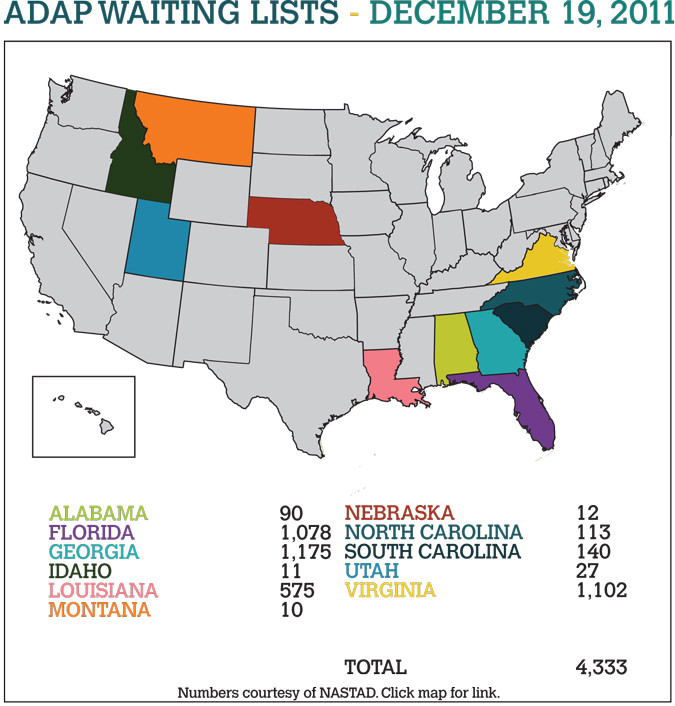
With recent additional federal money, ADAP waiting list numbers have come down some over the past month, but more than 4,000 Americans are still on wait lists. Ninety percent of them are in four Southern states, Florida, Georgia, Louisiana, and Virginia. All four are having financial difficulties in this economy, but the millions of dollars they would have to spend to eliminate their waiting lists are insignificant in multibillion dollar budgets, and spending the millions or not will not make their difficult positions materially any worse or any better.


Here are the latest numbers from our friends at NASTAD:

ADAP Waiting List for 12/15/11

The waiting list continues- up 59 persons in 2 weeks: