ADAP Watch, May 31, 2012

From The National Association Of People With AIDS:

It’s just over two years now since we first reported the ADAP funding crisis. We thought it would be over quickly. Sad to say, we were wrong. The number of ADAP-qualifying lower-income Americans on waiting lists for the HIV drugs that would keep them healthy peaked last year at more than nine thousand before coming down to this May 31’s 2,357.

More than 90% of those now wait-listed are in five Southern states: Alabama, Florida, Georgia, Louisiana, and North Carolina. All five have legitimate state budget shortfalls. All five, however, also have increasingly serious rural HIV epidemics, and extending immediate ADAP drug assistance to everyone who qualifies would be a useful step towards slowing the spread of the virus. The additional cost to the states would be trivial in the context of their whole state budgets – eliminating state ADAP contributions altogether would not materially improve their fiscal situations, and doubling them would not make them materially worse.


Here are the latest numbers from our friends at NASTAD:


Paying For Negative HIV Tests

Michael J. Coren writes a fascinating article about HIV: if health isn’t a good enough reason to protect yourself from HIV and STD’s, maybe money is.

Excerpt:

Scientists at MIT’s Poverty Lab recently published findings in BMJ Open that tested that theory in Tanzania. They used payments known as conditional cash transfers (CCTs)–known to encourage socially desirable behavior elsewhere in areas like such as school enrollment and medical check-ups–to deter risky sex among young people (18 to 30-year-olds) in Tanzania.

As much as 5% of Tanzania’s population is infected with HIV/AIDS. Although rates have declined there during the last five years, the country’s sub-Saharan neighbors are not so lucky. Just 10 sub-Saharan countries account for more than one-third of people infected with HIV worldwide; an equal proportion of new cases also occur there. It’s clear controlling existing infections is not enough; cheap and effective prevention is needed.

The MIT researchers asked about 2,000 participants to receive tests for four common STIs–chlamydia, gonorrhea, trichomonas, and M. genitalium–every four months during the course of a year. If results were negative, participants were paid $10, $20, or nothing depending on the experimental group. If positive, participants were treated, but did not receive cash. The STIs served as a proxy for HIV infection risk from sex, since payments were not contingent on HIV status, given the stigma attached to the infection in many communities.

Read the results here.

ADAP Watch

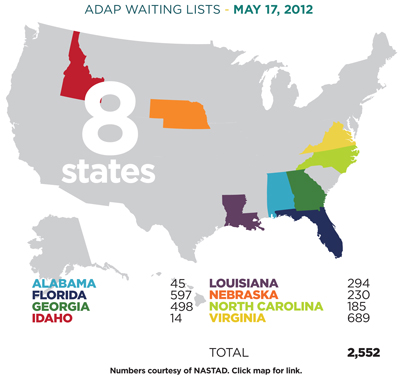
From NAPWA: Recently released supplemental federal funding is slowly bringing state waiting lists down – 2,552 this week. Regional disparities are troubling, though. Ninety percent of Americans on ADAP waiting lists are in the South. The only non-Southern state with comparable numbers is Nebraska. The South is where HIV is spreading fastest, and providing HIV drugs to those who need them would help prevent new infections.

Here are the latest numbers from our friends at NASTAD:

Clergy Can Fight HIV On Faith-friendly Terms

An excellent article from Science Daily:

In the United States, where blacks bear a disproportionate burden of the HIV/AIDS epidemic, black religious institutions could help turn the tide. In a new study in PLoS ONE based on dozens of interviews and focus groups with 38 of Philadelphia’s most influential black clergy, physicians and public health researchers find that traditional barriers to preaching about HIV prevention could give way to faith-friendly messages about getting tested and staying on treatment.

The public health community has long struggled with how best to reduce HIV infection rates among black Americans, which is seven times that of whites. In a new paper in the journal PLoS ONE, a team of physicians and public health researchers report that African-American clergy say they are ready to join the fight against the disease by focusing on HIV testing, treatment, and social justice, a strategy that is compatible with religious teaching.

“We in public health have done a poor job of engaging African-American community leaders and particularly black clergy members in HIV prevention,” said Amy Nunn, lead author of the study and assistant professor of medicine in the Warren Alpert Medical School of Brown University. “There is a common misperception that African American churches are unwilling to address the AIDS epidemic. This paper highlights some of the historical barriers to effectively engaging African American clergy in HIV prevention and provides recommendations from clergy for how to move forward.”

The paper analyzes and distills dozens of interviews and focus group data among 38 African-Amereican pastors and imams in Philadelphia, where racial disparities in HIV infection are especially stark. Seven in 10 new infections in the city are among black residents. With uniquely deep influence in their communities, nearly all of the 27 male and 11 female clergy said they could and would preach and promote HIV testing and treatment.

That message, delivered by clergy or other influential figures, would provide a needed complement to decades of public health efforts that have emphasized risk behaviors, Nunn said. Research published and widely reported last year, for example, suggests that testing and then maintaining people on treatment could dramatically reduce new infections because treatment can give people a 96-percent lower chance of transmitting HIV.

“For decades, we’ve focused many HIV prevention efforts on reducing risky behavior,” said Nunn, who is also based at The Miriam Hospital. “Focusing on HIV testing and treatment should be the backbone of HIV prevention strategies and efforts to reduce racial disparities in HIV infection. Making HIV testing routine is the gateway to getting more individuals on treatment. African American clergy have an important role to play in routinizing HIV testing.”

The barriers clergy members face

Many religious leaders acknowledged that they’ve struggled with how best to combat the epidemic, particularly with challenges related to discussing human sexuality in church or mosque, according to the analysis in the paper.

“One time my pastor spoke to young people about sex, mentioning using protection,” the paper quotes a clergy member as saying in one example. “I was sitting in the clergy row; you could feel the heat! I was surprised he said that. Comments from the clergy highlighted they were opposed to that. It’s a tightrope walk.”

Many clergy members also said they face significant barriers to preaching about risk behaviors without still emphasizing abstinence.

“It’s my duty as a preacher to tell people to abstain,” one pastor told the research team, “but if they’re still having sex and they’re getting HIV, there has to be another way to handle this.”

What clergy can do

Many clergy members suggested couching the HIV/AIDS epidemic in social justice rather than behavioral terms, Nunn said. They also recommended focusing on HIV testing as an important means to help stem the spread of the disease and reduce the stigma.

“We need to standardize testing,” one pastor told the researchers. “One thing that we could do immediately is to encourage our congregations — everybody — to get tested. … We’re not dealing with risk factors. And we’re all going to get tested once a year. That’s the one thing that we could do that doesn’t get into our doctrine about sexuality.”

In general, many of the religious leaders said they could encourage discussion of HIV not only in main worship services, but also in ministries and community outreach activities.

FULL ARTICLE HERE

FDA Panel Recommends Approval Of Preventative HIV Med

From CBS News:

In a landmark decision, an advisory panel to the Food and Drug Administration voted to recommend approval of Truvada to prevent HIV infection. The FDA is not required to the follow the panel of experts’ advice, though it typically does.

In a series of votes, a Food and Drug Administration advisory panel recommended approval of the daily pill Truvada for healthy people who are at high risk of contracting HIV, including gay and bisexual men and heterosexual couples with one HIV-positive partner.

A final decision on Truvada is expected by June 15, but the FDA doesn’t confirm such action dates and says the review of the application is ongoing, a spokesperson told CBS News.

“I think this is a huge milestone,” Dr. Robert Grant, associate director of the Center for AIDS Research at the University of California, San Francisco, who led the panel’s research, told CBS News medical correspondent Dr. Jon LaPook. “I think we are in an era for the first time when we can see the end of the AIDS epidemic.”

Gilead Sciences Inc., based in Foster City, Calif., has marketed Truvada since 2004 as a treatment for people who are infected with the virus. The medication is a combination of two older HIV drugs, Emtriva and Viread. Doctors usually prescribe it as part of a drug cocktail to repress the virus.

Since Truvada is already on the market to manage HIV, some doctors have prescribed it as a preventive measure. FDA approval would allow Gilead Sciences to formally market its drug for that use.

While panelists ultimately backed Truvada for prevention, Thursday’s 12-hour meeting highlighted concerns created by the first drug to prevent HIV. In particular, the panel debated whether Truvada might lead to reduced use of condoms, the most reliable defense against HIV. The experts also questioned the drug’s effectiveness in women, who have shown much lower rates of protection in studies.

The panel struggled to outline steps that would ensure patients take the pill every day. In clinical trials, patients who didn’t take their medication diligently were not protected, and patients in the real world are even more likely to forget than those in studies.

“The trouble is adherence, but I don’t think it’s our charge to judge whether people will take the medicine,” said Dr. Tom Giordano of Baylor College of Medicine, who voted in favor of the drug. “I think our charge is to judge whether it works when it’s taken and whether the risks outweigh the benefits.”

My view: This also allows sero-discordant couples- one HIV+, one not- an extra layer of protection. It may also help adherence if two persons are taking the same meds (or at least having to share a daily regimen) in the same household. That in itself is worth it….

 Full story here

HIV Is In Montana- It’s No Bull

The second video in the Montana social marketing campaign for HIV Awareness:

This HIV prevention animation targeting the MSM population is a playful look at a young bull elk that is looking for a relationship in Montana. As the party music plays he searches the herd for another bull who has been “Checked” (tested) for HIV. This is a creative project that was created by Laura Dybdal and Amber Bushnell as a part of Montana’s HIV Prevention Social Marketing Campaign. It also directs viewers to getcheckedmt.org, a resource to find the nearest HIV testing location in Montana.

The first one was posted yesterday….

Some Startling HIV Facts

…from The CDC’s Annual Report from the Division of HIV/AIDS Prevention (DHAP), Accelerating Progress, Investing for Impact. This report provides an overview of some of the HIV prevention activities conducted and supported by the Centers for Disease Control and Prevention (CDC) during late 2010 to the end of 2011.

Too few Americans with HIV are getting the testing, treatment, and care they need to stay healthy and prevent transmission to others.

Surprisingly, only 28% of all HIV-infected persons are considered to have HIV under control ( viral load less than 200/ml). That’s not enough.

Percentage of HIV-infected Individuals Engaged in Selected Stages of the Continuum of HIV Care, 2010-11

All HIV positive individuals- 100%

Aware of their infection- 80%

Linked to HIV care- 62%

Retained in HIV care- 41%

Receive antiretroviral therapy- 36%

Have their virus under control*- 28%

*Plasma viral load < 200 cells/ml

Source: MMWR  60(47);1618-1623


HIV In Montana: It’s Not Classified

One of two new Montana public service message targeting men who have sex with men- check back tomorrow for the second:

This short point of view video targeting Montana’s MSM population looks at the Classified Personal ads and points out some HIV facts that should not be classified and offers some excellent reasons to get tested (checked) for HIV. It also directs viewers to getcheckedmt.org , a resource to find the nearest HIV testing location in Montana.

This creative project was created by Laura Dybdal and Jason Gutzmer as part of Montana’s HIV Social Marketing Campaign.

Related articles

ADAP Watch 4/19/12

Last week (while I was on vacation)- NASTAD released the ADAP waiting list. From NAPWA (emphasis mine):

There’s some good news on the ADAP front: the FY 2011 emergency federal ADAP funding has brought waiting list numbers down in a number of states. South Carolina has eliminated its waiting list altogether, for the time being.

The bad news is that the numbers aren’t coming down very much. Georgia and Virginia – big states with big budgets – account for almost two-thirds of the nation’s total waiting list, and it looks like they are accepting their waiting lists as the “new normal.” Other states have disguised their real unmet need by setting income eligibility ceilings artificially low, and that looks set to become the “new normal,” too.

It’s hard to understand and hard to forgive. Over five years, it will cost the states with visible waiting lists or waiting lists whisked away by lowering income ceilings more to care for PLWHA who become sick enough for Medicaid than it would have cost to give them drugs to keep them healthy. It’s already a dollars-and-cents blunder before we even think about the human cost.

Here are the latest numbers from our friends at NASTAD:

AIDS Outreach Names New Executive Director

AIDS Outreach, a local HIV prevention, testing and support organization announces that D Gregory Smith, MA, will be its new Executive Director.

Smith, a Montana native (Twin Bridges) and local mental health therapist, is excited about the opportunity and challenges the position offers.

“We have the opportunity to do some real good here,” he said. “Despite popular belief, HIV is in Montana. There is a tremendous need to inform people at risk, help them protect themselves and to get people tested- to give them that crucial information about their health. There is also a need to support persons living with HIV here. I believe as a community we have a duty to assist those in need- and people with HIV are often economically disadvantaged. It’s about human dignity, and I want to help AIDS Outreach be at the forefront in Gallatin, Park and Madison counties.”

Smith has been involved in HIV/AIDS awareness work since 1994, and was an original member of the Montana Governor’s AIDS Advisory Council in 2000. He continues to serve on the Montana State Community Planning Group for HIV Prevention, and has written articles and abstracts for national publications and organizations and given numerous presentations on HIV/AIDS, especially HIV in rural communities.

Founded in 2006 and based in Bozeman, AIDS Outreach is a 501(c)3 organization offering free HIV testing, HIV prevention and educational materials, as well as assistance and a support group for HIV+ persons.

For more information, please call (406) 451-5718, write info@AIDSOutreachMT.org or visit http://www.AIDSOutreachmt.org