Impact of Affordable Care Act On HIV/STD Prevention

Wondering about the Supreme Court’s decision on HIV/STD prevention and care? Some help from The National Coalition Of STD Directors:

Sexually transmitted disease

As you consider the impact of today’s Supreme Court ruling on the Affordable Care Act on different populations, I would like to share with you the impact of today’s ruling on our fight to prevent and treat sexually transmitted diseases.

Sexually transmitted diseases (STDs) remain a major epidemic in the United States.  Each year, there are approximately 19 million new cases of STDs, approximately half of which go undiagnosed and untreated[i], giving the  United States the highest STD rate in the industrialized world.[ii]

STDs cost the U.S. health care system $17 billion every year—and cost individuals even more in immediate and life-long health consequences, including infertility, higher risk of acquiring HIV, and certain cancers.[iii]

  • Young people will continue to have expanded coverage under their parent’s insurance.  Young people bear a disproportionate burden of STDs—those aged 15-25 make up half of the STDs contracted annually, but make up only one-fourth of the sexually active population.
  • Private insurance will continue to have to cover prevention services with no cost out-of pocket costs to patients.  Many of those who visit STD clinics are low-income and would not be able to receive prevention sexual health services without coverage by insurance.  While there is still work to be done for certain at-risk populations, such as men who have sex with men, expanded STD testing and  STI counseling will be covered by insurance under this expansion of preventative care in the law and it is a great start.
  •  The continued need for safety-net service providers is underscored.  With the narrowing of the Medicaid expansion provisions, the very real possibility exists that many low-income individuals will not have access to affordable health care coverage.  Patients at STD clinics are young, minority, and poor—populations that are bear a much higher burden of STD disease—and may be left without coverage in a state that may choose not to expand their Medicaid coverage.

HIV-specifics from Lambda Legal:

“This is a victory for all Americans, but in particular, the Court’s decision today will save the lives of many people living with HIV – as long as states do the right thing. The Affordable Care Act will finally allow people living with HIV to access medical advancements made years ago but that have so far remained out of reach of many. With continuing prevention education, early detection, and quality care for everyone living with HIV, we have the power to stem the HIV/AIDS epidemic.

“But this is not a complete victory, because today’s decision allows states to opt out of the Medicaid expansion that would provide insurance coverage for many low-income people who cannot otherwise afford it. Our continuing challenge will be to make sure that states opt to expand Medicaid so that more low-income people, and particularly those with HIV, can get the health care they urgently need.”

Related articles

My Speech: Pride Rally 2012

From Yesterday’s Pride Rally: 

Last week someone said to me “Why do you people need a parade? Why do you have to make such a fuss?”

Here’s why:

We have been afraid to be who God created us to be. Sometimes it was our churches that made us afraid.

We have been legislated against- made criminals in the eyes of the law that is supposed to protect us.

We have been killed and we have killed ourselves.

We have lost good men and women to HIV/AIDS.

We have been bullied and teased and yes, driven from our very homes and schools and communities- and state.

We have been hurt and maligned right here under this big sky.


Why do we need a parade?


To remind us that there are people whose bravery has driven away darkness. Whose voices refuse to give in to hopelessness or complacency or fear.

That together, we can be that voice.


A voice to proclaim the goodness of our lives and the lives of our brothers, sisters, parents, children and friends- we are here and like it or not- we are not going away.


We will not forget the lives that have lived with pain to bring us here- to this place of hope and triumph.


Today is a gorgeous day in Montana History, because the Lesbian, Gay, Bisexual, Two-Spirit, Transgender, Intersex and Queer people of Montana- and our allies- are here to proclaim that we will not let our voice die.


We will not be afraid.


We will stand up when we are told to lie down.

We will speak when anyone tries to shame us into silence.

We will remain when we are told to leave.

We will proclaim the truth.


Firmly and gently and clearly and proudly.

The truth that we are light.

And that light makes Montana more beautiful, not less.  More.


I want to hear your voice.

Are We Good?

Are We Beautiful?

Are We Going Away?


We live in hope that one day all Americans agree.

Until then- we have a parade.

Because we.

Are not.

Going.

Away.

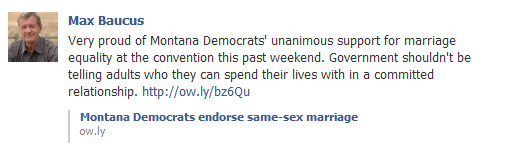
Baucus Endorses Marriage Equality

Say what you will about Max Baucus- and we have- but this gives me a moment of pride:

Fair is fair: he hasn’t always done what I would have liked (and it might take something much more major to get me over the healthcare debacle) but mad props for being the first elected statewide Montana official to stand for marriage equality. Thanks, Max. Click the link above to follow his Twitter feed.

Now for a Pride Present, I’d like to hear the other statewide elected officials following suit.

Hell, better yet, I want to see them in the parade this Saturday.

They’ve all been invited.

Update: Reader Karl Olson reminded us that “Pretty sure Justice Nelson came first, however, and by several years, and more openly. Nelson proved you could get a statewide vote with an unwavering pro-equality stance. Its history, but still relevant in the current fervor.”

Related articles

ADAP Watch, May 31, 2012

From The National Association Of People With AIDS:

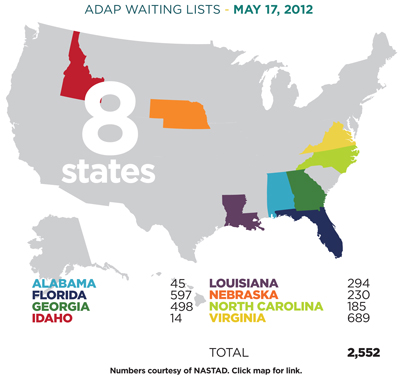
It’s just over two years now since we first reported the ADAP funding crisis. We thought it would be over quickly. Sad to say, we were wrong. The number of ADAP-qualifying lower-income Americans on waiting lists for the HIV drugs that would keep them healthy peaked last year at more than nine thousand before coming down to this May 31’s 2,357.

More than 90% of those now wait-listed are in five Southern states: Alabama, Florida, Georgia, Louisiana, and North Carolina. All five have legitimate state budget shortfalls. All five, however, also have increasingly serious rural HIV epidemics, and extending immediate ADAP drug assistance to everyone who qualifies would be a useful step towards slowing the spread of the virus. The additional cost to the states would be trivial in the context of their whole state budgets – eliminating state ADAP contributions altogether would not materially improve their fiscal situations, and doubling them would not make them materially worse.


Here are the latest numbers from our friends at NASTAD:


Preview: Inlaws and Outlaws in Bozeman!

The screening of Inlaws And Outlaws was received with great delight last night in Helena. One audience member told me “I’ve never laughed so hard one minute and then in the next moved so naturally to such empathy. Never. I loved it.”
And you can, too.
The filmmaker and director of Inlaws and Outlaws, Drew Emery, was on Montana This Morning to give viewers a taste of his film screening tomorrow night at the Bozeman Public Library.

See it here.

Helena Screening Tonight!

Don’t forget- tonight Inlaws and Outlaws will be screened at Plymouth Congregational Church at 7pm! Filmmaker Drew Emery will be introducing the film and staying around after for a Q&A. Copies of the film will also be available for purchase.

What do you get when you fall in love?

Inlaws & Outlaws cleverly weaves together the true stories of couples and singles— both gay and straight — and all into a collective narrative that is as hilarious as it is heartbreaking.

At the top of the film, you meet real people one on one. You don’t know who’s gay or straight or who’s with whom. As their stories unfold and stereotypes fall by the wayside, you won’t care because you’ll be rooting for everybody. With candor, good humor, great music and real heart, Inlaws & Outlaws gets past all the rhetoric to embrace what we have in common:

We love.

ADAP Watch

From NAPWA: Recently released supplemental federal funding is slowly bringing state waiting lists down – 2,552 this week. Regional disparities are troubling, though. Ninety percent of Americans on ADAP waiting lists are in the South. The only non-Southern state with comparable numbers is Nebraska. The South is where HIV is spreading fastest, and providing HIV drugs to those who need them would help prevent new infections.

Here are the latest numbers from our friends at NASTAD:

Clergy Can Fight HIV On Faith-friendly Terms

An excellent article from Science Daily:

In the United States, where blacks bear a disproportionate burden of the HIV/AIDS epidemic, black religious institutions could help turn the tide. In a new study in PLoS ONE based on dozens of interviews and focus groups with 38 of Philadelphia’s most influential black clergy, physicians and public health researchers find that traditional barriers to preaching about HIV prevention could give way to faith-friendly messages about getting tested and staying on treatment.

The public health community has long struggled with how best to reduce HIV infection rates among black Americans, which is seven times that of whites. In a new paper in the journal PLoS ONE, a team of physicians and public health researchers report that African-American clergy say they are ready to join the fight against the disease by focusing on HIV testing, treatment, and social justice, a strategy that is compatible with religious teaching.

“We in public health have done a poor job of engaging African-American community leaders and particularly black clergy members in HIV prevention,” said Amy Nunn, lead author of the study and assistant professor of medicine in the Warren Alpert Medical School of Brown University. “There is a common misperception that African American churches are unwilling to address the AIDS epidemic. This paper highlights some of the historical barriers to effectively engaging African American clergy in HIV prevention and provides recommendations from clergy for how to move forward.”

The paper analyzes and distills dozens of interviews and focus group data among 38 African-Amereican pastors and imams in Philadelphia, where racial disparities in HIV infection are especially stark. Seven in 10 new infections in the city are among black residents. With uniquely deep influence in their communities, nearly all of the 27 male and 11 female clergy said they could and would preach and promote HIV testing and treatment.

That message, delivered by clergy or other influential figures, would provide a needed complement to decades of public health efforts that have emphasized risk behaviors, Nunn said. Research published and widely reported last year, for example, suggests that testing and then maintaining people on treatment could dramatically reduce new infections because treatment can give people a 96-percent lower chance of transmitting HIV.

“For decades, we’ve focused many HIV prevention efforts on reducing risky behavior,” said Nunn, who is also based at The Miriam Hospital. “Focusing on HIV testing and treatment should be the backbone of HIV prevention strategies and efforts to reduce racial disparities in HIV infection. Making HIV testing routine is the gateway to getting more individuals on treatment. African American clergy have an important role to play in routinizing HIV testing.”

The barriers clergy members face

Many religious leaders acknowledged that they’ve struggled with how best to combat the epidemic, particularly with challenges related to discussing human sexuality in church or mosque, according to the analysis in the paper.

“One time my pastor spoke to young people about sex, mentioning using protection,” the paper quotes a clergy member as saying in one example. “I was sitting in the clergy row; you could feel the heat! I was surprised he said that. Comments from the clergy highlighted they were opposed to that. It’s a tightrope walk.”

Many clergy members also said they face significant barriers to preaching about risk behaviors without still emphasizing abstinence.

“It’s my duty as a preacher to tell people to abstain,” one pastor told the research team, “but if they’re still having sex and they’re getting HIV, there has to be another way to handle this.”

What clergy can do

Many clergy members suggested couching the HIV/AIDS epidemic in social justice rather than behavioral terms, Nunn said. They also recommended focusing on HIV testing as an important means to help stem the spread of the disease and reduce the stigma.

“We need to standardize testing,” one pastor told the researchers. “One thing that we could do immediately is to encourage our congregations — everybody — to get tested. … We’re not dealing with risk factors. And we’re all going to get tested once a year. That’s the one thing that we could do that doesn’t get into our doctrine about sexuality.”

In general, many of the religious leaders said they could encourage discussion of HIV not only in main worship services, but also in ministries and community outreach activities.

FULL ARTICLE HERE

Anne Rice Reviews “Marriage, a History: How Love Conquered Marriage”

One of the most contentious issues of our time, marriage has been “claimed” by Christians (and others) as an unchanging “institution”, “sacrament”, “contract”, etc. This is far from historically accurate. Author and- I would argue- theologian Anne Rice weighs in with a recommendation from her Facebook page yesterday:

The nation’s talking about marriage, Same Sex Marriage, definitions of marriage, who owns marriage, etc. Well, here is a link to an excellent History of Marriage written by Stephanie Coontz that I reviewed for Amazon a while back. I recommend this book to all who have strong feelings about the institution of marriage and how it has been viewed over the millennia. Comments welcome. (I’ve linked to my review, but there are a lot of others posted on the site).

From the book description: Marriage has never been more fragile. But the same things that have made it so have also made a good marriage more fulfilling than ever before. In this enlightening and hugely entertaining book, historian and marriage expert Stephanie Coontz takes readers from the marital intrigues of ancient Babylon to the sexual torments of Victorian couples to demonstrate how recent the idea of marrying for love is-and how absurd it would have seemed to most of our ancestors. It was only 200 years ago that marriage began to be about love and emotional commitment, and since then the very things that have strengthened marriage as a personal relationship have steadily weakened it as a social institution. Marriage, A History brings intelligence, wit, and some badly needed perspective to today’s marital debates and dilemmas.

Her Review: This is an extremely well researched investigation of the institution of marriage from earliest times to the present. It may prove shocking to some readers to discover how recent our concept of “traditional marriage” may be. But information such as this book provides is essential for those concerned about marital values. History provides us with immensely important lessons regarding the attitudes and feelings of human beings over the centuries; and we must not shrink from the observations made here as we seek to understand the social and economic and even religious crises of our times. The scope of the book is incredibly ambitious yet it is clearly and at times entertainingly written, and always inviting. It can point the way for further research in many areas. On all counts, a fine and important book.

Agreed. To have this information in one place is important- and the scholarship is undeniable. Click book to see more reviews on Amazon and get a sample of the book.

Montana Pride Announces: Jessie And The Toy Boys


From MontanaPride.org :

We are stoked to announce another awesome add to our weekend line-up for 2012 Pride.
Check out  Jessie and The Toy Boys … performing live on Friday night, June 15th at Montana Pride!
She’s toured with Britney and Nicki Minaj, and in just a month will be right here in Bozeman. (Share it!)

 And don’t forget to get your tickets early- they’re going fast! Click logo for site.