Reminder: AIDS Is Alive And Well In Montana

Kim McGeehan wrote an article for the Bozeman Magpie about HIV in Montana- and shared some of my story along the way. Excerpt:

English: HIV-1 particles assembling at the sur...

English: HIV-1 particles assembling at the surface of an infected macrophage. Français : Des particules de HIV-1 s’assemblant à la surface d’un macrophage infecté. (Photo credit: Wikipedia)

“I wasn’t diagnosed because I was scared. Now, I have memory issues and damage to my joints. HIV attacks soft tissues in the body—gums, brain, liver—even if you don’t have outward symptoms, the virus can still be doing damage,” Smith says. “At first, there were no treatments. Now there is a lot we can do. We can stop it or slow it down. You can live a healthy life. If you are on your meds and have a low viral load, your risk of transmitting the disease can be as low as 4%.”

That isn’t permission to take behavioral risks, but information that should encourage people to take advantage of the services offered by AIDS Outreach. Those services include fast, free, anonymous HIV tests, an HIV-positive support group, educational literature, and condoms condoms condoms.

Americans will soon be able to purchase an over-the-counter, rapid-response HIV test, but Smith worries that dealing with a positive result alone will be challenging for folks: “Denial is such a strong force in the human psyche. I remember it in myself. I’m worried that someone might test positive and not tell anyone, not get counseling or medical care.”

Read the rest:

http://www.bozeman-magpie.com/perspective-full-article.php?article_id=502

The Affordable Care Act & LGBT Persons

In 10,000 Same Sex Couples Magazine, an excellent overview of the benefits of the ACA for LGBT persons. Excerpt:

Nondiscrimination protection measures have been included in the Affordable Care Act, and significantly, by 2014, insurance companies will not be able to deny coverage based on pre-existing conditions such as HIV or transgendered medical history.

Increased services for preventive care and HIV testing and treatment have been included in the ACA.  As insurance companies will no longer be able to cancel or deny coverage based on pre-existing conditions, Americans living with HIV will have better access to care and to life-saving drugs, whereas currently, an estimated 25% of the 1.2 million Americans living with HIV in the United States have no health insurance coverage. Many of those living with HIV without insurance, or with insurance but consistently fearful of having it canceled due to a pre-existing condition, have been forced to pay out of pocket or seek other methods of treatment.

LGBTQ Activist Chris Barnett of San Francisco says: “I’ve been fortunate to have health coverage all my years of living with HIV, so pre-existing condition has thankfully never directly affected me. Though I must say, in my early years with this, late ’80s to early ’90s, I was fearful of using my insurance for fear of being redlined, so I paid for early treatment out of pocket, or found medical studies.”

As most states in America fail to recognize same-sex relationships, healthcare through a spouse’s workplace is not an option for many LGBTQ Americans. This often results in a high number of citizens forced to pay high prices for private insurance or to forgo having any insurance at all due to cost.  With ACA’s expansions to the affordability and accessibility of healthcare, more LGBTQ Americans will be able to be covered.

Read the rest here.

AZ Governor Jan Brewer To Supreme Court: Overturn Same-Sex Benefits

Governor while meeting with United States Pres...

Arizona Governor Jan Brewer is asking the Supreme Court to overturn same-sex partner benefits for Arizona state employees. The Arizona Daily Sun reports:

Legal papers filed by Attorney General Tom Horne contend that a three-judge panel of the appellate court got it wrong when it concluded earlier this month that it is illegal for the state to provide health care and other benefits to the partners of married workers while refusing to do the same for same-sex couples.

He said the state is allowed to make such distinctions.

In the opinion of several lawmakers in Arizona (who disagree with the move), this appeal is purely “to make a point” against immorality- oh, and to save the state some money. The Daily Sun again:

Hanging in the balance is whether gay workers will lose benefits they have had since 2008. That is when then-Gov. Janet Napolitano got her Department of Administration to rewrite the state’s personnel rules to expand the definition of who is a “dependent” for purposes of state employment.

Under those rules, that included someone living with the employee for at least a year and expected to continue living with that person. The rules, which did not specify the gender of the partner, also required a showing of financial interdependence and an affidavit by the worker affirming there is a domestic partnership.

But in 2009, after Napolitano resigned to take a post in the Obama administration, the Republican-controlled Legislature approved — and Brewer signed — a state law narrowing the definition and specifically excluding unmarried couples.

… According to the Department of Administration, there are 226 employees of the state, the University of Arizona and Arizona State University who are receiving same-sex domestic partner benefits. He said the annual cost is slightly more than $5 million a year.

Does this sound familiar? Prop 8, anyone? The question is whether the balance of social opinion and acceptance will have an affect on this decision. Fascinating also that this request comes just as the general elections ramping up…

Full story here

Why Romney Won’t Repeal Obamacare

Mitt Romney Steve Pearce event 056

Mitt Romney Steve Pearce event 056 (Photo credit: Wikipedia)

Just as I suspected. If Mitt Romney wants to (as he claims) overturn Obamacare, it’s going to cost the taxpayers billions of dollars to rollback the healthcare changes already underway. Not to mention the debt cliff that he will need the cooperation of Democrats to negotiate.

Ryan Lizza from the New Yorker:

Mitt Romney, speaking just before noon today, declared that on his first day in office, “I will act to repeal Obamacare.” I think he chose his words carefully. As President, he may indeed “act” to repeal it on Day One, but I don’t believe he will actually be able to overturn the law.

If Romney were to win in November, the first matter he’d have to deal with would be the fallout from the so-called fiscal cliff of December 31st, the day when some five hundred billion dollars worth of tax increases and spending reductions take effect, which could put the economy into another recession (if it’s not already in recession by then). This moment would perhaps be Romney’s greatest chance at repeal. Because the fiscal-cliff negotiations will be an enormous fight over the size and scope of the federal government, every government policy will theoretically be open to debate—including, Romney might insist, repeal of the A.C.A.

But it’s a fantasy. The negotiations would be dead before they started if Republicans demanded repeal as a price for a Grand Bargain on taxes, spending, and entitlements. The fiscal-cliff negotiations will undoubtedly include a great deal of horse-trading that will infuriate and cheer partisans on both sides. But there is literally nothing Republicans could offer Democrats in return for repealing the Party’s greatest achievement since the Johnson Administration.

The reality of the huge (enormous) cost of repeal will pull the bloom off the rose PDQ. It’s insanity.

Read the rest: http://www.newyorker.com/online/blogs/newsdesk/2012/06/why-romney-wont-repeal-obamacare.html#ixzz1zr4S7Yoi

Infographic: HIV Epicenter, Southern U.S.

click to see larger (readable) version

Courtesy AIDS United

Paying For Negative HIV Tests

Michael J. Coren writes a fascinating article about HIV: if health isn’t a good enough reason to protect yourself from HIV and STD’s, maybe money is.

Excerpt:

Scientists at MIT’s Poverty Lab recently published findings in BMJ Open that tested that theory in Tanzania. They used payments known as conditional cash transfers (CCTs)–known to encourage socially desirable behavior elsewhere in areas like such as school enrollment and medical check-ups–to deter risky sex among young people (18 to 30-year-olds) in Tanzania.

As much as 5% of Tanzania’s population is infected with HIV/AIDS. Although rates have declined there during the last five years, the country’s sub-Saharan neighbors are not so lucky. Just 10 sub-Saharan countries account for more than one-third of people infected with HIV worldwide; an equal proportion of new cases also occur there. It’s clear controlling existing infections is not enough; cheap and effective prevention is needed.

The MIT researchers asked about 2,000 participants to receive tests for four common STIs–chlamydia, gonorrhea, trichomonas, and M. genitalium–every four months during the course of a year. If results were negative, participants were paid $10, $20, or nothing depending on the experimental group. If positive, participants were treated, but did not receive cash. The STIs served as a proxy for HIV infection risk from sex, since payments were not contingent on HIV status, given the stigma attached to the infection in many communities.

Read the results here.

Infographic: Fitness

I’m enjoying the current trend of infographics- they’re like filmstrips- only digital.

Here’s one on fitness that Ken recommended to me because I’ve been having a hard time keeping a regular workout schedule (Click pic for larger):

The Anatomy of a Fitness Routine - Vibram Five Fingers

Can’t talk. I’m off to the gym. For my birthday.

ADAP Watch

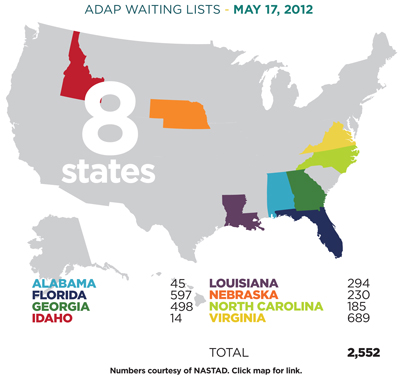
From NAPWA: Recently released supplemental federal funding is slowly bringing state waiting lists down – 2,552 this week. Regional disparities are troubling, though. Ninety percent of Americans on ADAP waiting lists are in the South. The only non-Southern state with comparable numbers is Nebraska. The South is where HIV is spreading fastest, and providing HIV drugs to those who need them would help prevent new infections.

Here are the latest numbers from our friends at NASTAD:

FDA Panel Recommends Approval Of Preventative HIV Med

From CBS News:

In a landmark decision, an advisory panel to the Food and Drug Administration voted to recommend approval of Truvada to prevent HIV infection. The FDA is not required to the follow the panel of experts’ advice, though it typically does.

In a series of votes, a Food and Drug Administration advisory panel recommended approval of the daily pill Truvada for healthy people who are at high risk of contracting HIV, including gay and bisexual men and heterosexual couples with one HIV-positive partner.

A final decision on Truvada is expected by June 15, but the FDA doesn’t confirm such action dates and says the review of the application is ongoing, a spokesperson told CBS News.

“I think this is a huge milestone,” Dr. Robert Grant, associate director of the Center for AIDS Research at the University of California, San Francisco, who led the panel’s research, told CBS News medical correspondent Dr. Jon LaPook. “I think we are in an era for the first time when we can see the end of the AIDS epidemic.”

Gilead Sciences Inc., based in Foster City, Calif., has marketed Truvada since 2004 as a treatment for people who are infected with the virus. The medication is a combination of two older HIV drugs, Emtriva and Viread. Doctors usually prescribe it as part of a drug cocktail to repress the virus.

Since Truvada is already on the market to manage HIV, some doctors have prescribed it as a preventive measure. FDA approval would allow Gilead Sciences to formally market its drug for that use.

While panelists ultimately backed Truvada for prevention, Thursday’s 12-hour meeting highlighted concerns created by the first drug to prevent HIV. In particular, the panel debated whether Truvada might lead to reduced use of condoms, the most reliable defense against HIV. The experts also questioned the drug’s effectiveness in women, who have shown much lower rates of protection in studies.

The panel struggled to outline steps that would ensure patients take the pill every day. In clinical trials, patients who didn’t take their medication diligently were not protected, and patients in the real world are even more likely to forget than those in studies.

“The trouble is adherence, but I don’t think it’s our charge to judge whether people will take the medicine,” said Dr. Tom Giordano of Baylor College of Medicine, who voted in favor of the drug. “I think our charge is to judge whether it works when it’s taken and whether the risks outweigh the benefits.”

My view: This also allows sero-discordant couples- one HIV+, one not- an extra layer of protection. It may also help adherence if two persons are taking the same meds (or at least having to share a daily regimen) in the same household. That in itself is worth it….

 Full story here

Some Startling HIV Facts

…from The CDC’s Annual Report from the Division of HIV/AIDS Prevention (DHAP), Accelerating Progress, Investing for Impact. This report provides an overview of some of the HIV prevention activities conducted and supported by the Centers for Disease Control and Prevention (CDC) during late 2010 to the end of 2011.

Too few Americans with HIV are getting the testing, treatment, and care they need to stay healthy and prevent transmission to others.

Surprisingly, only 28% of all HIV-infected persons are considered to have HIV under control ( viral load less than 200/ml). That’s not enough.

Percentage of HIV-infected Individuals Engaged in Selected Stages of the Continuum of HIV Care, 2010-11

All HIV positive individuals- 100%

Aware of their infection- 80%

Linked to HIV care- 62%

Retained in HIV care- 41%

Receive antiretroviral therapy- 36%

Have their virus under control*- 28%

*Plasma viral load < 200 cells/ml

Source: MMWR  60(47);1618-1623