Identification of LGBT Needs in the Exam Room

A physician performs a routine checkup on a pa...

A physician performs a routine checkup on a patient at the medical clinic. (Photo credit: Wikipedia)

Last time you were in an exam room, did you feel that the attending physician received all the information needed to gain an accurate perspective of your plight? Did you share everything you felt you should, no matter how personal? Did said physician even ask about anything, aside from the usual short list of inquiries we are all too familiar with in that particular setting?

If you are a physician, do you really get the answers you need from your patients? Or perhaps it is just too uncomfortable when talking about sexual health and behaviors. More likely, they do not disclose the details out of discomfort, or even fear.

LGBT persons have shown to have some unique healthcare needs, sometimes experiencing disparities in care. LGBT patients are often uncomfortable or inhibited from talking openly with healthcare providers about sexual orientation, gender identity, and sexual behaviors. Certain sexual behaviors do not automatically define that patient as LGBT, and not all LGBT patients are going to have similar sexual behaviors. Truthfully, it’s not about whether a person is a member of the LGBT community or not. It’s about the individuals choices and behaviors that could be putting their health at risk, as well as the health of others. In order to cover everyone’s needs, patients must speak openly with providers. Providers must delve into the patients behaviors and understand where the risk behavior is at for each patient. I am going to lay out a few examples, ideas, and suggestions for physicians, as well as patients.

In any healthcare position, you will find people from diverse backgrounds and lifestyles. Different interests, tastes, and mindset. The right approach will reassure patients that the provider is knowledgeable, genuine, concerned, confidential and accepting. This enables the patient to open up and discuss the very private matters of sexual behavior, often in this society a ‘taboo’ subject.

Ask the patient to tell a bit about themselves. As the patient, make sure you indulge your sexual partner(s), safe sex practices, and concerns. Some behaviors have an amount of risk attached to them that is often unknown to the patient.  A physician might ask “Do you have any questions or concerns about your sexuality, sexual orientation or sexual desires?”. Use gender-neutral terms and mirror the patient’s terminology to better understand how they identify. For example, asking “do you have a partner or spouse?” “Are you currently in a relationship?” “What do you call your partner?” are all good ways to decide how the patient will identify without offending them with clinical terms which may sound cold and ‘labeled’. From here the in-depth sexual questions begin: “Are you sexually active?” “When you have sex, do you have sex with men, women or both?” “Are you and your partner monogamous?” “How many sexual partners have you had in the past year?” “Do you have vaginal sex, anal sex, or both?”. These and many more are the key to finding out just what unique needs your particular patient might have.

It is important to differentiate between sexual identity and sexual behavior. Providers need to discuss sexual behavior with patients regardless of sexual identity in order to define risk-assessment, ascertaining what activities they engage in and to learn what they are doing to prevent the transmission of disease.

And for the majority of readers, as  patients we have a personal responsibility to find the courage to openly discuss in confidence all of our behaviors and desires with our doctors, nurses, therapists and counselors, etc. This is extremely important. We cannot rely on someone to read our thoughts and know the truth.

Stand up and be proud of yourself. I can almost guarantee that the person treating you has heard it all. And if they haven’t, they will soon enough.

Help! Helena Non-discrimination Poll Freeped By Haters

Also published on Bilerico.com

A poll in this week’s Helena Independent Record asks the question “Does Helena need a non-discrimination ordinance?” This is seemingly in response to the order of business currently before the Helena City Commission – an ordinance of non-discrimination [pdf].

“State and/or federal law prohibit the denial of civil rights or discrimination on the basis of age, race, color, national origin, ancestry, religion, creed, sex, pregnancy, marital status, familial status (solely for housing), and physical or mental disability. In addition to these protections, it is the intent of the City of Helena that no person shall be denied his or her civil rights or be discriminated against based upon his or her sexual orientation or gender identity or expression.”

Thumbnail image for Welcome to MontanaYeah, kind of a big deal for Montana.

At first, the numbers were fairly even on both sides – then those in favor of the ordinance outnumbered those opposed.

By hundreds.

Typically the IR polls receive about 500 respondents total, but it appears that some conservative blogs, websites and facebookers have called in their forces to vote (in this very unscientific poll) against this ordinance currently being considered by the Helena City Council.

While I’m not sure that this is a huge issue (the poll, not the ordinance), it irks me that those opposed are marshaling the forces of discrimination across the country to weigh in.

Well, turnabout’s fair play. Vote here – and show Helena that the nation is watching.

Why You Shouldn’t Donate to the Salvation Army Bell Ringers

Reprinted from Bilerico.com

By Bil Browning

As the holidays approach, the Salvation Army bell ringers are out in front of stores dunning shoppers for donations. If you care about gay rights, you’ll skip their bucket in favor of a charity that doesn’t actively discriminate against the LGBT community.

The Salvation Army has a history of active discrimination against gays and lesbians. While you might think you’re helping the hungry and homeless by Thumbnail image for Why you shouldn't give to the Salvation Armydropping a few dollars in the bright red buckets, not everyone can share in the donations. Many LGBT people are rejected by the evangelical church charity because they’re “sexually impure.”

The church claims it holds “a positive view of human sexuality,” but then clarifies that “sexual intimacy is understood as a gift of God to be enjoyed within the context of heterosexual marriage.” The Salvation Army doesn’t believe that gays and lesbians should ever know the intimacy of any loving relationship, instead teaching that “Christians whose sexual orientation is primarily or exclusively same-sex are called upon to embrace celibacy as a way of life.”

On its webpage, the group claims that “the services of The Salvation Army are available to all who qualify, without regard to sexual orientation.” While the words are nice, their actions speak volumes. They blatantly ignore the position statement and deny LGBT people services unless they renounce their sexuality, end same-sex relationships, or, in some cases, attend services “open to all who confess Christ as Savior and who accept and abide by The Salvation Army’s doctrine and discipline.” In other words, if you’re gay or lesbian, you don’t qualify.

The organization also has a record of actively lobbying governments worldwide for anti-gay policies – including an attempt to make consensual gay sex illegal. (Yes, you’re paying lobbyists with those donations.)

After the break are some highlights from the evangelical Christian charity’s recent anti-gay political lobbying, a handy video with more information, and a list of charities who don’t discriminate against their clients and employees.

Click here to read the rest at Bilerico.com

Bisexual Men and Women Less Likely Than Gay Men, Lesbians to Disclose Sexual Orientation

English: Illustration of the double moon symbo...

English: Illustration of the double moon symbol used by bisexuals who wish to avoid the use of triangles. This example is in the colours of the Bisexual Pride flag. (Photo credit: Wikipedia)

New research shows that bisexual men and women are less likely than gay men and lesbians to disclose their sexual orientation to healthcare providers.  The study, which examined nondisclosure of sexual orientation among lesbians, gay men and bisexual men and women, found that concealment of sexual orientation from healthcare providers was related to poor psychological wellbeing.

“This study adds to a growing literature that shows that a one-size-fits-all approach to understanding the health of sexual minorities ignores differences among subpopulations within this community,” said Laura Durso Ph.D., Williams Institute Public Policy Fellow.

Nondisclosure was higher among bisexual men of whom 39% did not disclose to any medical provider and bisexual women of whom 33% did not disclose to any medical provider.  Disclosure was much more prevalent among gay men and lesbians among whom only 13% and 10%, respectively, did not disclose their sexual orientation to any medical provider.  Among lesbians, greater nondisclosure was found among racial/ethnic minorities, women with lower educational level, and women with children. Among both gay and bisexual men, greater nondisclosure was found among younger men and men who were born outside the U.S.

The study, entitled “Patterns and Predictors of Disclosure of Sexual Orientation to Healthcare Providers among Lesbians, Gay Men, and Bisexuals,” was funded by the National Institute of Mental Health and is published in Sexuality Research and Social Policy.

Full study: click here.

Tim Fox Fails His First Test

Image

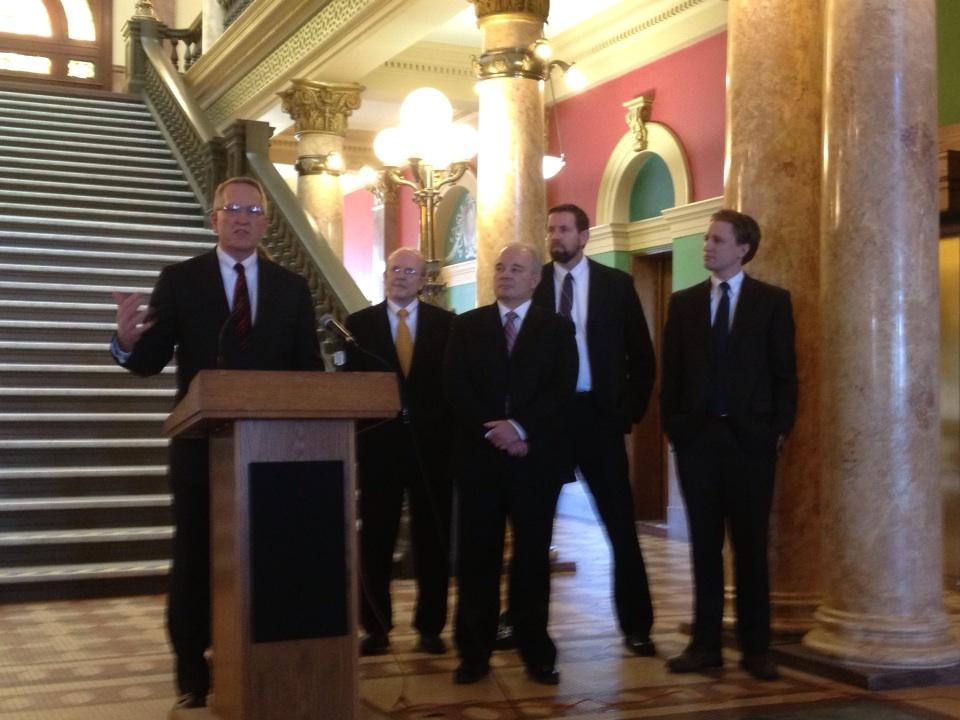
One of the first tests for statewide elected officials in Montana is the decision on their top staff appointments. On Friday, Tim Fox failed the test.

Fox announced 4 straight, white men as leadership in his office, and announced a female executive assistant (not pictured). The most notable of his selections is Jon Bennion, the former lobbyist for the Montana Chamber of Commerce. (I’ll have more to say on this appointment in a later post.)

These appointments make it painfully clear that diversity is not a priority for him.

Now, diversity for the sake of diversity isn’t inherently valuable. But when you seek a diverse staff so that you have a broad range of experiences, histories and viewpoints you can make your organization–in this instance the Department of Justice–a stronger entity.

The Department of Justice plays such a huge role in the lives of Montanans that this diversity of experience would improve our state. For example, the DoJ oversees all the law enforcement in the state, and we all know that there has been a history of real and perceived racial profiling by law enforcement in tribal communities. By selecting these men as his senior staff, Fox doesn’t have someone providing him with a first-hand understanding of this issue, so Fox is incapable of making an informed decision to do something about it.

It’s important to understand that building a diverse team isn’t something that happens by itself. It’s something that takes work and a concerted effort to make it a priority. Governor Schweitzer is the model on this.

Anyone who has followed Schweitzer’s time in office knows that he has more Native Americans in his staff and cabinet than all previous Montana governors combined. This emphasis on diversity in his staff has paid off, as Schweitzer has enjoyed a close relationship with Montana’s tribal communities to solve some of the problems these communities have faced.

Schweitzer has also put women and members of the LGBT community into senior staff and advisory positions.

Hopefully Fox will take a page out of Governor Schweitzer’s book, and for the sake of Montana, add a little bit of diversity to his staff.

In other appointment news, I’m closely following Governor-elect Bullock’s appointments. We all know that Bullock stumbled during the campaign when it comes to LGBT issues. Hopefully, he’ll follow our advice and appoint some LGBT people to his staff or cabinet. We have several current and former LGBT legislators that would be fantastic choices.

Love Wins!

628x471

Jesse Page, left, and Brendan Taga, exchange wedding vows just after midnight on Sunday, December 9, 2012 at the King County Courthouse in Seattle. Marriage ceremonies were held in the courtroom of Superior Court Judge Mary Yu beginning at 12:01 a.m. on Sunday, the first day same-sex couples in Washington State can legally be married. Many of the judges donated their time to be at the courthouse to officiate at the weddings. Click pic for more…. Photo: JOSHUA TRUJILLO / SEATTLEPI.COM

The Joys of Parenting

Ever since I was a little boy, I wanted to be a father. I even asked for a baby doll for Christmas, much to my parents’ chagrin. However, I actually GOT said baby doll. Her name was Tina! Funny how I can remember that. I took her everywhere around the house with me. Made sure she “ate” and changed her diaper. Mom used to watch me with her and she had decided that I would make a fantastic father, someday.

In church, on Sundays, Mom would often take nursery duty. There weren’t that many infants in those days, but she would bring me with her to “help.” Little did she know that my “help” really WAS help. She used to delight in telling people that little babies/children and dogs really love me. Whenever someone was fussy, into my arms they went. And, they quieted down very quickly.

I spent many years believing that I would, someday, be a father. I got married at 19 partly because of that. Now, never you mind that I had come out at 17 for the first time. My desire to be a parent far outweighed the fact that I am gay. And, I knew that the only way I could ever have children was to be married. This was a direct result of growing up in the church with a minister for a father.

Shortly thereafter, I got divorced. A marriage that lasted 9 months, legally. And, I came out again. All of my hopes of parenthood were dashed and I was preparing myself to never think of children again.

Fast forward some years later. I worked my way out of the “pink haze” and I became an adult. (In maturity vs. age – there is a HUGE difference!) I was spending my time around couples of all genders and sexuality. And, there were children. Who knew?

Again, hope flared. Albeit, briefly. I began to look into adoption, but here in the State of Montana, you are more likely to be able to adopt as a single parent, than as a gay couple. Hopes dashed again.

I met a young man at the theatre where I do some music direction and acting. He was a foster kid and really was one of societies throw-aways. He had been in the foster care system since he was 4 years old and was fast approaching 17. We struck up a friendship and then became a bit closer. I was a mentor to him. Eventually, he started calling me, “Dad.” And a family was born.

Fast forward just a few months later. Around the same time I met the young man, I met a single mother with a wonderful daughter. Come to find out, they were our neighbors across the street. We had only just moved in. Well, my partner and I used to spend a lot of time sitting on the front porch. Very late one evening, we send a text to “Mom” saying, “Kid is home. Isn’t she a bit late?” From that, became a surrogate parenthood of a teenage daughter. As a matter of fact, while I sit here writing this, she is staying at our house while her mother is out of town and I am fretting like any other parent because I am waiting for her to come home, the snow is starting to come down and she just got her driver’s license this summer. . .I digress.

Anyway, I read an article that gave me even more hope. Read it here: Foster Parenting

It would appear that in Los Angeles, they are trying to court LGBT couples to become foster parents! Something that we might consider in Montana. Think about it. . .so many children need stable homes. And, how many of us have had the desire to become parents, but lack the funds to adopt or have surrogacy, etc? (By the way, adopting from the foster care system is usually subsidized BY the foster care system! Or at least the costs are greatly reduced.)

So, my point in all of this is, “FAMILY” is defined many ways. There are many opportunities for us to become parents. There are many ways to help children out there. And, there are times for us to be positive role models to young people.

BREAKING: Supreme Court will hear DOMA discrimination case and Proposition 8 case in 2013

From Freedom To Marry:

By Adam Polaski
Dec 07, 2012 at 03:25 pm

Moments ago, the Supreme Court announced in an order that it has decided to hear the Proposition 8 case and a challenge to the so-called Defense of Marriage Act in 2013. Now, the Court must schedule the cases for oral arguments, which are likely to be heard in the spring of 2013. We should hear final news on rulings in both cases by June of 2013.

Our founder and president Evan Wolfson reflected on the news that the Supreme Court will hear Windsor v. United States, one of the key challenges to DOMA:

By agreeing to hear a case against the so-called Defense of Marriage Act, the Court can now move swiftly to affirm what 10 federal rulings have already said: DOMA’s  ‘gay exception’ to how the federal government treats married couples violates the Constitution and must fall. When it comes to the whole federal safety net that comes with marriage – access to Social Security survivorship, health coverage, family leave, fair tax treatment, family immigration, and over 1000 other protections and responsibilities – couples who are legally married in the states should be treated by the federal government as what they are: married.

With the clock now ticking on a Supreme Court marriage decision in 2013, it is more urgent than ever that we make the same strong case for the freedom to marry in the court of public opinion that our advocates are making in the courts of law. With momentum from Election Day victories for the freedom to marry in Maine, Maryland, Minnesota, and Washington, the way to maximize our chances of winning in court over the next several months is to win more states and win over more hearts and minds. We can show the justices that when they do the right thing, it will stand the test of time and be true to where the American people already are.

He also commented on the Court’s decision to hear the Proposition 8 case, Hollingworth v. Perry:

Gay and lesbian couples in California – and indeed, all over the country – now look to the Supreme Court to affirm that the Constitution does not permit states to strip something as important as the freedom to marry away from one group of Americans.

Windsor v. United States dates back to November 2010, when the American Civil Liberties Union filed suit on behalf of Edie Windsor, the 83-year-old widowed lesbian from New York who sued the government for the $363,000 in estate taxes that she was forced to pay under DOMA following the death of her late partner Thea Spyer in 2010. Windsor and Spyer were together for more than 40 years and wed in Canada in 2007. Because of DOMA, their marriage was not respected by the federal government.

In June 2012, U.S. District Court Judge Barbara Jones sided with Windsor by ruling DOMA’s Section 3 – which explicitly restricts marriage to different-sex couples – unconstitutional. In October 2012, the U.S. Court of Appeals for the Second Circuit upheld that lower ruling, and the case was subsequently petitioned to be heard by the nation’s highest court.

The Proposition 8 case, Hollingworthy v. Perry (formerly Perry v. Brown) dates back to March 2009, when the American Foundation for Equal Rights filed suit in the U.S. District Court for the Northern District of California to challenge the constitutionality of Proposition 8. Prop 8, which passed in California on November 4, 2008, is a citizens’ initiative that repealed the freedom to marry in the state, overturning a May 2008 decision from the California Supreme Court legalizing marriage for same-sex couples across the state.

You can help Freedom to Marry create the climate for pro-marriage decisions in both the Prop 8 trial and the DOMA trial. Tell us that you’re on the Right Side of History by DONATING TODAY. 

Yeah, I left the donation link in for a reason….
Help if you can.
~G

That’s a dealbreaker

Image

Earlier, Bobbie posted an update about the Helena Non-Discrimination Ordinance. And, in my first post on this blog, I’m going to strongly disagree with her on the preferred outcome related to the locker room amendment.

Bobbie believes that through compromise, this amendment could be modified to an acceptable level. I think this amendment is a dealbreaker and if it remains, is reason enough to oppose the ordinance as a whole.

Now, I want to throw a caveat into this assertion, and a little bit of wiggle room for me to admit that I might be wrong on this: I’m not a transgendered person; I will never assert that I know all of the experiences that a person goes through when dealing with the societal bias and stigma that transgendered people deal with on a daily basis.

That being said, I have a difficult time accepting an ordinance that could put any trans people in a more difficult position. Under her compromise position, Bobbie suggested,:

“the “locker room amendment” should be revised to preclude only those with socially inconsistent genitalia from revealing as much, from exposing such inconsistent genitalia.  To be clear, a pre-op transwoman could be excluded from the female locker room if she exposes her penis, and similarly a transman if he reveals the lack thereof in the male locker room.”

While I understand the sentiment that Bobbie is expressing, I don’t think this gets to the fundamental issue at hand. Currently, trans men and women often face a dilemma when deciding which locker room or restroom to use. This ordinance was introduced in order to make these sensitive situations more safe for all Helenans. I worry that this compromise amendment could leave some of our trans brothers and sisters behind.

Furthermore, there currently is no prohibition on trans people using their self-identified restroom or locker room. I worry that this amendment would codify a law which would leave some trans people in a worse position than when this debate started more than a year ago.

I want to restate though, I am not a trans person, so I’m not going to claim to understand the experiences they’ve been through. But, as a cisgendered homosexual person, I can’t handle the thought of knowing that my rights are being advanced, while the rights of others are being restricted in city code. That’s why, this amendment is a deal-breaker no matter your gender identity.

I hope that Commissioner Haque-Hausrath and Mayor Smith continue to oppose this amendment, and Commission Thweat changes his opinion on this measure.

New Contributors!

P writing blue

I’m delighted to welcome some new and shining voices to From Eternity To Here: Jim Bruce, Bobbie Zenker and Timber Venard!

They have each agreed to share their amazing and unique voices here, and I couldn’t be more delighted.

Please give them each a warm welcome and see the all new “Contributors” page under the masthead for more info about these amazing writers.

And there are more to come!

If you are interested in being a contributor, please write me at dgsma@hotmail.com with “Contributor” in the subject line.